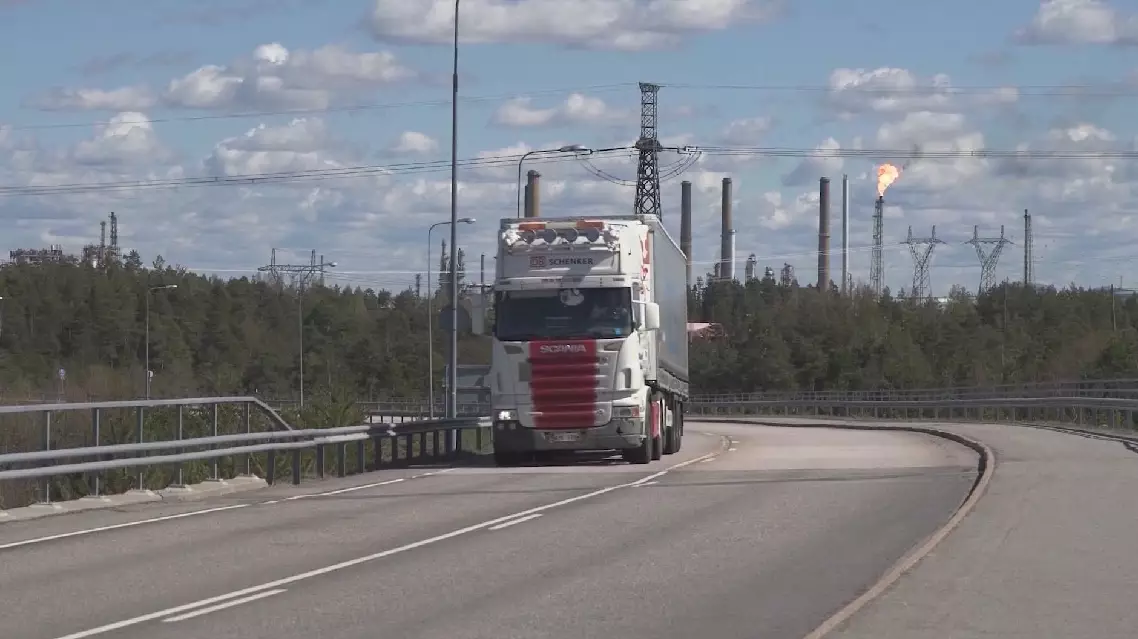
The TIR customs transit system can stabilize and accelerate cross-border road trade by eliminating border delays and streamlining customs procedures, said Habib Turki, secretary-general of the International Road Transport Union (IRU), on Wednesday.
TIR, an abbreviation for Transports Internationaux Routiers, or International Road Transports, is an international customs transit system managed by the IRU to help save time and cost for transport operators and customs authorities when moving goods across borders.
Speaking in an interview with China Global Television Network (CGTN) in Beijing, Turki noted that TIR's core value lies in standardizing how shipments are handled across countries and stripping out repeat processes that create delays and uncertainty.
"This is what you really see with TIR, it's that harmonization, it's the removal of unnecessary barriers, it's the removal of redundant checks. And at the end of the day, the key benefit and how we translate this in reality is competitiveness," Turki said.
China joined the TIR Convention in July 2016 to simplify and streamline the administrative formalities of international road transport. In May 2024, Xinjiang's Kashgar became home to China's first TIR assembly center certified by the IRU.
Looking ahead, Turki believes that technological innovation will be central to the next stage of cross-border road transport, and he called for deeper participation from China in shaping how TIR evolves.
"We want to learn also from China how transport is dealt with in this country. We have seen a lot of incredible advancement. We have seen fascinating innovation coming out of China in different areas of work, in autonomous driving, in new energy, electrification. Absolutely fascinating. A lot of lessons to be learned from China. And I believe also that we can co-create together the solutions of the future. IRU represents the largest community of transport operators around the world. We are talking about both freight transport and passenger transport, and we are here to support the development of the transport community here in China," said Turki.

TIR system key to stabilizing cross-border road freight: IRU chief