Skip to Content Facebook Feature Image

Local Woman Sentenced to 63-Month Imprisonment for Illegal Export and Possession of Pharmaceutical Products and Money Laundering

HK

Local Woman Sentenced to 63-Month Imprisonment for Illegal Export and Possession of Pharmaceutical Products and Money Laundering
HK

HK

Local Woman Sentenced to 63-Month Imprisonment for Illegal Export and Possession of Pharmaceutical Products and Money Laundering

2026-09-24 19:45 Last Updated At:09-25 00:07

Local woman convicted and jailed 63 months for illegal export and possession of pharmaceutical products and money laundering

A local woman was sentenced to 63 months' imprisonment by the District Court yesterday (September 23) for illegal export and possession of controlled pharmaceutical products and dealing with property known or believed to represent proceeds of an indictable offence (commonly known as money laundering), in contravention of the Import and Export Ordinance (IEO), the Trade Descriptions Ordinance (TDO), the Pharmacy and Poisons Ordinance (PPO), and the Organized and Serious Crimes Ordinance (OSCO).

Between September and October 2021, Hong Kong Customs seized approximately 1.6 million tablets of controlled pharmaceutical products, some of which were found to be counterfeit, with an estimated market value of about $55 million, at Hong Kong International Airport, an industrial unit in Hung Hom, and a logistics service centre in Sheung Wan. Subsequent investigation revealed that the woman had recruited individuals to pack and post the pharmaceutical products, and had rented an industrial unit to facilitate the operation of the offences.

The woman received bank transfers and cash deposits from unidentifiable sources through her personal bank accounts, laundering a total of $15 million in crime proceeds. Furthermore, her personal accounts were utilised to support the syndicate's operations, including payments for the individuals for packing and delivery of the pharmaceutical products and payments of the postage fees for the parcels.

Customs welcomes the sentence. The custodial sentence has imposed a considerable deterrent effect and reflects the seriousness of illegal exports of controlled pharmaceutical products and counterfeit goods, as well as money laundering offences.

Additionally, the prosecution applied to the court under the OSCO for a Confiscation Order against the woman's frozen assets totalling approximately $470,000.

Under the IEO, any person who exports pharmaceutical products and medicines without a valid export licence commits an offence. The maximum penalty upon conviction is a fine of $500,000 and imprisonment for two years.

Under the PPO, any person who possesses any poison included in Part 1 of the Poisons List other than in accordance with provisions commits an offence. The maximum penalty upon conviction is a fine of $100,000 and imprisonment for two years.

Under the TDO, any person who imports, exports, sells, or possesses for sale counterfeit goods commits an offence. The maximum penalty upon conviction is a fine of $500,000 and imprisonment for five years.

Under the OSCO, a person commits an offence if he or she deals with any property knowing or having reasonable grounds to believe that such property, in whole or in part, directly or indirectly represents any person's proceeds of an indictable offence. The maximum penalty upon conviction is a fine of $5 million and imprisonment for 14 years while the crime proceeds are also subject to confiscation.

Members of the public may report any suspected violation of the above-mentioned ordinances to Customs' 24-hour hotline 182 8080 or its dedicated crime-reporting email account (crimereport@customs.gov.hk) or online form (eform.cefs.gov.hk/form/ced002/en/).
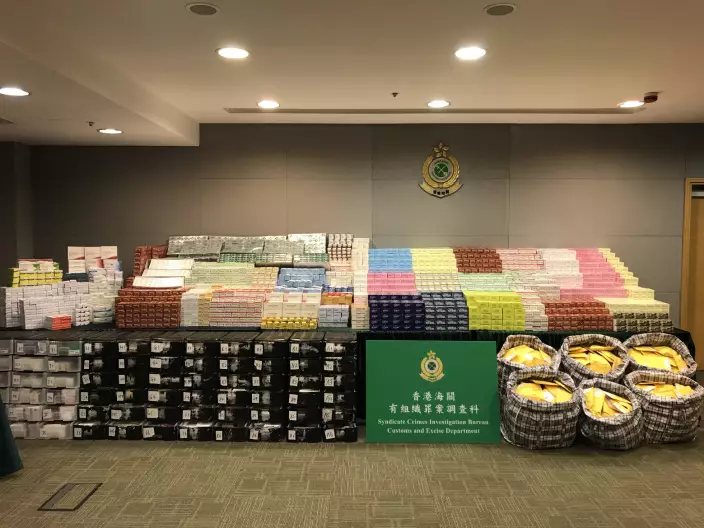
A local woman was sentenced to 63 months' imprisonment by the District Court yesterday (September 23) for illegal export and possession of controlled pharmaceutical products and dealing with property known or believed to represent proceeds of an indictable offence (commonly known as money laundering), in contravention of the Import and Export Ordinance, the Trade Descriptions Ordinance, the Pharmacy and Poisons Ordinance, and the Organized and Serious Crimes Ordinance. Photo shows the controlled pharmaceutical products seized. Source: HKSAR Government Press Releases
A local woman was sentenced to 63 months' imprisonment by the District Court yesterday (September 23) for illegal export and possession of controlled pharmaceutical products and dealing with property known or believed to represent proceeds of an indictable offence (commonly known as money laundering), in contravention of the Import and Export Ordinance, the Trade Descriptions Ordinance, the Pharmacy and Poisons Ordinance, and the Organized and Serious Crimes Ordinance. Photo shows the controlled pharmaceutical products seized. Source: HKSAR Government Press Releases
Child previously reported as severe case of paediatric influenza infection passes away

The Centre for Health Protection (CHP) of the Department of Health (DH) announced that a 14-month-old girl infected with influenza A passed away earlier today (November 13). The CHP announced the case as a severe case of influenza A infection on October 29.

This is the third fatal case of paediatric influenza infection in Hong Kong this year. Hong Kong entered the influenza season in late June this year, and the influenza season has lasted for more than four months by now. The latest surveillance data showed that the overall influenza activity has declined but remains above baseline levels. A cumulative total of 29 cases of severe paediatric influenza infection have been recorded in the current influenza season. Among these cases, 22 patients have recovered and been discharged from hospital, two are in stable condition, two are in critical condition, and three have passed away. The Controller of the CHP, Dr Edwin Tsui, reminded members of the public that Hong Kong is still in the midst of the influenza season. Although overall influenza activity has shown a downward trend over the past few weeks, it remains above baseline levels. Data from the previous year revealed that the rate of severe complications or death among unvaccinated children following influenza infection was approximately five times higher than that among vaccinated children. The CHP urged all individuals aged six months or older, except those with known contraindications, to promptly receive the seasonal influenza vaccination (SIV) if they have not yet done so.

This year's SIV Programmes have been underway for about two months. Currently, there is an adequate supply of vaccines in both the public and private healthcare sectors, providing free or subsidised SIV to eligible individuals. To facilitate members of the public in receiving SIV, eligible persons may receive SIV at about 270 public service points, including around 110 designated clinics under the DH located in various districts across the territory (including all 29 Maternal and Child Health Centres (MCHCs) for all children aged 6 months to under 2 years); 76 Family Medicine Clinics and 38 public hospitals under the Hospital Authority; and 45 District Health Centres, District Health Centre Expresses and their service points under the Primary Healthcare Commission. For the list of vaccination venues, please refer to the CHP's SIV Programmes webpage. Parents/guardians of eligible children may also book a vaccination appointment for their children at designated MCHCs via the online booking system.

Furthermore, over 1 900 private doctors currently participate in the Vaccination Subsidy Scheme (VSS), providing services at over 3 200 service points across all districts in Hong Kong. For the list of VSS doctors, please visit apps.hcv.gov.hk/public/en/SPS/Search.

Dr Tsui reminded members of the public to maintain strict personal and environmental hygiene. High-risk individuals, such as children, the elderly, and those with underlying illnesses or persons who are immunocompromised, should wear a surgical mask when using public transport or staying in crowded places. The health condition of children with influenza can deteriorate rapidly. Parents must pay close attention to their condition, and visit an accident and emergency department immediately if the child's condition deteriorates with symptoms such as shortness of breath, wheezing, blue lips, chest pain, confusion, a persistent fever or convulsions.

Source: AI-found images

Source: AI-found images

Recommended Articles