China's Ministry of National Defense has urged the Philippines to stop provocations in the South China Sea.
It has accused a Philippine vessel of deliberately causing a collision near Xianbin Jiao on September 18 by changing course and cutting across the bow of a China Coast Guard vessel.
The Philippine side's actions are a serious violation of international law, said the ministry's spokesperson Jiang Bin at a press conference on Thursday in Beijing.
"The China Coast Guard has provided details regarding the situation. The facts are clear and the evidence is irrefutable. There is no room for the Philippine side to argue shamelessly or hype up the issue. The Philippine government vessel was on a provocative mission in waters near Xianbin Jiao in China's Nansha Qundao, and made a dangerous maneuver like a lane-change cut-off to deliberately ram the Chinese vessel. Such actions seriously threaten the safety of the Chinese crew and vessel, and violate international law and basic norms governing international relations," said Jiang.
"Playing victim and peddling false narratives cannot change the provocative and illegal nature of the Philippine side's behavior. The Chinese side will continue to take effective measures to resolutely safeguard our territorial sovereignty and maritime rights and interests, and uphold peace and stability in the South China Sea," Jiang said.

Philippines' provocative actions near Xianbin Jiao illegal: defense ministry
Rising Chinese demand for services, from travel to finance, is fueling the rapid expansion of services trade with the United States and opening new opportunities for American businesses.
China's services imports topped 620 billion U.S. dollars in 2025, making it the world's second-largest services importer. That growing demand has created enormous opportunities for the global services industry.
From 2001 to 2025, trade between the two countries in services grew nearly ninefold, while the U.S. surplus surged nearly fifteenfold. As Chinese companies channel more resources into the sector, new openings are emerging for U.S. businesses.
"As the service market in China has been growing both in scale and sophistication, I think the real opportunity for multinationals is not only to sell products and services in the market, but also to participate in the innovation itself," said Andrew Wu, CEO of Dun and Bradstreet China, the Chinese arm of the global business data and analytics firm.
"The services industry here in China, whether it's leveraging AI, whether it's tech, whether it's health services, I think there's tremendous opportunity to focus on small and medium-sized businesses," said Randy Peers, president and CEO of the Brooklyn Chamber of Commerce.
China was the largest source of the U.S. services surplus in 2025, accounting for one-tenth of the total, or nearly 100 million U.S. dollars a day. Travel, intellectual-property royalties and financial services are among the main sources.
Meanwhile, China's services exports to the United States have also grown steadily, with transportation, travel and financial services ranking as the top three.
With AI and digital technologies reshaping services trade, the two countries' strengths complement each other like never before.
"We've set up a digital research and development center in Nanjing, with an investment of four billion yuan. Right now, 90 percent of our orders come from digital channels. That's the kind of effect you get from a market as big as China's," said Gu Lei, chief impact officer of McDonald's China.
"I think lots of capabilities really complement each other. We've been providing our partners with our sales marketing solution, compliance solution and the financial service solution. And our Chinese partners have been providing us with cloud computing and large language models to enable that innovation for us on the ground here," said Wu.
Looking ahead, Wu said that with both countries pursuing growth opportunities, he hopes businesses on both sides will continue to collaborate and bring valuable new products to the market.
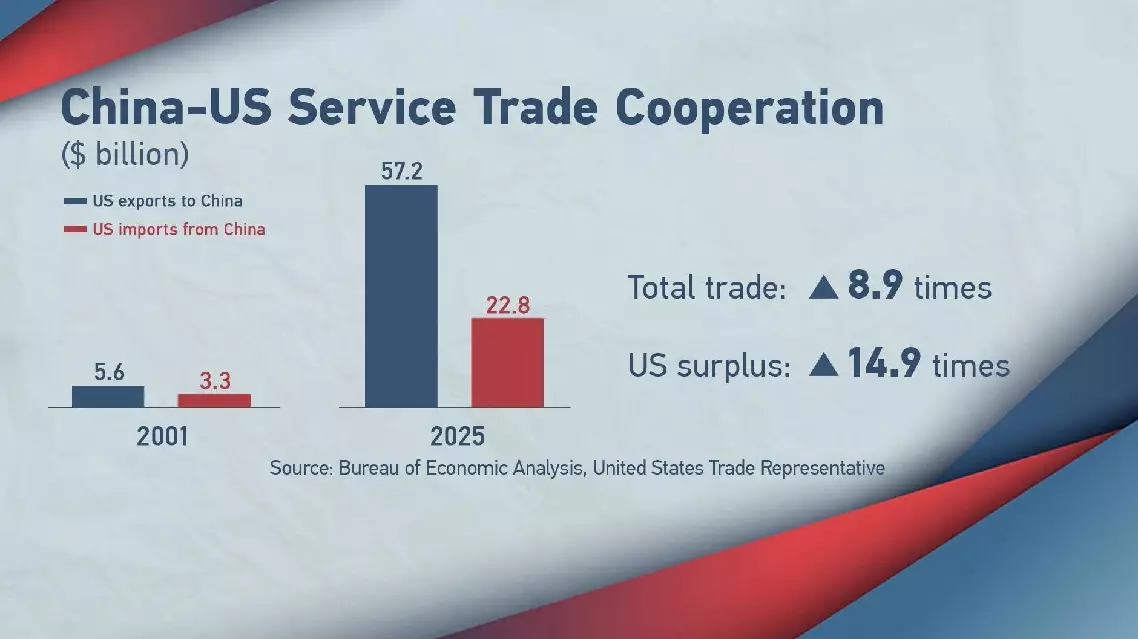
China's booming services demand brings opportunities for US businesses