NEW YORK (AP) — Nearly everyone will feel the impact of what's going on in the bond market, no matter how far away and abstract it may seem.
Bond yields have jumped to their highest levels in roughly two decades, and that affects anyone who borrows money. That includes discouraged people trying to keep up with high inflation, as well as businesses wanting to build data centers for artificial-intelligence technology.
High yields even affect people who don't borrow money. For savers, it means they can earn more in interest by putting cash into bonds or a high-yield savings account. It could also knock down the value of the stocks in their 401(k) accounts
And for all U.S. taxpayers, higher yields could lead to higher interest payments for their federal government, which must continually borrow cash to cover the massive gap between how much it spends and brings in through revenue. That would leave less money for everything else.
Here's a look at what's going on and what it means:
When governments and big companies need money, they don’t ask a bank for a loan. Instead, they sell IOUs to investors and promise to repay the money with a certain interest rate. IOUs that get paid back years down the line are called bonds.
Investors buy and sell these IOUs in the bond market after they’re issued. And if bonds begin to look less attractive, such as when worries rise about inflation, a buyer can get one that was earlier worth $100 for less than that.
Even after a bond's price drops, it continues to pay the same interest rate. That means the new buyer will get a bigger return on their money, percentagewise, than the interest rate the bond pays on its face value. Those payments are called the bond’s yield.
In other words, when a bond's price drops, its yield rises. And vice versa.
The centerpiece of the bond market is the U.S. Treasury, which is the IOU the U.S. government sells to borrow money. And yields on U.S. Treasurys are the baseline off which the interest rate for most other kinds of borrowing is based.
For someone looking to buy a home, for example, the interest rate on their 30-year fixed mortgage will likely be what the 10-year Treasury is yielding, plus a little or a lot more depending on how good or bad their credit score is.
There are different parts of the U.S. Treasury market, ranging from short-term bills maturing in a few days to bonds that will get repaid in three decades. Each part affects different kinds of loans, whether it's how much a saver can make on a 12-month certificate of deposit or how much interest a company will pay to borrow money to expand its factories.
The different parts of the bond market don't always move together, but right now, they're all rising.
The yield on the 10-year Treasury climbed to nearly 5.18% on Thursday and is back to where it was in 2007, before the 2008 financial crisis and Great Recession sent yields toward zero.
It's been climbing since bottoming out below 0.50% in 2020 because of the COVID pandemic. But its rise has accelerated since the end of February, when the war with Iran sent oil prices and worries about inflation much higher. The 10-year yield was sitting at just 3.97% before the United States and Israel attacked Iran.
That climb has pulled the average long-term U.S. mortgage rate to 7% for the first time since early 2025, making it even more difficult for would-be homebuyers to afford a house.
It's also slowed a rally for the U.S. stock market, which had returned to the brink of an all-time high earlier this week. High Treasury yields undercut prices for all kinds of investments, from stocks to gold to cryptocurrencies. The thought is: Why should anyone pay high prices for riskier investments or ones that pay zero dividends when U.S. Treasurys are paying more than before?
Much of the recent rise in Treasury yields is because of higher oil prices and worries about inflation. When inflation is high, $1 next year will buy less than $1 does today. And bonds generally pay a fixed amount of interest for years in the future, making inflation a big risk.
At the same time, governments worldwide continue to rack up more debt. That means they're issuing more bonds to borrow, and the consistent increase in supply pushes down on their prices. All the bonds getting issued by big companies looking to build AI data centers and otherwise expand their businesses are having the same effect.
Part of the rise in Treasury yields is also because the U.S. economy looks so solid despite its many challenges. Treasury yields got a jolt Wednesday, for example, after a preliminary report suggested growth in U.S. business activity surged to its strongest level in more than five years.
Such data could convince the Federal Reserve that the economy is strong enough to withstand more increases to the very short-term interest rate that it controls directly. The Fed hiked its federal funds rate last week for the first time since 2023 in hopes of slowing the economy and removing some of the fuel for inflation.
Traders are betting the Fed will hike rates again this year and next, which has sent shorter-term Treasury yields higher.
It's not just the U.S. Treasury market seeing yields rise. They're climbing worldwide as investors see mounting debt loads and inflation across continents.
The 10-year yield for Germany, long seen as one of the safest places to lend money in Europe, is near 3.60% and back to where it was in 2008. The European Central Bank raised its own interest rate earlier this month in hopes of slowing inflation.
The Japanese 10-year yield is at 3.08%, a huge turnaround from the negative yield it was carrying as recently as 2020 when officials were trying to stimulate the economy.
This story has been corrected to say the US and Israel attacked Iran.
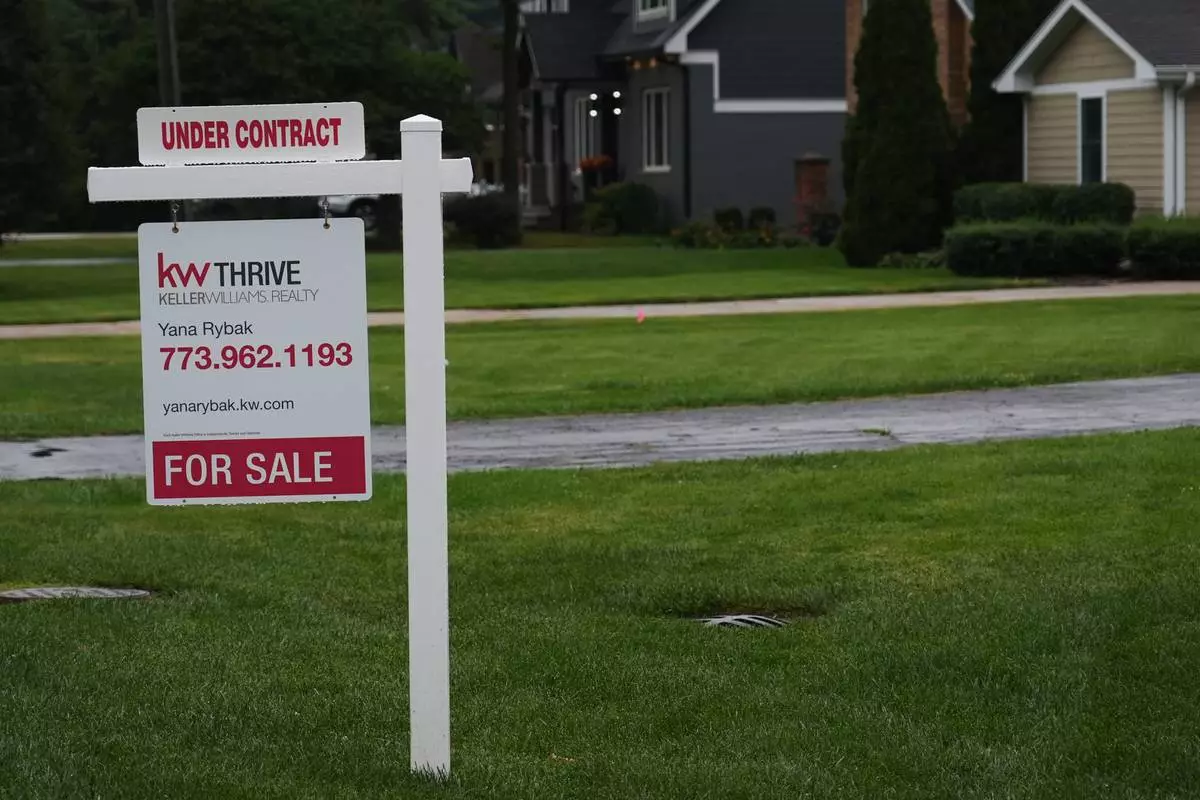
For sale sign is seen outside of a home in Arlington Heights, Ill., Wednesday, Sept. 16, 2026. (AP Photo/Nam Y. Huh)

FILE - The seal of the Treasury Department is seen before a news conference, Aug. 24, 2026, at the Treasury Department in Washington. (AP Photo/Julia Demaree Nikhinson, File)
Israel's increasingly isolated Prime Minister Benjamin Netanyahu took center stage at the United Nations General Assembly on Thursday, defending his decision to attack Iran as an easy one.
Hamas said it was ready to move forward on a Gaza peace agreement, while a top European Union official said only a small amount of the funds needed to rebuild the Gaza Strip has been collected.
Here is a look at the latest news from the Middle East. More coverage of the U.N. General Assembly is available here.
Allegations of Israeli genocide in Gaza are “the biggest lie of the century,” Netanyahu told world leaders in a defiant speech before the U.N. General Assembly.
Netanyahu's appearance in the hall was met with a mix of cheers, boos and mass walkouts. Scores of delegates trooped out and a majority of seats sat empty as he spoke.
“If there are any other moral cowards who have not yet left the hall, please do so now,” Netanyahu said.
His voice rising in emphasis, Netanyahu said attacking Iran “was one of the easiest decisions I’ve ever had to make” and denounced as “moral cowards” delegates who walked out of the hall.
Palestinian President Mahmoud Abbas was forced to address the U.N. in a prerecorded video after the United States again denied him a visa to attend the General Assembly.
The 90-year-old leader’s popularity at home and relevance abroad have both waned. But in his remarks, Abbas made clear he did not intend to quietly accept being sidelined.
“We will not leave our homeland. We will not accept displacement. And we will not allow anyone to decide our future on our behalf,” Abbas said.
Though world leaders have repeatedly invoked the plight of Palestinians in speeches throughout the week, Abbas urged the international community to take more tangible action against Israel.
It was the second straight year Abbas was denied a visa.
A Hamas spokesman said the group is ready to move forward with the next steps of a peace agreement, after Trump’s Board of Peace unveiled a six-month, $2.45-billion plan for Gaza's reconstruction.
Hamas spokesman Hazem Qassem expressed the Palestinian militant group’s “full readiness to implement the Board of Peace’s roadmap” but made no mention of any disarmament plans.
Israel has said it will not allow reconstruction until Hamas disarms.
Last year, Hamas agreed to a plan that includes disarmament but has since traded accusations with Israel of ceasefire violations and has accused Israel of violating the agreement by continuing to occupy much of Gaza.
Iran-backed Houthi rebels in Yemen claimed attacks on a “sensitive target” in the Saudi capital of Riyadh and on Aramco oil company facilities in the Saudi port city of Yanbu, but did not provide evidence of those claims.
Houthi military spokesperson Brig. Gen. Yahya Saree said in a statement that cruise and ballistic missiles and drones were used, but did not specify when. It was the second claim of an attack against the Saudi capital in days.
The rebels also said they fired dozens of missiles and drones on the southwestern Saudi province of Jazan. Saree said that they were in response to the “unjust siege and the launching of aggressive airstrikes” from Saudi territory.
The Associated Press couldn’t independently verify the claims.
The Saudi government and Aramco did not immediately respond to requests for comments. A Saudi military spokesman, Maj. Gen. Turki al-Malki, had said earlier that six ballistic missiles targeting Saudi Arabia ’s Red Sea port of Yanbu and southwestern city of Taif had been intercepted.
At the U.N., Saudi Arabia’s foreign minister, Prince Faisal bin Farhan, said he wasn’t worried about a Houthi takeover of parts of Yemen, and that the government is “very capable of defending the territory it controls.”
The U.N. pleaded for the fast delivery of humanitarian aid in Yemen as fighting between Iran-backed Houthi rebels and Saudi-backed government forces intensifies an already dire humanitarian situation.
U.N. Human Rights Chief Volker Türk said people fleeing violence need access to food, shelter and healthcare. Ground fighting, artillery and aerial strikes have killed and wounded at least 125 civilians since the beginning of August. Türk also called for the release of 73 U.N. staffers detained by the Houthis in the past few years.
UN agency for Palestinian refugees raises tens of millions of dollars including from France, Germany, Spain and Belgium
Jordan’s Foreign Minister Ayman Safadi said over 50 countries attended a closed ministerial meeting on the agency, known as UNRWA, on the sidelines of the U.N.’s annual gathering of world leaders on Thursday which he welcomed.
“We continue to emphasize that UNRWA is indispensable, irreplaceable against the horrific humanitarian reality that continues to exist in Gaza,” he told a press conference afterward.
Israel has banned UNRWA from operating in its territory and the United States has cut all funding.
UNRWA’s acting commissioner-general Christian Saunders said the agency received about 30 million euros Thursday, according to an unconfirmed tally, bringing its deficit down to near $60 million.
This report will be updated throughout the day as new developments emerge.

Demonstrators gather to protest ahead of Israeli Prime Minister Benjamin Netanyahu's address during the 81st session of the United Nations General Assembly, Thursday, Sept. 24, 2026, in New York. (AP Photo/Madison Swart)
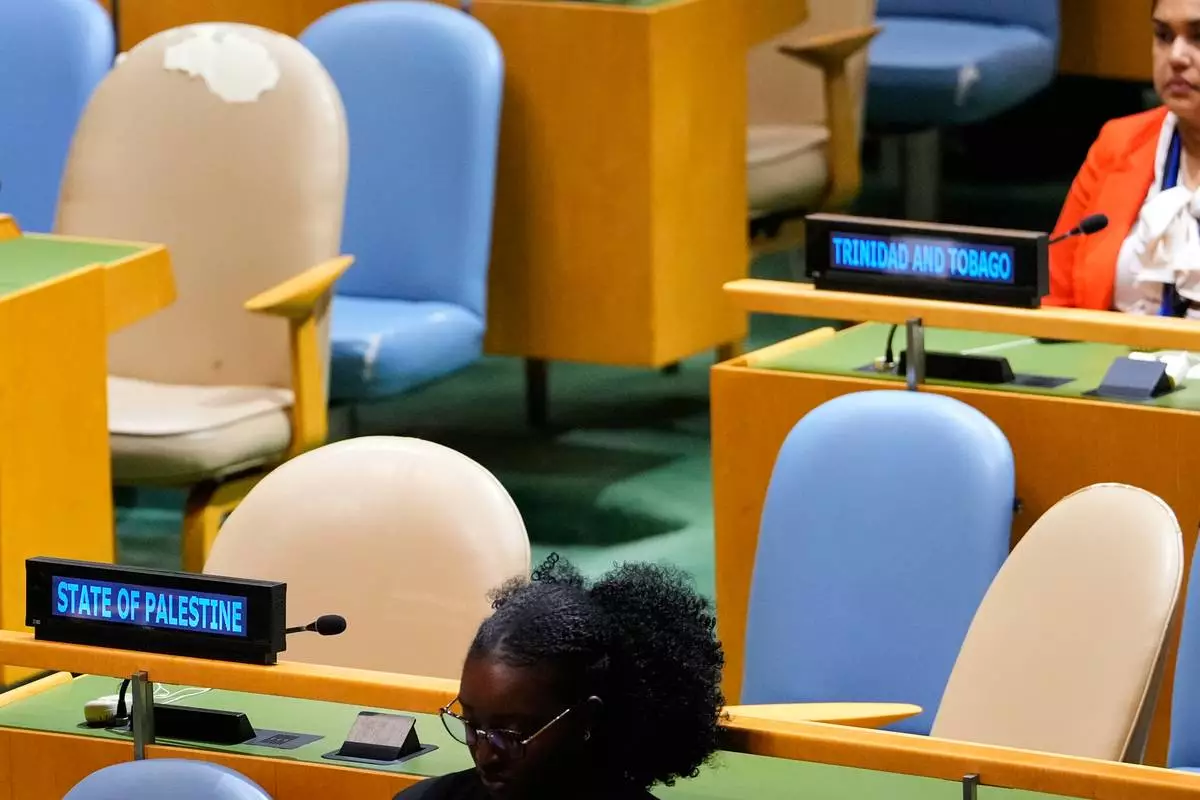
Chairs for Palestinian delegates are unoccupied as Israeli Prime Minister Benjamin Netanyahu speaks during the 81st session of the United Nations General Assembly at United Nations headquarters, Thursday, Sept. 24, 2026. (AP Photo/Yuki Iwamura)
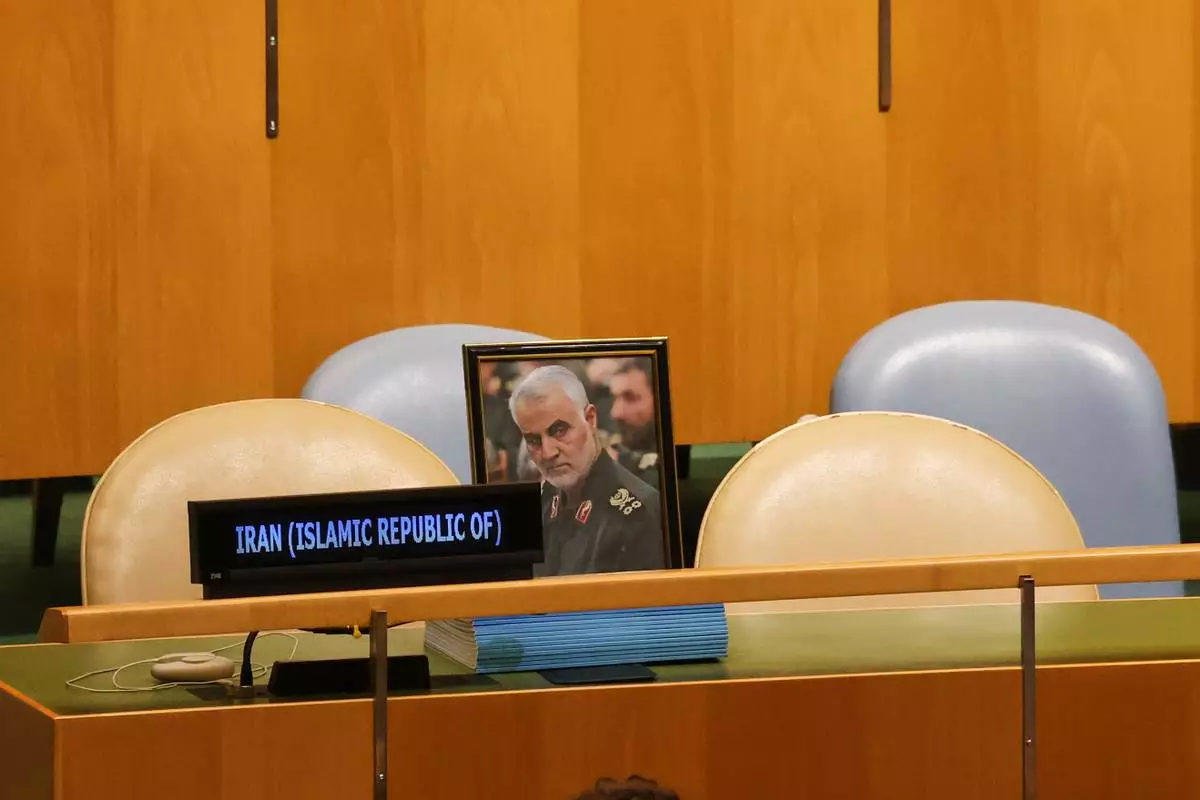
A photo of the late Qasem Soleimani is displayed as chairs for delegates from Iran are unoccupied while Israeli Prime Minister Benjamin Netanyahu speaks during the 81st session of the United Nations General Assembly at United Nations headquarters, Thursday, Sept. 24, 2026. (AP Photo/Heather Khalifa) ADDS ID

Israeli Prime Minister Benjamin Netanyahu speaks during the 81st session of the United Nations General Assembly at United Nations headquarters, Thursday, Sept. 24, 2026. (AP Photo/Yuki Iwamura)
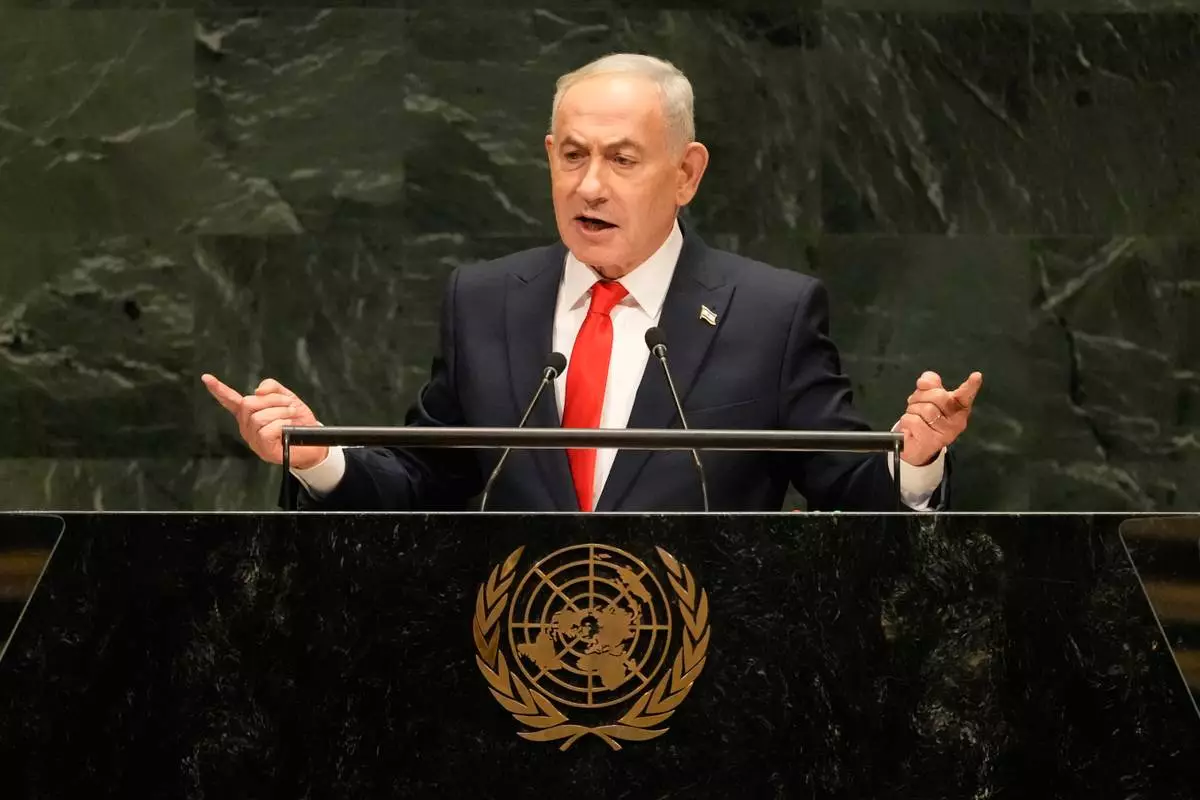
Israeli Prime Minister Benjamin Netanyahu speaks during the 81st session of the United Nations General Assembly at United Nations headquarters, Thursday, Sept. 24, 2026. (AP Photo/Seth Wenig)
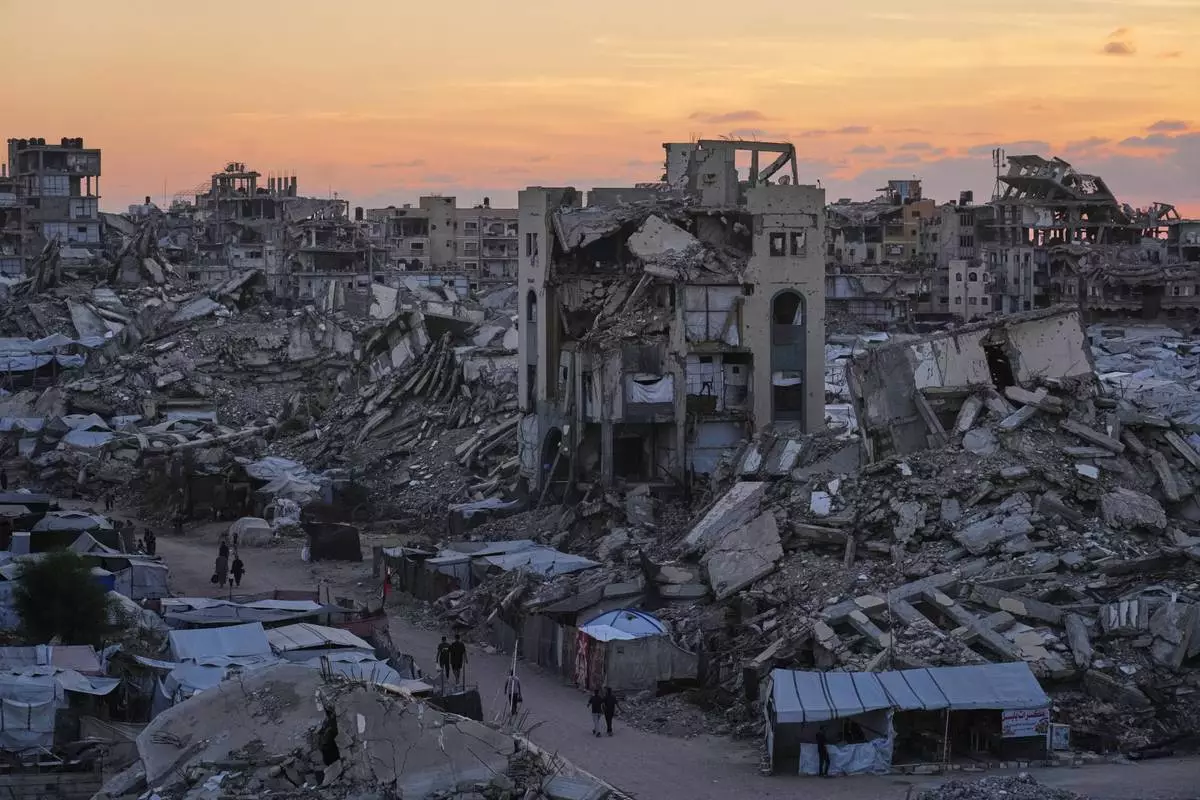
Palestinians walk amid war-damaged buildings in Gaza City, Wednesday, Sept. 23, 2026. (AP Photo/Jehad Alshrafi)

Israeli Prime Minister Benjamin Netanyahu at his Likud party New Year event in Tel Aviv, Israel, Thursday, Sept. 17, 2026. (AP Photo/Ariel Schalit)