VATICAN CITY (AP) — Pope Leo XIV is taking his call to respect the dignity of every human life on the road with a weekend visit to France, where the Catholic Church has lost ground on influencing ethical issues as the country maintains a strict approach to secularism.
Leo is spending four intense days in Paris, the Catholic shrine at Lourdes and the northeastern city of Metz. He's hoping to draw attention to his appeals for peace at a time of war, and for greater reflection as artificial intelligence questions the very essence of what it means to be human.
Click to Gallery
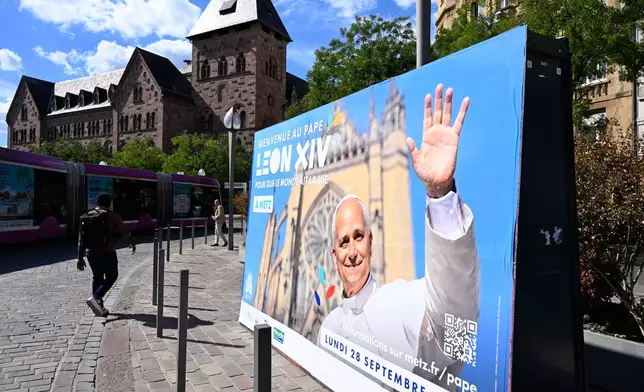
A banner announces the upcoming visit of Pope Leo XIV in Metz eastern France, Tuesday, Sept 15, 2026 as part of his official visit to France from Sept. 26 to 28. (AP Photo/Pascal Bastien)
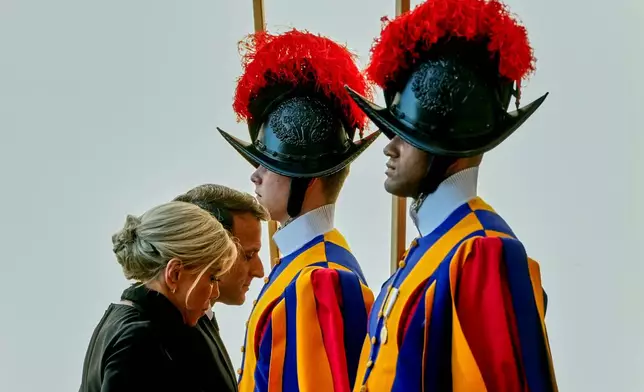
FILE - French President Emmanuel Macron and his wife Brigitte arrive in the St. Damasus Courtyard at the Vatican to meet with Pope Leo XIV, Friday, April 10, 2026. (AP Photo/Andrew Medichini, File)
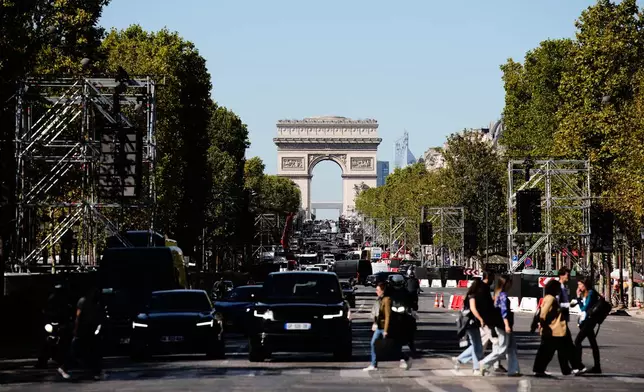
The Champs Elysees prepares for the mass that Pope Leo XIV will celebrate during his visit in Paris, Wednesday, Sept. 23, 2026. (AP Photo/Teresa Suarez)
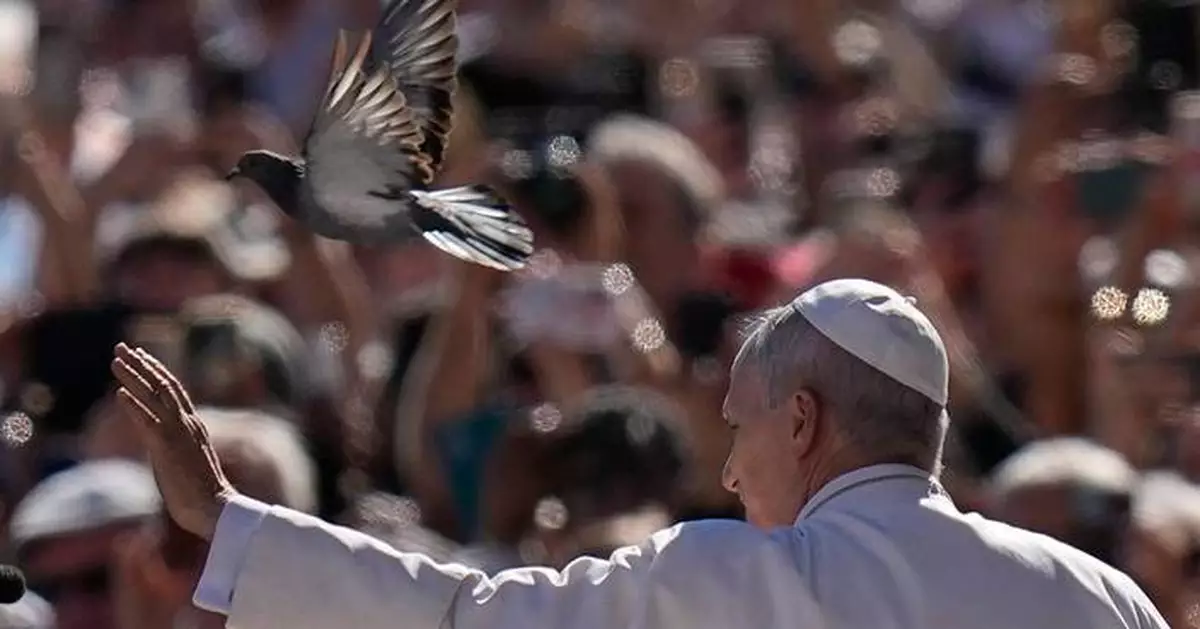
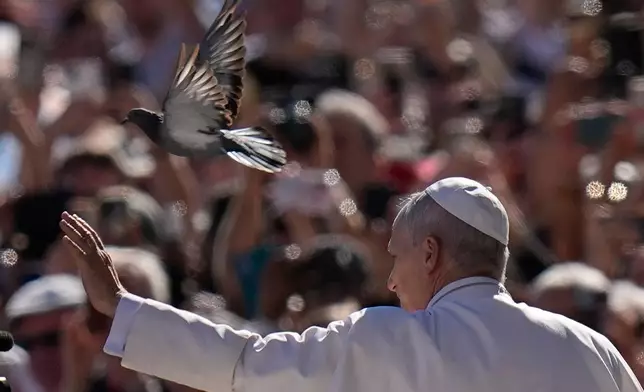
A pigeon flies past Pope Leo XIV as he arrives for his weekly general audience in St. Peter's Square, at the Vatican, Wednesday, Sept. 23, 2026. (AP Photo/Alessandra Tarantino)
Church bells across France are expected to toll at 10 a.m. Friday, when Leo’s charter flight lands at Paris’ Orly airport, and upward of a million people are expected to turn out to see him. The welcome has underscored the surprising level of interest in Leo’s visit, the first by a pope in 18 years.
Leo was to meet with President Emmanuel Macron at the airport upon arrival and then again at the Élysée Palace. During his busiest day of the trip, Leo was to then deliver a speech at UNESCO headquarters, celebrate vespers at the newly reopened Notre-Dame cathedral and then preside over a massive youth vigil at the Paris stadium Friday night.
For Macron, who is barred from seeking a third term in May elections, hosting the American pope is something of a capstone, after Pope Francis refused repeatedly to make a proper state visit to France during his 12-year pontificate.
“For a president of the republic as Macron, who is at the end of his mandate, it can be important to be aside the pope and to capture a part of his popularity. It’s not new,” said Charles Mercier, director of history and sociology of Catholicism studies at Paris EPHE university.
With seven months left in his term, Macron’s approval ratings are near record lows, driven by anger over the rising cost of living and criticism of France’s growing debt and deficit and deteriorating public services. Macron’s office said Friday’s meeting with Leo will provide an opportunity to discuss global challenges such as climate change and artificial intelligence, along with European and international affairs. The talks also are expected to address end-of-life care and the protection of children.
Leo seems keen to emphasize Europe’s Christian roots and try to push the church’s message about the value and dignity of human life in a country where the right to abortion was enshrined in the Constitution in 2024 and where lawmakers recently gave final approval to a bill allowing adults with incurable illnesses to receive lethal medication.
The French Catholic hierarchy strongly opposed the measures, in keeping with Catholic teaching that human life must be protected and defended from conception until natural death. But the French hierarchy has lost much of its influence amid the secularizing trends at play across Western Europe as well as a credibility crisis stemming from France’s reckoning with its legacy of clergy sexual abuse.
France’s distinctive model of secularism, known as laïcité and enshrined in its Constitution, guarantees the freedom to believe or not to believe, as well as the freedom to practice a religion as long as it doesn't disturb public order. It also requires the state to remain neutral toward all religions.
Key rules have been defined by a historic 1905 law, primarily intended to distance the state from the then-powerful influence of the Catholic Church.
Leo, whose paternal ancestors were French, isn’t expected to scold the French over the abortion and end-of-life legislation. Rather, he's expected to summon them to a fundamental, higher-altitude consideration about what it means to be human today, said the Vatican’s editorial director Andrea Tornielli.
“The pope is not landing in the City of Light to condemn anyone, nor to barge into the French political debate, which is as polarized as that of every other European country,” Tornielli wrote in Vatican News. “He comes as a shepherd to meet a people, their history, and their culture.”
Olympic-level security measures were being put in place, including mounted police, bomb disposal experts, anti-drone measures and counter-terrorism measures, said Paris police prefecture spokesperson Hélène Denéchère.
In Paris alone, plans called for 14,000 police officers, gendarmes, and military personnel and 2,500 firefighters on Friday. On Saturday, when Leo celebrates Mass at the central Place de la Concorde, the numbers are only slightly lower.
“We are implementing a system similar to what was in place during the Paris 2024 Olympic and Paralympic Games, which means a protective perimeter around which other security perimeters will be added,” Denéchère said.
Visual journalist Jeffrey Schaeffer contributed from Paris.
Associated Press religion coverage receives support through the AP’s collaboration with The Conversation US, with funding from Lilly Endowment Inc. The AP is solely responsible for this content.
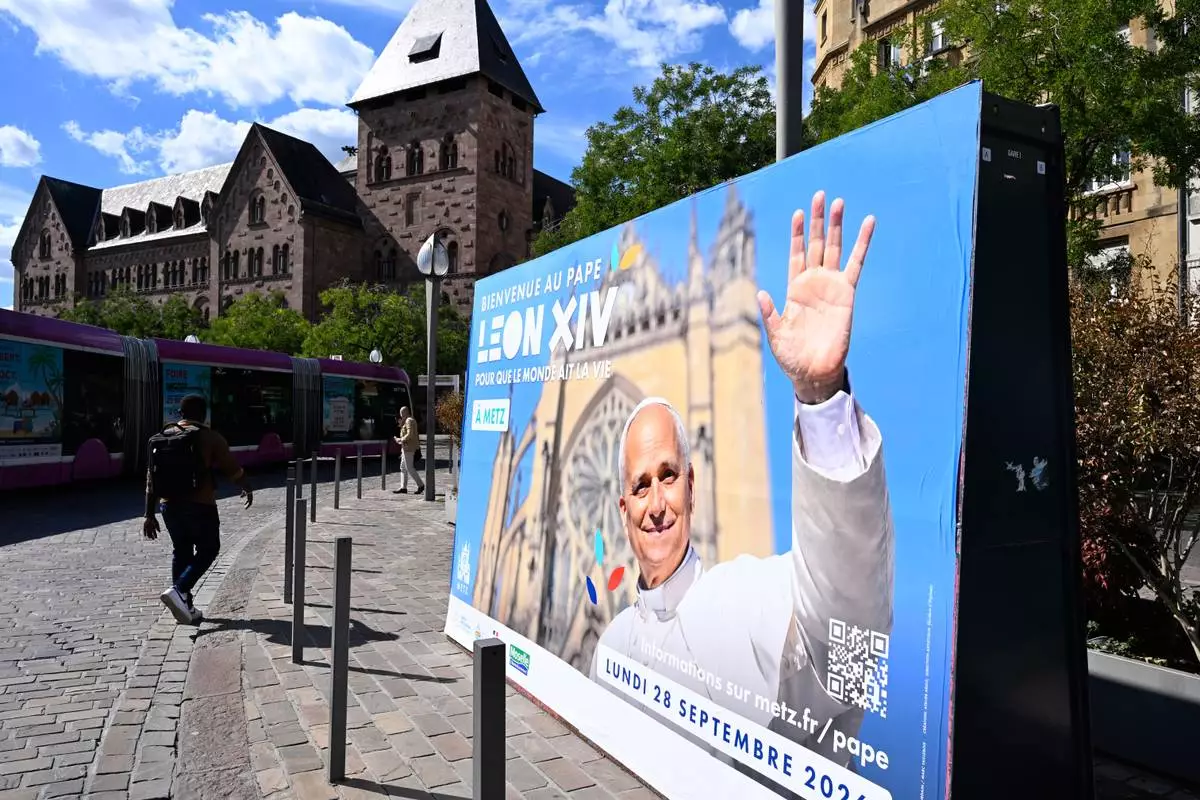
A banner announces the upcoming visit of Pope Leo XIV in Metz eastern France, Tuesday, Sept 15, 2026 as part of his official visit to France from Sept. 26 to 28. (AP Photo/Pascal Bastien)
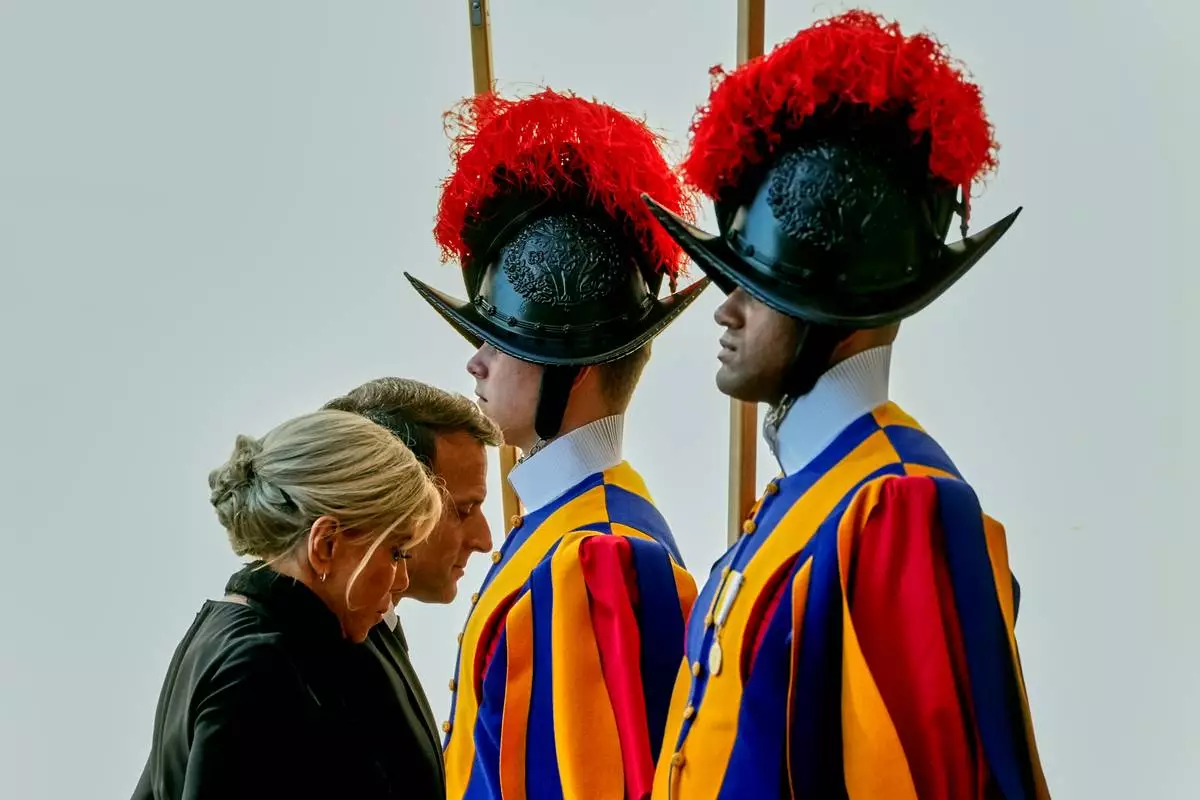
FILE - French President Emmanuel Macron and his wife Brigitte arrive in the St. Damasus Courtyard at the Vatican to meet with Pope Leo XIV, Friday, April 10, 2026. (AP Photo/Andrew Medichini, File)
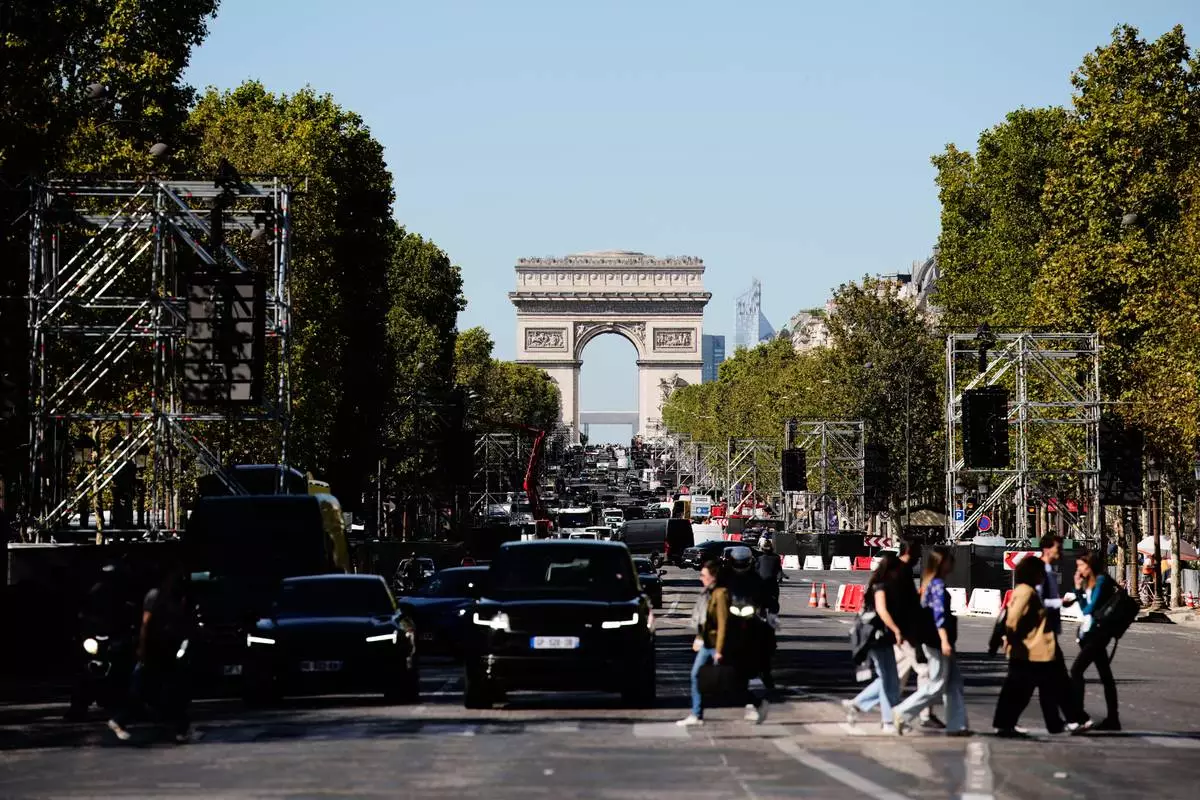
The Champs Elysees prepares for the mass that Pope Leo XIV will celebrate during his visit in Paris, Wednesday, Sept. 23, 2026. (AP Photo/Teresa Suarez)

A pigeon flies past Pope Leo XIV as he arrives for his weekly general audience in St. Peter's Square, at the Vatican, Wednesday, Sept. 23, 2026. (AP Photo/Alessandra Tarantino)
WASHINGTON (AP) — For decades, a key principle underpinned civil rights enforcement in American schools: Not all discrimination was intentional.
Even if a school policy was written without overt racial bias, it might unfairly hurt one group of students over another, the understanding went. The concept is known as systemic racism, and Republican and Democratic administrations agreed: Schools and universities that received federal funding had an obligation to address it.
Under President Donald Trump's administration, that's no longer the case. One by one, the administration has limited the remedies schools can use to address systemic racial injustice.
This summer, the Education Department rescinded a regulation that allowed schools to gauge potential discrimination by comparing outcomes across races, such as the racial breakdown of students in advanced classes. Then, it issued a letter to American schools, emphasizing it's illegal to consider race when crafting discipline policies — even if one particular racial group ends up suspended or expelled more often.
At the same time, Trump's Justice Department has stepped away from many school desegregation cases. In a news release Thursday, the department boasted of successfully working through the courts to close more than 50 desegregation cases since Trump took office, with motions to dismiss in the works in many other cases. Previous administrations had used these federal court cases to hold schools accountable when students of color had worse outcomes than white students — high rates of discipline, worse school facilities or reduced access to extracurriculars and advanced coursework.
While Trump's first administration deprioritized enforcing racial justice, his current administration has gone further — threatening to punish schools for any consideration of race in their policies and practices.
To the administration, the practice of examining different outcomes for particular groups of students, sometimes known as “disparate impact,” was itself a form of racial discrimination.
“The Obama and Biden Administrations weaponized disparate impact by effectively coercing schools to discipline students differently based on race in order to engineer equitable disciplinary outcomes across racial groups,” Education Department spokesperson Sabin Sidney said. "These practices unfortunately led to unsafe classrooms and undermined student learning."
Critics worry the administration's actions will make it easier to get away with racial discrimination.
“When they talk about returning it to the states and making America great again, they’re talking about returning to how it was before 1954,” when school segregation was legal, said U.S. Rep. Bobby Scott, D-Va.
Since Trump's return to office, the administration has set its sights on school discipline.
In May 2025, the president signed an executive order directing federal agencies to stop looking for “ disparate impact," or policies that appear neutral but result in outsized impact to one group over another. Those policies had been examined for possible discrimination, regardless of their intent.
In education, that analysis had most often been applied to school discipline — especially to removing students from the classroom, such as through suspensions, expulsions and referrals to law enforcement.
Federal and state data have long shown students of color, particularly Black students, are more likely than their peers to be pulled from the classroom for similar infractions. Research shows that students who are suspended are more likely to become disengaged from school and to have worse academic outcomes.
In 2021, the Education Department began investigating a complaint alleging Black male students with disabilities in Denver Public Schools were being disproportionately pushed out of the classroom. Progress on the case halted after Trump took office in 2025.
Advocates had also filed the complaint with state authorities, who found violations of civil rights laws and ordered the district to mandate new training. Meanwhile, families have heard nothing from the federal Education Department.
The silence gives school districts permission to continue with business as usual, said Pam Bisceglia, executive director of Advocacy Denver, which filed the complaints.
“I’d like to say that we have overcome and that marginalized communities are enjoying equal protections. We see that, in fact, that isn’t true,” she said.
Under Trump's first administration, the Education Department continued to investigate and resolve cases of racial discrimination against minority students.
In 2018, the Education Department reached a settlement agreement with Durham Public Schools in North Carolina, after examining whether the district's discipline policies, or their effects, were racially discriminatory. The investigation found Black students were disproportionately given out-of-school suspension — especially in instances involving subjective decisions on matters like disobedience.
For a time, Jovonia Lewis, a parent and former Durham school board member, constantly received calls about her son being kicked out of the classroom. She was told he couldn’t sit still. But the federal settlement agreement helped Black parents see their children's experiences were not occurring in isolation, Lewis said.
“We knew our kids were being treated differently, but this data gave us leverage,” she said.
The investigation had a significant impact in Durham, Lewis recalled. The district adopted a new student code of conduct and created an equity affairs office.
Under the Trump administration's new guidance, federal authorities are unlikely to take up similar cases.
“The federal government has chosen to close its eyes to that way of understanding discrimination,” said Catherine Lhamon, who oversaw education civil rights under Presidents Barack Obama and Joe Biden, both Democrats.
The impact of the administration's changes will outlast Trump's presidency, said Johnathan Smith, a former attorney in the civil rights division at the Justice Department and a managing director at the National Center for Youth Law. Once the administration changes rules and regulations, future efforts to investigate civil rights could be held up in court.
“They're building an infrastructure that says, ‘Not only are we taking down these structures, but we are building in roadblocks to make it very difficult for any future administration to change course,’” Smith said.
Across the South, the Justice Department has taken an interest in closing cases of court-mandated school desegregation, arguing the decades-old orders are outdated. But civil rights attorneys say the impact of segregation continues to be felt today.
Courts have long maintained the passage of time is not enough to rule that discrimination has passed, said Kelly Gardner, deputy director of litigation at the NAACP Legal Defense Fund. To be released from a desegregation order, schools have had to show that they have removed the lingering effects of segregation to the extent possible. That can involve assessing extracurricular offerings, funding levels and the state of school facilities.
Now, the Justice Department is intervening to close cases, often without taking account of those considerations, Gardner said.
In January, a federal court granted a request from the Justice Department and the DeSoto Parish School Board in Louisiana to release the small district from its desegregation order. In the order, the district had allowed students to transfer out of racially isolated schools, with transportation provided. As recently as 2024, the order was used to ensure those students had equal access to extracurriculars in their new schools.
Louisiana Attorney General Liz Murrill, a Republican, praised the court decision for freeing the district from federal oversight.
“After 60 years of litigation and federal control, the elected members of the DeSoto Parish School Board now have the full powers of their office, as our Constitution has always intended,” Murrill wrote in a social media post at the time.
A few months after the order was lifted, the school district amended its policies. The district would no longer accept new applications for transfers, and students in the transfer program would have to return to their zoned schools once they finished the highest grade at their current school.
The Associated Press’ education coverage receives financial support from multiple private foundations. AP is solely responsible for all content. Find AP’s standards for working with philanthropies, a list of supporters and funded coverage areas at AP.org.
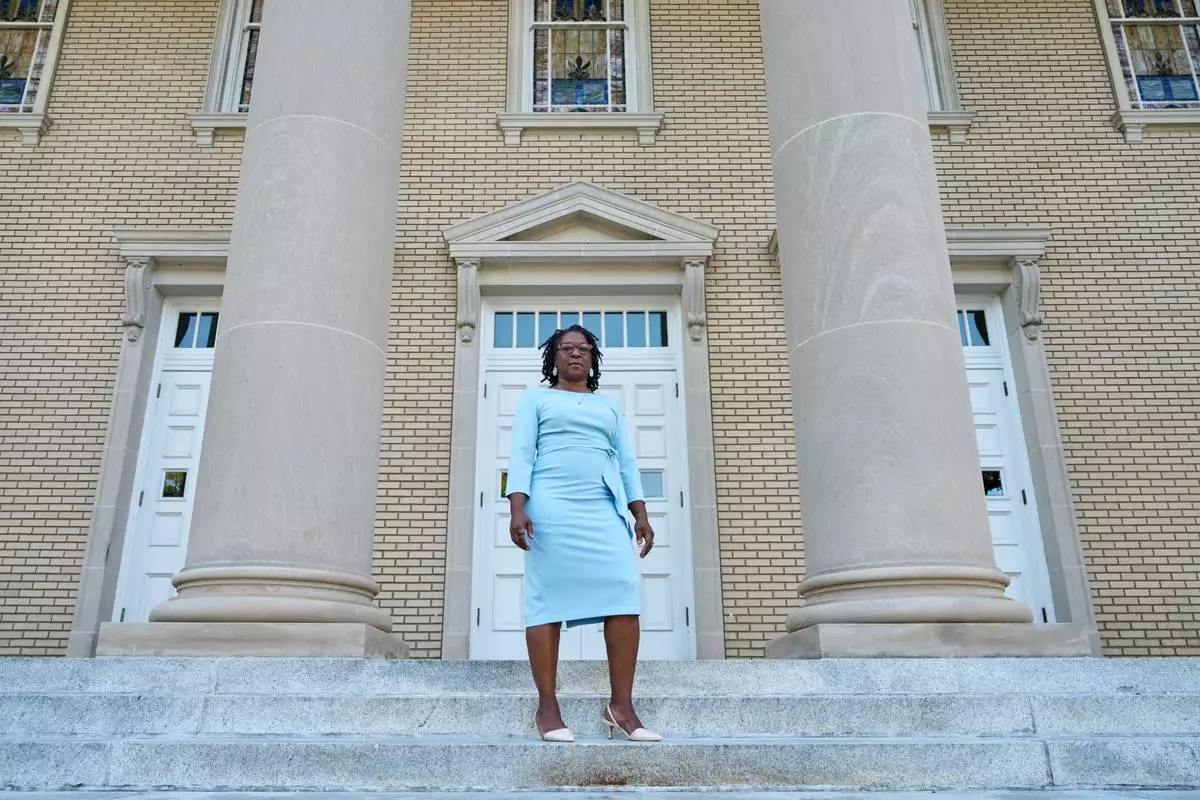
Jovonia Lewis poses for a portrait across from the Durham Board of Education building on Monday, Sept. 21, 2026, in Durham, N.C. (AP Photo/Matt Ramey)