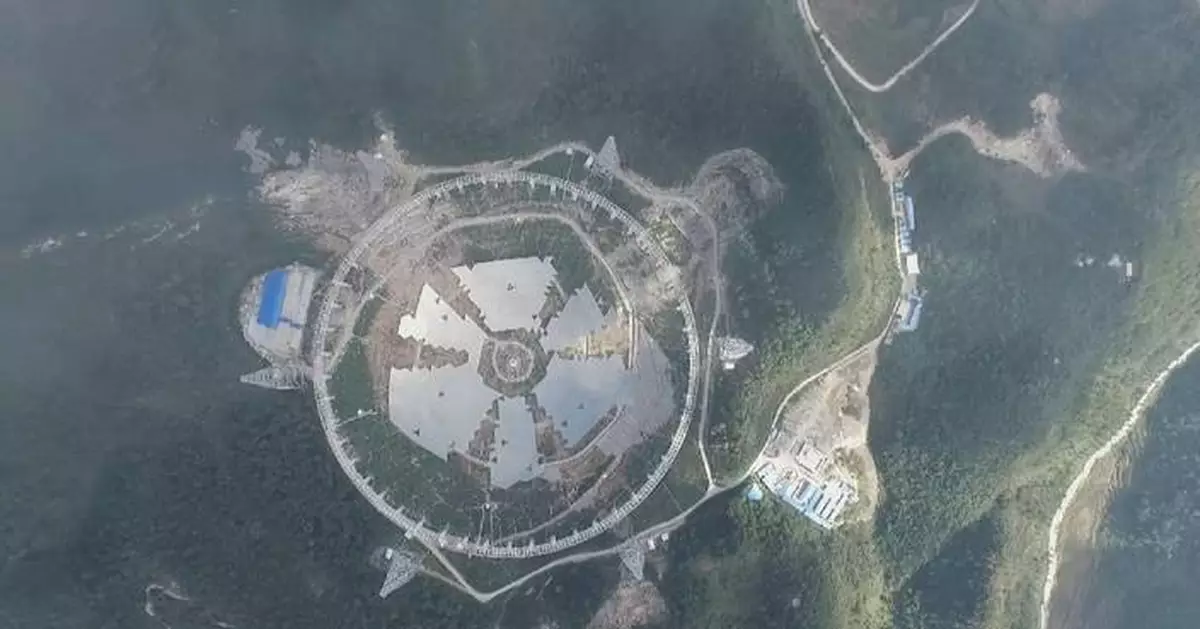
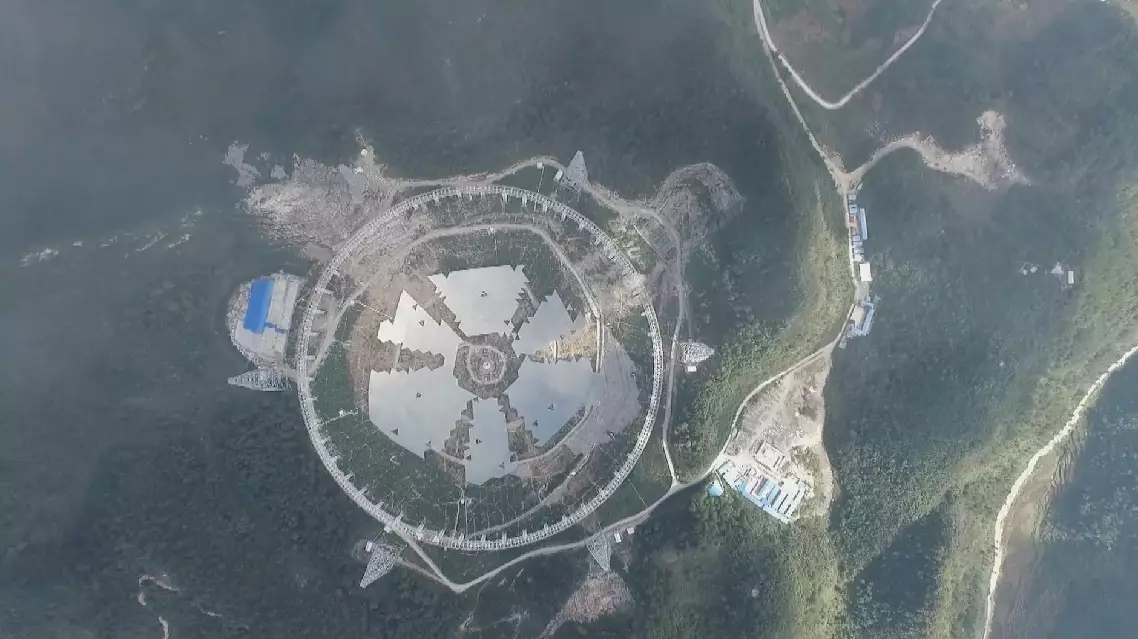
Friday marks the 10th anniversary of the completion of FAST, the 500-meter Aperture Spherical Radio Telescope - the world's largest single-dish radio telescope, nestled in the mountains of southwest China's Guizhou Province. Over the past decade, from commissioning to scientific observation, FAST has stood witness to the efforts of a team of researchers and engineers chasing their dreams of exploring the deep cosmos.
In an exclusive interview, Jiang Peng - deputy director of the National Astronomical Observatories under the Chinese Academy of Sciences, and director of the FAST Operation and Development Center - shared the stories behind the project.
Jiang, also chief engineer of FAST, recalled that in the early days, the team was not sure that the telescope could even be built, let alone operate well or produce meaningful scientific results.
The project seemed almost unreal - a dream too far-fetched to be plausible. Turning that dream into reality, step by step, has been a source of immense pride and accomplishment, he said.
"The cable-net system is a very core part of the FAST project's research and development. Not only does it span a great distance - the telescope has an aperture of 500 meters, and its reflector covers an area equivalent to 30 football fields - it must also achieve the precision required of an astronomical instrument. Crucially, it has to move, continuously forming a paraboloid in some areas, and in the process, it must cope with Guizhou's less-than-friendly climate, with frequent fog and rain. This placed extremely demanding requirements on measurement and control technology. We had no successful experience for reference - we couldn't even find lessons from past failures. That meant every detail had to be worked out correctly in a single attempt," he said.
Jiang also spoke of the skepticism FAST faced when it began producing world-class data. The telescope's first paper in the journal Nature, on fast radio bursts, took about two years to see through to publication, as the team had to continuously supply supporting evidence to prove the telescope's performance and data quality.
"FAST's first article in the main journal Nature was about fast radio bursts. The international community was not entirely convinced that your telescope could produce such data, so you had to keep providing various supporting materials to prove that your telescope's performance really reached that level and that your data quality really was up to that standard. This paper took about two years in total before it was finally finished. This is an inevitable process of proving yourself - you have to come up with truly convincing evidence. Thanks to the construction and operation of FAST, China's radio astronomy field has rapidly propelled its strength into the international first tier," he said.
FAST chief engineer reflects on 10 years of China's giant eye of sky