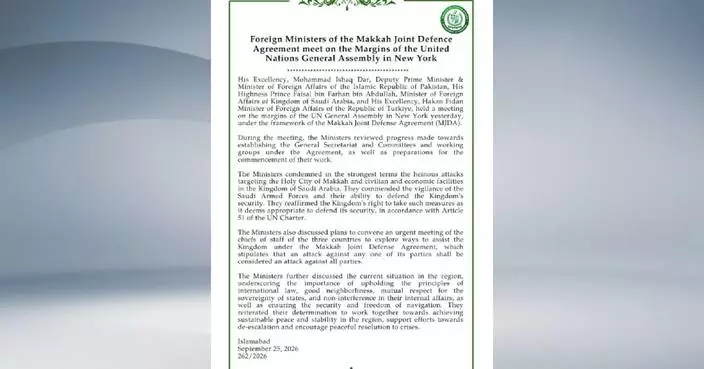
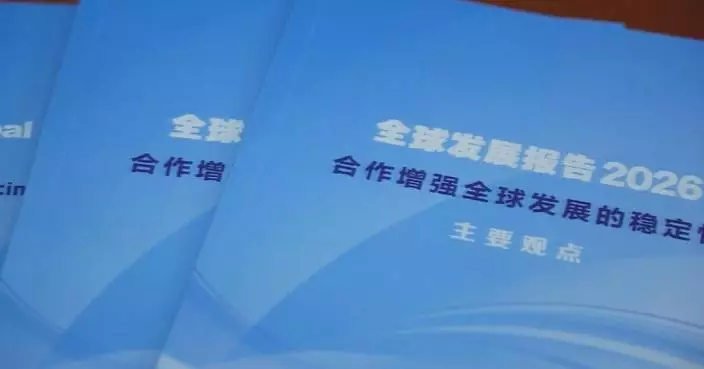
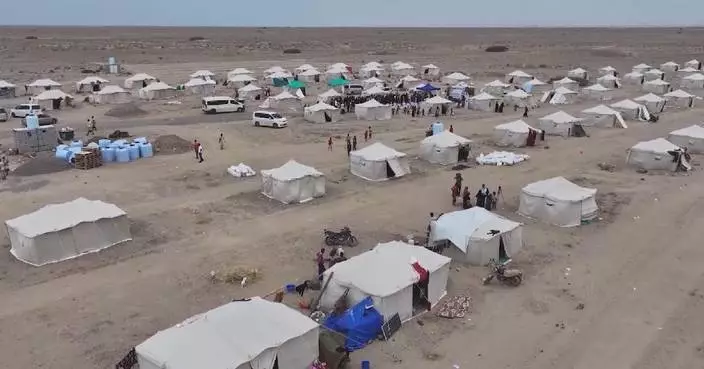
A report released by China at a high-level dialogue marking the fifth anniversary of the Global Development Initiative (GDI) held at the UN headquarters in New York on Friday calls for putting development back at the center of the global agenda amid rising turmoil.
The Global Development Report 2026 (Key Points), the fifth editions of the report, offers a comprehensive review of the philosophy and practical contributions of the GDI.
The report, published by China's Center for International Knowledge on Development (CIKD), points out that risks and uncertainties are building up across multiple areas, holding back global development.
It says that the Global Trade Policy Uncertainty Index surged to its highest level in decades in 2025 and the number of global conflicts has also reached the highest level since 1946.
According to the report, the compounding effects of geopolitical conflicts and climate anomalies have further increased vulnerabilities in food supply.
Meanwhile, the report stresses that there are still fundamental momentum for promoting development, with the five‑year‑long practices of the GDI demonstrating that even in an era of deepening divisions and intensifying competition, all parties can still reach consensus, pool resources and create development opportunities together.
"Put forward by China, the GDI responds to the call of a large number of developing countries to place development at the core of international cooperation. Over the past five years, more than 130 countries, regions and international organizations have lent their support to and taken part in the initiative, and over 100 countries, regions and organizations have signed cooperation documents with China under the initiative. As a global public good that has attracted wide attention, the GDI has been helping make international cooperation more diversified and sustainable," said Wang Jinzhao, executive deputy director of the CIKD.
According to the report, since the GDI was put forward, more than 23 billion U.S. dollars have been mobilized for promoting global development.
It says the initiative, by targeting some of the most pressing needs of developing countries, has drawn all parties in launching over 2,000 cooperation projects, covering areas like poverty reduction, food security, green development, industrialization, digitalization, scientific and technological innovation.
"We attach great importance to cooperation on and support for building development capacity. Over the past five years, we have held tens of thousands of capacity building training sessions, training 200,000 professionals. We have actively built knowledge networks and carried out exchanges on governance experience," said Wang.
The report calls on the international community to continuously build consensus on development cooperation, always put development at the core of the global agenda, expand openness and strengthen cooperation, as well as jointly foster new drivers for global development through concrete actions.
"The GDI is positioned as an accelerator for the UN 2030 Agenda for Sustainable Development. We believe that China can thrive only when the world does, and the world will be better with a prosperous China. What we pursue is common development and development that brings mutual benefits and win-win outcomes," said Wang.
First proposed during the general debate of the 76th UN General Assembly in September 2021, the GDI anchors six core principles: development as a priority, a people-centered approach, benefits for all, innovation-driven development, harmony between humanity and nature, and results-oriented actions. The framework fully aligns with the UN 2030 Agenda for Sustainable Development.
Amid a widening global development deficit and stalled progress of the UN 2030 Agenda for Sustainable Development for many developing nations, China has positioned the GDI as a global public good. Upholding mutual benefit and shared growth, the country has served as a reliable partner for the Global South, delivering a result-oriented platform for pragmatic development cooperation.
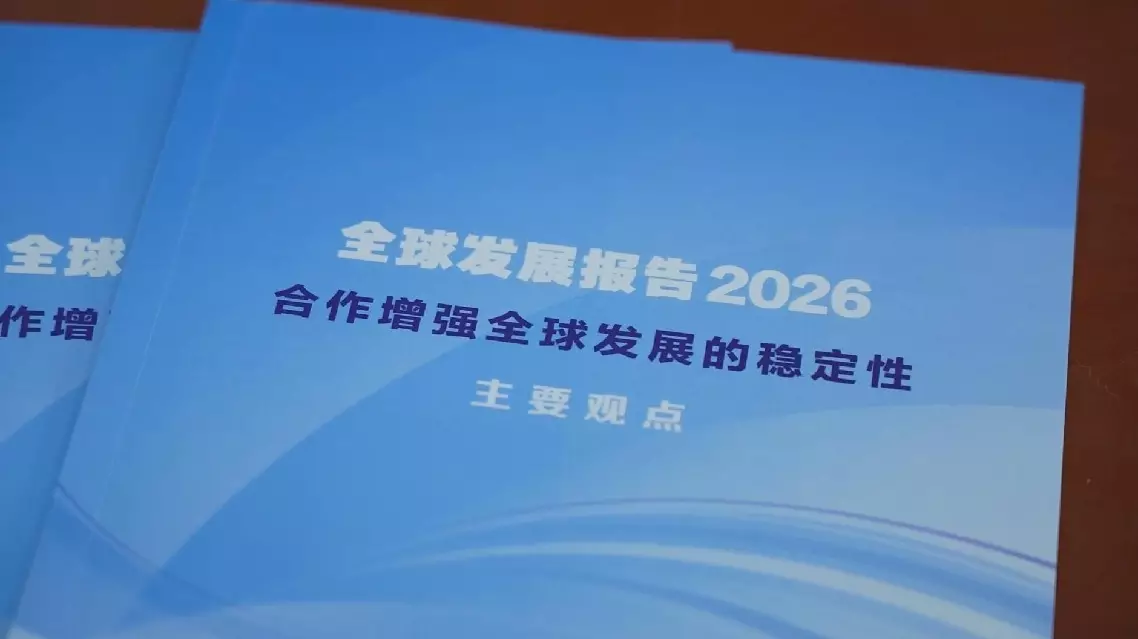
China releases report at UN dialogue, calling for promoting development amid rising turmoil
Beijing resident Wang Zhigang lost his vision five years ago to retinitis pigmentosa, a group of rare, inherited genetic eye disorders.
He had suffered from the disease for years, and gradually lost all sight at the age of 50.
"It wasn't just a small change. It was a complete change in my life. At first, I simply couldn't accept it. Luckily, I had some time to prepare. But the biggest problem was, I didn't know how to live in the society anymore. How should I position myself? How could I even go outside?" he said.
At first, going outside was next to impossible. But things picked up after he turned to the city's hotline services to help navigate his daily walks, an action that prompted a series of accessibility upgrades in his neighborhood.
In 2019, Beijing, home to over 20 million residents, launched an innovative "swift response to public complaints" initiative aimed at addressing public concerns promptly and resolving everyday challenges efficiently.
The initiative has integrated more than 60 hotline services into a single unified hotline number -- 12345 -- which serves as the primary channel for residents to voice their concerns.
Operating 24/7, the hotline is staffed by over 1,700 operators who work in shifts to address calls and handle requests covering nearly every aspect of urban life, including transportation, housing, education, healthcare, employment and business services.
Once a complaint is filed through Beijing's 12345 hotline, it is promptly forwarded to relevant government departments and public service companies for resolution. The outcome is then evaluated by the complainants, ensuring active engagement, assessment and oversight in the city's governance by the public.
It is this service that helped Wang reconnect with the world. Through this, he successfully applied to the local government for a guide dog named Juan'er.
"It was the Spring Festival, so there were fewer people and cars. I thought this was a rare chance to go out in Beijing on my own. So Juan'er and I went out together. It was freezing that day. When I got home, I was sweating from fear. But I ran into all kinds of problems. So I thought, why not give it a try? I called the 12345 hotline and explained my situation," he said.
Meng Lin, deputy director of the Infrastructure Coordination Center in Beijing's Chaoyang District, handles residents' concerns about local roads and traffic. Wang's complaint landed on her desk two years ago in her first case involving a visually impaired resident.
Wang walks a fixed route of about 1.7 kilometers each day that includes several busy intersections. While his guide dog helps him navigate, it cannot read traffic lights, and the audible signals along the route were also too faint for him to hear clearly.
With few pedestrians around during the Spring Festival, Wang found himself stranded at a crossing, unable to tell whether the light was green or red. He stood there for minutes, feeling completely helpless.
Meng decided to walk the route with him to see the problems firsthand. During the walk, she checked the audio signal at a key intersection, which Wang noted was much clearer and safer than before.
"His experience helped me better understand visually impaired people. It also showed me where we need to improve accessibility," said Meng.
Meng found several accessibility issues along the route, including disconnected tactile paving, uneven surfaces, and a height gap between the paving and the crosswalk. All have been repaired.
At one intersection, the tactile paving was moved back from the road edge to create more space between pedestrians and traffic, a change Wang said makes the crossing much safer for him and his guide dog.
Wang said he hopes visually impaired people can enjoy greater freedom of movement within society, adding that with the right facilities and laws in place, he feels fortunate today.
Meng said the approach to infrastructure is changing.
"In the past, the focus was simply on having roads and making them wide enough. Now, we are moving toward more detailed improvements. It's like embroidery. We need to make every detail more precise. As we move forward, accessibility will be an essential area of our work," said Meng.
According to official data, in the past seven years, Beijing has processed approximately 180 million public complaints, with both the resolution and satisfaction rates surpassing 97 percent.

Local gov't improves accessibility for visually impaired individuals