China, already home to the world's largest high-speed rail network, opened a new high-speed railway to traffic on Monday, linking the Xiong'an New Area in Hebei Province in the north with Shangqiu in Henan Province in central China.
The Xiong'an-Shangqiu line is a new section of the Beijing–Hong Kong High-Speed Railway, forming about a quarter of the entire high-speed corridor.
Train G3935, the first service on the newly opened route, pulled out of Beijing West Railway Station at 08:06 on Monday. The train will stop along the way at Xiong'an, Hengshui, Liaocheng and Heze in Hebei, and Shangqiu in Henan, among other stations, before terminating at Hefei West Railway Station in east China's Anhui Province. The total journey takes about five hours and 40 minutes.
Beijing now has three major north-south high-speed rail arteries: the Beijing–Hong Kong, Beijing–Guangzhou and Beijing–Shanghai high-speed railways. All three are connected to Xiong'an in Hebei.
The newly opened section is expected to further strengthen Shangqiu's role as a national rail hub and significantly cut travel time between Shangqiu and Beijing.
"The travel time from Shangqiu to Beijing on the new line is nearly one hour shorter than on previous routes that required detours," said Wang Xiaojing, a staff member at Shangqiu Station under the China Railway Zhengzhou Group.
In addition to the Xiong'an-Shangqiu route, three other major high-speed rail lines were opened to traffic on Monday in China, including the country's northernmost high-speed railway in Heilongjiang Province in the northeast.
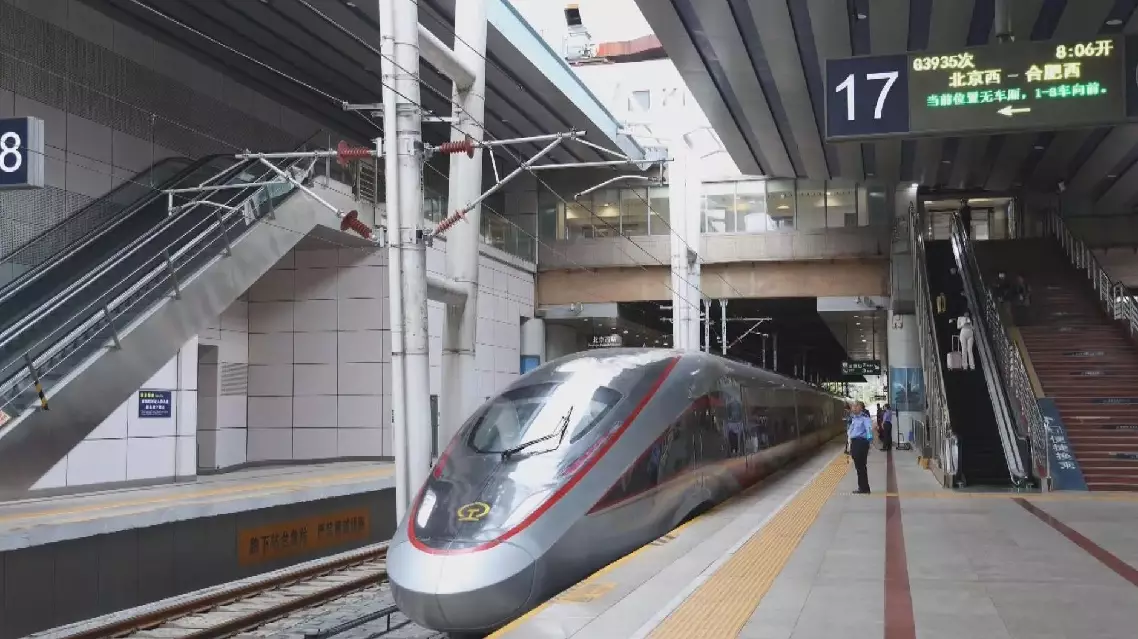
China opens Xiong'an-Shangqiu High-speed Railway, expanding world's largest network
Giant pandas Ping Ping and Fu Shuang arrived in Atlanta on Sunday morning, drawing visitors who made special trips to Zoo Atlanta to welcome them -- even though the pair will not be able to meet the public right away.
The pair departed from China's Chengdu Shuangliu International Airport in southwest China's Sichuan Province on a chartered flight at 02:55 on Sunday.
As planned, Ping Ping and Fu Shuang will stay in the United States for 10 years as part of a cooperative research program for giant panda conservation.
Upon their arrival, zoo visitors were filled with excitement. Many Atlanta residents still remember the panda family that previously stayed at the zoo before returning in 2024.
"I saw them. I got to see them one time when they were here last time and we're excited. It's my wife's favorite animal, so she'll be very excited to have an opportunity to see him because she wasn't here last time, she didn't get to see him," said a visitor.
"I'm really excited. We managed to catch the last ones before they left, so I'm glad they're coming back, especially with our baby here, Rena. I'm excited to show her the pandas when they are available to see," said another visitor.
Ping Ping, the male panda born on March 17, 2020, is easily recognizable due to his large, dark eye rims. His name, together with that of his brother An'an, comes from the wish for them to be safe and sound throughout their lives. He has a stocky build, moves nimbly, and has demonstrated proficiency in climbing trees, often resting among the branches.
Fu Shuang, the female panda born on October 18, 2020, is characterized by a small tuft of fluffy fur on her head and a full, protruding forehead. Her name comes from her mother, Fu Lu, and carries the meaning of both fortune and prosperity. With a round appearance, she is quick to react and very capable of foraging for food.
According to the Chinese side, both Chinese and U.S. veterinarians and keepers conducted a joint examination and confirmed that the two pandas are in good health. They have begun a routine quarantine period of about one month before making their debut to the public.

Visitors flock to Zoo Atlanta to welcome giant pandas Ping Ping, Fu Shuang