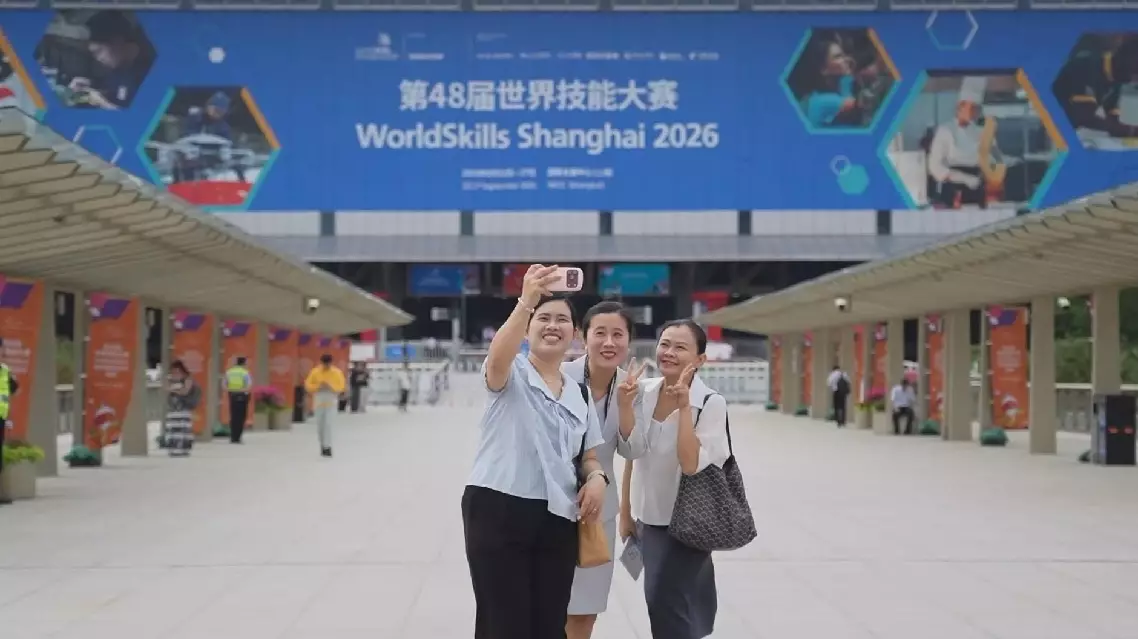
The 48th WorldSkills Competition closed in Shanghai on Sunday, debuting AI-centered events and raising evaluation standards for traditional skills to keep pace with evolving real-world demands.
Known as the "Olympics of skills", the biennial competition represents the highest level of international vocational skills competition. This year's edition featured higher standards and greater use of digital skills, drawing visitors eager to see how competitors would rise to the challenge.
"My son, he's competing as an electronic engineer. We are expecting that to be incredible, really amazing, and innovative," shared a mother from Australia.
"I just wanted to see how far competitors from different countries have advanced," a Chinese visitor said simply.
"AI is developing very fast. I want to see how it empowers skilled workers," a younger attendee noted.
The shifting standards have had a major impact on traditional events. Wall and floor tiling, for example, now demands far more than neat, precise work. Millimeter-level accuracy is required.
"This event is really about hands-on skills, so competitors need a very good feel for laying tiles, and the standards are very high. This year, there's also a new requirement: they have to drill holes in the tiles," shared Wang Huafei, chief technical expert for wall and floor tiling.
In heavy vehicle technology, participants must master electrical, hydraulic and braking systems on top of traditional mechanical skills, and must be able to locate information in digitized technical manuals that can run to thousands of pages, some available only in English.
"It can only be stored on a computer. Within three hours, competitors have to read through and search the repair manuals as quickly as possible to find the key technical information they need," shared Weng Yan, Medallion for Excellence winner in the category.
These changing standards reflect broader industrial upgrading. This year's competition featured 64 events, including seven AI and digital technology skills making their debut, alongside multiple standard upgrades, underscoring the rapid development of smart manufacturing, the digital economy, and modern services.
WorldSkills Competition presents new standards as AI, digital technology reshape jobs
Competition between the United States and China is healthy when it is fair, but dangerous when it becomes an effort to trip or eliminate the other side, David Lampton, former president of the National Committee on United States-China Relations, said in commenting on Chinese President Xi Jinping's just-concluded state visit to the U.S.
Xi paid a state visit to the United States on Sept 23-25 at the invitation of President Donald Trump. It was Xi's first state visit to the country in 11 years and followed Trump's state visit to China back in May.
During the trip, Xi had an in-depth exchange of views Trump on bilateral relations as well as major international and regional issues of common concern.
The two leaders reached a consensus on eight outcomes which span a wide range of areas, including the economy and trade, technology, people-to-people exchanges and international situations. A major one is that the two sides have agreed to build a constructive relationship of strategic stability based on respect, fairness and reciprocity.
Speaking at a welcome ceremony hosted by Trump at the White House on Thursday, Xi said that China and the U.S. should embrace healthy competition, avoid confrontation, and jointly explore the right way to get along.
Reflecting on the nature of competition between major countries, Lampton outlined three distinct forms it can take.
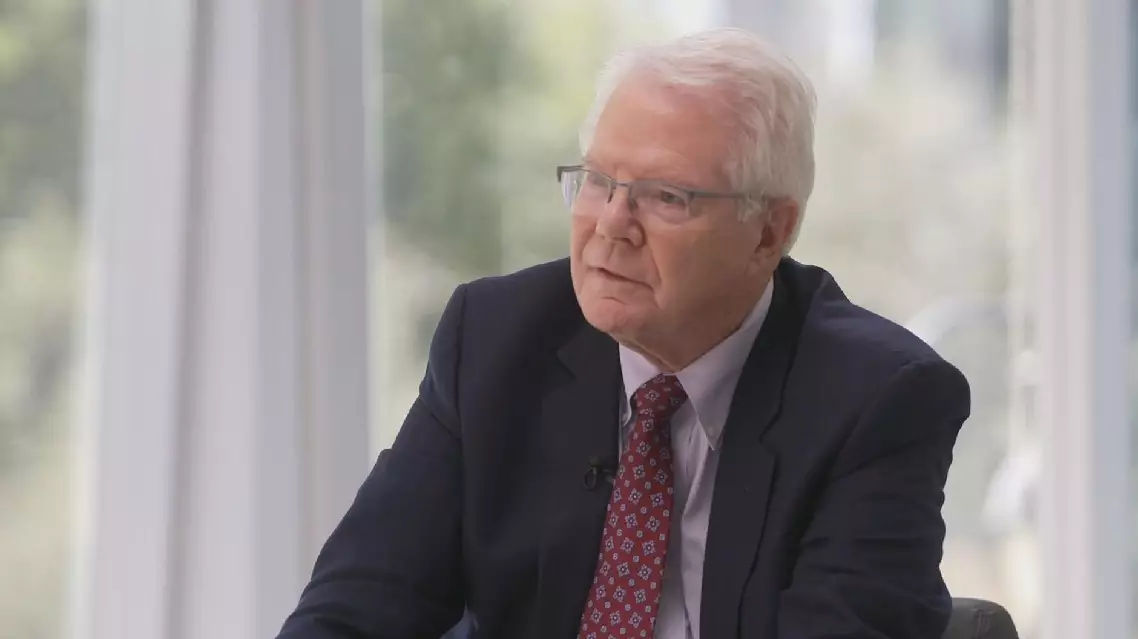
"There are different forms of competition. There's the form of competition, like a tracks race, a running race. You all line up at the same line, the gun fires and whoever is the most capable wins at the end of the race. But there's the kind where the gun goes off and I try to trip, or you try to trip the other guy. And then there's the kind of competition where you're trying to eliminate the other, right?" he said in an interview with China Global Television Network (CGTN) on Friday.
Lampton made clear which form he believes should define the China-U.S. relationship.
"Obviously, I think competition is good in that first sense. That's what economic progress, scientific innovation [means]. It was [Thomas] Edison [who] made fortune out of inventing the light bulb. Inventors were motivated by their desire for knowledge, but also money. So, I think competition is basically human life, but I think we need to have the kind of competition if we're not helping the other, in some case through partnership and so forth, we're at least not trying to trip them," he added.
During the visit, Xi and Trump agreed to support each other as China will host the 2026 APEC Economic Leaders' Meeting in November and the United States will host the G20 Leaders' Summit in December, expressing intention that they will attend each other's event.
Lampton said the focus now should be on putting those commitments into practice to build a stronger foundation for future engagement.
"[It is] very important for both sides to do what they say. If it's only for two months, at least let's both do what we say for two months and then that'll create a better foundation when we get together for the next two meetings that you just mentioned," said Lampton.
China-U.S. relations expert urges fair competition, warns against "tripping" each other