CARLSBAD, Calif.--(BUSINESS WIRE)--Sep 28, 2026--
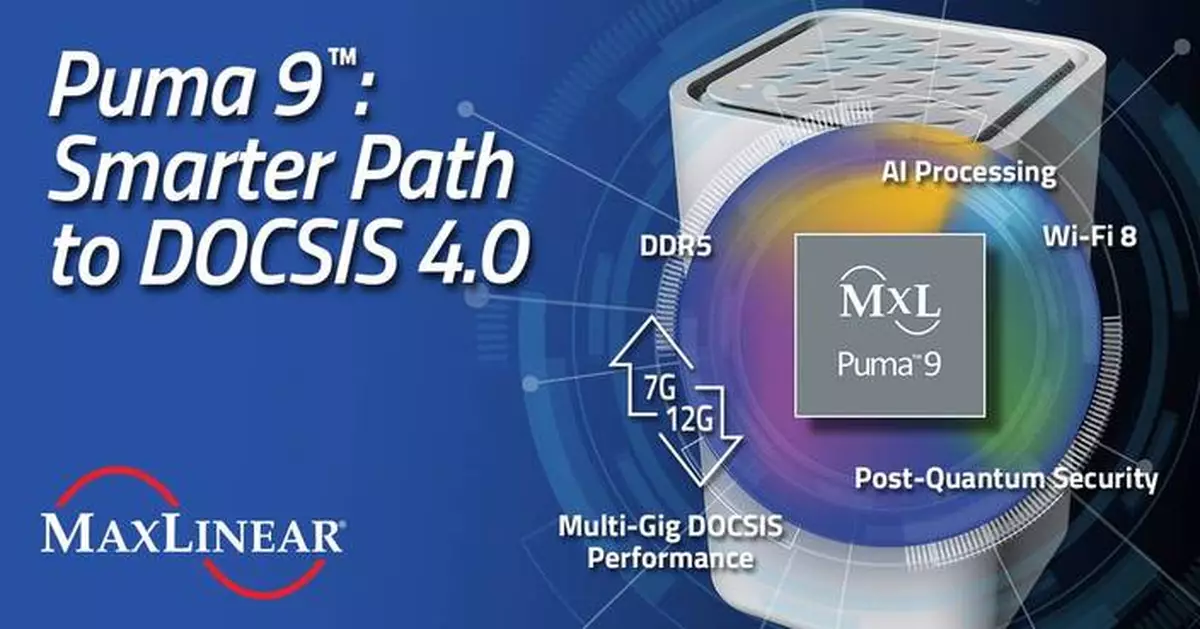
MaxLinear, Inc. (Nasdaq: MXL), a leading provider of communications semiconductors for broadband, connectivity, and infrastructure applications, today announced Puma™ 9, a next-generation DOCSIS® platform designed to help broadband operators accelerate the rollout of D4.0/D3.1+ multi-gigabit services, power Edge AI, personal AI and Wi-Fi 8 connectivity while also helping operators to reduce their cost and complexity of transitioning to DOCSIS 4.0.
This press release features multimedia. View the full release here: https://www.businesswire.com/news/home/20260928528178/en/
Puma 9 brings advanced Post-Quantum Cryptography (PQC) security readiness and DDR5 memory compatibility, helping operators protect their networks against future threats and avoid supply chain risk associated with legacy memory types. Built with a secure-by-design approach, Puma 9 is designed to support compliance with leading cybersecurity frameworks and regulations, including NIST IR 8425A (U.S.), Radio Equipment Directive (RED), and the Cyber Resilience Act (CRA) (EU).
Operators are facing expanding demands that extend far beyond raw bandwidth. From Edge AI and Personal AI to Wi-Fi 8, heightened security requirements, and tighter capital budgets, success increasingly depends on the ability to evolve services without constantly replacing hardware. Puma 9 reimagines the gateway lifecycle, helping operators maximize existing DOCSIS 3.1 investments while preparing for next-generation services. Through flexible in-field upgrades, operators can deliver multi-gigabit experiences on their own timeline without frequent hardware refreshes or costly requalification cycles.
With a high level of integration in 8nm process technology, Puma 9 is the first and only platform that can support DOCSIS 3.1, DOCSIS 3.1+, and DOCSIS 4.0 standards on a single SoC without incurring significant cost additions. By unifying these capabilities into a highly integrated architecture, Puma 9 enables operators to reduce their spending today while providing a path to accelerate new services, reduce deployment complexity, and maximize infrastructure investments.
Key Capabilities
Key features in Puma 9 help bridge gaps in network economics and flexibility for DOCSIS deployments:
Addressing the DOCSIS 4.0/3.1 Upgrade Dilemma
As operators prepare for a new wave of growth fueled by Edge AI, personalized AI services, Wi-Fi 8, and increasing demand for uninterrupted multi-gigabit speeds, they face a significant challenge: existing solutions typically require expensive DOCSIS 4.0 CPE refreshes and qualification cycles. To manage costs, many operators delay CPE investments until broader network upgrades are underway. This approach not only increases the financial stress on operators but also takes away the flexibility to offer D4.0 surgically in those markets where competitive pressure or consumers demand it sooner than other markets. Long and costly D4.0 qualification cycles and expensive D4.0 CPE HW deployments take the flexibility and competitive advantage away from DOCSIS operators.
Operators are also contending with growing supply chain uncertainty as major memory vendors transition away from DDR4. Dependence on DDR4-only D4.0 CPE introduces further price pressure and significant longevity risk, as broadband equipment requires stable component availability and support throughout extended product lifecycles.
Puma 9 addresses both challenges by optimizing CPE cost to enable a software-driven migration path from DOCSIS 3.1 to DOCSIS 3.1+ and/or to DOCSIS 4.0 through in-field upgrades. Puma 9-based designs offer CPE cost parity with existing D3.1 CPE costs. This enables operators to deploy a highly capable DOCSIS platform without incurring additional CPE spend. That means operators can now deploy DOCSIS 4.0-ready devices today, preserve their investments, and upgrade to D4.0 or D3.1+ only when their business requires it—without costly truck rolls, expensive HW/SW investments, or large-scale equipment replacement programs. Further, Puma 9 supports five OFDM channels in D3.1+ configuration. This allows operators to offer 12 Gbps, i.e., a D4.0-like experience, over existing D3.1 networks. This further accelerates time to better consumer experiences and enables operators to phase their network spend.
“ When planning their next-gen network and CPE upgrades, operators require flexibility above all else," said Jeff Heynen, Vice President, Broadband Access and Home Networking, Dell'Oro Group. "Operators are looking to proactively manage their spending on next-gen upgrades, which is now becoming more of a focus because of the DDR supply situation. Having the flexibility to separate the timing of network and CPE spends, eliminating long SW qualification cycles with a single CPE platform that is backward and forward compatible, enabling CPE upgrade while meeting legacy CPE HW costs – all these items materially lower operators’ deployment risk and capital expenses, and allow them to spend exactly where they need to be competitive."
Transforming Broadband Economics
A recent Dell’Oro industry forecast indicates that DOCSIS 4.0 and fiber expansion investments are entering a new spending cycle that is expected to peak in 2028, while escalating residential gateway costs remain a concern for operators. Puma 9 was designed specifically for this environment, enabling operators to align CPE investments with network evolution while significantly reducing deployment costs.
Puma 9 helps operators accelerate DOCSIS 4.0 adoption with a highly integrated platform that lowers deployment costs, extends the value of existing software investments, and provides a flexible migration path to future broadband services. By enabling a flexible, operator-driven migration strategy, Puma 9 minimizes upgrade risk, enhances deployment agility, and positions operators to capitalize on long-term broadband growth opportunities.
Executive Quote
"Operators are looking for a smarter path to DOCSIS 4.0—one that minimizes cost and risk while maximizing the value of today's investments," said Puneet Sethi, SVP & GM of MaxLinear’s Network Infrastructure and Carrier Business Unit. "Puma 9 significantly changes those economics to benefit operators and consumers. Operators can now deploy DOCSIS 4.0-ready equipment today without expanding their CPE budget allocation, enabling them to offer higher speeds to consumers who need it. Puma 9 also offers 12 Gbps in D3.1+ mode, which enables D4.0 experience over a D3.1 network, enabling operators to phase their network upgrade spend without compromising consumer experience."
Partner Quotes
“Over the past decades, together with our partner MaxLinear, we have enabled operators and consumers to benefit from an unmatched broadband experience – one that consumers now associate with FRITZ!," said Diego Friedel, Vice President of Software at FRITZ!."With FRITZ!’s software expertise, our focus has always been on continuously improving the consumer experience through new broadband technologies, including DOCSIS. We are excited to learn about the Puma 9 platform and its capabilities, and we look forward to evaluating it in our lab."
" At Askey, we are committed to delivering commercial-ready broadband platforms that simplify operator deployments while enabling next-generation connected-home experiences," said Eric Lui, R&D VP of Askey. "By combining Wi-Fi 8, AI processing, post-quantum security readiness, and a forward-looking DOCSIS architecture, Puma 9 gives us the foundation to deliver platforms that support new revenue-generating services while meeting long-term customer needs. We're developing our next generation of gateways on the Puma 9 platform to help operators create a scalable, future-proof solution that accelerates service innovation, optimizes deployment costs, and seamlessly supports evolving subscriber demands."
"Delivering scalable, long-life CPE requires architectural flexibility from the silicon up," said James Lee, President, Gemtek."We are leveraging MaxLinear's Puma 9 platform to develop next-generation DOCSIS and Wi-Fi gateways that help operators meet growing bandwidth demands while simplifying technology transitions over time. With support for DDR5 memory, post-quantum cryptography readiness, and future broadband upgrades, Puma 9 enables us to deliver solutions that maximize performance today and protect operator investments well into the future."
"Mediacom is always evaluating technologies that can help us balance performance, flexibility, and reliability," said JR Walden, SVP Technology and CTO of Mediacom Communications. "The ability to deploy a platform that supports DOCSIS 3.1+, DOCSIS 4.0, and future services without significant CPE cost increases is an attractive concept. We look forward to learning more about Puma 9 and evaluating its potential within our network."
Availability
Puma 9 is currently available to broadband operators and OEM partners developing next-generation DOCSIS gateways and eMTA solutions. Additional product and partner announcements are expected throughout 2026.
About MaxLinear, Inc.
MaxLinear, Inc. (Nasdaq: MXL) is a leading provider of radio frequency (RF), analog, digital, and mixed-signal integrated circuits for access and connectivity, wired and wireless infrastructure, and industrial and multi-market applications. MaxLinear is headquartered in Carlsbad, California.
For more information, please visit www.maxlinear.com.
Cautionary Statement Regarding Forward-Looking Statements
This press release contains forward-looking statements within the meaning of Section 27A of the Securities Act of 1933, as amended, and Section 21E of the Securities Exchange Act of 1934, as amended. Forward-looking statements include, among others, statements relating to MaxLinear’s Puma™ 9 platform and the anticipated functionality, performance, benefits, availability and cost savings of Puma 9 and the ability of Puma 9 to support compliance with cybersecurity frameworks and regulations; statements regarding anticipated market trends, spending cycles and demand for multi-gigabit broadband and DOCSIS 4.0 services; statements regarding the plans of MaxLinear’s customers and partners to develop, evaluate or deploy products based on Puma 9; statements regarding the expected timing of future product and partner announcements; and statements attributed to MaxLinear’s SVP & GM of MaxLinear’s Network Infrastructure and Carrier Business Unit. These forward-looking statements involve known and unknown risks, uncertainties, and other factors that may cause actual results to be materially different from any future results expressed or implied by the forward-looking statements and our future financial performance and operating results forecasts generally. Forward-looking statements are based on management’s current, preliminary expectations and are subject to various risks and uncertainties. In particular, our future operating results are substantially dependent on our assumptions about market trends and conditions. Additional risks and uncertainties affecting MaxLinear’s business, future operating results and financial condition include, without limitation; risks relating to: the development, testing, and commercial introduction of new products and product functionalities and the capabilities of MaxLinear’s technology, including MaxLinear’s Puma 9 and DOCSIS products and technology; risks related to the markets for MaxLinear’s broadband and DOCSIS products not developing or growing; our terminated merger with Silicon Motion and related arbitration and class action complaint and the risks related to potential payment of damages; the effect of intense and increasing competition; increased tariffs, export controls or imposition of additional trade barriers; impacts of global economic conditions; the cyclical nature of the semiconductor industry; a significant variance in our operating results and impact on volatility in our stock price, and our ability to sustain our current level of revenue, which has previously declined, and/or manage future growth effectively, and the impact of excess inventory in the channel on our customers’ expected demand for certain of our products and on our revenue; escalating trade wars, military conflicts and other geopolitical and economic tensions among the countries in which we conduct business; international geopolitical and military conflicts; our ability to obtain or retain government authorization to export certain of our products or technology; the loss of, or a significant reduction in orders from major customers; legal proceedings or potential violations of regulations; information technology failures; a decrease in the average selling prices of our products; failure to penetrate new applications and markets; development delays and consolidation trends in our industry; inability to make substantial and productive research and development investments; delays or expenses caused by undetected defects or bugs in our products; substantial quarterly and annual fluctuations in our revenue and operating results; failure to timely develop and introduce new or enhanced products; order and shipment uncertainties and differences between our estimates of customer demand and product mix and our actual results; failure to accurately predict our future revenue and appropriately budget expenses; lengthy and expensive customer qualification processes; customer product plan cancellations; failure to maintain compliance with government regulations; failure to attract and retain qualified personnel; any adverse impact of rising interest rates on us, our customers, and our distributors and related demand; risks related to compliance with privacy, data protection and cybersecurity laws and regulations; risks related to conforming our products to industry standards; risks related to business acquisitions and investments; claims of intellectual property infringement; our ability to protect our intellectual property; security vulnerabilities of our products; use of open source software in our products; failure to manage our relationships with, or negative impacts from, third parties; and future decisions relating to our stock repurchase program. Other risks and uncertainties indicated from time to time in MaxLinear's filings with the Securities and Exchange Commission ("SEC"), including the annual report on Form 10-K, and quarterly reports on Form 10-Q, and those disclosures under the "Risk Factors" section therein. The foregoing list of factors is not exhaustive. Forward-looking statements speak only as of the date they are made. Readers are cautioned not to put undue reliance on forward-looking statements, and MaxLinear assumes no obligation and does not intend to update or revise these forward-looking statements, whether as a result of new information, future events, or otherwise.
In addition to these risks and uncertainties, investors should review the risks and uncertainties contained in the filings of MaxLinear with the Securities and Exchange Commission, including our Current Reports on Form 8-K, as well as the information set forth under the caption "Risk Factors" in MaxLinear’s most recent Quarterly Report on Form 10-Q. All forward-looking statements are based on the estimates, projections and assumptions of management as of the date of this press release, and MaxLinear is under no obligation (and expressly disclaims any such obligation) to update or revise any forward-looking statements whether as a result of new information, future events, or otherwise.
Market and Industry Data
This press release contains statistical data, estimates, and forecasts concerning the Company’s industry and market that are based on independent industry publications, reports by market research firms, other published independent sources and/or the Company’s own internal estimates and research based on such data. Industry publications, surveys, and studies generally state that they have obtained information from sources believed to be reliable, but do not guarantee the accuracy or completeness of such information. The Company has not independently verified the data obtained from these third-party sources and cannot assure you of its accuracy or completeness. Statements as to the Company’s market position are based on management estimates using such third-party data together with the Company’s internal data. In addition, projections, assumptions, and estimates of the future performance of the industry in which the Company operates, and the Company’s future performance, are necessarily subject to uncertainty and risk due to a variety of factors, including those described under “Cautionary Statement Regarding Forward-Looking Statements” above. These and other factors could cause actual results to differ materially from those expressed in, or implied by, the estimates made by independent parties and by the Company.
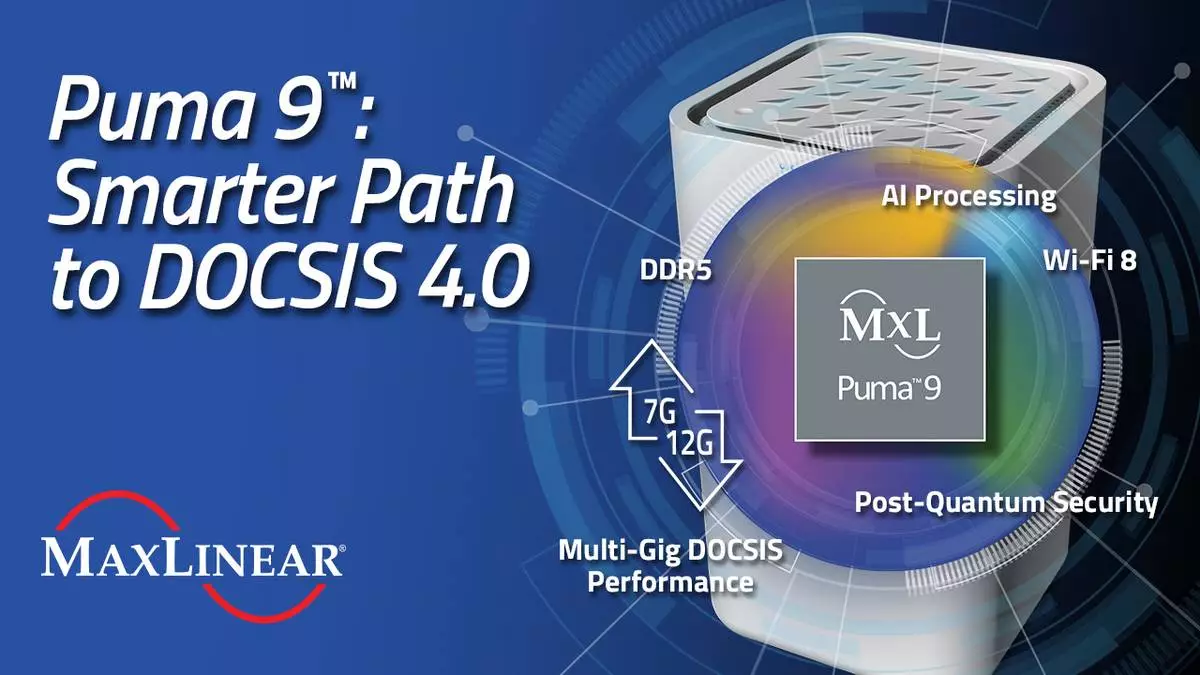
Puma™ 9 helps operators accelerate DOCSIS 4.0 deployment while reducing CPE costs, preserving investments, and enabling a flexible upgrade path from DOCSIS 3.1 to 4.0.