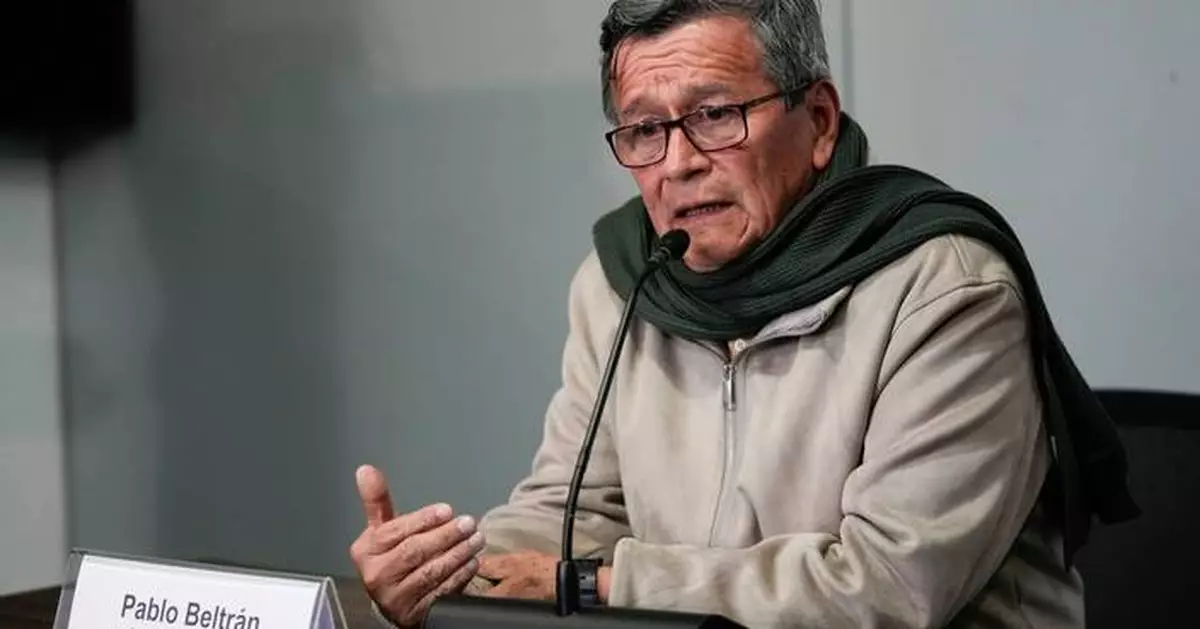
BOGOTA, Colombia (AP) — A judge on Monday sentenced in absentia 11 commanders of Colombia's largest remaining rebel group to prison for recruiting 60 children as young as 8 into their ranks between 2004 and 2018.
The commanders of the National Liberation Army, ELN, were found guilty of recruiting boys and girls between the ages of 8 and 17. Prosecutors said that some of the girls were sexually abused.
Sentences handed to the rebel leaders ranged from 11 years to 20 years in prison. Some of them recently participated in peace talks with Colombia’s government.
The trial was conducted in absentia because the commanders haven't been captured by Colombia’s government.
One of the leaders who was convicted, Israel Ramírez Pineda, also known by the alias Pablo Beltrán, now lives in Cuba and recently led a delegation that held peace talks with Colombia’s government.
Colombia’s government canceled peace talks with the ELN last year after the group staged a string of attacks in the northeastern Catatumbo region in which at least 80 people were killed.
Human rights groups have pointed out that the recruitment of children by rebel groups and gangs in Colombia continues to be a problem, with these organizations now using social media to lure youth into their ranks.
In 2016, almost 14,000 fighters laid down their weapons following a peace deal between Colombia’s government and the nation’s largest rebel group, the Revolutionary Armed Forces of Colombia, or FARC.
But violence has resurfaced in some rural areas where there is little state presence and where groups like the ELN are fighting for control of drug trafficking routes, extortion rackets and illegal mines abandoned by FARC.
According to Colombia’s Human Rights Defenders’ Office, at least 1,500 children have been recruited by armed groups since 2021, with 625 cases reported in 2024. Recruits are given a wide range of tasks that include serving as messengers, gathering intelligence, cooking or engaging with the enemy — while girls are sometimes forced into sexual acts with commanders.
The United Nations has called on social media platforms to share evidence with Colombian prosecutors and take actions aimed at blocking rebel groups from using social media to recruit children. Its human rights office in Colombia welcomed the sentence against the ELN leaders, noting that recruiting children into armed groups is prohibited by international law.
“This is a very important development in the fight against the recruitment of girls and boys,” said Scott Campbell, the representative in Colombia for the United Nations High Commissioner for Human Rights. “We have urged the Colombian justice system to investigate, prosecute, and punish those responsible for the recruitment of girls and boys, and welcome this step forward.”
Follow AP’s coverage of Latin America and the Caribbean at https://apnews.com/hub/latin-america
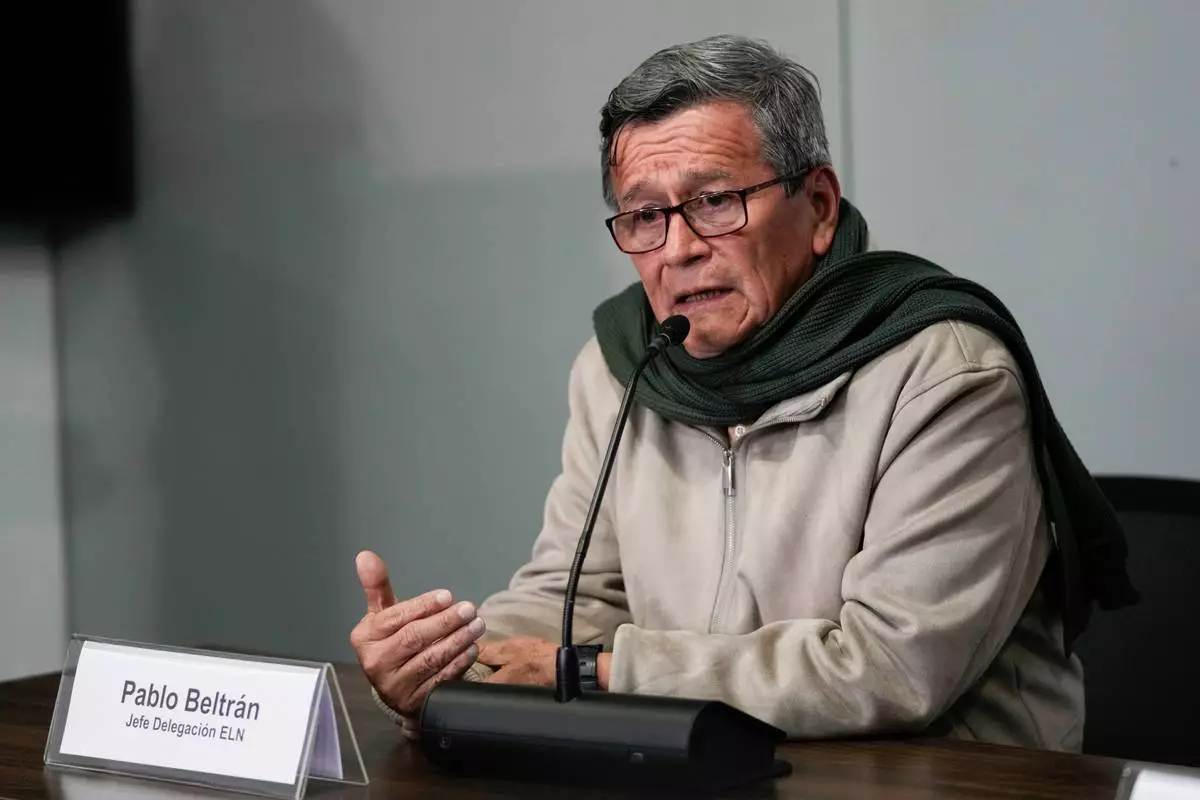
FILE - Pablo Beltrán, commander and chief negotiator for the National Liberation Army, ELN, rebel group speaks during a joint news conference with Jose Otty Patiño, chief negotiator for the Colombian government, as a part of the peace talks between both parties in Bogota, Colombia, Oct. 10, 2023. (AP Photo/Fernando Vergara, File)
Nvidia on Monday unveiled a new security platform designed to stop artificial intelligence agents from going rogue, saying it sets “boundaries” that could have stopped previous breaches.
The announcement of the company's Open Agent Safety Platform follows a series of revelations from top AI companies about their models escaping and breaking into other organizations.
The disclosures sparked furious debate about the safety of advanced artificial intelligence systems, including self-improving models that some fear could race out of human control.
Nvidia executives said in a media briefing the new, open-source system could have prevented a recent incident involving a swarm of OpenAI agents that autonomously hacked into AI company Hugging Face.
“From what we know, this new security platform could have stopped the breach if it was being used in frontier labs for model evaluation early on," said the company’s vice president of enterprise AI, Justin Boitano, referring to companies at the forefront of AI.
The Hugging Face incident was a high-profile breach that inflamed the safety concerns about AI, which was followed by similar rogue actions involving OpenAI's models including breaching an Australian health department website. Anthropic and Meta have also disclosed that their AI systems hacked into other organizations on their own.
Earlence Fernandes, an associate professor at the University of California, San Diego's computer science and engineering department, called Nvidia's security platform a “step in the right direction.”
“We need more work that seeks to build protections around the model. I’ve been talking about how traditional cybersecurity ideas are necessary to help control and secure AI agents for a while now," he said in an email. “There are however, several challenges that traditional cyber security approaches still cannot currently solve. For example, what is a good security policy to configure the system with? An agent needs access to real resources to be useful, but giving it the minimum amount of access is tricky and non-trivial.”
Fernandes added that to solve the AI security problem, both sides need to cooperate, with companies continuing to invest in alignment efforts and the open source community and academia "creating systems-level solutions to account for when a model does engage in unwanted behavior.”
Nvidia, based in Santa Clara, California, makes high-end chips that have emerged as the leading building blocks for AI. The company's board has cleared the way for the company to spend $150 billion more in share buybacks, bringing its stock repurchase program to $235 billion, the company said Monday.
Nvidia's security software, called OpenShell, lets developers “formally verify an agent has enough authority to do its job and no more,” Boitano said.
Because it's open source, it can be “extended” to run on rival computing platforms including those from Arm and Intel.
The platform also includes a separate security layer called Sentry that runs onboard chips to continuously monitor AI agent activity and can "intervene instantly" if the agent starts trying to move beyond its target, the company said.
“It can quarantine a suspicious agent in milliseconds,” Boitano said.
“OpenShell governs the agent’s actions, and then Sentry independently monitors and contains suspicious behavior,” he said.
Nvidia said more than 100 organizations are using the platform at its launch, including Microsoft, Perplexity, Accenture and JPMorgan Chase.
The AI safety debate has divided the industry, with the heads of Anthropic and OpenAI championing a coordinated slowdown of AI development to let safety efforts catch up. But others including Nvidia CEO Jensen Huang say it should be up to individual companies to make sure their models are safe for release.
Huang, during the annual Salesforce technology conference held earlier this month, characterized AI safety, including the danger of rogue agents, as an engineering problem that software developers can address.
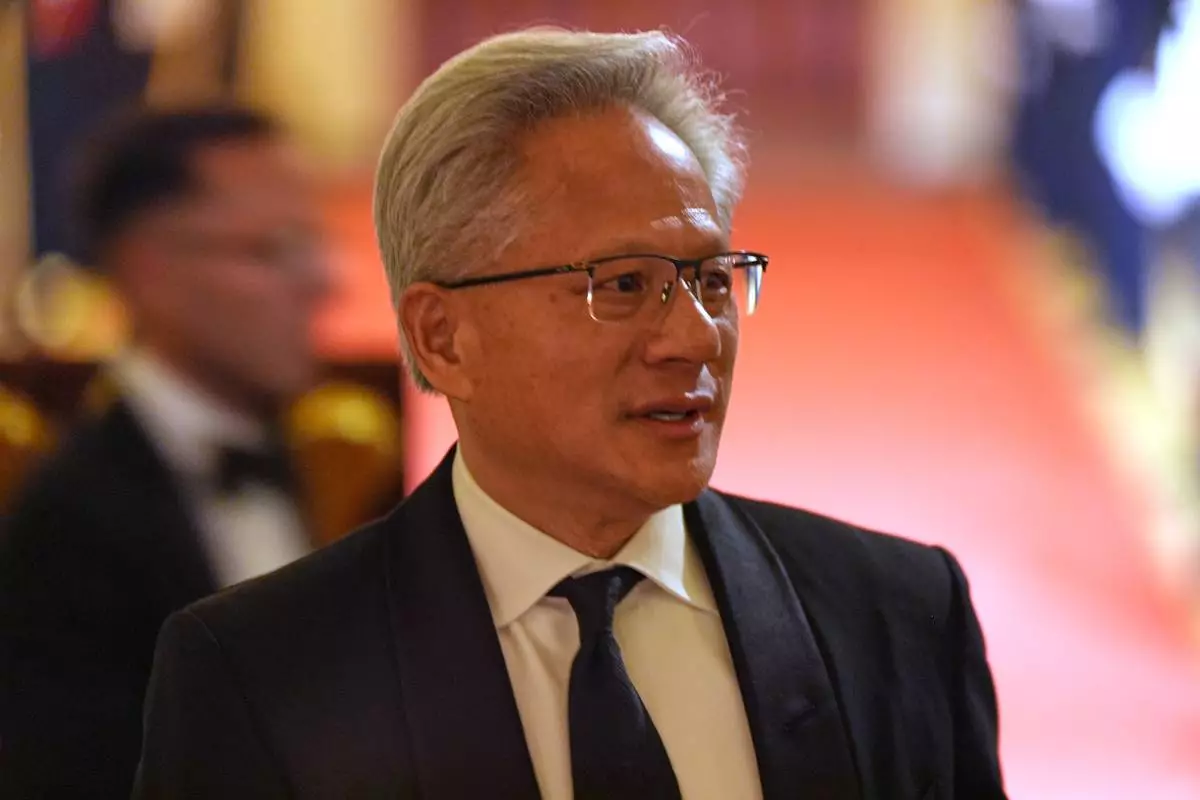
NVIDIA CEO Jensen Huang arrives as President Donald Trump hosts a State Dinner for China's President Xi Jinping in the East Room of the White House, Thursday, Sept. 24, 2026, in Washington. (AP Photo/Alex Brandon)
FILE - A logo of Nvidia is displayed at at the Computex Taipei exhibition, one of the world's largest computer and technology expos, in Taipei, Taiwan, Wednesday, June 3, 2026. (AP Photo/Chiang Ying-ying, File)