MUNICH--(BUSINESS WIRE)--Sep 29, 2026--
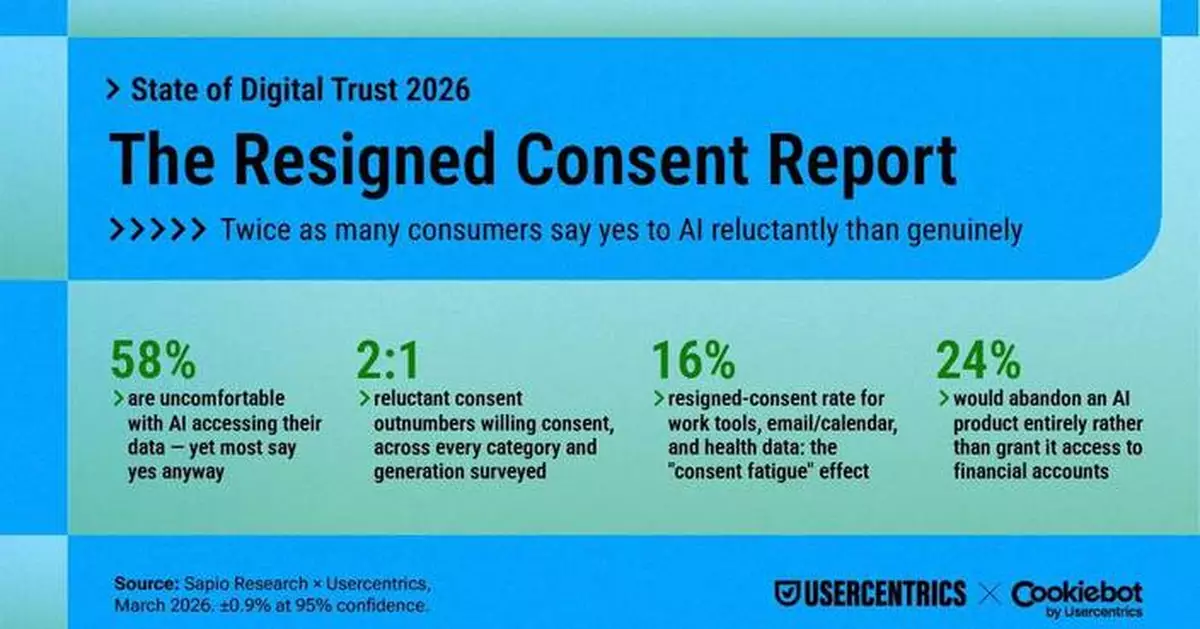
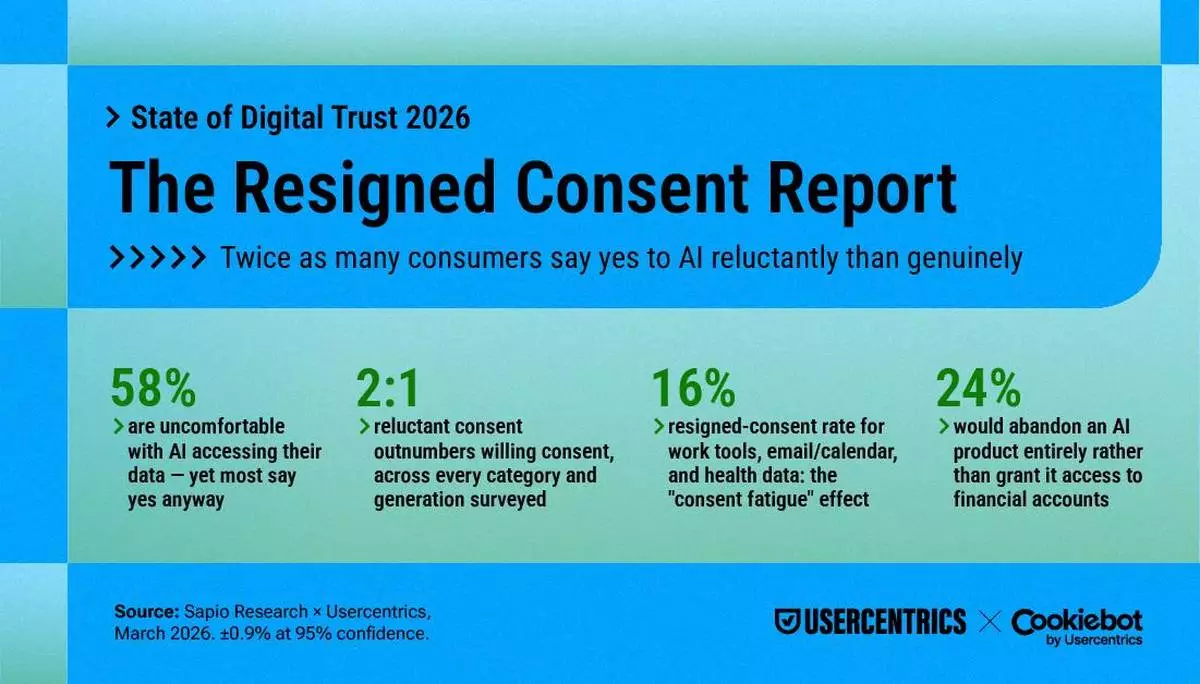
Nearly six in ten consumers are uncomfortable letting an AI assistant access their data. Most of them say yes anyway, and new global research shows a large share of that "yes" is based on resignation, not trust.
This press release features multimedia. View the full release here: https://www.businesswire.com/news/home/20260928277816/en/
According to the new findings based on a study of 11,000 consumers across seven markets conducted by Sapio Research, just 7% of consumers are fully comfortable granting an AI assistant access to their data with no conditions attached. More than twice as many, 17%, grant that access despite feeling uncomfortable about it: a pattern the report calls "resigned consent," permission given not because the request feels right, but because refusing feels like more trouble than it's worth.
The distinction matters because access rates and consent quality are being read as the same signal, when they are not. A resigned yes and a genuine one register identically in a consent rate. They do not behave the same way afterward.
"A resigned yes and a real one look identical in your consent rate, but behave nothing alike," said Tilman Harmeling, Strategy & Market Intelligence at Usercentrics. "One holds under pressure. The other holds until the first bad headline. If you can't tell which one you have, you don't know how much of your AI adoption is actually yours to keep."
The findings arrive as businesses across sectors expand AI assistants, copilots and agents into systems that touch consumer and employee data, often citing high opt-in or access rates as evidence the rollout is landing well.
Key findings:
"The goal isn't a higher yes rate. It's a more honest one. A considered yes from fewer people holds up better than a reluctant yes from many, which is exactly what we see in the UK and US," said Harmeling.
The full Resigned Consent Report is available here.
For the wider research, see the full State of Digital Trust Report 2026 — with country-by-country and generational breakdown.
About the research
The State of Digital Trust Report 2026 is the second annual study commissioned by Usercentrics and conducted by Sapio Research. The survey polled 11,000 consumers across seven markets: the UK, USA, Germany, Spain, Italy, the Netherlands and Sweden. Fieldwork was conducted in March 2026 and is accurate to ±0.9% at 95% confidence. Sweden joins the study for the first time this year; year-on-year comparisons exclude Swedish data.
About Usercentrics
Usercentrics is a leading data privacy technology company that helps businesses collect, manage, and activate consented data with confidence. Trusted by 2.4 million websites and apps across 195 countries, the company processes more than 8.8 billion user consents every month. Through its platform, which spans consent management, server-side tagging, and AI data connectivity and access, Usercentrics gives businesses the compliance infrastructure to grow, innovate, and operate responsibly in an AI-first world. Learn more at usercentrics.com.
"Resigned Consent": New Global Study Finds Consumers Grant AI Access Reluctantly More Than Twice as Often as Willingly
METZ, France (AP) — Pope Leo XIV urged Europe on Monday to draw from its Christian roots and tradition of dialogue to blunt the “desire for domination” driving today's wars, as he wrapped up a visit to France by recalling the forces that contributed to the continent's peaceful integration.
Leo traveled to the eastern city of Metz, near the border with Luxembourg and Germany, to honor Robert Schuman, a French Catholic statesman regarded as one of the founding fathers of European unity after World War II.
Leo decided to end his four-day visit to France in Metz, at a conference center named for Schuman, to drive home his appeal. The American pope wants Europe to draw from its Christian foundations and traditions to respond to wars and other conflicts, including Russia’s war in Ukraine, and the challenges of migration.
“Over the past 80 years, Europe has amply demonstrated that it is possible to articulate divergent opinions, claims and interests through encounter rather than conflict,” he said.
“We need to commit ourselves to patient dialogue, to show courage in negotiation and to be willing to give up some positions for the greater good of peace,” he said, without naming specific conflicts or positions.
Élysée Palace, the French presidential office, had invited all European Union heads of state and the heads of European institutions to attend the conference. But only a handful, from smaller states such as Monaco, Andorra and Luxembourg, joined President Emmanuel Macron.
Leo’s visit to the once staunchly Catholic and officially secular France has been marked by his appeal for Europe to remember its Christian heritage and apply it to today’s ethical and geopolitical challenges.
It has also been marked by huge crowds at nearly every turn — 800,000 attended Leo’s Mass on Paris’ iconic Place de la Concorde — surprising even organizers and suggesting that the Catholic Church still has a place in an overwhelmingly secular public square.
On Monday morning, Leo's Air France charter received a military escort of two French fighter jets for the flight from Lourdes to Metz in a sign of respect. Macron tweeted a photo of Leo's plane taken by one of the jets while in flight, writing “Welcome to Metz, Most Holy Father.”
Macron joined Leo on stage at the Schuman event, vowing “unfailing” European support for Ukraine and noting that the country is among those aspiring to join the EU and a “space of peace, security, democracy and prosperity.”
“War has come back to our continent and our Europe is rocked by the return of empires,” Macron said. “To guarantee real sovereignty, we must therefore act, act firstly to preserve our security and our values.”
In his final event in France, Leo celebrated Mass in the cathedral of St. Stephen in Metz, a city with a long history of conflict that was part of Nazi Germany during the war.
The cathedral, finished in 1522, is one of the greatest examples of French Gothic style, with its soaring vaults and stained-glass windows, some of which were later designed by Marc Chagall, a 20th-century Jewish artist.
In his homily, Leo said that Metz and its surroundings experienced evil, but now “bear witness to the whole world that reconciliation is only possible when one has the courage to break the chains of resentment.”
The cathedral’s stained-glass windows, designed by a Jew, are “an extraordinary symbol of ecumenism and interreligious dialogue,” where God’s light unites “different histories and cultures into a single marvelous mosaic of peace.”
“As we contemplate these stained-glass windows, we learn that Europe’s future does not lie in uniformity, but in the harmony of differences, where the wounds of the past become openings through which light shines,” he said.
The colored glass has given the cathedral the nickname the “Lanterne du Bon Dieu,” or “The Good Lord’s Lantern.”
As they did in Paris during Saturday's Mass along the Champs-Élysées, priests in Metz set up makeshift confession stands on the streets to accommodate the faithful who packed the squares around the cathedral.
The Vatican estimated that 35,000 people had turned out. Macron changed his schedule at the last minute to attend and sat in the front row.
Schuman is best known for the Schuman Declaration of 1950, five years after World War II ended. It proposed the creation of a European Coal and Steel Community to pool production between historic rivals France and Germany.
The idea, as Europe was emerging from the ruins of the war, was guided by the belief that intertwined economic interests would make another conflict between them “not merely unthinkable, but materially impossible.”
The coal and steel organization was the first among European institutions that were precursors to what eventually became the European Union.
Schuman, a resistance fighter imprisoned by the Nazis, was declared “venerable” in 2021, a step in the Catholic Church's process toward possible sainthood.
Leo praised especially Schuman's respect for international law in pursuing his idea of peaceful integration. It was an indirect reference to how Russia's invasion of Ukraine, as well as U.S. military incursions in Venezuela and the Iran war, have taken place outside the international legal order.
Leo said international law and multilateralism “constitute the best antidote to the desire for domination, which lies at the root of every conflict.”
He lamented that in its place, relations today between states are becoming “increasingly uncivilized.”
“The value of keeping one’s word is dismissed; instead, people boast of lies and deceit,” he said.
Asked if Leo had crossed a line and entered into the European political debate, the Vatican's foreign minister, Archbishop Paul Gallagher, said that the pope was just preaching Catholic morals.
“He spoke about morality, ethics and the principles of the Church’s moral teaching. If anyone wants to draw political conclusions, they are free to do so,” Gallagher said.
John Leicester contributed to this report from Paris.
Associated Press religion coverage receives support through the AP’s collaboration with The Conversation US, with funding from Lilly Endowment Inc. The AP is solely responsible for this content.
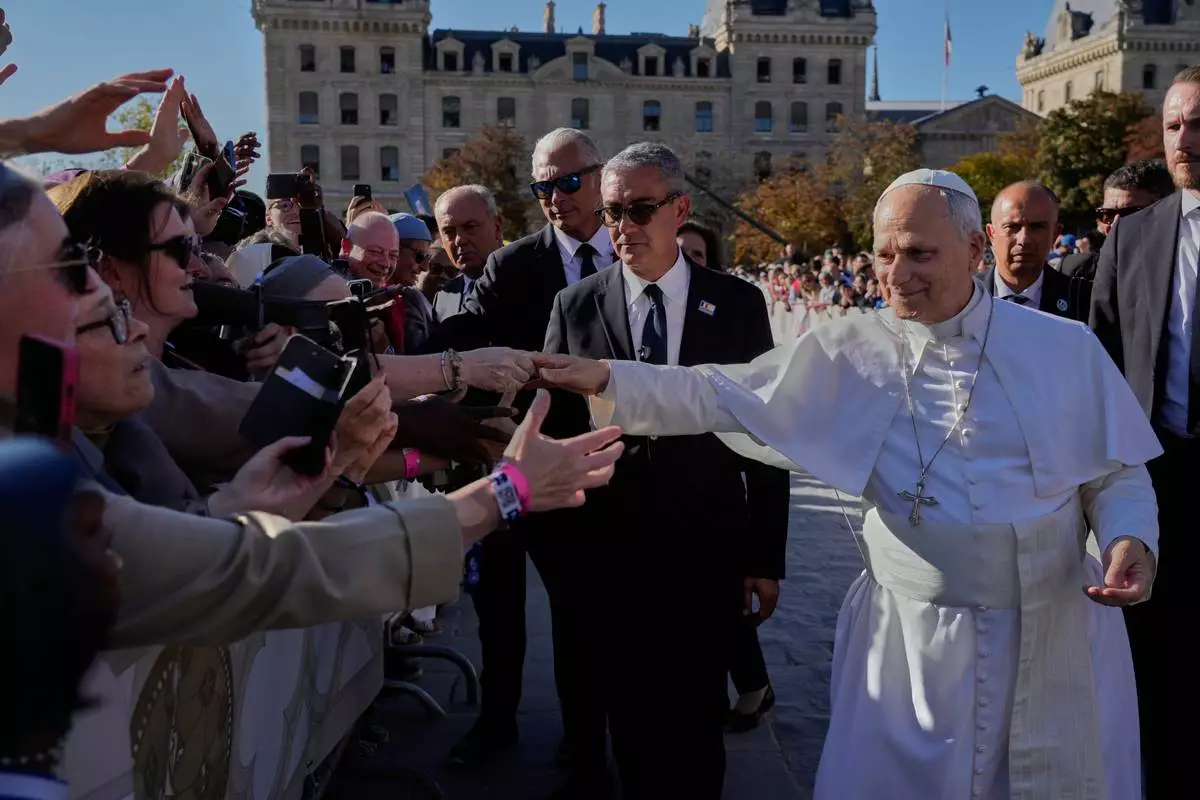
Pope Leo XIV arrives at Notre-Dame Cathedral to lead the vespers, Friday, Sept. 25, 2026, in Paris. (AP Photo/Gregorio Borgia)
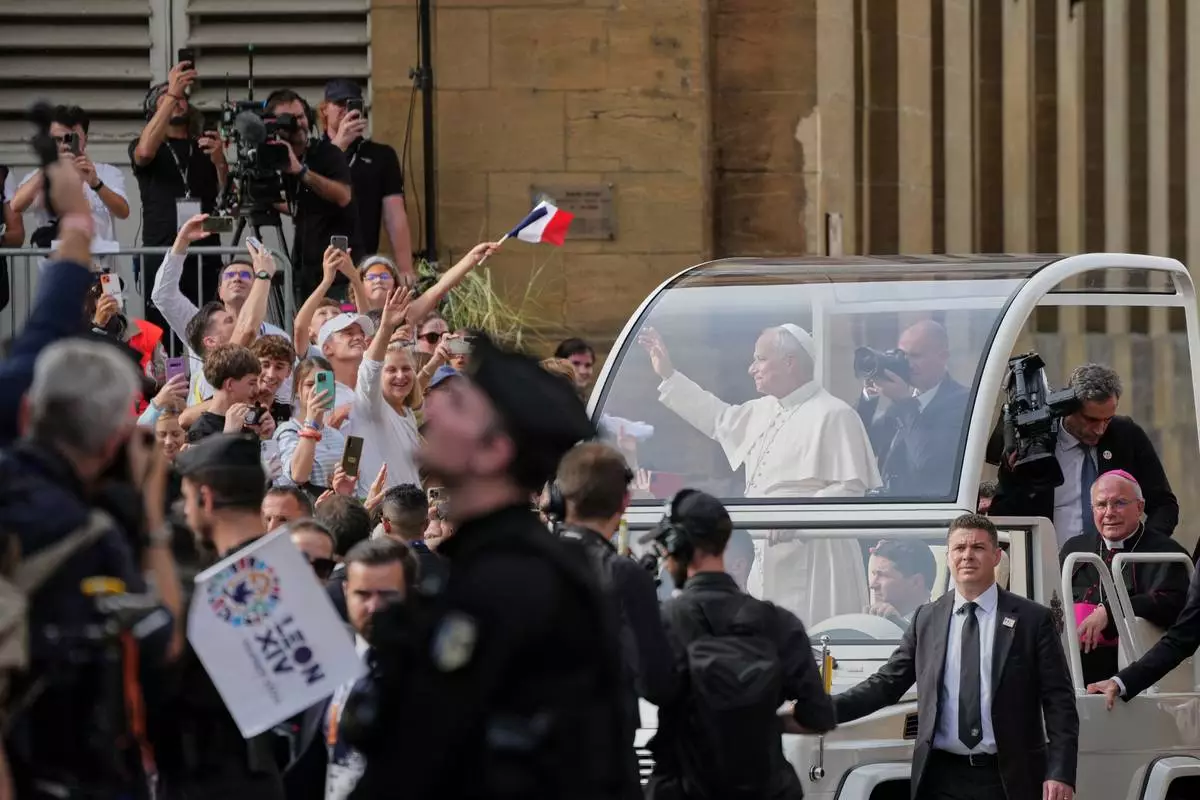
Pope Leo XIV arrives to celebrate mass at the Cathedral of Saint Stephen, in Metz, France, Monday, Sept. 28, 2026. (AP Photo/Gregorio Borgia)
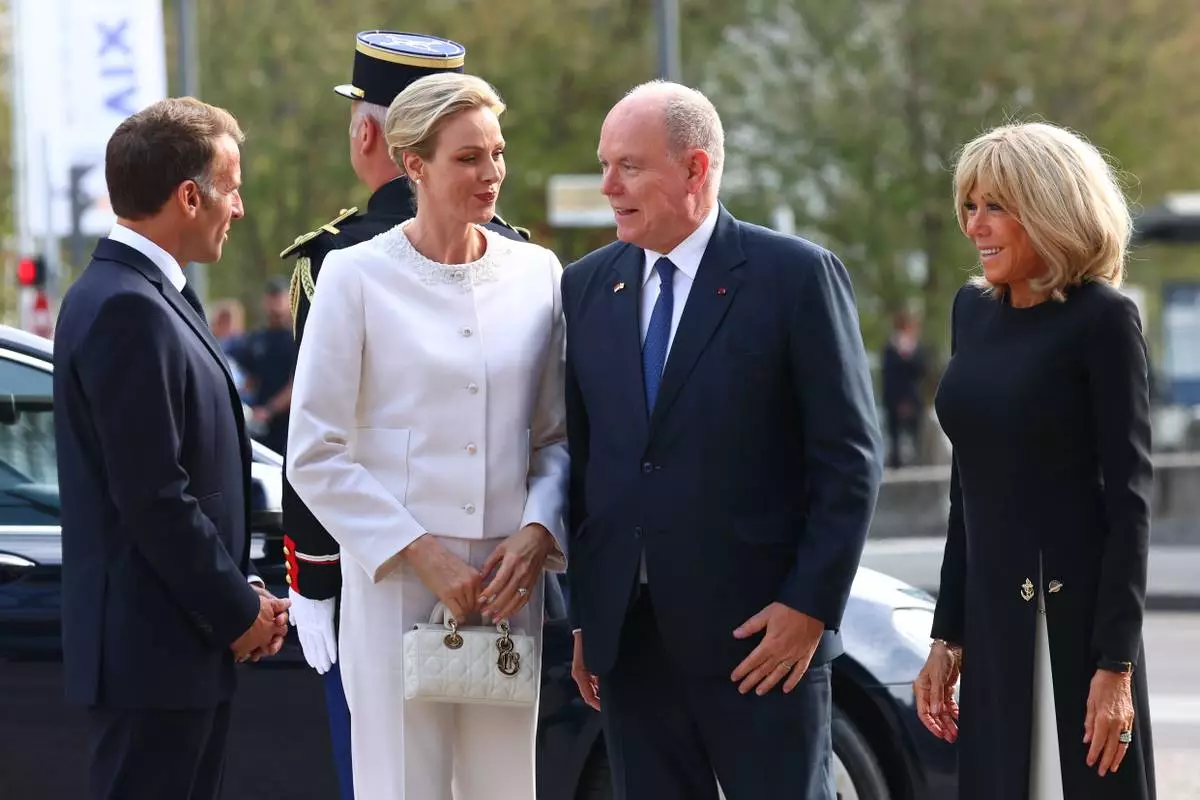
French President Emmanuel Macron, left, and his wife Brigitte Macron, right, welcome Prince Albert II and Princess Charlene of Monaco before a meeting at the Roots of Europe for Peace and Unity with Pope Leo XIV, Monday, Sept. 28, 2026, in Metz. (AP Photo/Antonin Utz)
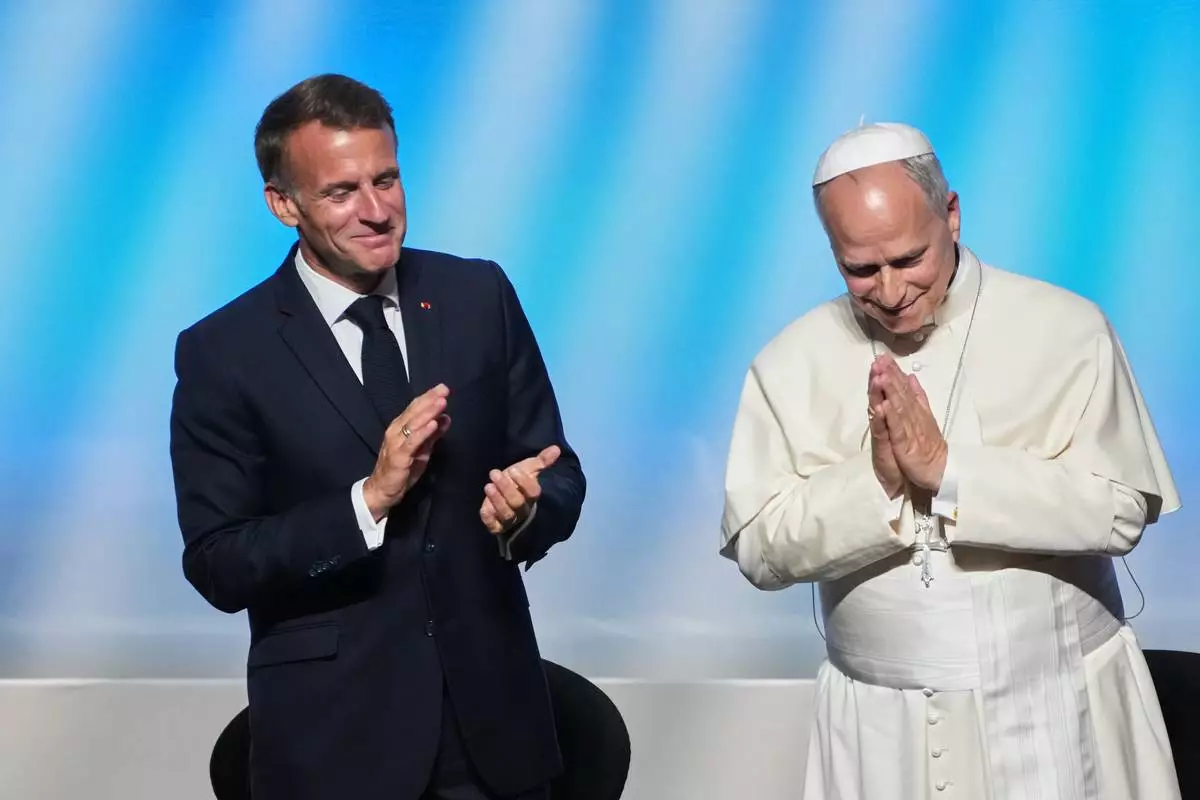
Pope Leo XIV is congratulated by French President Emmanuel Macron, left, after his speech at the meeting At the Roots of Europe for Peace and Unity with, Monday, Sept. 28, 2026, in Metz, France. (AP Photo/Gregorio Borgia)
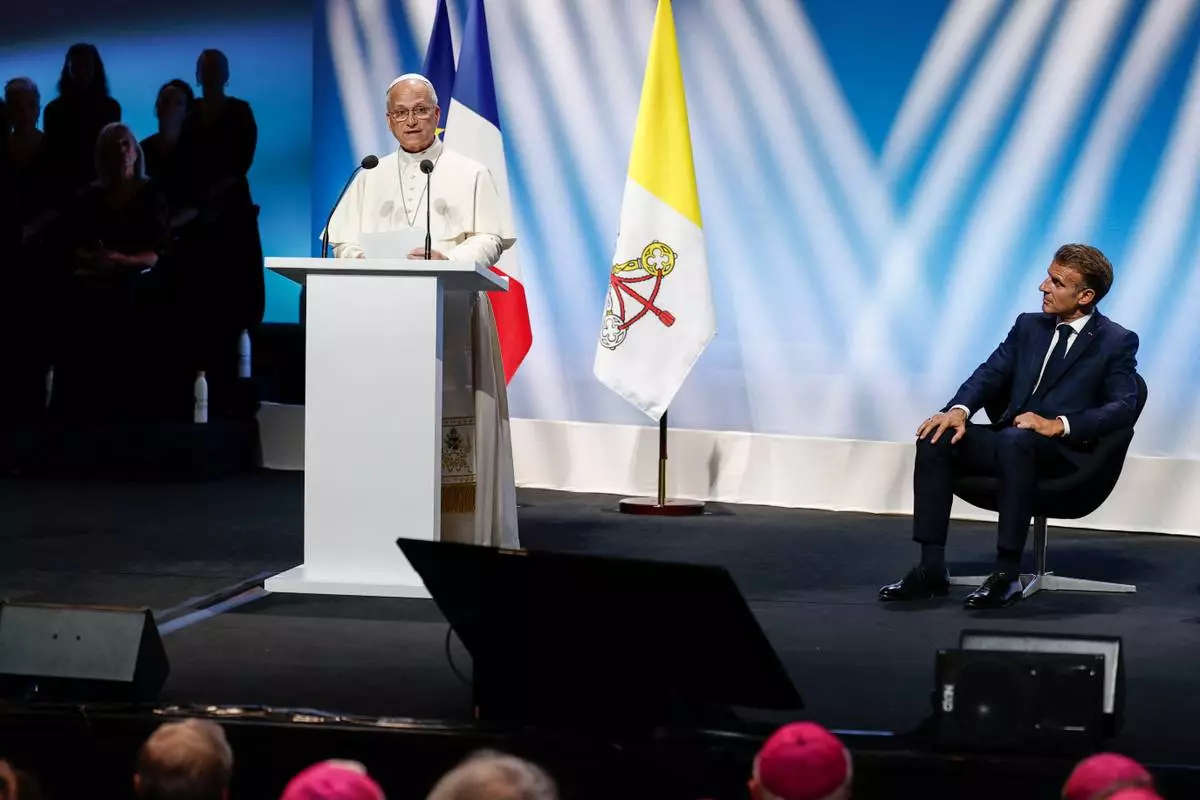
French President Emmanuel Macron looks on as Pope Leo XIV speaks at the meeting "At the Roots of Europe for Peace and Unity", in Metz, France, Monday, Sept. 28, 2026. (Benoit Tessier/Pool Photo via AP)
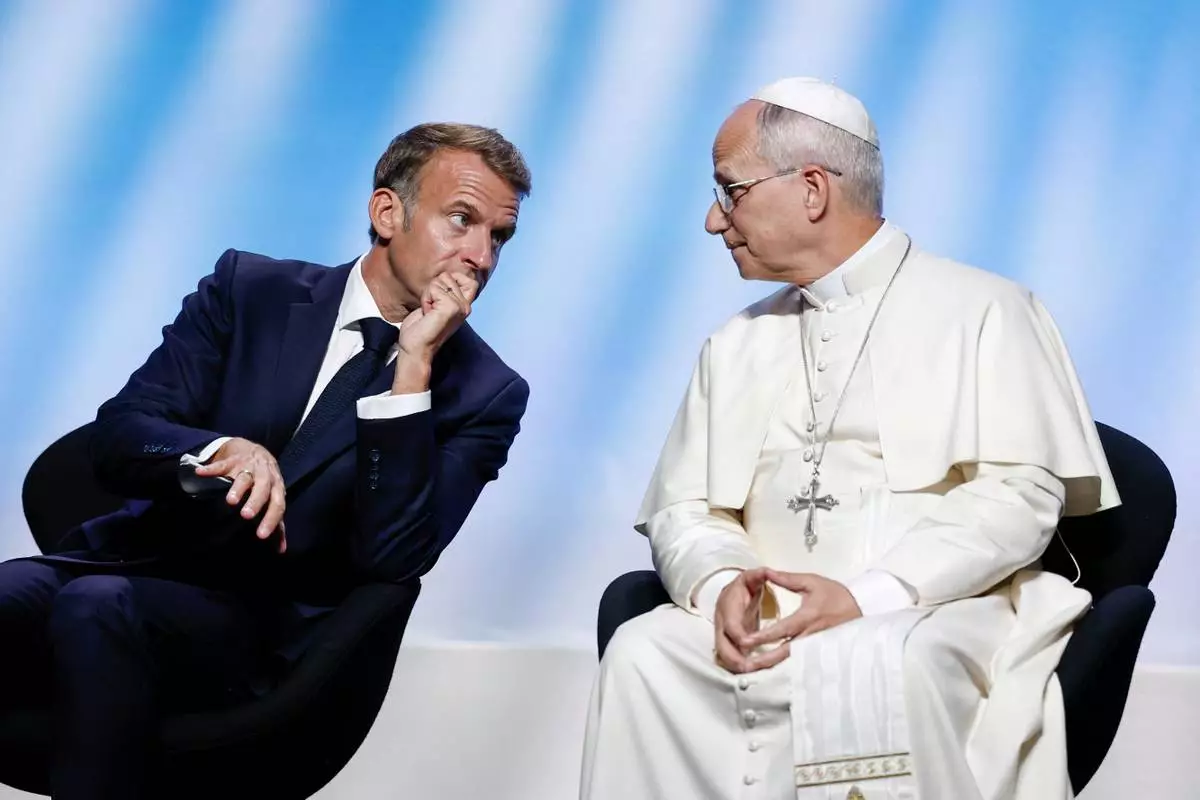
French President Emmanuel Macron and Pope Leo XIV attend the meeting "At the Roots of Europe for Peace and Unity", in Metz, France, Monday, Sept. 28, 2026. (Benoit Tessier/Pool Photo via AP)
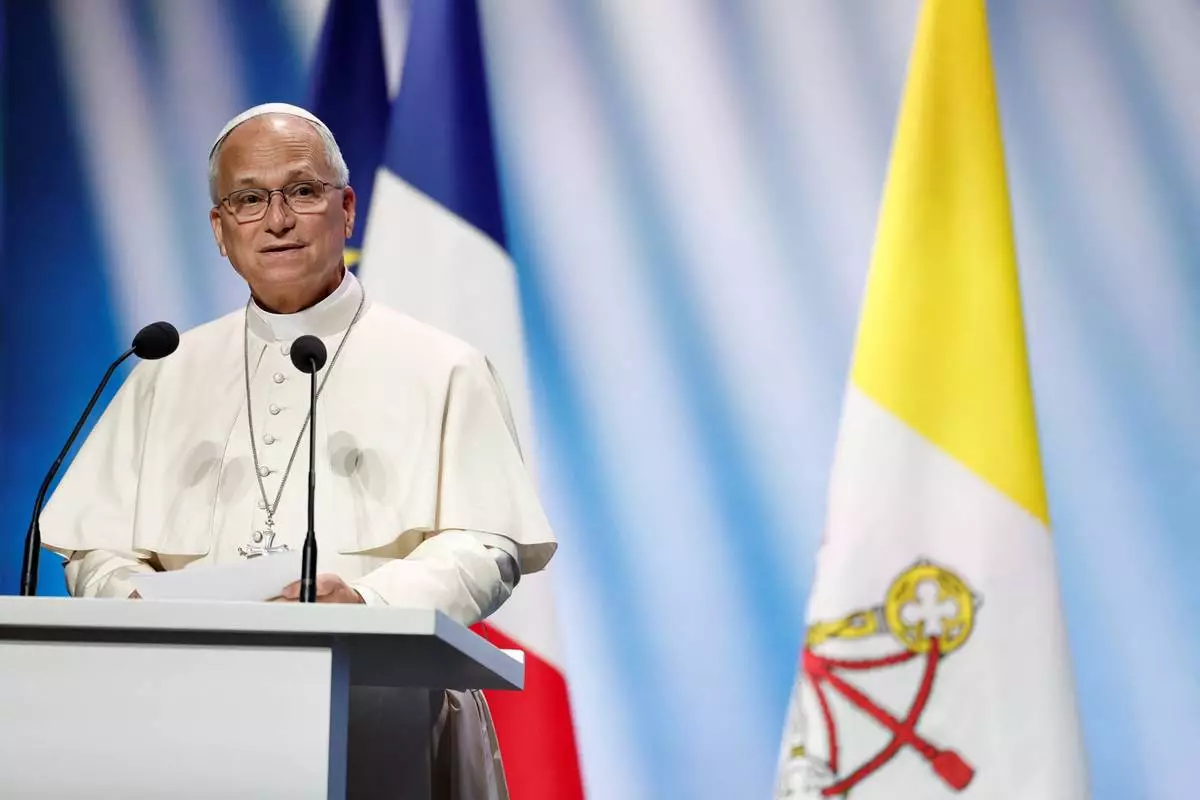
Pope Leo XIV speaks at the meeting "At the Roots of Europe for Peace and Unity", in Metz, France, Monday, Sept. 28, 2026. (Benoit Tessier/Pool Photo via AP)
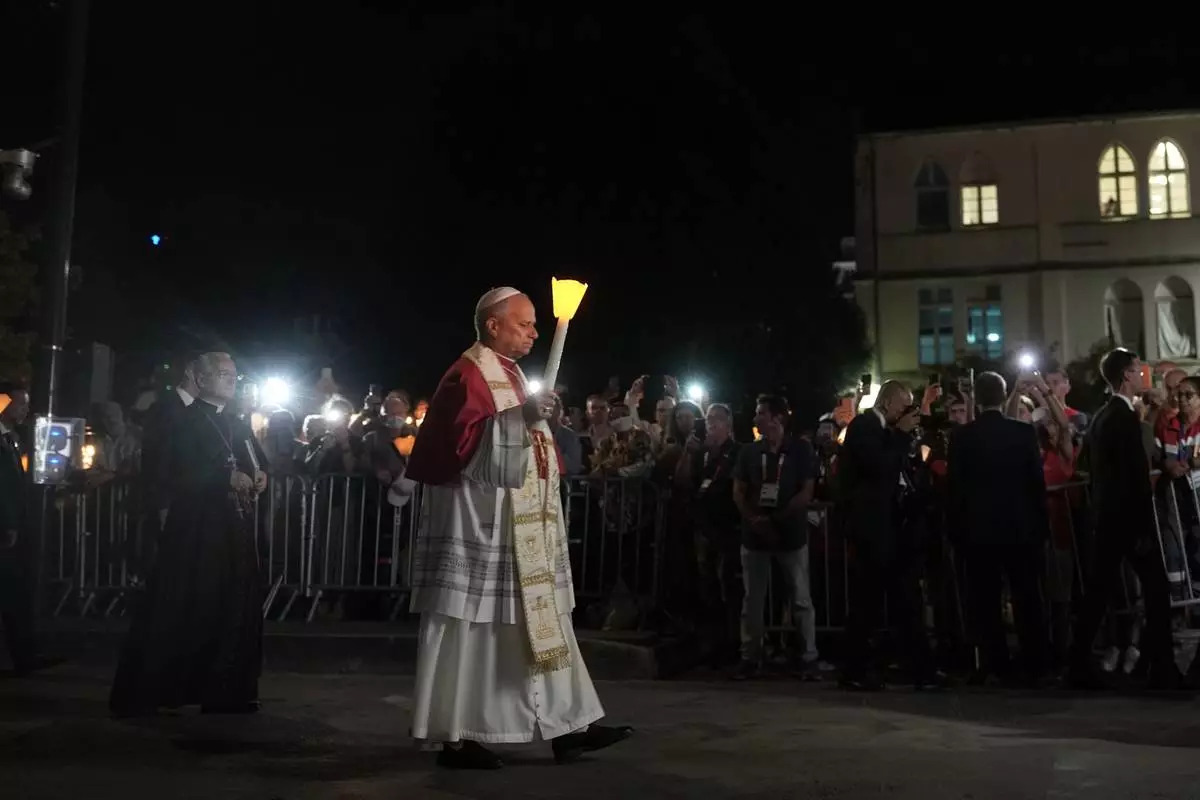
Pope Leo XIV holds a candle during a prayer of Holy Rosary and torchlight procession at the Sanctuary of Our Lady of Lourdes, France, Sunday, Sept. 27, 2026. (AP Photo/Thibault Camus)
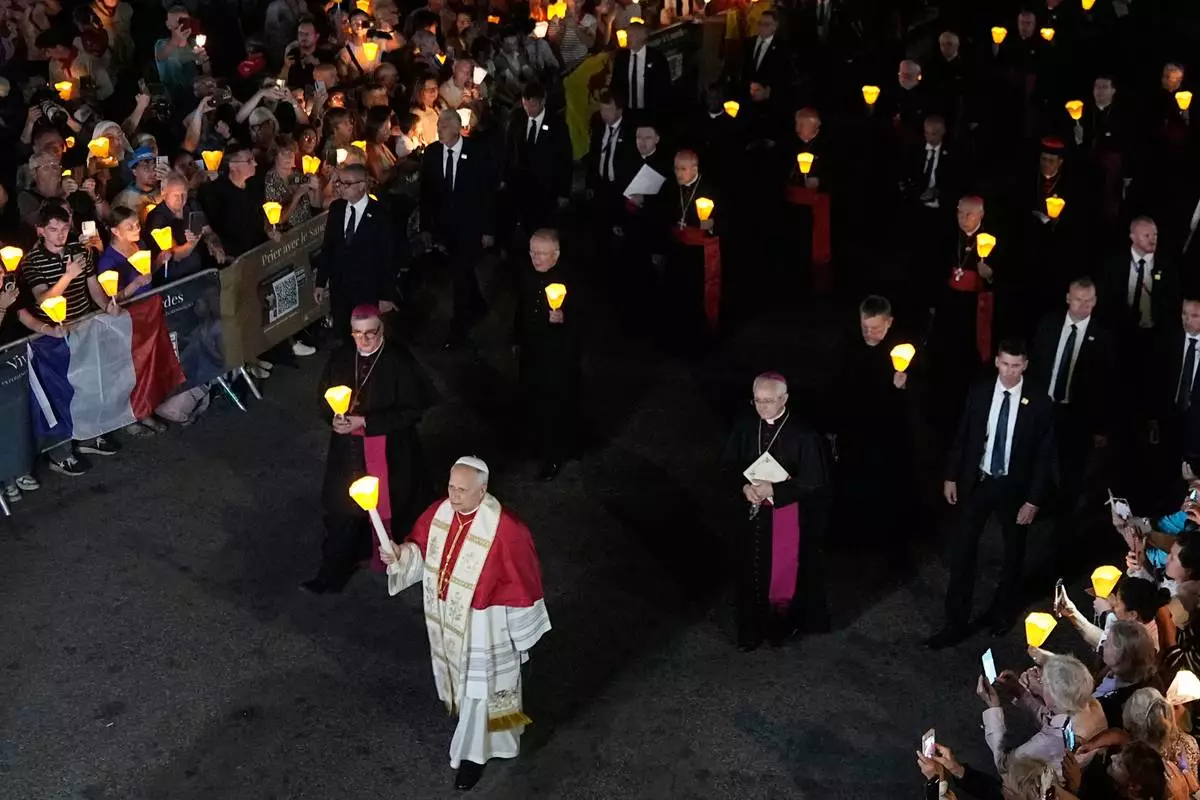
Pope Leo XIV, center, holds a candle during a prayer of Holy Rosary and torchlight procession at the Sanctuary of Our Lady of Lourdes, France, Sunday, Sept. 27, 2026. ((AP Photo/Laurent Cipriani)
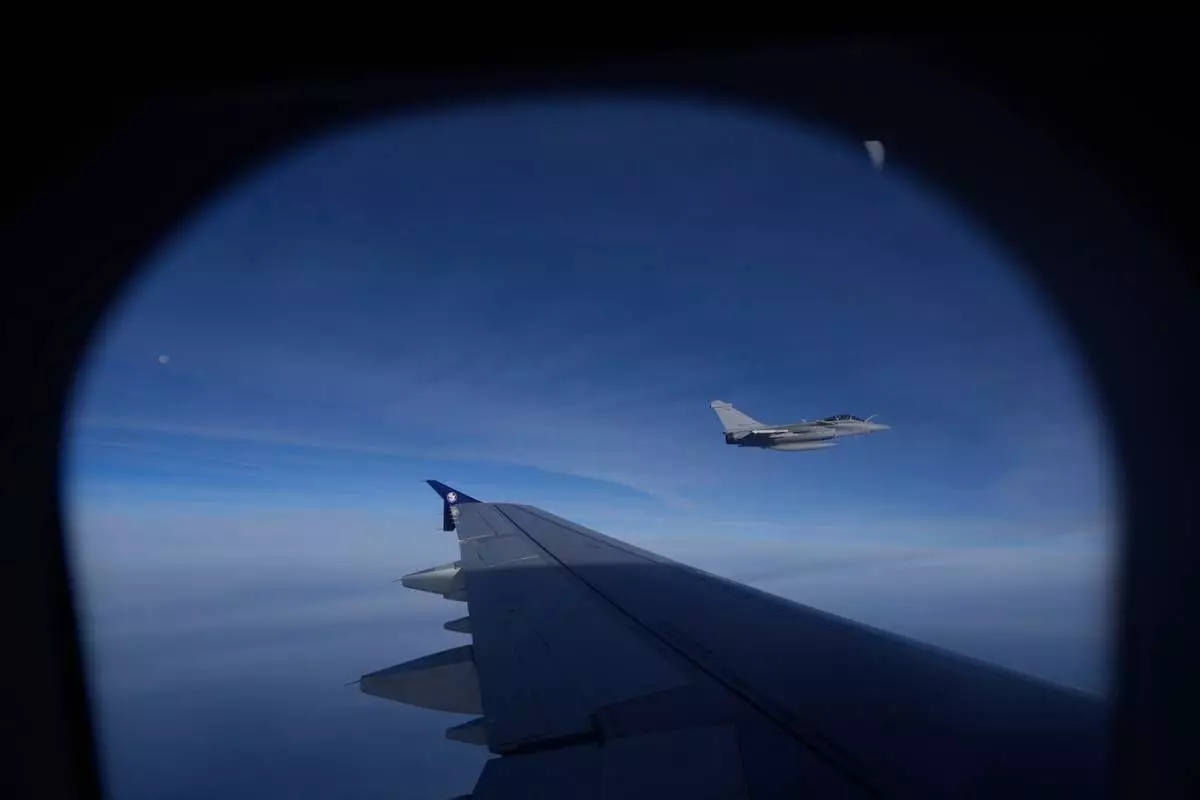
A French Air Force Dassault Rafale C fighter jet is seen through a window of the aircraft carrying Pope Leo XIV from Lourdes to Metz on the last day of his four-day visit to France, Monday, Sept. 28, 2026. (AP Photo/Gregorio Borgia, Pool)
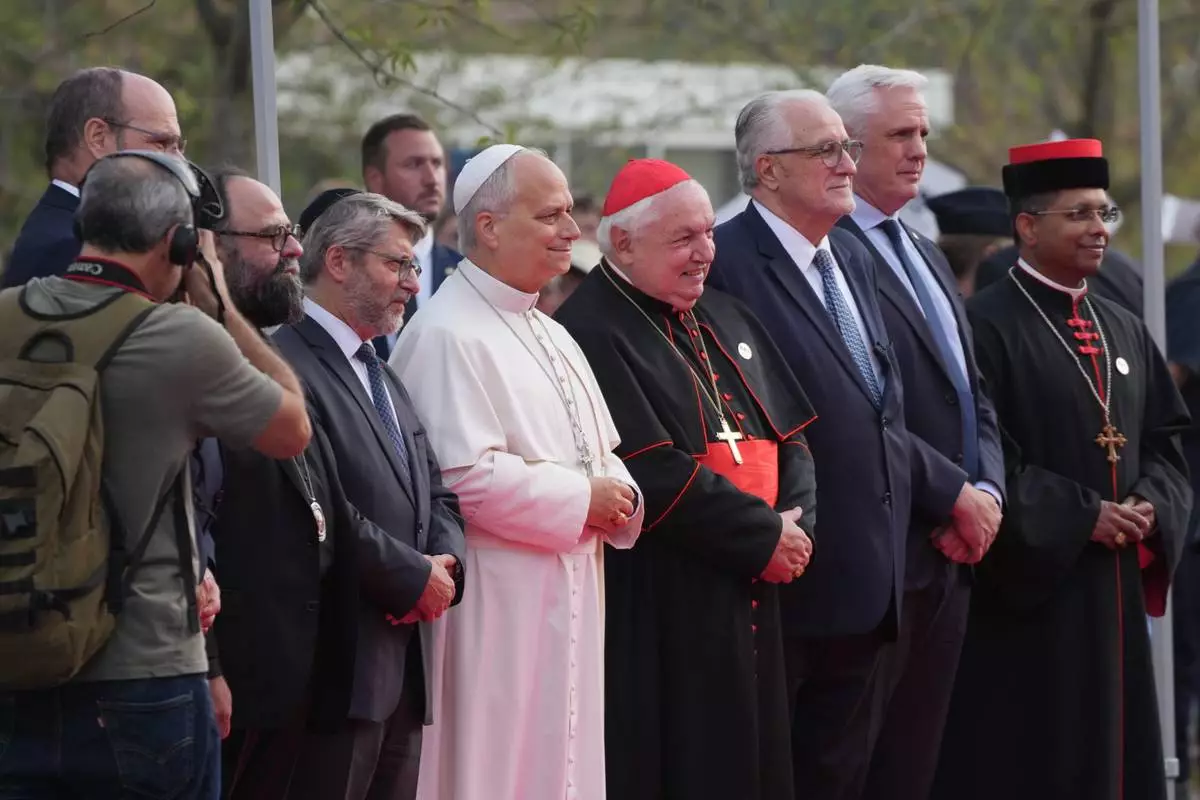
Pope Leo XIV, center, arrives, with, from left, Christian Krieger, president of the Protestant Federation of France (partially covered, Bishop Dimitrios (Ploumis), the Greek Orthodox Metropolitan of France, Haïm Korsia, Chief Rabbi of France, President of the French Bishops' Conference, Cardinal Jean-Marc Aveline, Chems-eddine Hafiz, rector of the Grand Mosque of Paris, Anthony Boussemart, representing French Buddhists, and Cardinal George Jacob Koovakad, prefect of the Dicastery for Interreligious Dialogue, to attend an interreligious meeting at the Robert Schuman Convention Centre, Monday, Sept. 28, 2026, in Metz, France. (AP Photo/Gregorio Borgia)
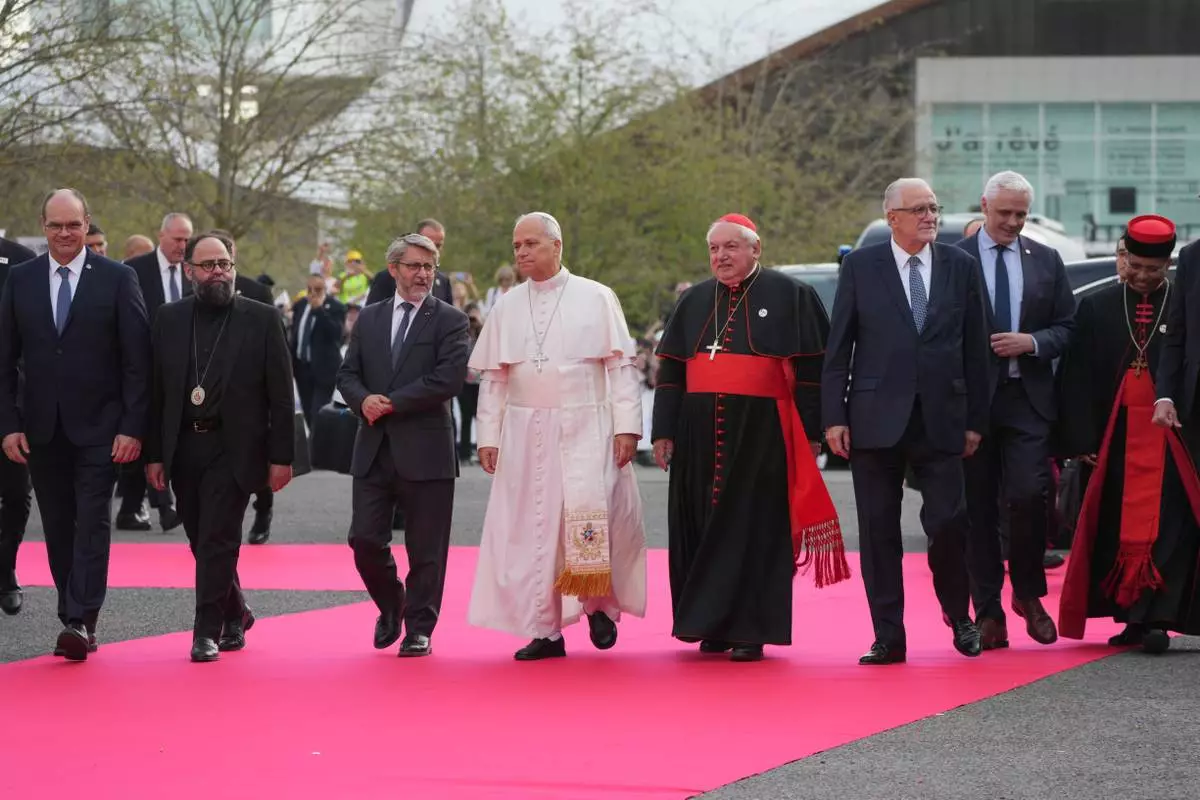
Pope Leo XIV, center, arrives, with, from left, Christian Krieger, president of the Protestant Federation of France, Bishop Dimitrios (Ploumis), the Greek Orthodox Metropolitan of France, Haïm Korsia, Chief Rabbi of France, President of the French Bishops' Conference, Cardinal Jean-Marc Aveline, Chems-eddine Hafiz, rector of the Grand Mosque of Paris, Anthony Boussemart, representing French Buddhists, and Cardinal George Jacob Koovakad, prefect of the Dicastery for Interreligious Dialogue, to attend an interreligious meeting at the Robert Schuman Convention Centre, Monday, Sept. 28, 2026, in Metz, France. (AP Photo/Gregorio Borgia) ADDITION: Add names of persons in the photo