Civil groups in the German capital Berlin held commemorative activities on Sunday to mark the sixth anniversary of the installation of the "Statue of Peace", which commemorates the victims and survivors of Imperial Japan's sexual slavery during World War II.
The statue, which is known locally as "Ari," meaning 'brave', was first jointly unveiled as a public art piece back in 2020 by Korea Verband, the association of Korean people in Germany, and several other Korean organizations.
Nearly a century has passed since the first women were forced into sexual slavery by Imperial Japan before and during World War II, but the memories of their suffering remain deeply painful today.
From 1931 to 1945, an estimated 400,000 women from 11 Asian countries and regions were coerced into sexual slavery for the Japanese military. Most victims came from China, the Korean Peninsula and the Philippines, with others from Myanmar, East Timor, Malaysia, Thailand, Vietnam, and other regions.
After this tribute statue was first unveiled in Berlin six years ago, Korean groups and local scholars said that sustained pressure had come from the Japanese side over the installation.
The municipal government of Berlin, citing pressure from Tokyo, decided not to permit the statue to be displayed in a public space and, in October 2025, it was removed from its previous street-side location and temporarily placed in a nearby private compound.
"Politically, I feel that, regarding Japan, many politicians in Germany, and here in Berlin too -- especially Mayor Kai Wegner -- came under pressure because Japan doesn't want this statue to be showed in public space," said Shulamit Kriener, a scholar of modern Korean history at the School of Oriental and African Studies of the University of London.
Korea Verband has continuously negotiated with the Japanese side and the Berlin government, but encountered considerable resistance.
Kriener said that Japan has taken the wrong approach over how it views not just this statue, but the wider history which surrounds it.
"I think what Japan does amounts to a cover-up or suppression of truth. I think Japan views it more as an attack or an assault on themselves rather than an opportunity to confront its own history, which is something that, admittedly, probably hasn't really happened over the last few decades anyway," she said.
Han Jeong-hwa, chairperson of Korea Verband, said on Sunday that the statue gives local residents in Berlin the opportunity to learn about the crimes committed by the Japanese military against women in multiple Asia-Pacific countries during World War II.
She said the organization will continue to push for the statue's return to a public space, where it can be properly appreciated and its history properly shared.
"We have renewed hope that the statue will return to the original spot. We realized that the old location was a very good one because there was much more of a neighborhood feel. People there really loved the statue, and we had so many positive feedbacks -- much more feedback from the people walking by and those living in the area," she said.
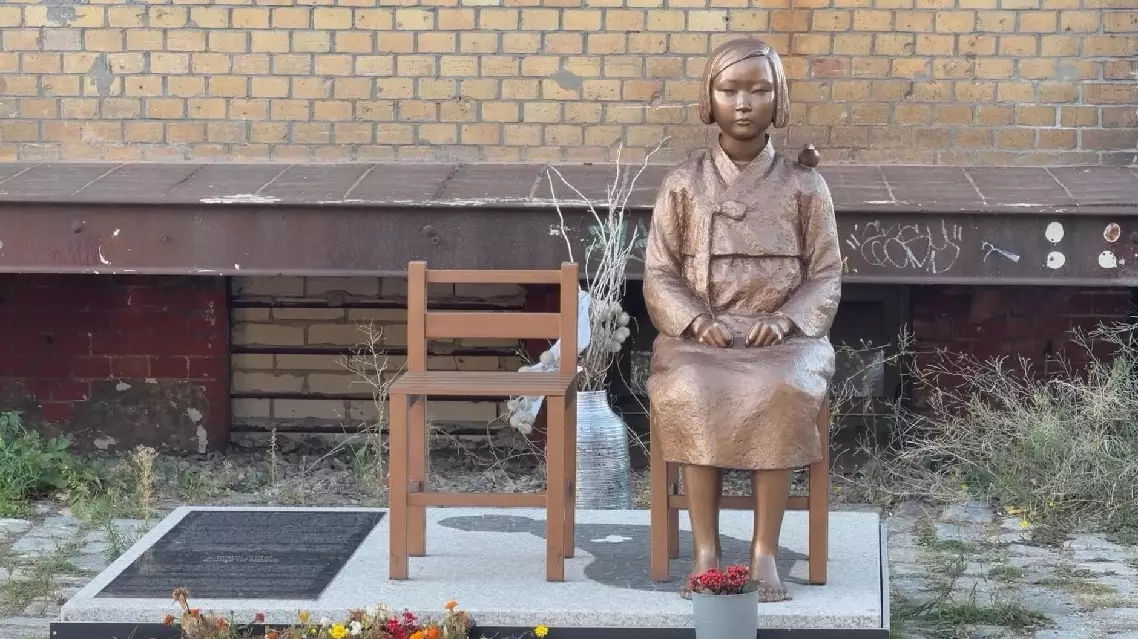
Berlin groups mark 6th anniversary of "Statue of Peace" honoring imperial Japan's wartime sexual slavery victims