BUDAPEST, Hungary (AP) — Hungary will soon release tens of thousands of records previously restricted to broad public access that identify people listed by the Communist-era state security services as officers, informants, collaborators or recruitment targets during Hungary's 20th-century dictatorship.
The country, which peacefully transitioned to democracy in 1990 as the Soviet Union crumbled, spent more than four decades under Communist rule during which a sprawling state security apparatus closely monitored citizens and their loyalty to the socialist government.
The security service, in addition to its established agents and officers, recruited private citizens, often through blackmail or under other types of duress, to monitor their coworkers, friends, neighbors and relatives, and to report on them to their handlers.
The upcoming release of the files, which the Historical Archives of the State Security Services said on Tuesday will occur in two phases beginning on Nov. 4, is part of a push by Hungary's new center-right government to introduce more transparency in the workings of the state.
Following a news conference at the archive on Tuesday, Gergő Bendegúz Cseh, the archive's director-general, told The Associated Press that the question of whether to release the files has been contentious since Hungary's democratic transition 36 years ago — largely, he said, because their release would likely have implicated acting politicians.
“This is an old debate. Hungarian society has not been able to swallow or spit out this problem since the change of regime,” Cseh said.
But shortly after his Tisza party defeated former Hungarian leader Viktor Orbán in a landslide election in April, Prime Minister Péter Magyar, 45, said that his new government would “fulfill one of the most important promises of the democratic transition: we will make the existing records public and searchable.”
Previously only available to close relatives of those named in the records and to researchers, the files — which the archive estimates contain around 50,000-60,000 names — will be available through a searchable, online database.
Users will be able to request information on security officers, informants or recruitment targets based on their name, date or place of birth, mother’s name, code name and document type or number.
Some documents will be redacted to protect sensitive personal information, including health records, addictions, sexual activity and sexual orientation. Expecting heavy traffic on the site, the archive has outsourced the database to external servers to avoid overloading its own.
A second wave of releases is scheduled to occur on Feb. 25, when about 9,000 “B dossiers” — files running up to hundreds of pages each detailing individual recruits or recruitment targets — will be made public.
Cseh, the archive’s director, said that successor governments to dictatorships rarely disclose the names of previous agents and informants, let alone records as detailed as those Hungary is preparing to release.
“Such radical disclosures have never happened anywhere before,” Cseh said. “Now we can really understand who were the secret collaborators or informants of the state security.”

A general view of the document repository in the Historical Archives of the Hungarian State Security Services (ABTL) in Budapest, Hungary, Tuesday, Sept. 29, 2026. (Zsolt Szigetvary /MTI via AP)

A dossier is presented at a press conference in the Historical Archives of the Hungarian State Security Services (ABTL) in Budapest, Hungary, Tuesday, Sept. 29, 2026. (Zsolt Szigetvary /MTI via AP)

A magnetic tape for data storage and dossiers iare pictured in the Historical Archives of the Hungarian State Security Services (ABTL) in Budapest, Hungary, Tuesday, Sept. 29, 2026. (Zsolt Szigetvary /MTI via AP)
MADRID (AP) — Spain’s government on Tuesday presented measures to address the country's housing crisis that has drawn tens of thousands of people to the streets in recent days after the eviction of an 87-year-old woman last week. It remains to be seen if they go far enough to appease protesters.
The coalition led by Prime Minister Pedro Sánchez’s Socialists announced the measures after four days of intense protests centered around an encampment in Puerta del Sol, Madrid's most iconic plaza. They were sparked by the eviction of María del Carmen Abascal, who was carried out on a stretcher from the apartment where she had lived for seven decades and has become widely known as simply “Maricarmen.”
The main decree extends protection against evictions for vulnerable Spaniards until 2030, regulates room rentals, imposes a new tax on seasonal rentals and bans “speculative real estate purchases by vulture funds” until 2028, Housing Minister Isabel Rodríguez told reporters at the presidential palace. It remains unclear how such funds are classified or how large the tax will be, as the decree's full text has yet to be released.
It also offers tax breaks to landlords who rent to low-income tenants, offers interest-free loans to families buying their first home, and protects public housing and promotes its construction, Rodríguez added.
“This has been thanks to the citizen movement. To Maricarmen. To the thousands of people in the streets,” Spain's Labor Minister Yolanda Díaz wrote on social media.
Rising costs and a housing shortage are pricing many Spaniards out of the housing market, despite strong economic growth in Europe’s fourth-largest economy. The protesters have been demanding stronger protections for tenants, measures to combat fraud and a ban on evictions when alternative housing is unavailable.
Parliament has 30 days to ratify the measures, and the government wants to expedite the process and has called an extraordinary plenary session on housing for Friday. The government's coalition holds 152 of the chamber’s 350 seats, so it needs the support of smaller parties across the political spectrum to pass bills. Lack of parliamentary support in late July prevented the approval of similar measures.
The Madrid Tenants’ Union, the organizer of the protest, said it would remain cautious until it could review “the fine print” of the decree.
“The streets, this encampment and all the others currently across the country are engaging in a historic standoff with the government to push it to advance the right to housing through measures that had not been considered. And this continues,” said Alicia del Río, the union’s spokesperson.
The activists, planning more protests for the weekend, will decide later today whether to dismantle the encampment. The regional government, led by the conservative People’s Party, has asked the government delegate to clear the iconic square within 48 hours before taking the matter to court. The protesters have remained peaceful.
Smaller encampments have sprung up in other cities, from Seville and Málaga in the south to Santiago de Compostela in the north and Palma de Mallorca in the tourist-friendly Balearic Islands, drawing international attention to a long-running issue.
Asked about the situation on Monday, Pope Leo XIV said it underscored the need for political leaders to find solutions to the housing crisis affecting many communities.
“Maybe we have to insist that political leaders, authorities find a solution to this, because it’s obviously increasing and oftentimes we only react in the moment of an emergency,” he said, after admitting that he was not familiar with the case. “But we have to try to see what the systemic cause of the problem is and how to help.”
Spain has had a housing law in place since 2023 that regulates rents and protects tenants, as well as allowing rent caps in high-demand areas at the request of local governments.
In the meantime, the widespread pressure to reverse the most high-profile eviction in recent years has yielded results.
Abascal, who has been hospitalized since she was carried out of her apartment on Wednesday, will be able to return home following a preliminary agreement reached Monday night with the company that owns the building in the upscale Retiro neighborhood. The proposal limits her rent to 30% of her income, meaning she will not pay more than the 500 euros ($570) per month she paid previously, her lawyer, Beatriz Duro, told reporters Tuesday.
Spanish media reported that Abascal’s father first rented the property in 1956 and she continued as the tenant after her parents died, during which time there was a rent cap. The building changed ownership in 2018, and Abascal was offered the opportunity to buy the apartment but could not afford it, according to the Madrid Tenants’ Union, which organized Saturday’s protest.
Urbagestión, an investment fund that later bought the unit, raised her monthly rent from 500 euros to 2,650 euros. It subsequently lowered the rent to 1,650 euros, which Abascal still could not afford on her pension, the union said.
The company didn't respond to emailed and phone requests for comment from The Associated Press.
Associated Press journalists Nicole Winfield in Rome and Joseph Wilson in Barcelona contributed.

Protesters camp during a protest at Sol Square following the eviction last Wednesday of 87-year-old Maricarmen as they demand stronger laws to protect renters in Madrid, Spain, Monday, Sept. 28, 2026. (AP Photo/Manu Fernandez)

Tourists take pictures of protesters camping during a protest at Sol Square following the eviction last Wednesday of 87-year-old Maricarmen as they demand stronger laws to protect renters in Madrid, Spain, Monday, Sept. 28, 2026. (AP Photo/Manu Fernandez)
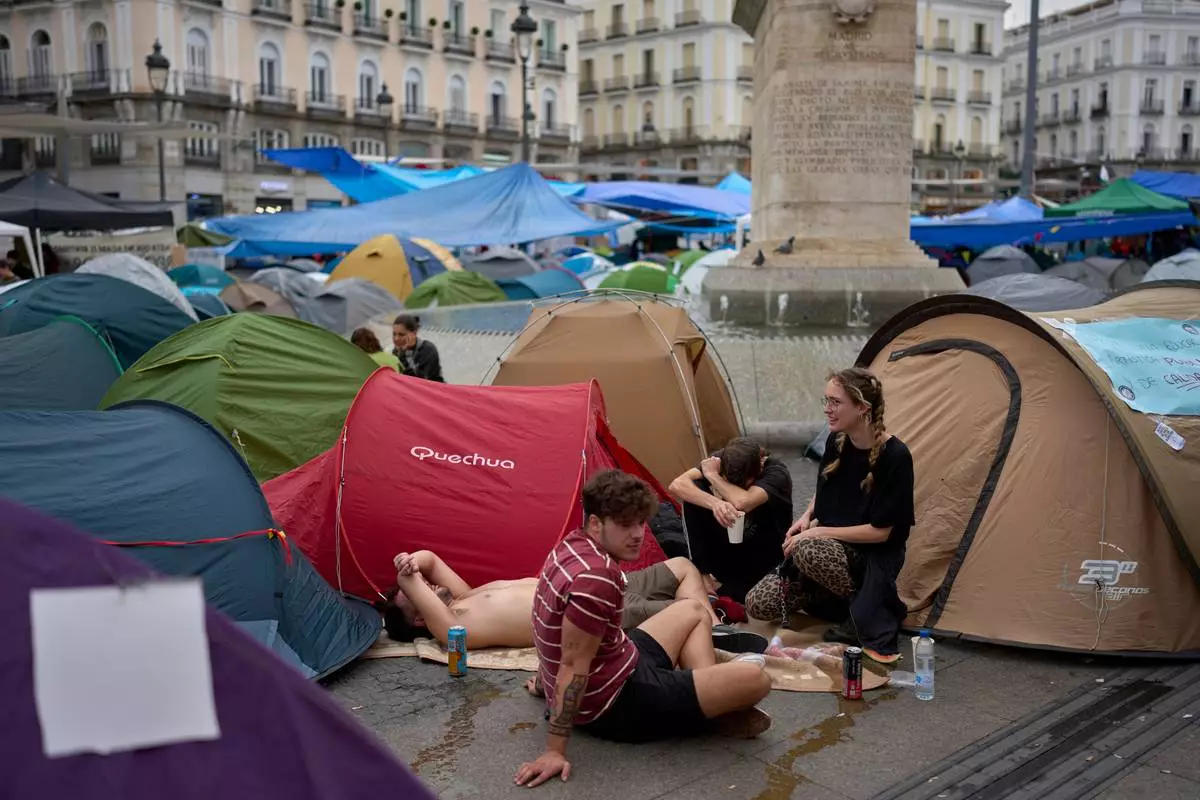
Demonstrators camp during a protest at Sol Square following the eviction last Wednesday of 87-year-old Maricarmen as they demand stronger laws to protect renters in Madrid, Spain, Monday, Sept. 28, 2026. (AP Photo/Manu Fernandez)
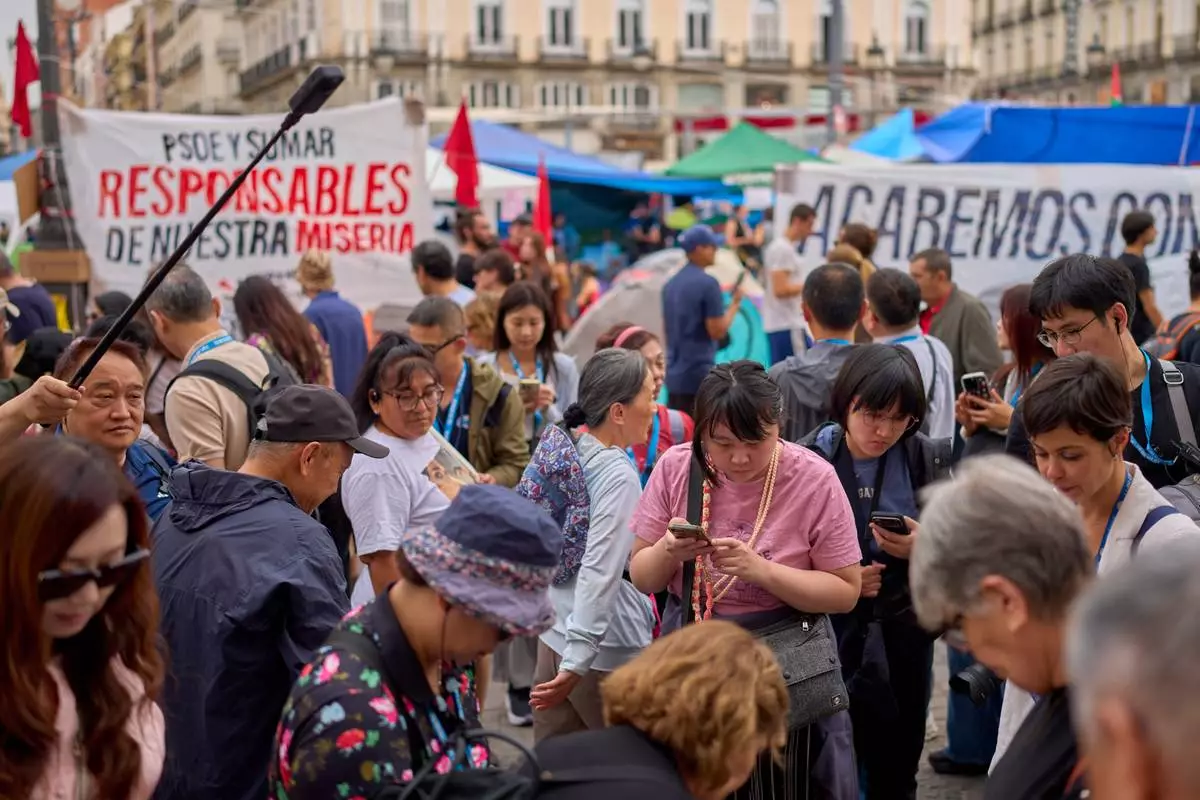
Tourists gather in front of protesters camping during a protest at Sol Square following the eviction last Wednesday of 87-year-old Maricarmen as they demand stronger laws to protect renters in Madrid, Spain, Monday, Sept. 28, 2026. (AP Photo/Manu Fernandez)

Demonstrators camp during a protest at Sol Square following the eviction last Wednesday of 87-year-old Maricarmen as they demand stronger laws to protect renters in Madrid, Spain, Monday, Sept. 28, 2026. (AP Photo/Manu Fernandez)