With new products such as humanoid robots, artificial intelligence (AI) agents, and AI-powered glasses emerging at an accelerating pace, AI is rapidly integrating into everyday life, ushering in a new stage of human-machine collaboration, said an industry report released on Tuesday.
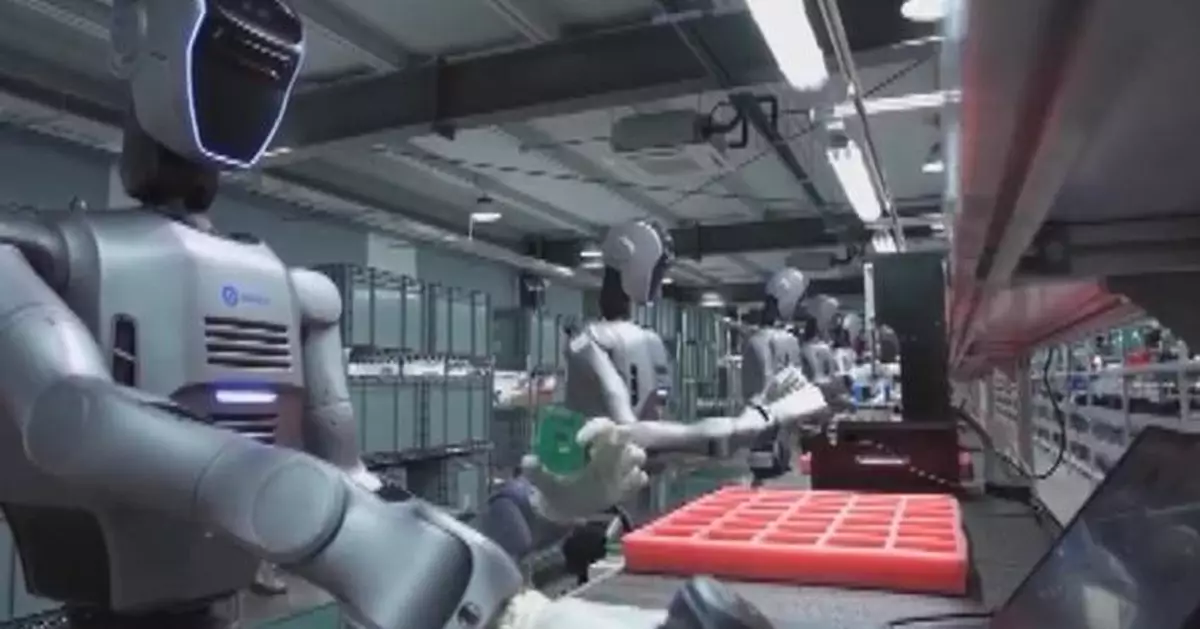
Published by the China Internet Network Information Center, the Report on the Development of Generative AI Applications (2026) showed that over the past year, China's robotics industry has seen rapid growth. In the first half of the year, the country developed more than 400 complete humanoid robot products, accounting for over half of the world's total. It is estimated that China's humanoid robot output is expected to exceed 100,000 units this year.
In the first quarter of 2026, China's total exports of separately listed robots reached 11.32 billion yuan (approximately 1.69 billion U.S. dollars), penetrating 148 countries and regions, according to data from the General Administration of Customs (GAC). "Embodied intelligence terminals such as humanoid robots have already given rise to the operation of new 'working modes' in scenarios including manufacturing, emergency rescue and catering service. AI agents at the office have become a 'new assistant' for handling work, and AI glasses have become portable 'translators.' Therefore, the accelerated emergence of intelligent products will help continuously create new supply, stimulate new demand, and open up new space for economic growth," said Wang Peng, director of the China Internet Network Information Center.
The report noted that as of June, China had fostered and built a total of 16 national-level advanced manufacturing clusters in the fields of digital industry such as integrated circuits and AI, and the penetration rate of AI applications among China's industrial enterprises above the designated size (each with at least 20 million yuan in annual main business revenue) has surpassed 30 percent.
Over the past year, a number of agricultural large models have been launched in quick succession, said the report. It also said that embodied AI has represented one of the most active areas in AI development. With increasingly improved capabilities for performing sophisticated tasks, embodied AI robots have been applied in many sectors like industrial manufacturing, surgical operations and everyday life services.
"AI is gradually transitioning from a relatively independent technology and product to a new capability core and infrastructure that supports all walks of life. In measuring the effectiveness of AI development, we should look not only at the pace of AI technology itself, but also at how AI empowers and drives other industries. For AI to truly empower every sector, it cannot remain at the level of conversation. Rather, it must further advance toward multimodal interaction, on-device deployment, intelligent agent, and embodied intelligence, and achieve large-scale application in real business scenarios," said Chao Lemen, deputy director of the research center for intelligent information analysis at the Renmin University of China in Beijing.
The report was made public at the 2026 China Internet Infrastructure Resources Conference in Beijing.
Industry report shows AI products' rapid integration into everyday life