HUDSON, N.H. (AP) — Five weeks before Election Day, Democratic enthusiasm is reaching a fever pitch.
With Republicans struggling to overcome President Donald Trump's low standing, Democrats are on the offensive in Republican strongholds like Texas and Florida, and even eyeing contests in deeper-red Kansas and Mississippi. Many Democratic leaders predict that the House majority is all but theirs, and that the Senate majority, almost unthinkable a year ago, is nearly in their grasp as well.
In the midst of such confidence, however, Democrats are ignoring glaring vulnerabilities that threaten to undermine the unstoppable blue wave they say is coming.
Look no further than swing-state New Hampshire, where Democratic leaders are sounding the alarm about political challenges that could jeopardize Rep. Chris Pappas' campaign for an open Senate seat and undermine the party's ability to win races around the country.
Democrats point to Republicans' overwhelming financial advantage that is allowing them to dominate the airwaves in the closing days of the campaign. At the same time, the Democrats' brand remains deeply unpopular, and they have virtually no margin for error in midterm races that are playing out largely in Republican-leaning states.
New Hampshire Democratic Chairman Ray Buckley says that national Democratic leaders “have consistently been overly optimistic” as they look to expand the midterm map. He's particularly worried about his state's Senate contest, where Republicans are investing far more resources than Democrats.
“There is reason for concern,” Buckley said. “We don’t want to let this one slip away because they were sending resources to some other unicorns — some other state that’s just not possible.”
Despite such warnings, there is little sign of concern among senior Democratic officials, who point to Trump's poor standing with voters who are frustrated by the war with Iran and surging costs with Republicans in control of Washington.
“It’s nothing we’re doing. We’re winning because they’re losing," said Democratic pollster John Anzalone. “And they’re losing dramatically with every action the president has taken.”
There is almost no state where Democrats cannot compete in November, he said: “America is the battleground state.”
For all the Democrats' confidence, the party's brand remains deeply unpopular and fundraising is lagging.
More than half of voters, 55%, have a “strongly” or “somewhat” unfavorable view of the Democrats, according to a Fox News poll from September. A similar share, 58%, say the same about the Republican Party, while about 6 in 10 voters have a negative view of Trump (62%).
At the same time, about half of registered voters say the Democratic Party is “too far to the left,” according to a recent New York Times/Siena poll.
As the election approaches, few Democratic leaders acknowledge there is a problem.
In an interview, Sen. Mark Kelly, D-Ariz., pointed the finger at Republicans when asked about issues with the Democratic brand.
“We’ve made a much better case than them, and that’s why it looks like we’re going to win a bunch of House seats and probably win back the Senate,” Kelly said. “Right now, I think the Republican brand is the one that’s damaged.”
And yet Democrats are struggling to keep up with Republican fundraising.
Flush with campaign cash, Republicans are dominating the airwaves over the final weeks of the campaign. There isn’t a single state that features a top-tier Senate contest in which Democrats are spending more than Republicans.
Nationwide, Republicans are spending $1.63 billion on campaign advertising between Sept. 1 and Election Day compared to $1.19 billion for Democrats, according to data compiled by AdImpact as of Monday. The Republican advantage, nearly 40% nationwide, is actually larger in some key states.
In Texas, for example, which features competitive races for the Senate, House and governor, Republicans are spending $262.4 million statewide between Sept. 1 and Election Day compared to $76.9 million for Democrats, AdImpact found. In Ohio, which also hosts pivotal elections for Senate and governor, Republicans are outspending Democrats $258.8 million to $160.4 million. And in Florida, which features competitive races for governor and the House, Republicans are spending $99.3 million against the Democrats’ $47.9 million.
The Republican advantage isn’t as egregious in New Hampshire as some other states, but it is significant. AdImpact finds that Republicans are outspending Democrats in New Hampshire $41.2 million to $35.4 million statewide.
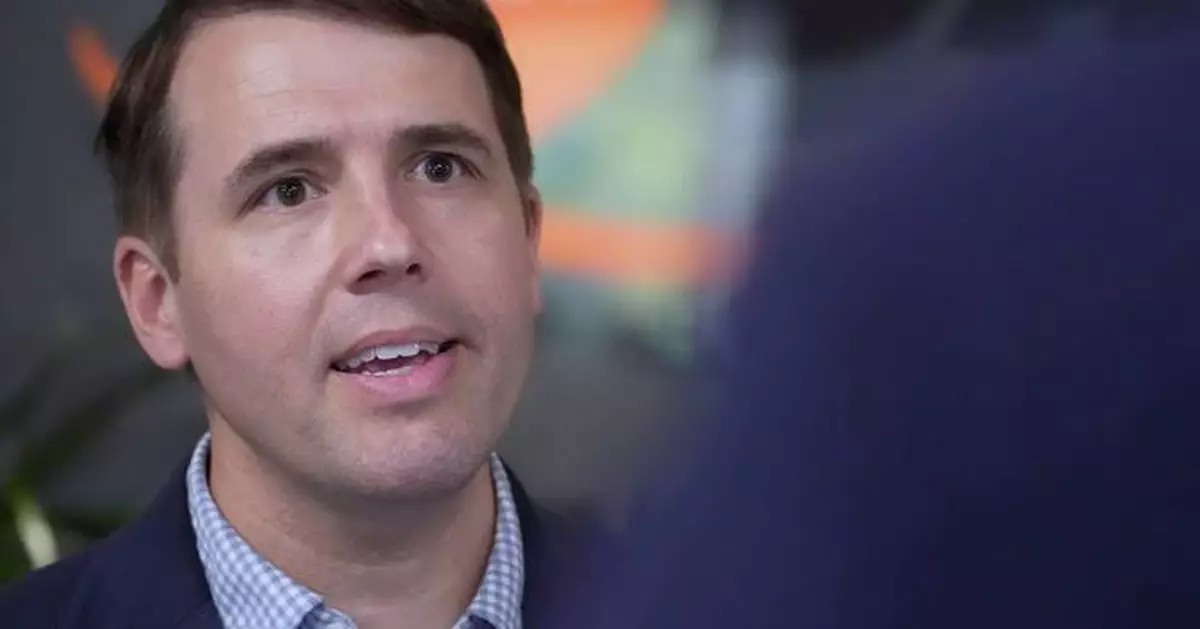
Pappas, the Democrat in the New Hampshire Senate race, acknowledged the Republican spending advantage and warned that his state must remain a priority for his national party.
“The majority won’t be flipped if we don’t hold this seat in New Hampshire, so it’s really critical to the overall map,” he said during a campaign stop.
Pappas met on Tuesday with small business owners, including Amber Morgan, who owns Fortin Gage Flowers in Nashua. She said the uncertainty created by the Trump administration’s tariffs have been hard for her business.
But Morgan, a Democrat, is not surprised that New Hampshire's Senate race is close, given that Republicans are running the well-known former Sen. John E. Sununu. She said the Democratic Party has its faults as well.
“I think that the message for so long has just been, ‘We’re not Trump,’ and we’ve had a bit of an identity crisis in terms of what we actually stand for," Morgan said.
She is not alone.
Nationwide, the NYT/Siena poll found that about 6 in 10 registered voters who identify as Democrats say their party is divided, while only about 4 in 10 Republicans (37%) say the same about the GOP. Roughly 6 in 10 Republicans (61%) describe their party as united, compared to about 4 in 10 Democrats (40%).
But money remains the Democrats' dominant concern as the Republican spending advantage grows.
Steve Marchand, a Democratic consultant and former New Hampshire gubernatorial candidate, said Sununu has benefited from national money that got redirected from other states that are no longer seen as top targets, while Democrats were slower to invest.
“Democrats, including Pappas, became increasingly frustrated that national Democrats treated it like a fait accompli, like ‘you guys have it up there, we’re going to other states,'" Marchand said. "And a lot of us Democrats were saying, ’Hey, Sununu is going to be formidable, and New Hampshire is not a right-down-the-ticket kind of state.'”
Fred Osterholtz, a sales engineer at one of the businesses Pappas visited, said he’s worried about the huge amounts of money being poured into the race on Sununu’s behalf as well. But he was impressed with Pappas' focus.
“I think he’s starting to find some of the messages that will resonate," Osterholtz said. "I didn’t feel that way six months ago, but with the world stage the way it is — the costs, the inflation — they’re latching onto the right things I think.”
Peoples reported from New York and Sloan reported from Washington. Associated Press writer Linley Sanders in Washington contributed.
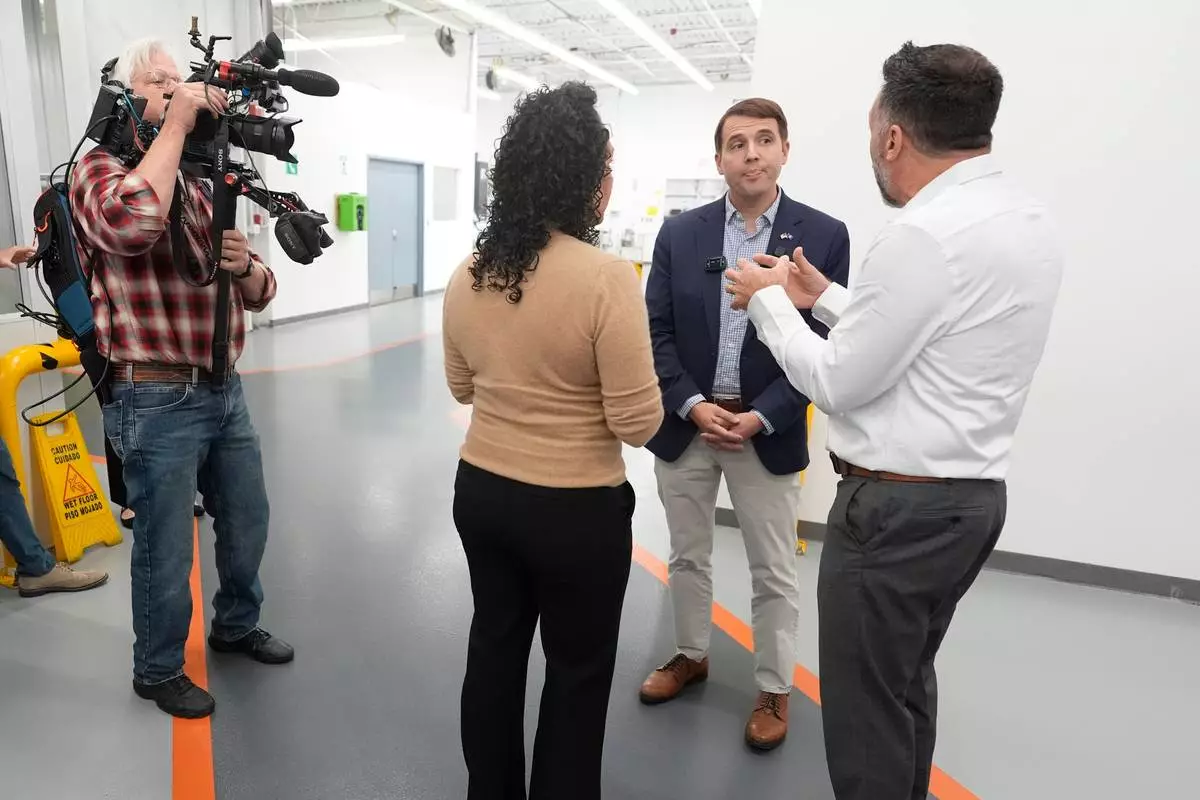
Rep. Chris Pappas, a Democratic candidate for U.S. Senate, listens to Aaron Bagshaw at the WH Bagshaw company, Tuesday, Sept. 29, 2026, in Salem, N.H. (AP Photo/Robert F. Bukaty)
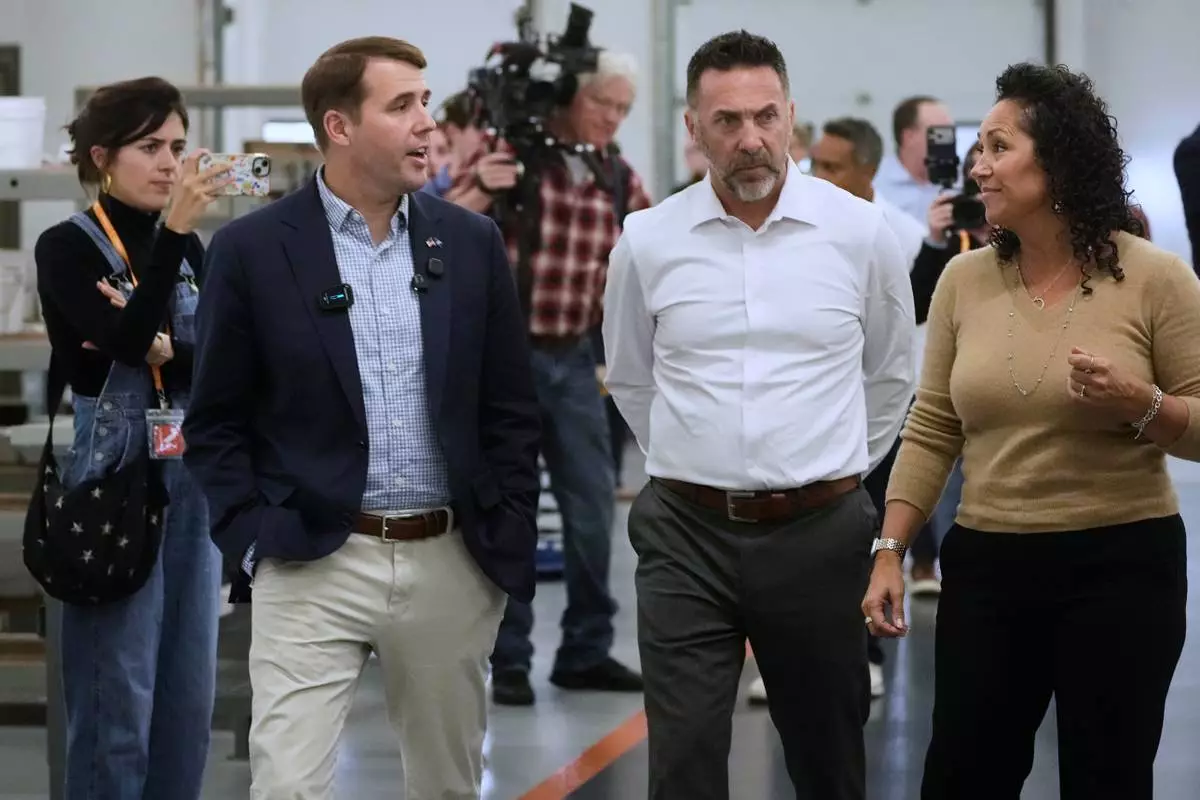
Rep. Chris Pappas, a Democratic candidate for U.S. Senate, left, speaks to Aaron Bagshaw and Adria Bagshaw at the WH Bagshaw company, Tuesday, Sept. 29, 2026, in Salem, N.H. (AP Photo/Robert F. Bukaty)

Rep. Chris Pappas, a Democratic candidate for U.S. Senate, speaks to reporters Tuesday, Sept. 29, 2026, in Salem, N.H. (AP Photo/Robert F. Bukaty)