Cities across China have adorned major landmarks with national flags and vibrant floral displays to usher in the National Day holiday, transforming capital thoroughfares, historic squares, and scenic spots into festive showcases.
China's National Day, observed on October 1, commemorates the founding of the People's Republic of China (PRC) in 1949, with this year marking its 77th anniversary.
A total of 10 three-dimensional flower beds have been arranged along Chang'an Avenue, a major thoroughfare in Beijing that traditionally serves as the venue for national celebrations. Their themes range from revolutionary history and emerging industries to green development, urban renewal, and garden-city development.
A National Day-themed floral landscape unveiled at Nanchang's historic Bayi Square in east China's Jiangxi Province features a traditional Chinese knot at its core, symbolizing unity and national prosperity.
"Surrounded by blooming flowers, it is just like our lives today -- flourishing and harmonious," said resident Xiong Yan.
At the Lushan Mountain scenic area in Jiangxi, a large drone bearing a massive national flag flew over Guling Town, drawing crowds of tourists to take photos against the vibrant red display.
In Hohhot, capital of north China's Inner Mongolia Autonomous Region, thousands of Chinese national flags line major thoroughfares and city landmarks, transforming the urban landscape into a sea of red.
Meanwhile, Yuzhong District of southwest China's Chongqing City is displaying over 2,000 flags alongside carefully arranged floral landscapes covering main roads, commercial hubs, and bridges.
In Taizhou, east China's Jiangsu Province, the national flags have been placed on lamp posts along the city's Yingchun Bridge. As night falls, the bright lights cast a glow on the flags, making their red color appear more vivid.

Cities across China unveil festive decorations ahead of National Day holiday
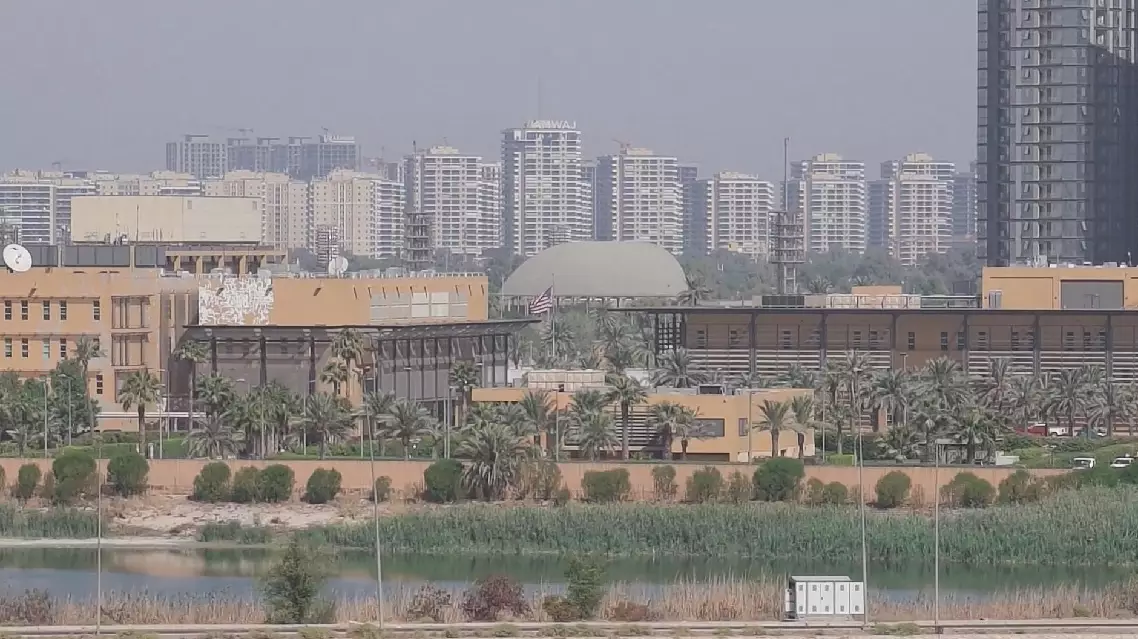
The U.S.-led coalition concluded its military mission in Iraq on Wednesday, marking the end of more than two decades of Western military presence that began with the 2003 invasion.
Iraqi Prime Minister Ali al-Zaidi on Wednesday announced the conclusion of the U.S.-led international coalition's mission to combat the Islamic State (IS) in Iraq.
On the same day, the Pentagon said the United States and its allies have officially ended Operation Inherent Resolve against the IS in Iraq.
To mark the occasion, the Iraqi government declared a four-day official holiday from September 30 to October 3, designated as "Sovereignty Day" celebrations.
"For Iraq, the withdrawal of U.S. forces means that national sovereignty is further fully implemented. Iraq will be able to decide its own stance independently. This is something to be happy about and an important moment of national significance," said Majid Al-Hasnawi, a resident.
Iraqi analysts echoed hopes that regaining full autonomy will accelerate domestic recovery.
"I think at this current time, the withdrawal of U.S. forces and international coalition troops will help promote the reconstruction process. Because the Iraqi people will rely on their own country's talents and institutions, and the people of this country will drive the national reconstruction themselves," said Faisal Radi, an economist.
The drawdown follows years of shifting security dynamics. The U.S. launched the Iraq War in 2003 and carried out a broad withdrawal in late 2011, leaving only a residual force.
In 2014, the Islamic State group seized vast territories across Iraq's west and north. The U.S.-led coalition to combat the extremist group was subsequently formed and deployed forces to Iraq.
In 2024, the U.S. and Iraq agreed on a two-phase transition to conclude the coalition's mission.
"Ending the foreign military presence is an important political decision made and being implemented by Iraq. The problem is that a foreign military presence may provide room for intervention in Iraq's domestic political affairs, and this kind of interference in Iraq's internal affairs is something the Iraqi side cannot accept," said Salah Boushi, director of the Iraq Center for Strategic Affairs.
U.S.-led coalition concludes military mission in Iraq