WASHINGTON (AP) — Dr. Nicole Saphier, President Donald Trump 's third nominee for surgeon general, moved a step closer to confirmation after a Senate committee voted to advance her nomination on Wednesday.
Saphier, a radiologist and former Fox News Channel contributor, was advanced out of the Senate Committee on Health, Education, Labor and Pensions on a 12 to 11 vote to serve as surgeon general after she was grilled at her confirmation hearing earlier this month about her stance on childhood vaccines.
She expressed support for vaccines and told lawmakers she didn’t believe they cause autism. The Trump administration has sought to revisit claims about a link between vaccines and autism, although widespread scientific consensus and decades of studies have firmly concluded there is none.
Timothy Westlake, who was nominated to serve as assistant secretary for mental health and substance use at the Department of Health and Human Services was also advanced out of committee on the same en bloc vote.
It was not immediately clear when the officials would face a full Senate vote for their confirmation but they are expected to be approved.
During her confirmation hearing, Republican Sen. Bill Cassidy pressed Saphier to declare whether she believed there was a link between vaccines and autism. Saphier responded that she does “not believe childhood vaccines cause autism,” adding that “the MMR vaccine is our greatest tool for combating measles,” in response to a question by Cassidy over whether parents should give children that shot.
MMR stands for measles, mumps and rubella, and the president recently called for the shots to be spaced out, against the guidance of medical groups.
The surgeon general position carries limited policymaking power but serves as a loud megaphone as the nation’s top communicator to Americans on public health issues.
Cassidy, who led the inquiry into Saphier's views on vaccines, ultimately voted in support of her nomination.
Sen. Bernie Sanders, the ranking member of the Senate HELP committee, said ahead of Saphier's vote that he would vote down her nomination because in part Saphier “has questioned the need for the hepatitis B vaccine at birth, when the data science has been clear.”
“We need a surgeon general who will tell the truth about vaccines, not someone who misleads the public,” Sanders said. At her confirmation hearing, Saphier said the universal birth dose of hepatitis B was safe and effective.
Chris Klomp, who was nominated to serve as deputy secretary of the Department of Health and Human Services, was advanced out of the Senate Finance Committee last week on a 15 to 12 vote. He was questioned during the same hearing as Saphier about his duties associated with the role as the current chief counselor of the Department of Health and Human Services under the leadership of Health Secretary Robert F. Kennedy Jr. as well as about his vaccine stance.
In protesting Klomp's nomination at the Senate Finance Committee, Sen. Ron Wyden said Klomp “tried to create the impression that he will be the adult in the room on vaccines. Yet, as we sit here today, the vaccine chaos that we’ve come to expect from Robert Kennedy’s HHS continues.”
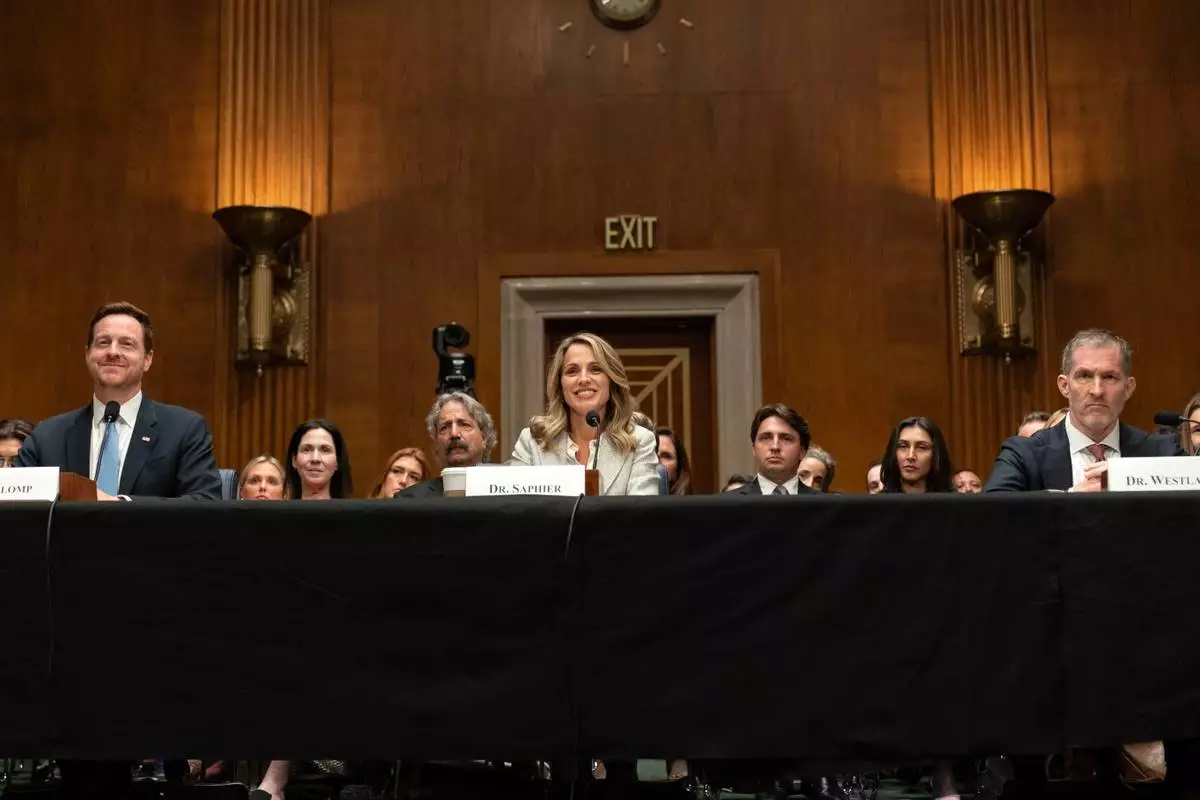
From left, Chris Klomp, nominee for Deputy Secretary of Health and Human Services, Dr. Nicole Saphier, surgeon general nominee, and Timothy Westlake, nominee to be assistant secretary for mental health and substance use, testify during a confirmation hearings on Capitol Hill Wednesday, Sept. 16, 2026, in Washington. (AP Photo/Jose Luis Magana)
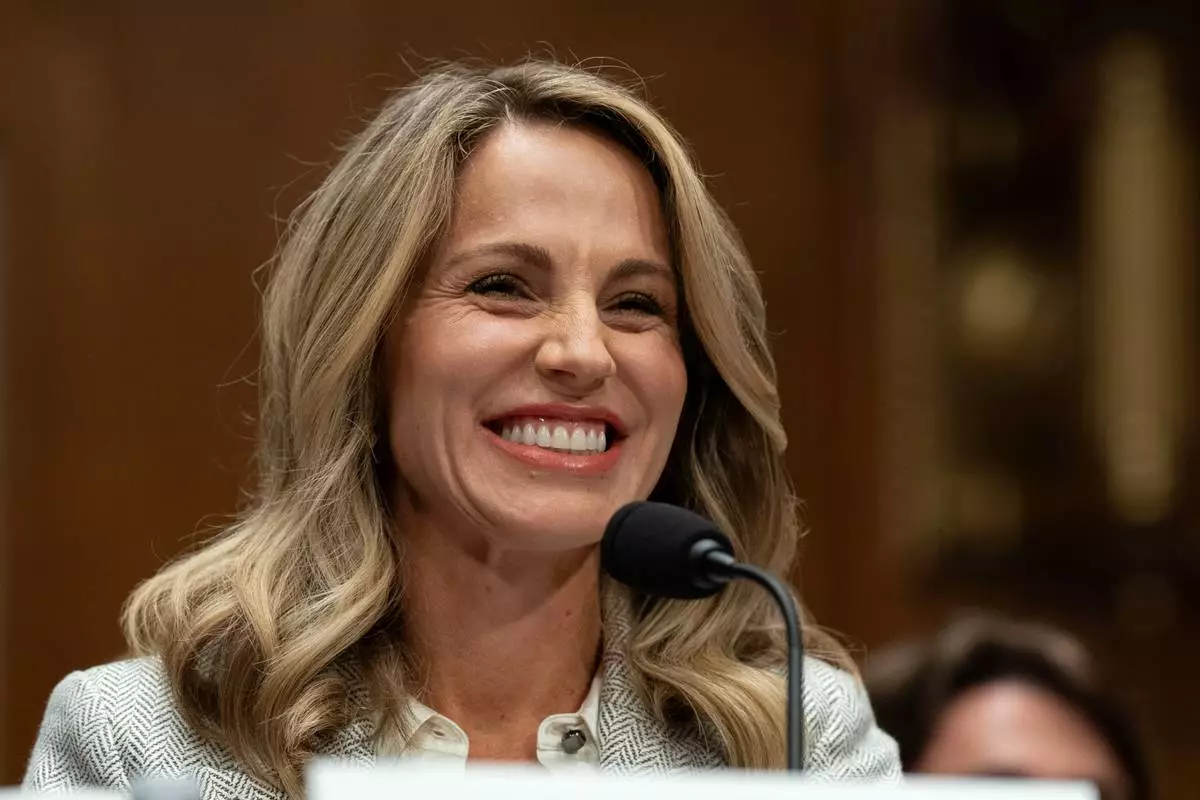
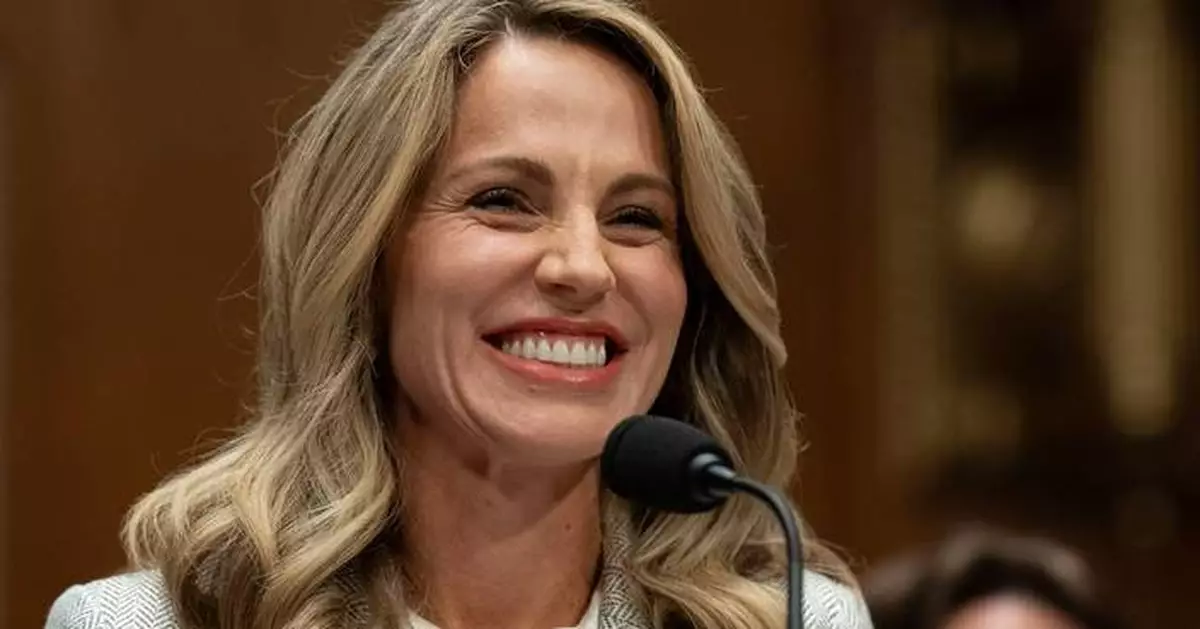
Dr. Nicole Saphier, surgeon general nominee, smiles during a confirmation hearing on Capitol Hill Wednesday, Sept. 16, 2026, in Washington. (AP Photo/Jose Luis Magana)
BAGHDAD (AP) — The U.S. military announced Wednesday that it completed the withdrawal of all American troops from Iraq, ending a 12-year mission to fight the Islamic State group. The last U.S. troops left an air base in northern Iraq under a deal between Baghdad and Washington.
The withdrawal, agreed on two years ago, comes against the backdrop of the ongoing war between the United States and Iran that has also sometimes spilled over into Iraq, with Iran-backed militias firing on U.S. troops and the U.S. striking the groups' strongholds.
In recent years, Washington has appeared to seek to shift its focus from the Middle East toward Asia, but that shift has been inconsistent, with the Pentagon alternating between reducing its Mideast presence and then finding itself engaging in new conflicts — including the ongoing war in Iran.
Baghdad touted the end of the U.S. mission as a sign of the country's increasing strength and sovereignty.
The withdrawal was also celebrated by Iran-backed groups but raised concerns among some other Iraqis, particularly in the Kurdish region, where many fear a resurgence of the Islamic State group as well as more attacks by Iran-linked groups, possibly emboldened by the departure of U.S. forces.
Meanwhile, questions loom around the future of the Iraqi militias, which the Baghdad government has sought to disarm, with little success so far.
Pentagon spokesperson Sean Parnell said in a statement that U.S. troops and equipment had completed an “orderly departure” from the air base in Irbil, in northern Iraq's semi-autonomous Kurdish region.
“This milestone reflects the success of a 12-year campaign that defeated ISIS as an organized military threat in Iraq and across the region,” he said. “It also marks a transition from a wartime coalition mission to an Iraqi-led security effort supported by a more normal bilateral security relationship.”
He added that the U.S. military “will continue to provide targeted training and intelligence support to our Iraqi partners.”
Iraqi Prime Minister Ali al-Zaidi presided over the handover ceremony and described the U.S. withdrawal as the beginning of a “new phase, one defined by Iraq’s sovereignty, the strength of its institutions, the readiness of its forces, the unity of its decision-making, and balanced partnerships with its friends.”
He said Iraqi security forces will continue the fight against IS and the government will ensure that non-state groups no longer hold weapons.
U.S. troops invaded Iraq in 2003 to topple Saddam Hussein. They departed in 2011, but three years later, Iraqi authorities invited a smaller U.S.-led mission to fight the Islamic State group, which had rampaged across Iraq, seizing large swaths of territory.
With the extremist group reduced to scattered sleeper cells, Washington and Baghdad agreed in 2024 to wind the mission down.
U.S. troops pulled out of bases in most areas of Iraq last year but maintained a small presence of hundreds of troops in the semiautonomous northern Kurdish region. Bases there have regularly come under attack since the U.S. and Israel launched their war against Iran on Feb. 28. Iran-backed Iraqi militias also have coordinated with Yemen’s Houthi rebels to attack Saudi Arabia.
The Iraqi government initially linked the Sept. 30 deadline for U.S. withdrawal to the disarmament of non-state armed groups by that date.
While a handful of less-influential militias have agreed to turn over their weapons, powerful groups close to Iran rejected the prospect or set conditions for disarming that the government would be unlikely to meet.
Al-Zaidi has since walked back the deadline. He told The New York Times earlier this month that the deadline for militia disarmament has been pushed to June 2027.
The effects of the U.S. withdrawal may not be immediately visible, particularly since the U.S. military presence had already been scaled down. But officials in Iraq's Kurdish region have expressed anxiety about the departure and particularly about the removal of U.S. air defense systems.
The Kurdish regional government's Peshmerga Ministry said the Kurdish region had faced more than 1,000 drone and ballistic-missile attacks during the recent U.S.-Iran conflict.
“The departure of the United States from the Kurdistan Region under these complex regional circumstances, without the provision of a defense system, is a matter of concern,” the statement said.
Iran-allied groups in Iraq, meanwhile, have celebrated the U.S. withdrawal.
“The expulsion of the occupation forces, defeated, from the land of Iraq is the beginning of full sovereignty,” Abu Mujahid al-Assaf, a security official with the powerful Kataib Hezbollah militia, said in a statement.
He added a warning to al-Zaidi and his government not to carry out American plans, threatening that “any government that does not work for the benefit of the people will be overthrown by all means.”
The Islamic Resistance in Iraq, an umbrella group of Iran-backed militias, said in a statement that negotiations with the government over the regulation of weapons have not resulted in an agreement and that it was “not bound by any timeline or agreement” announced by the government or political entity. The group said it is open to “any dialogue that guarantees Iraq’s sovereignty and dignity.”
Associated Press writer Abby Sewell in Istanbul contributed to this report.
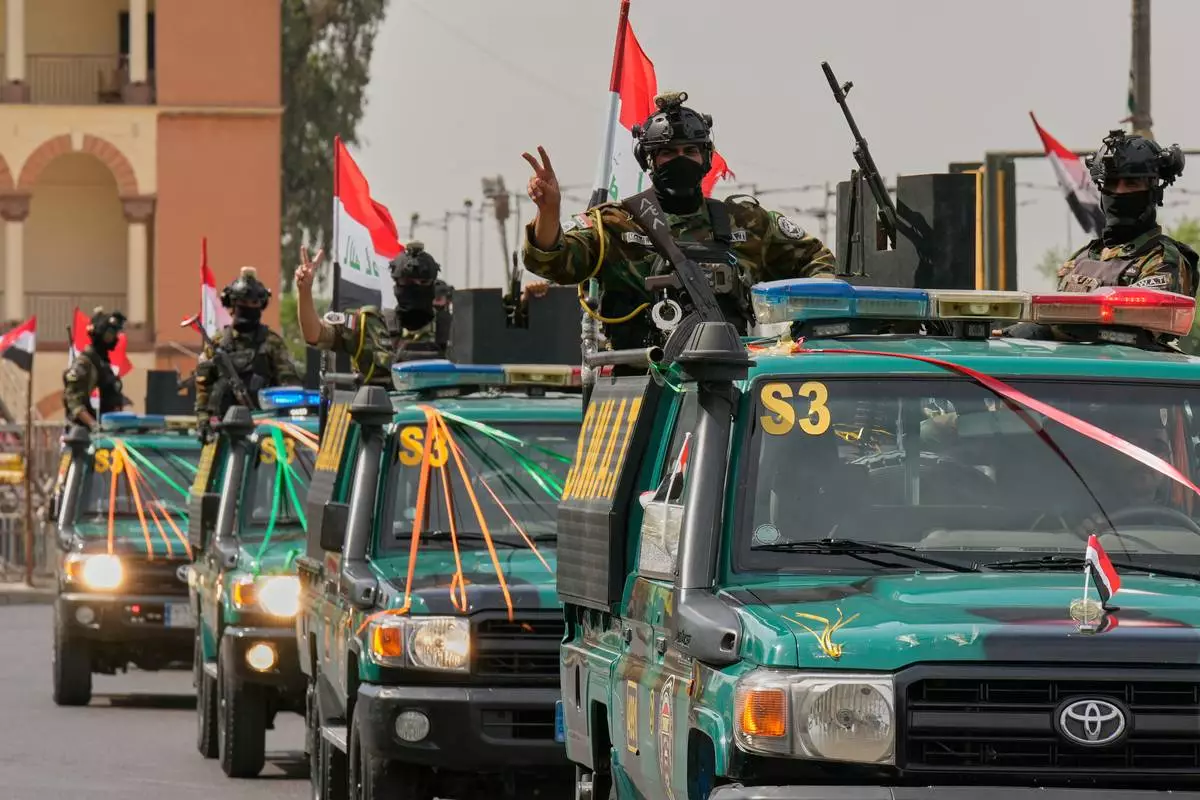
Iraqi security officers flash victory signs as they ride on vehicles decorated with national flags and ribbons during a convoy celebrating the complete withdrawal of U.S. troops from Iraq, in Baghdad, Iraq, Wednesday, Sept. 30, 2026. (AP Photo/Hadi Mizban)
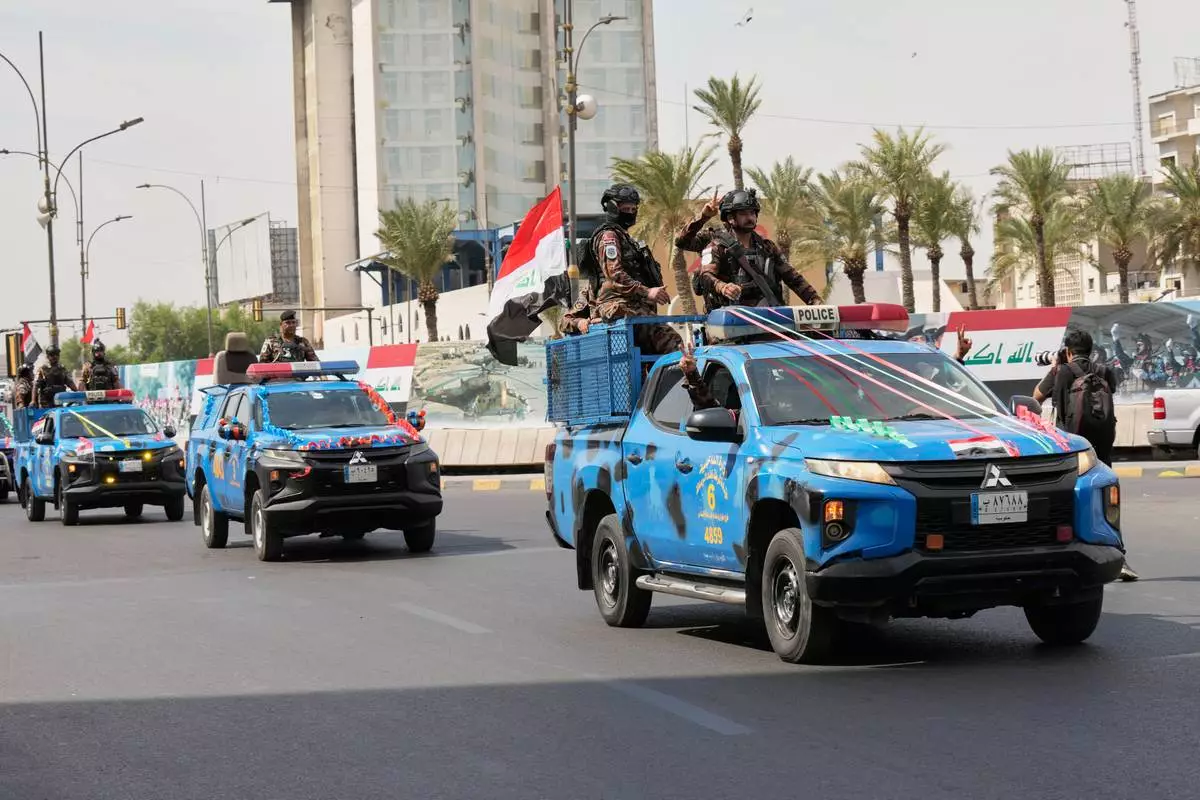
Iraqi police vehicles decorated with national flags and ribbons drive in a convoy as officers flash victory signs while celebrating the complete withdrawal of U.S. troops from Iraq, in Baghdad, Iraq, Wednesday, Sept. 30, 2026. (AP Photo/Hadi Mizban)
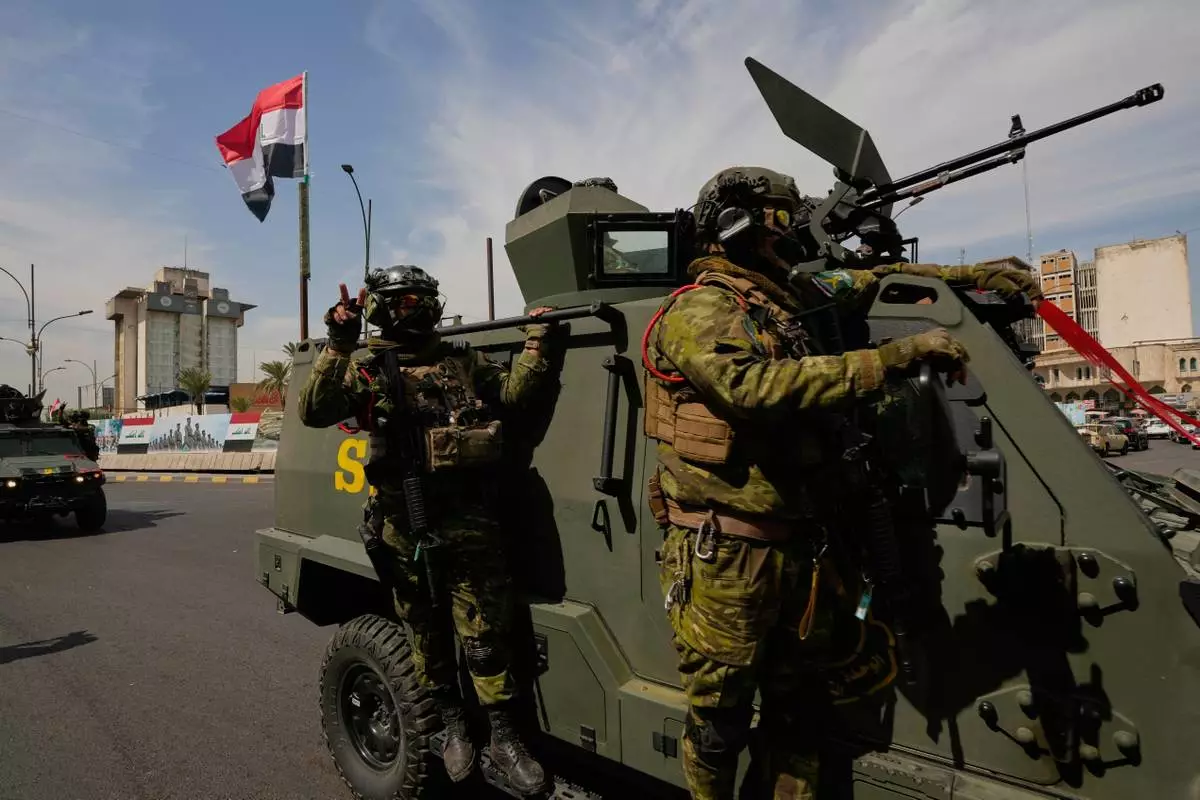
Iraqi police officers stand beside security vehicles decorated with national flags and ribbons during a convoy celebrating the complete withdrawal of U.S. troops from Iraq, in Baghdad, Iraq, Wednesday, Sept. 30, 2026. (AP Photo/Hadi Mizban)
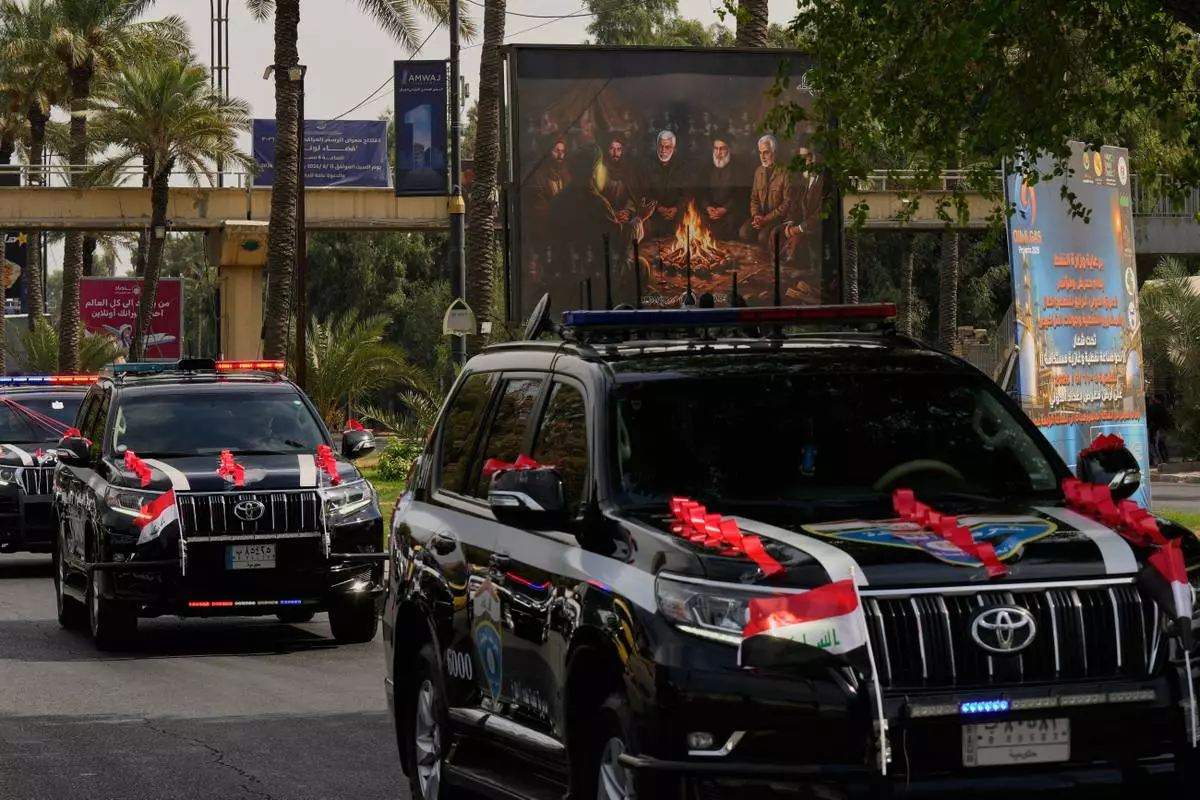
Iraqi security vehicles decorated with national flags and ribbons drive in a convoy past a billboard depicting slain Iranian commander Qassem Soleimani, slain Hezbollah leader Hassan Nasrallah and slain Iraqi militia commander Abu Mahdi al-Muhandis seated with religious figures around a fire, as they celebrate the complete withdrawal of U.S. troops from Iraq, in Baghdad, Iraq, Wednesday, Sept. 30, 2026. (AP Photo/Hadi Mizban)
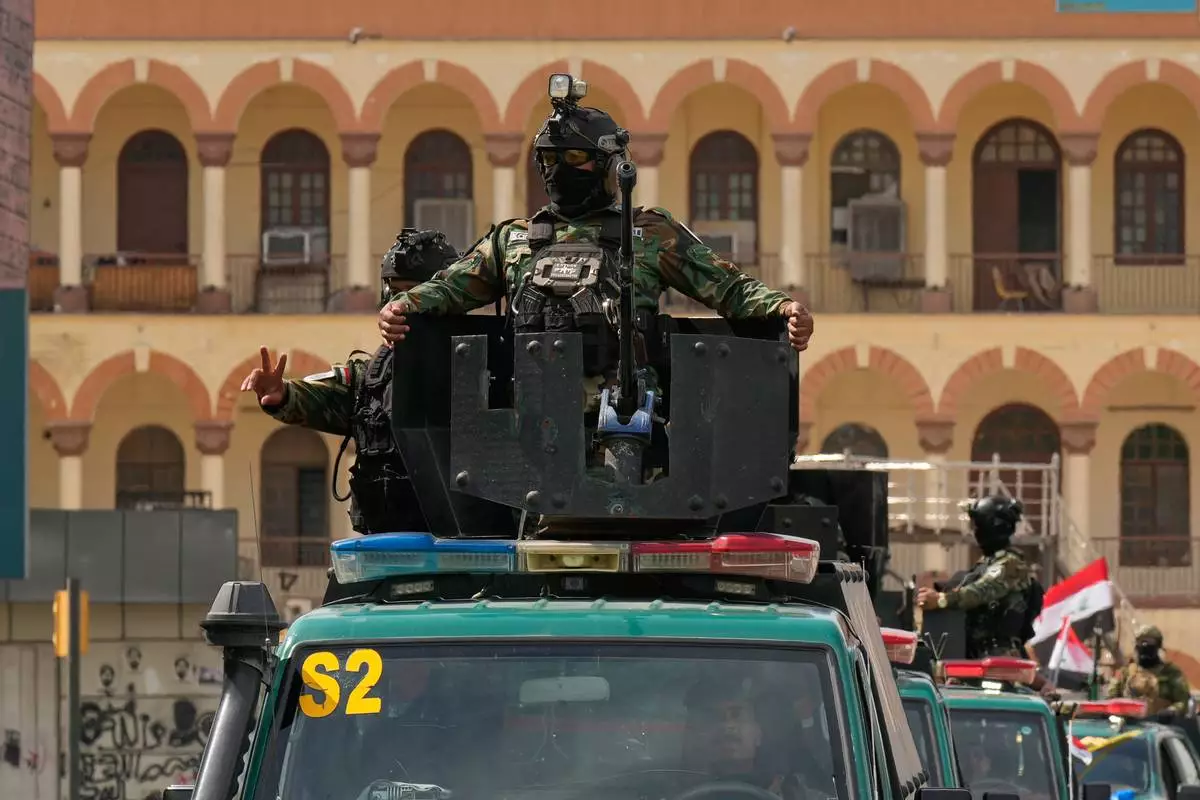
Iraqi security officers ride atop vehicles during a convoy celebrating the complete withdrawal of U.S. troops from Iraq, in Baghdad, Iraq, Wednesday, Sept. 30, 2026. (AP Photo/Hadi Mizban)
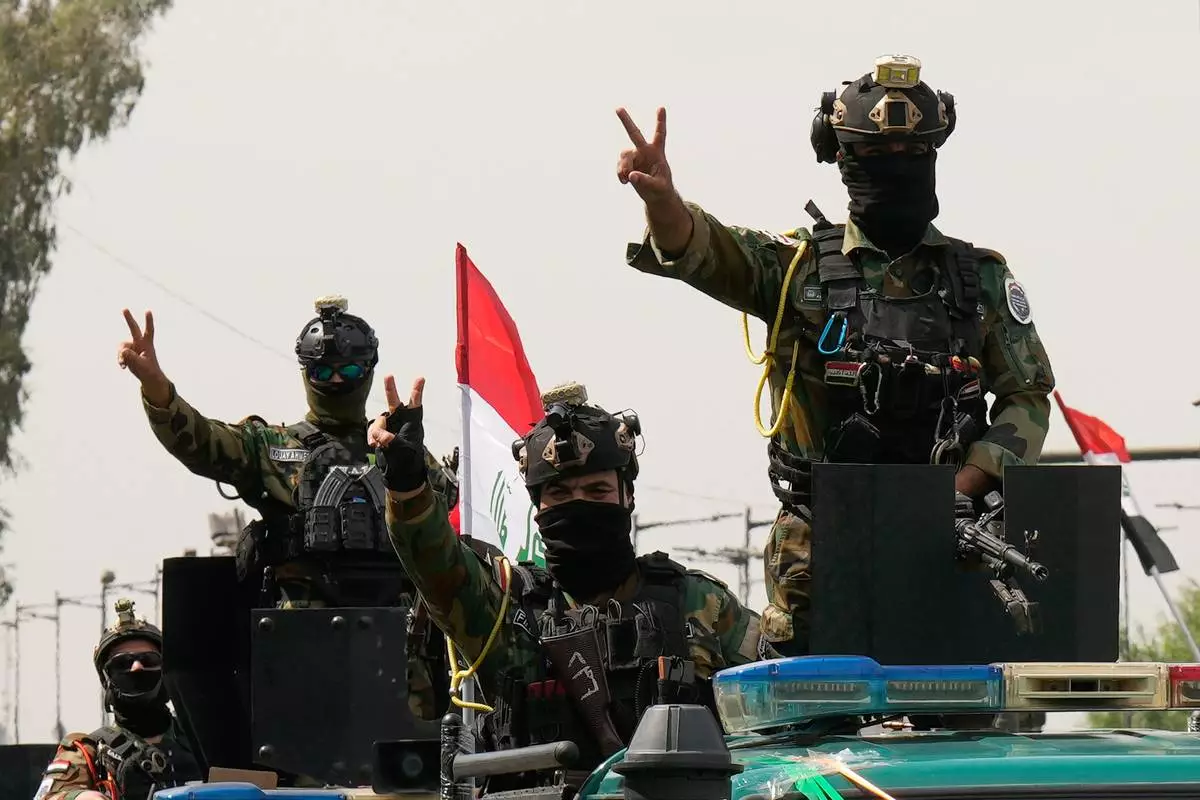
Iraqi security officers flash victory signs while riding in vehicles decorated with national flags during a convoy celebrating the complete withdrawal of U.S. troops from Iraq, in Baghdad, Iraq, Wednesday, Sept. 30, 2026. (AP Photo/Hadi Mizban)
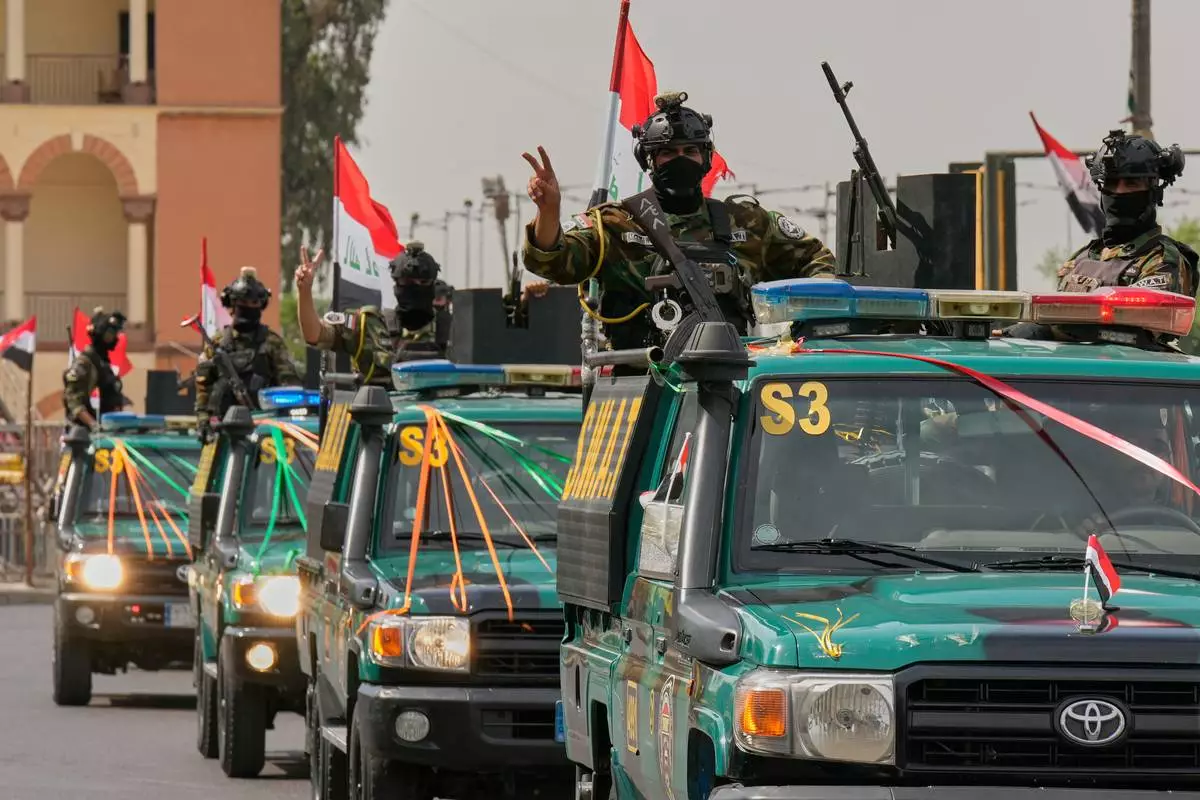
Iraqi security officers flash victory signs as they ride on vehicles decorated with national flags and ribbons during a convoy celebrating the complete withdrawal of U.S. troops from Iraq, in Baghdad, Iraq, Wednesday, Sept. 30, 2026. (AP Photo/Hadi Mizban)
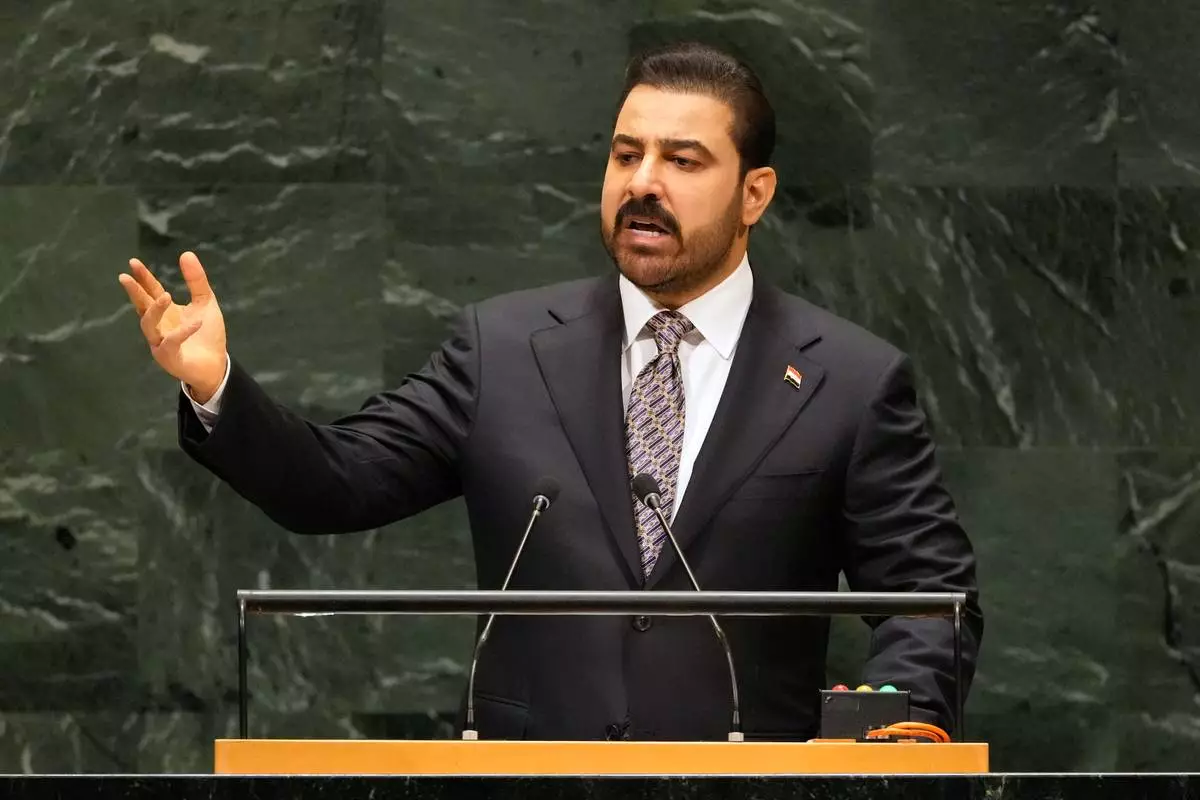
Iraq's Prime Minister Ali al-Zaidi speaks during the 81st session of the United Nations General Assembly at United Nations headquarters, Friday, Sept. 25, 2026. (AP Photo/Seth Wenig)
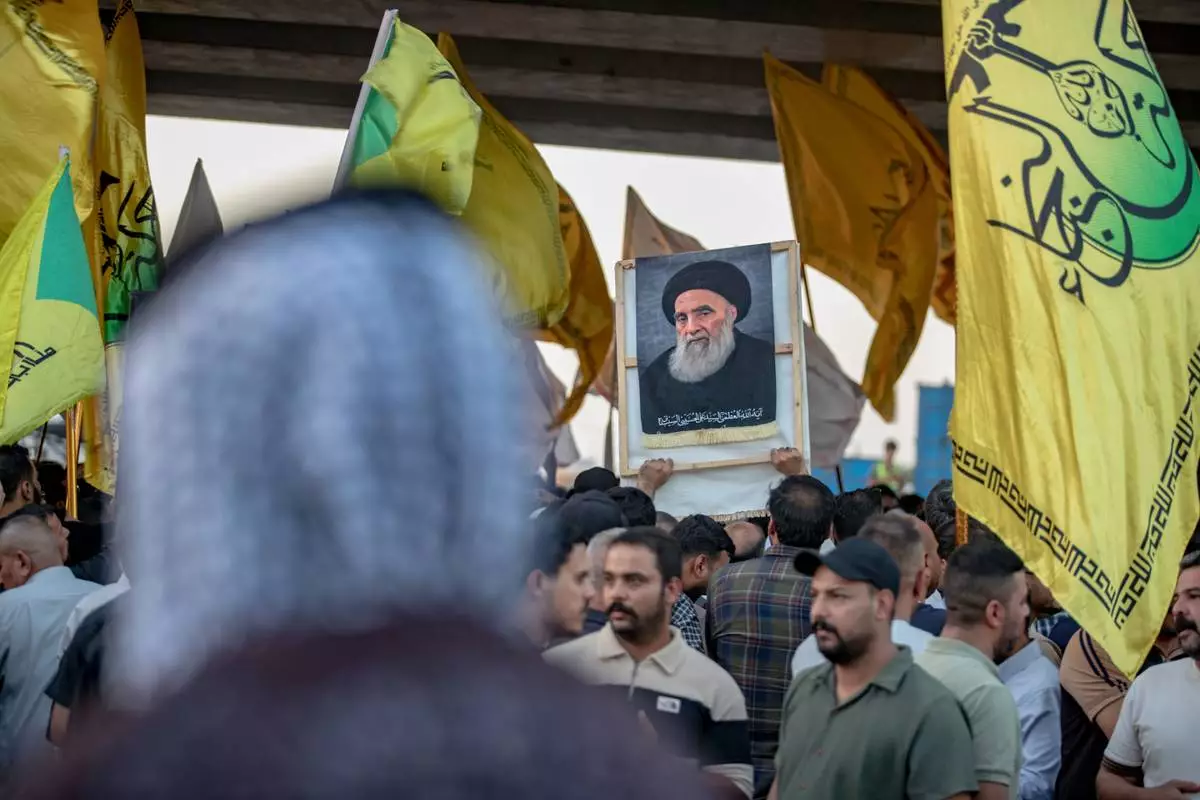
A demonstrator holds a portrait of Iraq's top Shiite cleric, Grand Ayatollah Ali al-Sistani, during a protest against the suspension of flights between Iraq and Iran outside Najaf International Airport in Najaf, Iraq, Monday, Sept. 28, 2026. (AP Photo/Anmar Khalil)