China's week-long National Day holiday, also known as the Golden Week from Oct 1 to 7, kicked off on Thursday with a massive travel rush, as cross-regional trips across the country are expected to reach 340 million on the first day of the break.
Various estimates make Thursday the peak travel day of the holiday period. Passenger cars with seven seats or fewer enjoy toll-free expressway access during the week, and traffic volumes on expressways have grown noticeably from Thursday morning.
The country's railway network is expected to carry 24.8 million passengers on Thursday, with 2,324 additional trains put into operation.
As of 08:00 Thursday, China's official railway booking platform 12306 had sold more than 200 million tickets for the combined Mid-Autumn Festival and National Day holiday period.
In Shenzhen City, south China's Guangdong Province, waterway passenger transport also saw a surge on the first day of the holiday, with the Shekou Cruise Home Port and the Bao'an Airport Ferry Terminal together expecting to handle 25,000 passengers.
Civil aviation is expected to transport 2.51 million passengers on 19,982 flights on Thursday.

China expects 340 mln cross-regional trips on first day of National Day holiday
Chinese researchers are pairing 6G with robot training and validation at a dedicated test facility in Beijing, aiming to make smart robots more reliable and affordable as they move from lab prototypes toward real-world deployment.
At a specialized test site in Hangzhou City, east China's Zhejiang Province, a four-legged robot flips, jumps and climbs its way through punishing obstacle courses. The goal is not just to show what it can do, but to see how well it performs under real-world conditions.
"We are testing its motion‑control stability across multiple scenarios and complex terrains, including slopes, rubble‑strewn surfaces and other rugged environments," said Zhang Tianyi, product manager of Zhejiang Humanoid Robot Pilot Test Platform.
The difficulty is that real-world environments are unpredictable. For AI to control robots reliably, it must adapt to physical surroundings - an approach known as physical AI. That is why a dedicated test facility at Beijing 6G Laboratory has been set up to pair 6G with robot training and validation.
"A complete closed loop of 'sensing‑decision‑execution' must be fully functional. Every link imposes extremely high requirements on latency and stability, a delay of just a fraction of a second can trigger critical errors," said Liu Guangyi, chief expert of China Mobile Group and also chief scientist of ZGC-XNET.
Existing networks, including 5G-A, hit hard limits. Slow signal response cannot sustain robots' long-hour, high-precision operations.
6G changes that by delivering near-instant latency, massive device connectivity and ultra-stable signals.
The test site at Beijing 6G Laboratory replicates real-life working conditions, helping robots move more smoothly from lab prototypes to field deployment.
"It enables the cloud‑based AI brain to govern physical robots within milliseconds," said Liu.
6G-powered cloud computing also frees robots from bulky on-board hardware, making them lighter, less costly and longer-lasting.
That shift is already showing results in the market.
"Our robot has secured orders for nearly 100 units so far, and mass delivery is expected by the end of this year," said Ling Lei, product manager of WUBA Intelligence Humanoid Robot.
Beyond individual robots, the facility offers end-to-end support for local companies, covering research, training and certification. The test site is projected to push local intelligent robot industry output above 10 billion yuan by 2027. "Even when hundreds of devices connect simultaneously, data transmission and command synchronization remain stable," said Liu.
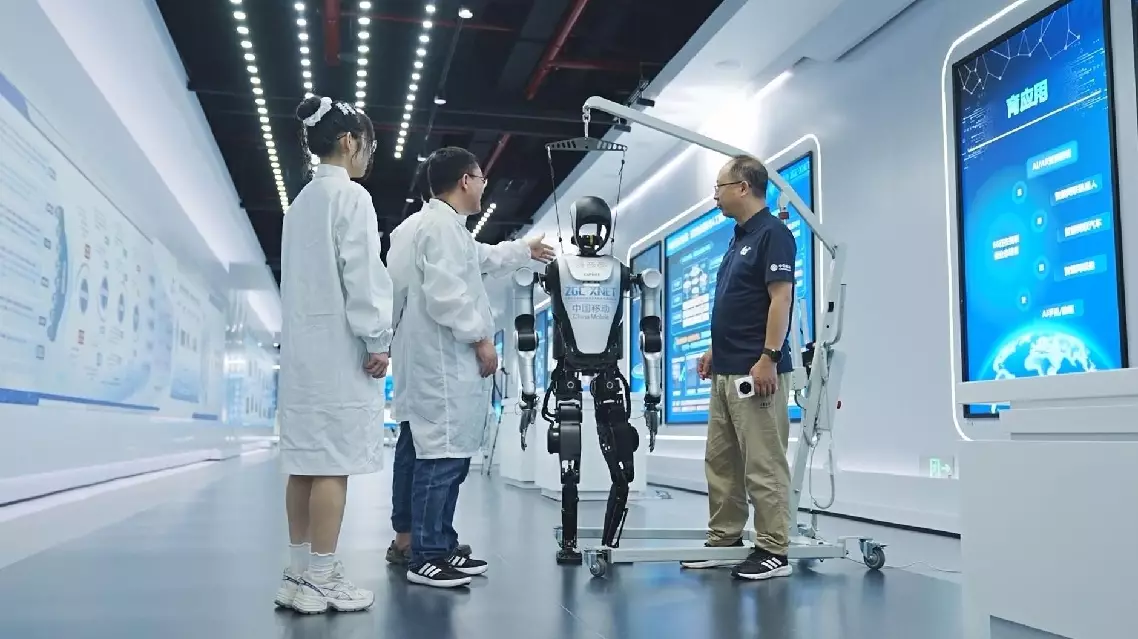
Chinese researchers use 6G to boost smart robots' real-world performance