MINNEAPOLIS--(BUSINESS WIRE)--Oct 1, 2026--
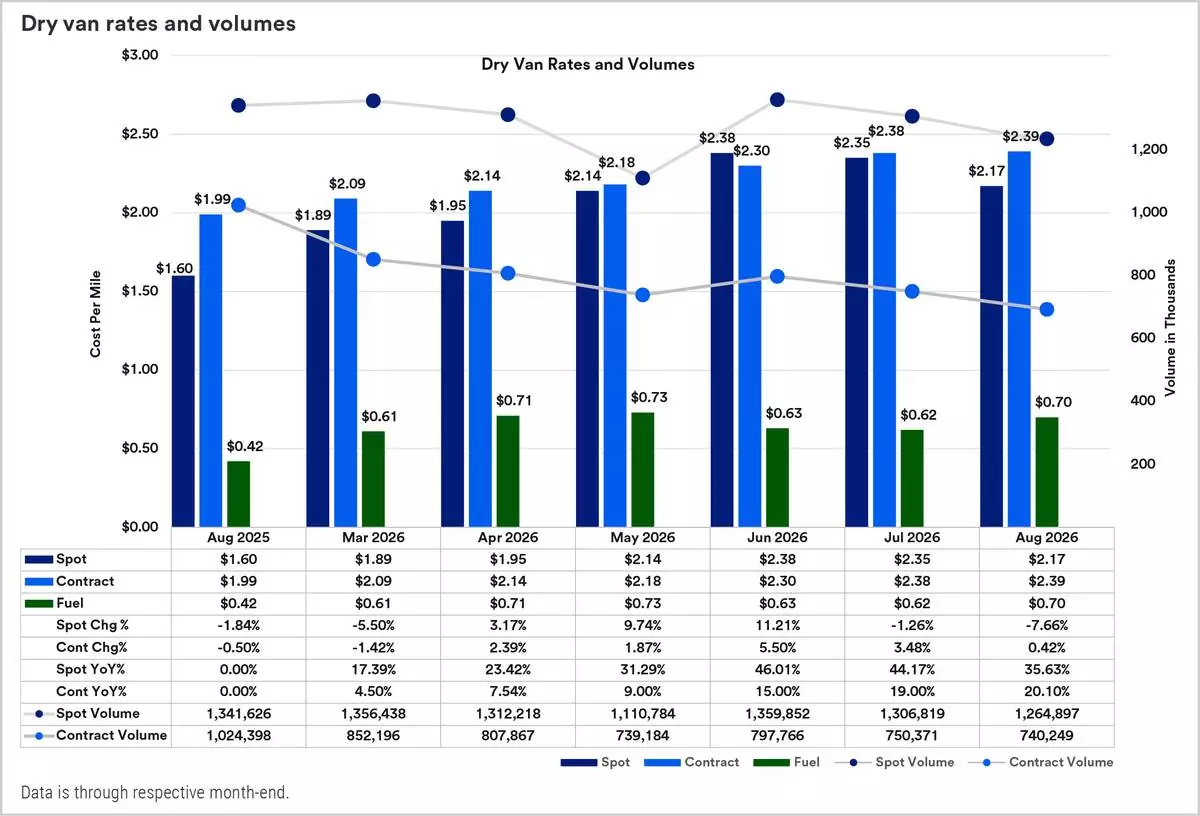
The latest quarterly U.S. Bank Freight Payment Index – Rates Edition showed contract and spot rates following different paths from June through August. Produced in collaboration with DAT Freight & Analytics, the report showed contract rates increasing while spot rates moderated from their June level.
This press release features multimedia. View the full release here: https://www.businesswire.com/news/home/20261001882013/en/
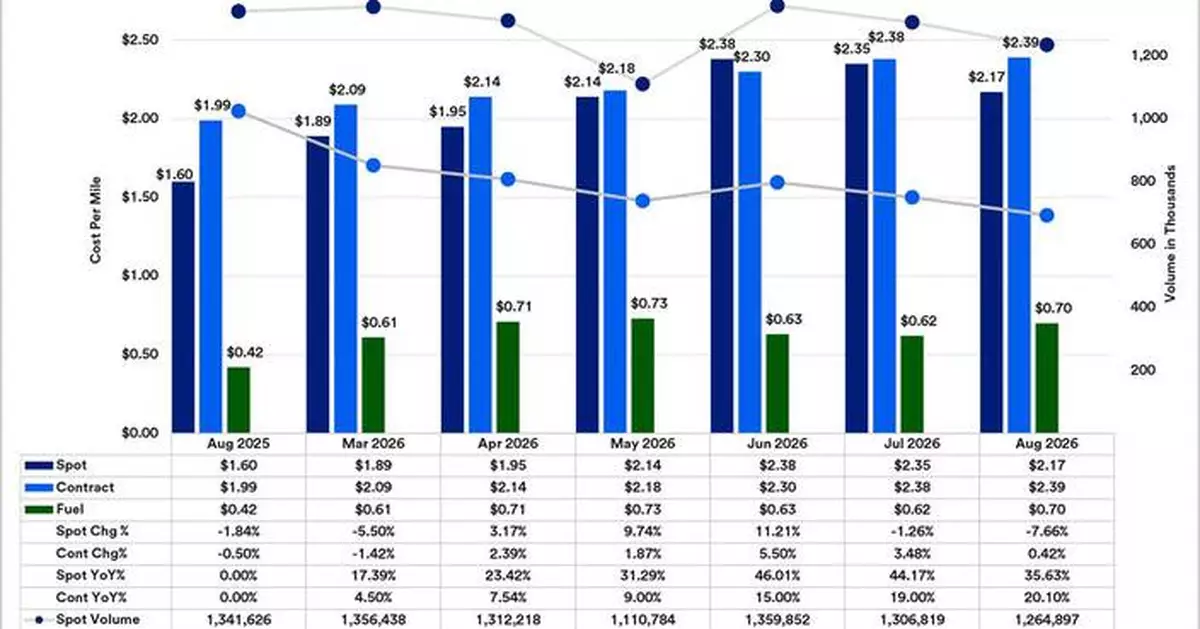
Dry van spot rates decreased from $2.38 per mile in June to $2.35 in July and $2.17 in August. Contract rates moved higher during the same period, rising from $2.30 per mile in June to $2.38 in July and $2.39 in August. By August, contract rates carried a premium of roughly $0.22 per mile over spot freight.
Fuel costs also played a growing role in overall transportation spending. Average fuel surcharge rates increased from $0.62 per mile in June to $0.70 in August, elevating total freight costs even as spot linehaul pricing softened.
“Fuel costs are increasing while linehaul pricing is softening, making it important for transportation teams to closely analyze the components of their freight spend,” said Jeff Pape, head of transportation for U.S. Bank Corporate Payment Systems.
“Fuel made up about 21% of the per-mile broker-to-shipper spot rate on dry van loads in June,” said Patrick Pretorius, General Manager Shipper Segment, DAT. “By August, it was 24%, and diesel is trending higher into the fall. Higher fuel costs push smaller, thinner-margin carriers out of the market, which adds to an already shrinking driver pool. Shippers who've spent two years squeezing rate per mile would do well to shift focus to consolidation and network planning, as the market is tightening from two directions at once.”
The Rates Edition, launched in January 2026, complements the U.S. Bank Freight Payment Index, which the bank has published quarterly since 2017. The Index measures quantitative changes in freight shipments and spend activity based on data from transactions processed through U.S. Bank Freight Payment, which processes more than $46 billion in freight payments annually.
About U.S. Bank Freight Payment
For more than 25 years, U.S. Bank Freight Payment has been a trusted steward between shippers and carriers—protecting capital flow, payment accuracy, data integrity and relationships with bank-grade standards. We audit invoices line-by-line, pay securely and on time, and deliver clean, decision-grade reporting, with $46 billion in freight payments processed annually. We keep innovating—advancing automation, analytics and workflows that turn freight spend into action. Our experts lean in to resolve issues and optimize working capital—reducing friction, extending terms and moving supply chains forward with clarity, confidence and certainty. Learn more here.
About DAT Freight & Analytics
DAT Freight & Analytics operates DAT One, North America’s largest truckload freight marketplace; Convoy Platform, an automated freight-matching technology; DAT iQ, the industry’s leading freight data analytics service; Trucker Tools, the leader in load visibility; and Outgo, the freight financial services platform. Shippers, transportation brokers, carriers, news organizations, and industry analysts rely on DAT for market trends and data insights, informed by nearly 700,000 daily load posts and a database of more than $1 trillion in freight market transactions. Founded in 1978, DAT is a business unit of Roper Technologies (Nasdaq: ROP), a constituent of the Nasdaq 100, S&P 500, and Fortune 1000. Headquartered in Beaverton, Oregon, DAT continues to set the standard for innovation in the trucking and logistics industry. Learn more at: https://www.dat.com/.
Dry van rates and volumes
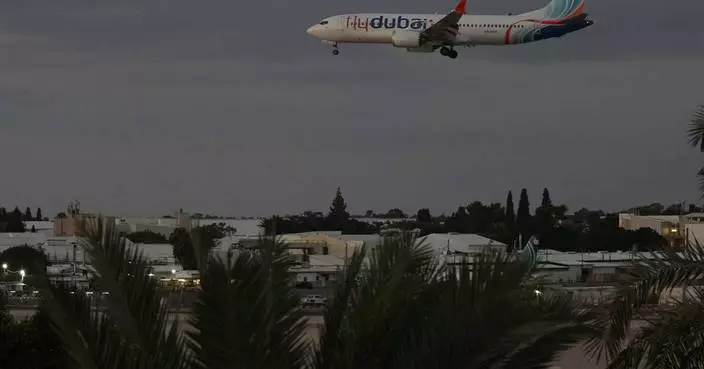
MUMBAI, India (AP) — An Indian airline captain who was at the controls of a FlyDubai flight when his copilot stabbed him in an apparent attempt to crash the plane has been hailed as a hero, with his actions to thwart the disaster drawing praise from world leaders and those who knew him.
Capt. Smit Machchhar, who is from India’s financial hub of Mumbai, was seriously injured in Wednesday's attack. Passengers described how the pilot still managed to open the cockpit door, allowing them to enter and restrain the attacker as the Boeing 737 descended sharply, according to witnesses and Israeli authorities.
The attack forced the flight carrying 174 people from Dubai, United Arab Emirates, to Tel Aviv, Israel, to make an emergency landing in Tabuk in northwestern Saudi Arabia. FlyDubai said the aircraft was secured by on-duty crew “who diverted and landed the aircraft safely.”
Machchhar was taken to a hospital in stable condition, the Indian Embassy in Riyadh, the Saudi capital, said late Wednesday. Embassy officials said Thursday that his family had been briefed on his recovery.
Indian Prime Minister Narendra Modi on Thursday called Machchhar a hero.
“In the face of the gravest danger and despite being seriously injured, he showed immense courage and an unwavering resolve to protect the lives of others. His valor helped save hundreds of lives and avert a great tragedy,” Modi wrote on X.
Modi also praised the captain for demonstrating ”patience, presence of mind and courage,” saying his “actions prevented another 9/11-like attack from happening." He said he had spoken with Machchhar's parents and wife and that the pilot was undergoing treatment.
“Smit’s bravery fills every Indian with pride,” Modi said.
According to Machchhar's LinkedIn profile, he has worked for FlyDubai for about four years. Before joining the airline, he spent 11 years with SpiceJet, an Indian low-cost carrier, where he served as a senior commander and line training captain. He logged more than 9,750 flying hours with SpiceJet, according to the profile.
SpiceJet, in a post on X, praised Machchhar’s “heroic courage” and “selfless actions.” “You are a hero to us all, Captain,” the airline wrote.
Machchhar, who is married and has two children, trained as a pilot at Mainland Air in the New Zealand city of Dunedin for 18 months, beginning in 2008, the school's head Philip Kean told 1News, a New Zealand television news channel.
Kean said Machchhar "did very well” as a student and later returned to India, where he worked as a recruiter for the school.
“We’re all very proud of him here and wish him a speedy recovery,” Kean said.
The school, which opened in 1991, offers a range of certifications, from private pilots' licenses to a diploma in aviation, and is popular with international students.
A report published last year by the New Zealand Qualifications Authority found that 39 international students, all from India, were enrolled at the school at the time of its review, accounting for half of its total enrollment.
In a podcast interview last year, Machchhar recalled how nervous he was and how he made mistakes during his first commercial flight in India, and the lessons he learned from the experience.
“At that stage, relaxing would have been the best option,” he told interviewer Zalak Mehta of the “Bona-Fide Banter” podcast.
“Stressing is not going to help, at least … in this industry,” he added.
Machchhar also described an onboard emergency when a pregnant woman went into premature labor, forcing the crew to divert the plane. He said he followed procedures carefully and ensured a safe landing on the first attempt.
“It was methodical. It was quick. It was as quick as it should have been," he said.
Wednesday's attack triggered a major security response in Israel, with authorities scrambling fighter jets in case of a possible hijacking.
Israeli Prime Minister Benjamin Netanyahu said the attacker, an Omani national, was arrested in Saudi Arabia and was undergoing interrogation there. His motive for the attack was not immediately clear.
Netanyahu also praised Machchhar’s “extraordinary bravery” in a post on X, saying the wounded captain fought back after being stabbed, opened the cockpit door and helped passengers and crew overpower the attacker, preventing what Netanyahu described as a “catastrophic midair disaster.”
“He saved the lives of 174 people, including Israeli citizens and other nationals,” Netanyahu wrote.
Shota Musayev, a dentist and eyewitness, told The Associated Press how the wounded Machchhar managed to open the cockpit door to let them in before they grappled with the copilot.
Musayev then treated Machchhar.
“Poor pilot, he was just praying the whole time and was in contact with me, and I was afraid we would really lose him,” Musayev said.
In Ghatkopar East, the Mumbai suburb where Machchhar’s family lives, neighbors spoke of how easy-going he is and also lauded his courage.
“He has a lot of bravery in him,” said Ami Sapani, a neighbor who knows the family. “God is with him.”
Saaliq reported from New Delhi. Associated Press journalists Charlotte Graham-McLay in Wellington, New Zealand and Adam Schreck in Bangkok contributed to this report.
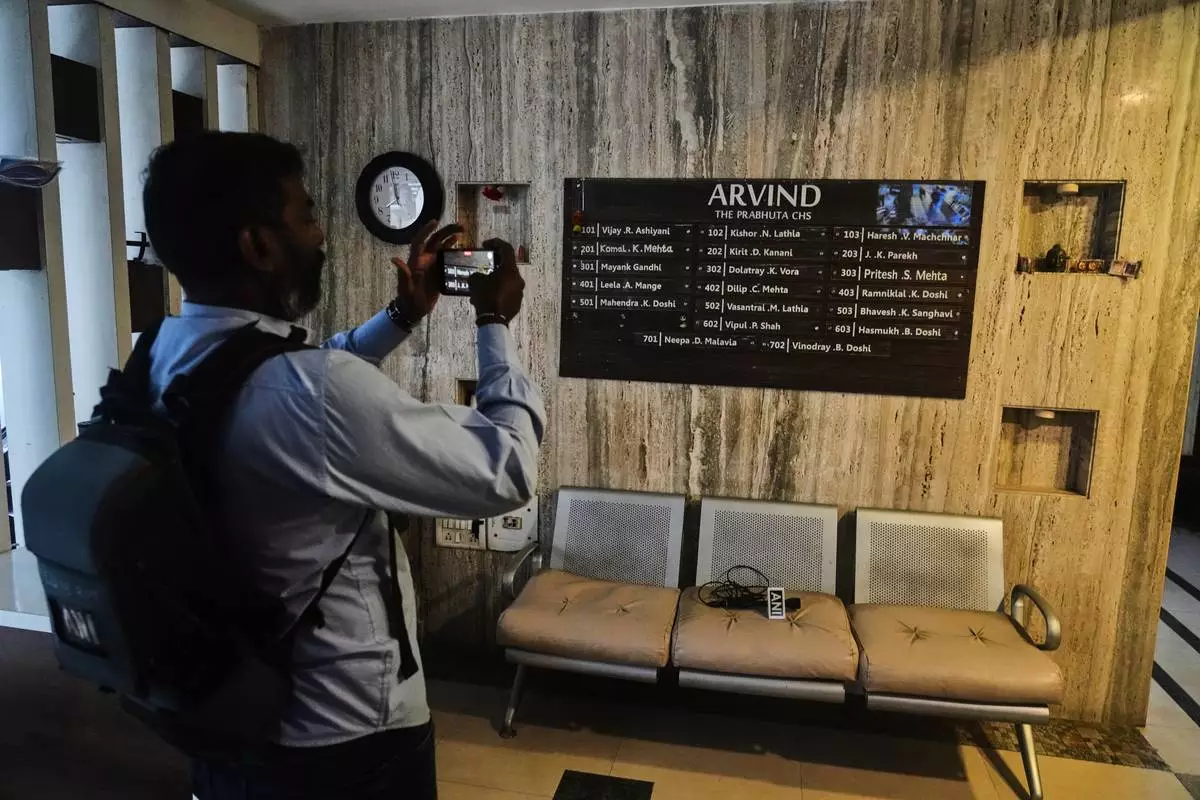
News media personnel film in the building where relatives of Smit Machchhar, an Indian pilot for Flydubai, previously lived in Mumbai, India, Thursday, Oct. 1, 2026. (AP Photo/Rafiq Maqbool)
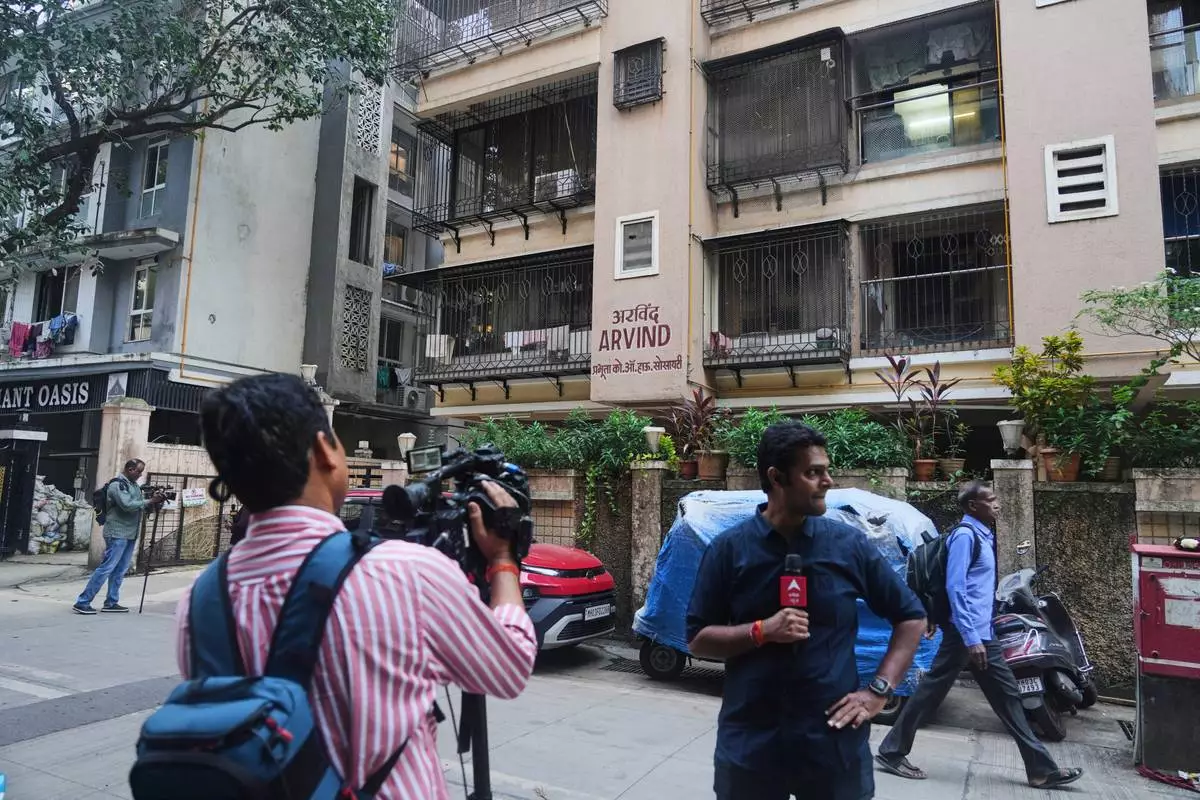
News media personnel stand outside the building where relatives of Smit Machchhar, an Indian pilot for Flydubai, previously lived in Mumbai, India, Thursday, Oct. 1, 2026. (AP Photo/Rafiq Maqbool)