GENEVA (AP) — Skiing’s governing body was on track to spend all its cash reserves by 2028 and has now cut jobs while aiming to add new events to help restore finances.
The International Ski and Snowboard Federation’s rescue plan — steering away from expected annual losses of 20 million Swiss francs ($24 million) — was detailed at meetings this week ahead of the first winter season since new president Alexander Ospelt from Liechtenstein was elected by a single vote.
Rising concerns about spending during the five-year presidency of Johan Eliasch, the billionaire boss of the Head ski and sportswear brand, seemed to be decisive in the June election.
“We are in a serious situation, not a desperate one,” the ski body’s interim secretary general Urs Lehmann said in an interview on the sidelines of the week-long gathering in Geneva. “The FIS family deserved to have clarity where we are.”
An FIS office in Munich, Germany was closed and race prize money subsidies that began during the COVID-19 pandemic have been curbed. It's part of the financial reset for the governing body that oversees Alpine and cross-country skiing, freestyle and snowboarding, ski jumping and Nordic combined.
The World Cup race earnings leaders across the FIS disciplines last winter were the superstars of Alpine skiing who also won their overall titles.
Switzerland's Marco Odermatt won 741,000 euros ($832,000) in prize money from race organizers and Mikaela Shiffrin topped the women's list with 615,000 euros ($690,000) earned. Yet they were the only Alpine skiers to earn more than 400,000 euros ($450,000) from races across the five-month season.
Those totals also were boosted by FIS money that started during the pandemic and is no longer viable.
“If you add something, that’s easy," Lehmann, the 1993 men’s downhill world champion for Switzerland, told The Associated Press. “Taking it away again is super difficult and nobody did it over the last three years.”
Maintaining and increasing athlete prize money likely will mean more races spread around more venues that want to either join or be a more regular stop on the World Cup circuits.
“There is only one way — add competitions," Lehmann said. “Can we do this? Yes, because I’m a strong believer that our calendar has more space. We have more interested parties than we have spots today.”
Extra world championships are set to be added in the current down year of a four-year Olympic cycle which includes two editions of worlds.
Member federations were told at a specially convened FIS Summit in Geneva that “FIS is solvent today but in a critical point," according to a presentation.
Equity reserves had almost halved at the end of last year to about 43 million Swiss francs ($52 million) since 2021 when Eliasch was elected, after a second pandemic-hit season.
Total revenue for the four-year cycle through 2029 is set to double to almost 650 million Swiss francs ($783 million) yet expenses are rising at a faster rate.
Reserves are set to be exhausted by the end of the 2028 winter season, with reasons cited including a decline in the value of world championships broadcasting rights and rising broadcast production costs.
FIS members were told their governing body had been paying them too much while its staffing almost doubled from 50 to 98.
“We had to let go a bunch of our teammates unfortunately to become leaner, more efficient and also cost efficient,” said Lehmann, who joined FIS in a newly created chief executive role last year then resigned days before the presidential election.
“We have a plan but this plan works only if the FIS family is really standing together,” Lehmann said.
Long-term broadcast and commercial contracts mean the situation cannot change fast enough.
“In media rights, basically the deals are done until 2030. The effect of having a higher value we will only see in almost four years,” Lehmann said. "I am convinced that we are going to make it but everybody has to know where we stand today.”
See full AP coverage of European sports here

FILE - Newly chosen president of the International Ski and Snowboard Federation (FIS) Alexander Ospelt speaks during the 57th International FIS Congress 2026 in Belgrade, Serbia, June 11, 2026. (AP Photo/Darko Vojinovic, File)

FILE - United States' Mikaela Shiffrin celebrates winning the globe trophy for the alpine ski women's slalom discipline at the Lillehammer World Cup Finals in Hafjell, Norway, March 24, 2026. (AP Photo/Marco Trovati, File)
BRUSSELS (AP) — European Union officials met Thursday to strengthen border controls and curb migration as activists presented new evidence they say shows the bloc's border agency provides surveillance data to Libya's coast guard to intercept migrants at sea.
Home affairs ministers from the EU's 27 countries gathered in Luxembourg to discuss border surveillance and other policies, including setting up “ return hubs ” in third countries and efforts to increase deportations across the bloc.
Ahead of the meeting, European Commissioner for Migration Magnus Brunner said he would call for a vast expansion of Frontex, including new powers, more funding and a larger workforce.
The EU has hardened its migration policy over the past decade, with most member countries supporting more deportations and stricter border controls. The recent crisis in Ceuta — where tens of thousands of migrants arrived in the Spanish exclave in Morocco — added urgency to calls at the meeting in Luxembourg to strengthen the border agency.
“A stronger border management system is important. And there, I see a big role for Frontex,” said Belgium's Interior Minister Anneleen Van Bossuyt.
Many stressed the need for Frontex to have a rapid intervention force that could intervene in border crises.
“Frontex has to play a more important role," Brunner said. And it should have “more flexibility to react to extraordinary situations like hybrid threats,” like the one seen in Ceuta.
The agency is already one of the most well funded EU organizations with a budget of 1.2 billion euros ($1.3 billion) in 2026.
Speaking by video from an undisclosed location in Libya, a Sudanese refugee told a packed cafe in Brussels that Libyan authorities subject asylum-seekers and migrants there to horrific violence.
“I have tried many times to escape from here but I was not lucky because of Frontex and their allies” in Libya, said the 31-year-old refugee, whose full name was not disclosed for safety reasons.
In 2024, he sued Frontex with the help of lawyers from the legal activist group Front-LEX, the advocacy group Refugees in Libya and the German nongovernmental organization Sea-Watch.
“Today more than ever, Frontex, the long, violent arm of Europe, is making everything more dangerous,” said David Yambio, co-founder of Refugees in Libya. “With the help of the agency, people are captured at gunpoint and returned to Libya, a well-known place of torture, rape, enslavement, extortion, arbitrary detention, death, and enforced disappearance."
The United Nations found evidence in 2021 that crimes against humanity may have been committed against migrants in Libya. An AP investigation also documented widespread human rights violations by militias in Libya, enabled in part by EU funds.
Sea-Watch spokesperson Julia Winkler said that the group had documented Frontex sharing surveillance data with Libyan vessels more quickly and at higher resolution than what it shares with charity rescue groups operating in the Mediterranean. The Associated Press could not independently verify the claims, which Frontex denies.
Winkler said Frontex provided Libyan authorities with the coordinates of migrant boats detected by EU-funded drones and airplanes, effectively helping keep the migrants from reaching EU shores.
Human rights groups and U.N. agencies have long said Libya should not be considered a safe place to disembark migrants rescued in the Mediterranean because of the abuse they face there.
“Frontex is actively and systematically facilitating interceptions and definitely not rescue,” Winkler said. “European aerial surveillance is crucial in all of this... Without this information, the so-called Libyan coast guard would not be able to know the positions of the majority of the boats, and interceptions would not be possible on that scale.”
The Libyan coast guard and other Libyan groups operating in the Mediterranean have been accused numerous times of shooting at migrants and European charity vessels trying to rescue them.
Frontex said Thursday it does not provide information directly to the Libyan coast guard, but instead alerts an emergency rescue center in Tripoli or sends broadcasts and “mayday relays” to nearby vessels able to respond.
“If you don’t have the eyes to see boats in distress in this area, then you probably will have more lives that are being lost,” said agency spokesperson Chris Borowski. “The more Frontex planes fly in the area, the more they’re able to see and the more lives that we hope we’re able to save.”
Migrants and activists have called for these flights to be suspended and hope to advance their case before the General Court of the European Union.
The lawsuit brought forward “seeks to end this information-sharing, and thereby stop refugees from being sent back to death or torture in Libya,” said Iftach Cohen, a lawyer with the legal advocacy group Front-LEX representing the plaintiff. “No one can stop Frontex but the judges.”
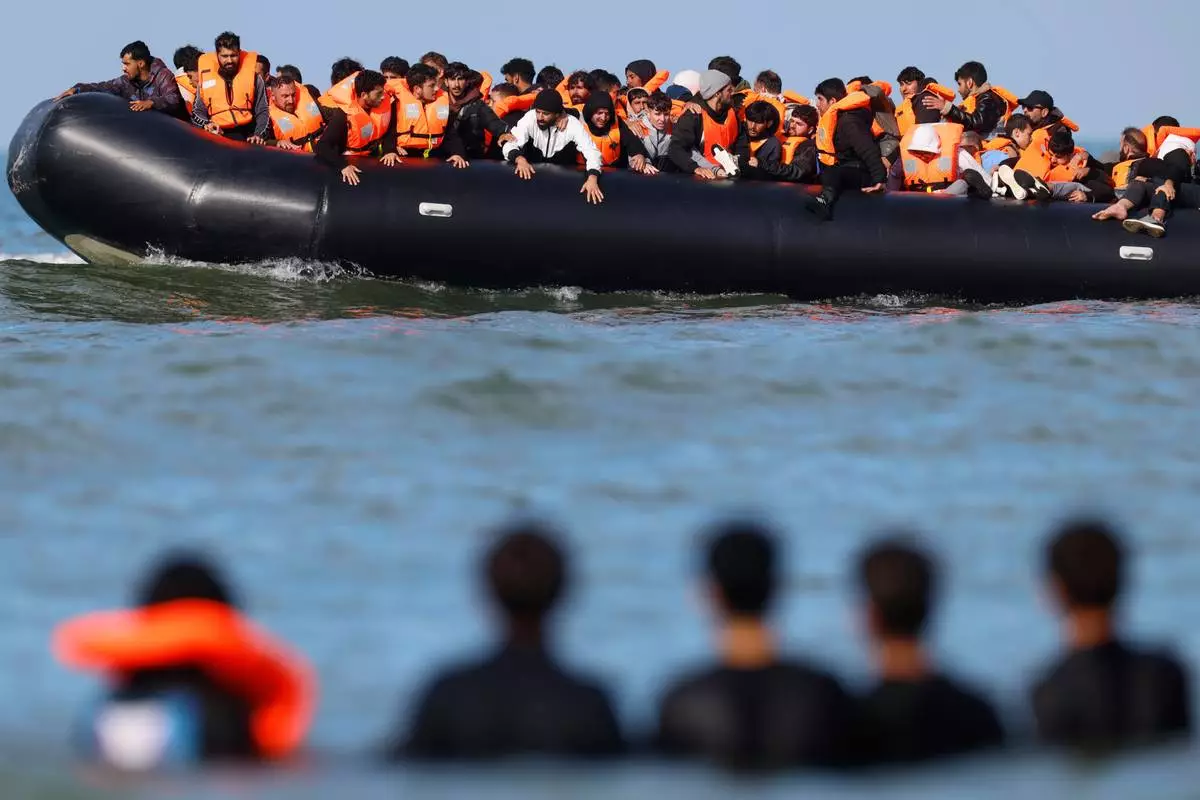
FILE - A group of migrants attempt to cross the English Channel in a dinghy off Hardelot, northern France, Sept. 23, 2026. (AP Photo/Jean-Francois Badias, File)

FILE - Police officers with the newly formed General Service Unit (USG) gather in Loon-Plage, northern France, Sept. 1, 2026, to combat illegal immigration. (AP Photo/Jean-Francois Badias, File)
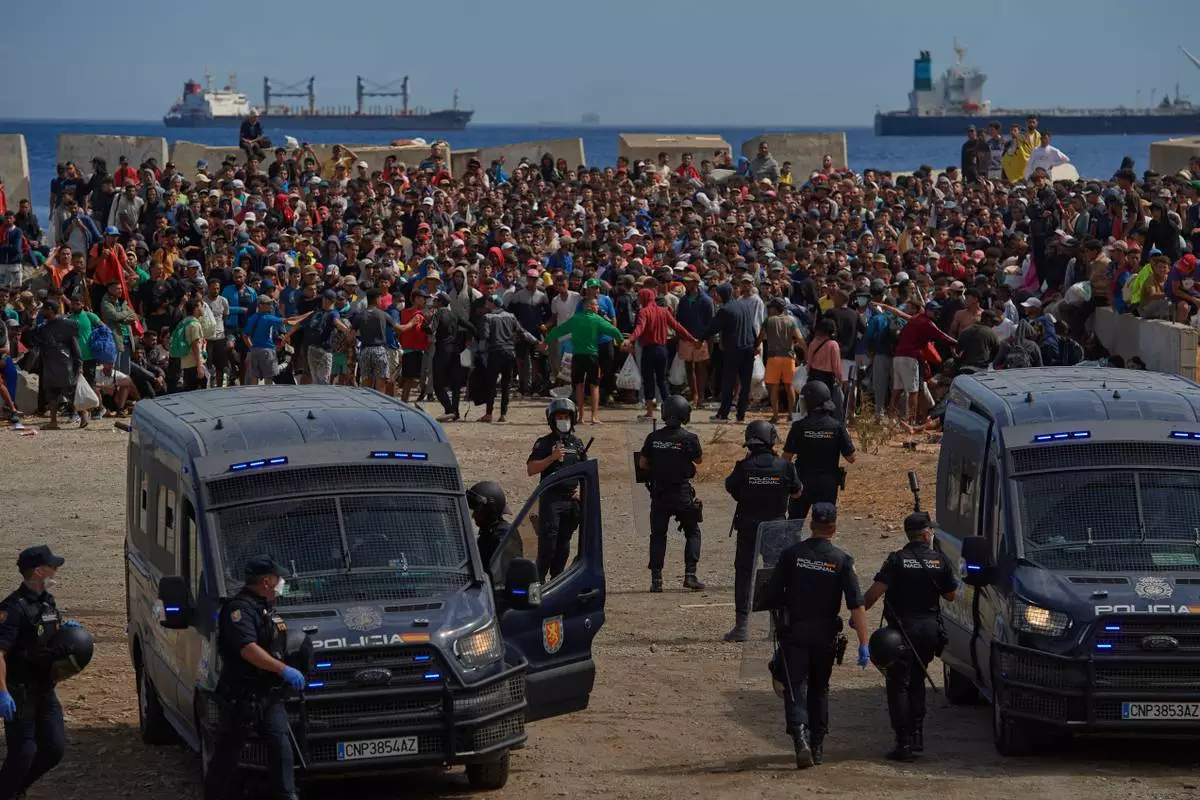
FILE - Migrants who crossed from Morocco into Spain return to a beach after being expelled from the area the previous day, as Spanish police escort them in the Spanish exclave of Ceuta, Aug. 21, 2026. (AP Photo/Antonio Sempere, File)