China connected its first 100-megawatt-class compressed carbon dioxide energy storage facility to the grid on Friday, marking a major breakthrough in large-capacity, zero-carbon energy storage technology.
Located in Mori Kazakh Autonomous County, in northwest China's Xinjiang Uygur Autonomous Region, the facility can store 290 million kilowatt-hours of electricity during off-peak hours and discharge 180 million kilowatt-hours of green power during peak demand each year.
The technology acts as a massive grid-scale battery, equipped with five gas holders, 141 liquid storage units, and 97 thermal storage units. It compresses carbon dioxide gas into a liquid state during periods of low electricity demand to store energy, then expanding it back into gas to drive power turbines when demand peaks.
Unlike conventional pumped-hydro or compressed-air energy storage systems, the closed-loop technology does not require specific geological features like mountains or underground caverns, offering a high-reliability, low-cost alternative for long-duration grid storage.
"Compressed carbon dioxide has a higher energy density and offers numerous advantages, including high efficiency, low cost, high safety, and zero pollution. The project's designed efficiency makes it the most efficient carbon dioxide power generation unit in China today. Upon completion, the project is expected to generate approximately 200 million kilowatt-hours of electricity annually, saving 50,000 tons of standard coal and reducing carbon dioxide emissions by about 170,000 tons each year," said Ma Guojiang, leader of the project.
The project is designed to stabilize the local power grid by absorbing excess electricity during off-peak hours and discharging it during demand spikes, helping integrate more renewable energy into the regional network.
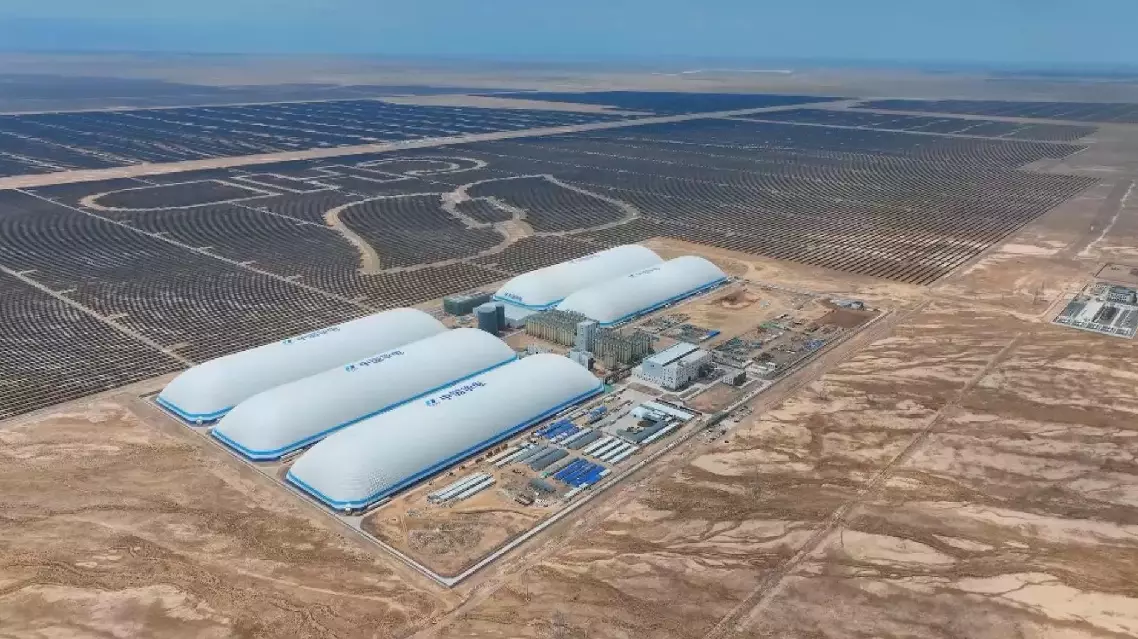
China connects first 100-MW compressed carbon dioxide energy storage project to grid