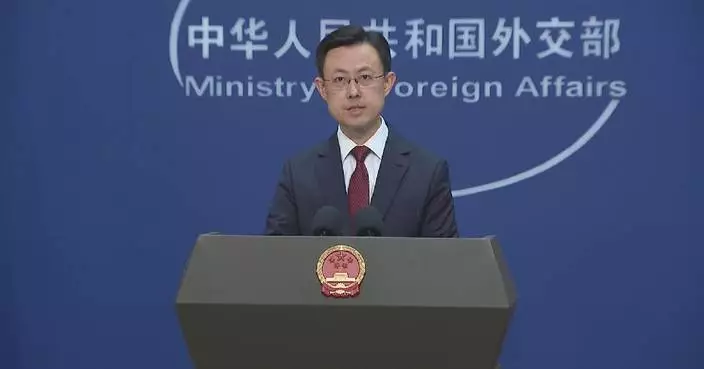
Chinese Foreign Minister Wang Yi and Vice President of the Swiss Federal Council and Foreign Minister Ignazio Cassis co-chaired the fifth round of China-Switzerland Foreign Ministers' Strategic Dialogue in Nanjing, a city in east China's Jiangsu Province, on Monday.
Wang, also a member of the Political Bureau of the Communist Party of China Central Committee, said China-Switzerland ties have continued to grow, remaining at the forefront of China-Europe relations.
This year marks the 10th anniversary of the China-Switzerland innovative strategic partnership.
China is ready to work with Switzerland to implement the agreements reached by the two countries' leaders, strengthen exchanges at all levels, and deepen political mutual trust, Wang noted.
For his part, Cassis said the China-Switzerland innovative strategic partnership has remained strong over the past decade, bringing real benefits to both sides.
He said China has become an important force in globalization and addressing global challenges, adding that Switzerland is ready to work with China to support free trade, oppose protectionism, tackle climate change, and strengthen global artificial intelligence (AI) governance.
The two sides agreed to strengthen dialogue, expedite domestic approval procedures for the upgraded free trade agreement, and deepen cooperation in finance, technology, intellectual property, AI, telecommunications and education to elevate their innovative strategic partnership to a new level.
Cassis is visiting China from Monday to Tuesday at Wang's invitation.

China, Switzerland hold 5th round of foreign ministers' strategic dialogue
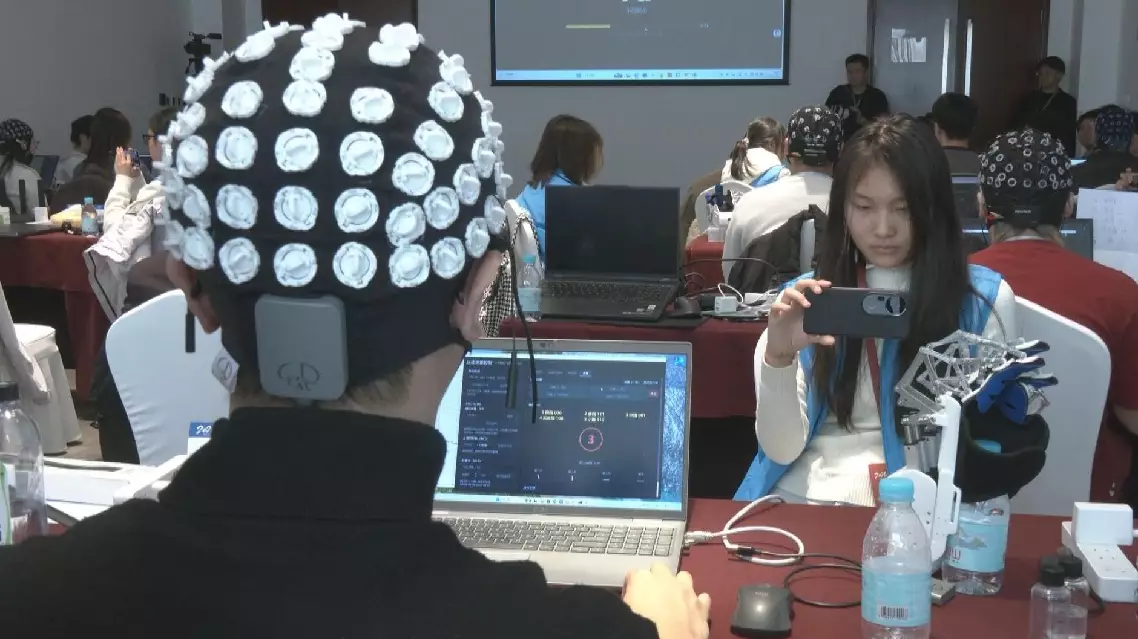
A national Brain-Computer Interface (BCI) competition took place in Beijing from Thursday to Sunday, bringing together teams from universities, research institutions, and enterprises across China to showcase advances in brain signal decoding and human-machine interaction.
Running concurrently with the 2026 Brain-Computer Interface Conference, the competition was hosted by China Academy of Information and Communications Technology, featuring eight competition events into three categories of control systems, algorithm development, and innovative roadshow.
Among the most followed areas, the brain-controlled robotic hand final saw eight teams compete with electroencephalogram (EEG) acquisition headsets.
By decoding participants' motor imagery signals, BCI systems in competition can direct robotic hands to carry out precise finger movements. Steady mental focus and accurate EEG signal recognition were critical to ensuring the robotic hands completed tasks smoothly.
Zhou Fangyujia, a student from the University of Science and Technology of China's School of Information Science and Technology, detailed her team's breakthrough in EEG signal classification.
"Our subject imagines six distinct movements: five separate finger motions plus a thumb-index pinch. This is a core innovation, as most industry solutions currently only support binary, ternary or four-movements classification. We have reached six," she said.
In the brain-controlled car event, competitors navigate a vehicle through obstacle courses and designated paths with EEG signals, reaching four task points in sequence by translating mental intent directly into physical motion.
One participant said as BCI technology matures, brain-controlled systems are projected to expand into industrial operations, accessibility support, and other practical fields.
"Today we are controlling a small car with brain signals, but this framework can be adapted for drones, unmanned vehicles, or to help people with paralysis operate wheelchairs," said Wang Junyang, a member of Tianjin University's BCI team.
The emotion perception event focused on decoding brain states. Leveraging real-time EEG analysis, participating teams track subjects' emotional fluctuations and convert intangible emotional and cognitive states into measurable data, a practical technology which can facilitate mental health screening and attention level assessment.
Judges noted that the event's broad coverage of medical, industrial and consumer health applications reflects the growing commercial and practical viability of BCI technology.
"The competition is designed around application scenarios where BCI products and applications can be rolled out quickly, and we have seen many innovative concepts with strong practical potential," said competition judge Wang Yijun, also a researcher with the Chinese Academy of Sciences' Institute of Semiconductors.
"Beyond showcasing technological progress, the competition helps researchers identify priorities for further advancement. From improving the convenience and reliability of interaction, to developing next-generation hardware such as user-friendly ear electrodes and optimizing algorithms to boost the signal-to-noise ratio of captured data, all these areas need further improvement," said fellow judge Xu Guanghua, a professor at Xi'an Jiaotong University.
Listed as a key future industry in China's 15th Five-Year Plan (2026-2030), BCI technology was written into the annual Government Work Report for the first time in 2026.
Brain-Computer Interface Competition in Beijing showcases application potential