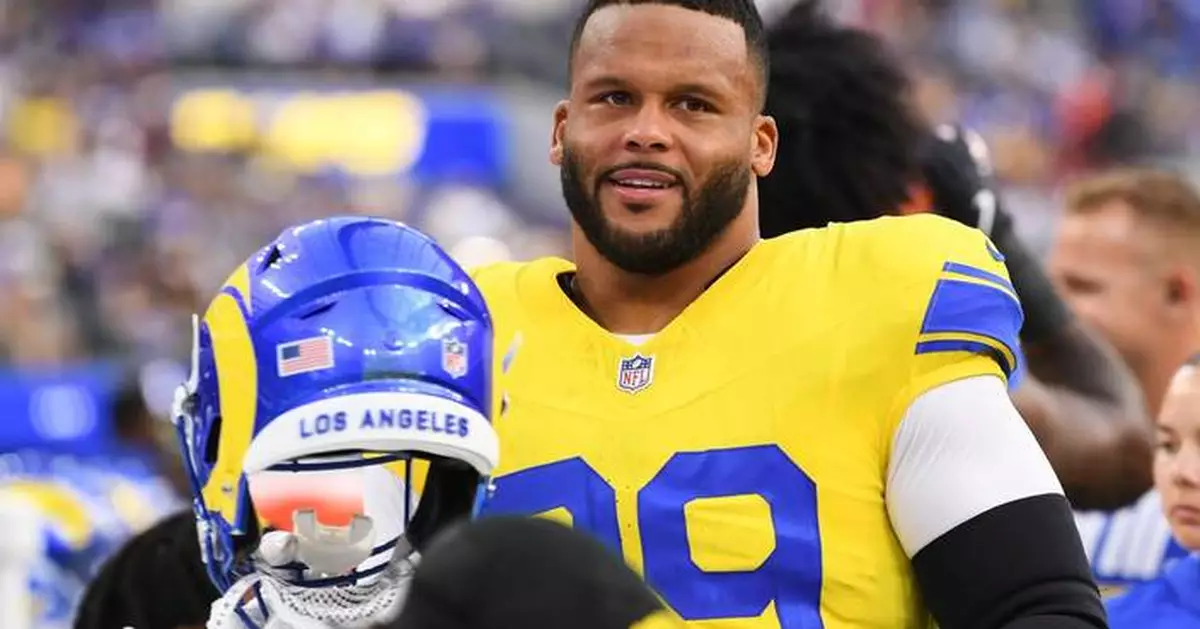
LOS ANGELES (AP) — Aaron Donald will miss the Rams’ game against the Philadelphia Eagles on Sunday because of a sore back, while Puka Nacua will return after missing two games because of a hip and groin injury.
Donald did not practice all week and coach Sean McVay officially ruled him out Friday. A three-time AP Defensive Player of the Year, Donald has four tackles, one tackle for loss and one quarterback hit in two games after ending his two-season retirement.
McVay said the Rams (1-2) were erring on the side of caution with Donald and that the 35-year-old defensive tackle probably could have played through the injury if needed.
“We have to protect him from him,” McVay said. “This guy will do everything (to play) and that much more.”
Nacua had five receptions for 74 yards in the season opener against the 49ers but missed games versus the Giants and Broncos after hurting himself in practice on Sept. 17.
“Just in some of the change of direction stuff, some of the stuff in my hip area just was not feeling great,” Nacua said. “It was causing me some pain and some restriction in some of my movements.”
The Rams also ruled out tight end Terrance Ferguson (ankle) and cornerback Jaylen Watson (shoulder), while tight end Colby Parkinson (knee/shoulder) and outside linebacker Josaiah Stewart (groin) is questionable.
McVay also said wide receiver Alex Bachman will likely be called up off the practice squad to contribute on special teams after return specialist Xavier Smith was waived on Friday.
The decision to move on from Smith came one day after special teams coordinator Bubba Ventrone was critical of his performance while also ruling out replacing the third-year wide receiver from Florida A&M. Smith's status had been in question since he muffed a punt leading to a Seattle touchdown in the Seahawks' 31-27 win over the Rams in the NFC championship last season.
“We just need better production out of that position,” McVay said. “That's exclusively what it was.”
“We weren't thinking about it when (Ventrone) talked to you guys yesterday. And as you get a chance to kind of take a step back, evaluate the totality of our group — what's the best way to try to be able to put together all three phases? Did feel like that was in the best interest of the group, and that was kind of what went into it.”
See AP’s full NFL coverage here
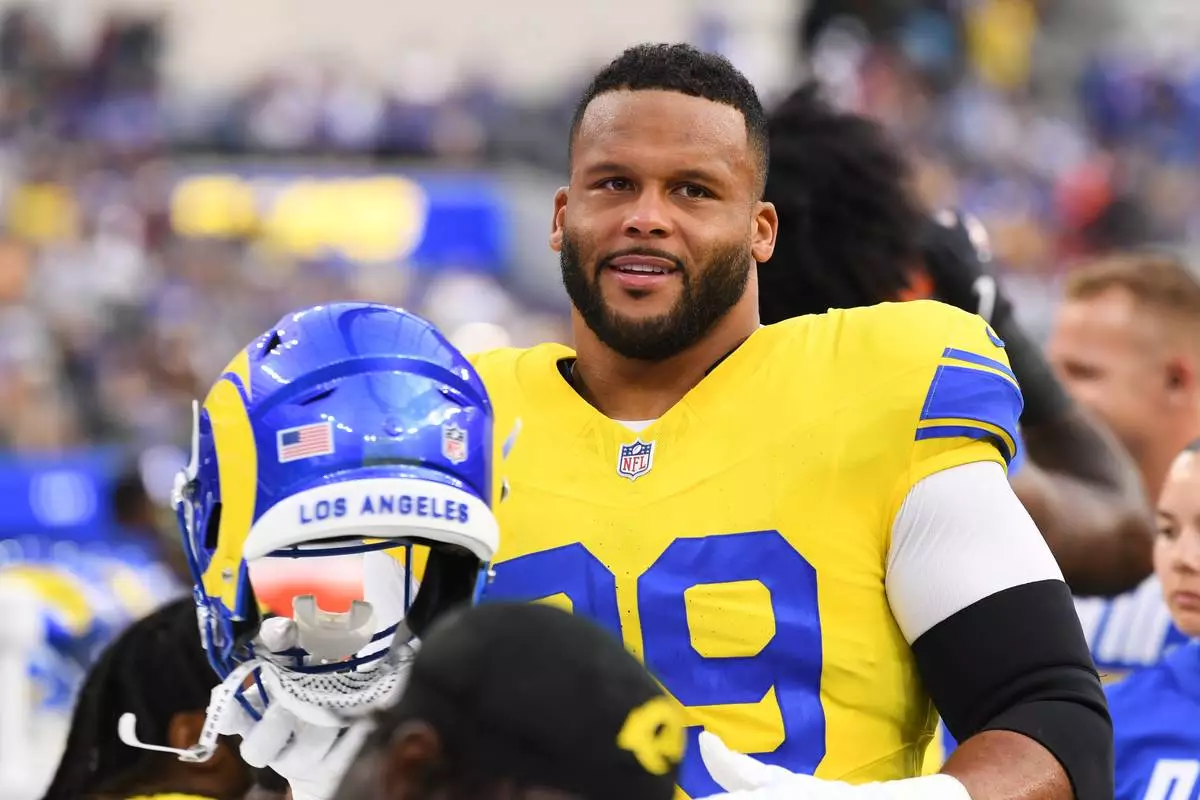
Los Angeles Rams defensive end Aaron Donald looks on from the bench before an NFL football game against the New York Giants in Inglewood, Calif., Monday, Sept. 21, 2026. (AP Photo/Katie Chin)
NEW YORK (AP) — U.S. stocks rose near their record after the latest jobs report cooled worries that a potentially hot U.S. economy could make inflation worse. The S&P 500 climbed 0.7% Friday and pulled within 1% of its all-time high. The Dow Jones Industrial Average added 0.5%, and the Nasdaq composite rose 1.2%. They got a boost after a report showed U.S. employers slowed their hiring last month. That pushed traders to pare bets that the Federal Reserve will hike interest rates later this month. Treasury yields initially tumbled but later retraced their losses as oil prices recovered most of an early swoon.
THIS IS A BREAKING NEWS UPDATE. AP’s earlier story follows below.
NEW YORK (AP) — U.S. stocks are rising near their all-time high on Friday after the latest jobs report cooled worries that a potentially hot U.S economy could make inflation much worse.
The S&P 500 rose 0.7% and pulled within 1% of its record set in August. The Dow Jones Industrial Average was up 233 points, or 0.5%, with an hour remaining in trading, and the Nasdaq composite was 1.2% higher.
All of Wall Street got a jolt after the U.S. government said employers across the country added 29,000 jobs to their payrolls last month. That was fewer than economists expected and a slowdown from August’s hiring rate of 133,000.
More importantly for financial markets, it tamped down concerns that the U.S. economy could be so strong that it could fuel inflation even higher. Inflation has remained much worse than anyone would like, and the Federal Reserve recently raised its main interest rate for the first time in three years to try to rein in the painful increases for the cost of living.
Even though Americans are feeling more frustrated about inflation and their finances, the overall U.S. economy has been chugging along. Earlier this week, the U.S. government said the economy’s growth in the spring was better than earlier thought, driven by businesses building AI data centers and spending by consumers.
Friday’s softer-than-expected data on the economy pushed traders to pare bets the Fed will hike its main interest rate at its next meeting later this month. They now see less than a 23% probability of that, down from 64% a week ago, according to data from CME Group.
“This report strengthens the case for the Federal Reserve to remain patient,” according to Adam Schickling, senior economist at Vanguard. “The labor market has not deteriorated sharply, but there is also little evidence that it has meaningfully strengthened, giving policymakers reason to wait for additional data.”
The pullback in expectations for an October rate hike helped calm what's been a rattled bond market.
The centerpiece of the U.S. bond market, the 10-year Treasury, saw its yield briefly drop below 5.17%. That was down from its peak near 5.35% on Thursday, when it and other longer-term yields neared their highest levels in two decades.
An easing of yields can help the economy by making it more affordable for everyone to borrow money. Higher yields, meanwhile, tend to undercut prices for stocks and other investments.
But a solid U.S. economy is only one of the many drivers that have caused yields to jump in bond markets.
Oil prices yo-yoed in another shaky day, with the price of a barrel of Brent oil veering between $98 and $103 on Friday. It ended up settling at $102.25, down just 0.1%, for its latest zigzag amid uncertainty how the war with Iran will reshape the global oil industry.
As oil prices pared their losses through Friday, so did Treasury yields. The 10-year Treasury yields bounced back to 5.28%, more than 0.10 percentage points higher than its bottom for the day. That in turn helped U.S. stocks pare their own gains. The S&P 500 had been up as much as 1.2% at one point in the morning.
Concerns about big spending by governments, along with the mountains of debt they’re racking up, meanwhile continue to keep yields high worldwide. In France, for example, yields have been particularly shaky as the government contends with its record debt and strained budget.
On Wall Street, Tesla rallied 5.2% after the electric-vehicle company said it delivered 486,532 vehicles to customers during the latest quarter, more than analysts expected.
Lower yields in the bond market help investors justify paying higher prices for stocks, even those that get criticized for being too expensive. That helped companies in the artificial-intelligence industry add to their already stellar gains.
Nvidia’s 1.6% rise was the single strongest force lifting the S&P 500.
Such gains more than made up for a 4% drop for Nike. The sneaker and athletic apparel company reported a stronger profit for the latest quarter than analysts expected, but its revenue weakened by more than feared. Nike also gave a forecast for profit this fiscal year that fell short of analysts’ expectations.
In stock markets abroad, indexes bounced back in Europe from sharp losses taken a day earlier after bond yields swung sharply across the continent.
Asian indexes were mixed, with Hong Kong’s Hang Seng dropping 2.6% but South Korea’s Kospi adding 0.5%.
AP Business Writers Chan Ho-him and Michelle Chapman contributed to this report.
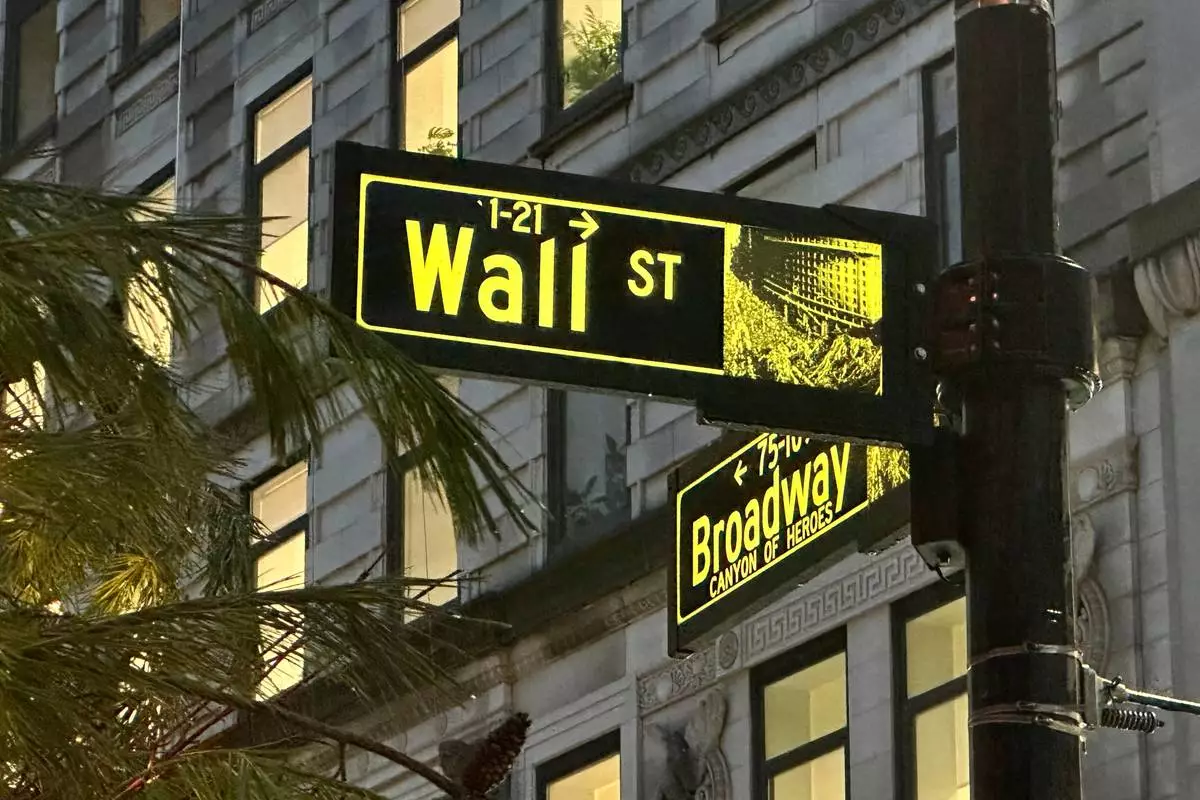
FILE - Signs mark the intersection of Wall Street and Broadway in New York's Financial District on Wednesday Dec.11, 2024. (AP Photo/Peter Morgan, File)