The Center-2026 strategic military exercise wrapped up in Russia's Chelyabinsk region, with troops from eight countries carrying out coordinated land and air operations during the live-action phase.
The month-long exercise brought together military contingents from Russia, China, Belarus, Pakistan, Kazakhstan, Kyrgyzstan, Mongolia and Tajikistan.
According to the Russian President's official website, more than 47,000 personnel took part in missions at 11 training grounds and in the Caspian Sea. The exercise was conducted alongside the Interaction-2026 drills organized by the Collective Security Treaty Organization, or CSTO.
The Chinese contingent included personnel from the headquarters of the Central Theater Command, the 82nd Group Army of the Central Theater Command's ground force and a subordinate combined-arms brigade.
At the Chebarkul training ground, participating troops first trained in long-distance force deployment, joint operational planning, and adaptation to the exercise environment. They then moved into the final phase featuring comprehensive live-action land and air operations.
Under the unified exercise framework, the participating forces established an exercise directing staff, an operational command and multiple combat groups. Commanders worked from underground command facilities, assessing battlefield developments and issuing instructions, while troops on the ground coordinated their movements and carried out tactical operations against simulated enemy targets.
"The exercise involved a large number of unmanned systems, presented considerable challenges in operational coordination and featured a high degree of realism. We designed our training subjects around actual combat requirements and adjusted our actions according to the changing situation, while bringing together our strengths to improve coordination. Throughout the exercise, the participating sides worked together on the employment of unmanned systems, coordination mechanisms, tactics and operational methods. We learned from each other's strengths and complemented each other, enabling a high level of integration during the live-action operation," said Zhang Jiayi, an officer from the Chinese troops in the exercise.
The training area was designed to replicate a complex battlefield environment, with ravines, shell craters and damaged villages, forests and farmland. Abandoned or damaged tanks and vehicles were scattered across the area.
The participating troops also adopted different approaches to camouflage their field positions and equipment. Some used standard camouflage nets, while others relied on branches and vegetation or used the surrounding terrain and structures for concealment.
"The way targets were presented was also designed to closely replicate actual combat conditions. During our tank assault, there were no clearly identifiable targets, meaning we had to locate them ourselves. This presented a significant challenge. At the same time, the experience showed us that improving the standards of realistic combat training requires attention to detail. By accumulating experience step by step, we can continuously raise the level of realistic training and strengthen our ability to conduct actual combat operations," said Zhu Jun, an officer from the Chinese contingent participating in the Center-2026 exercises.
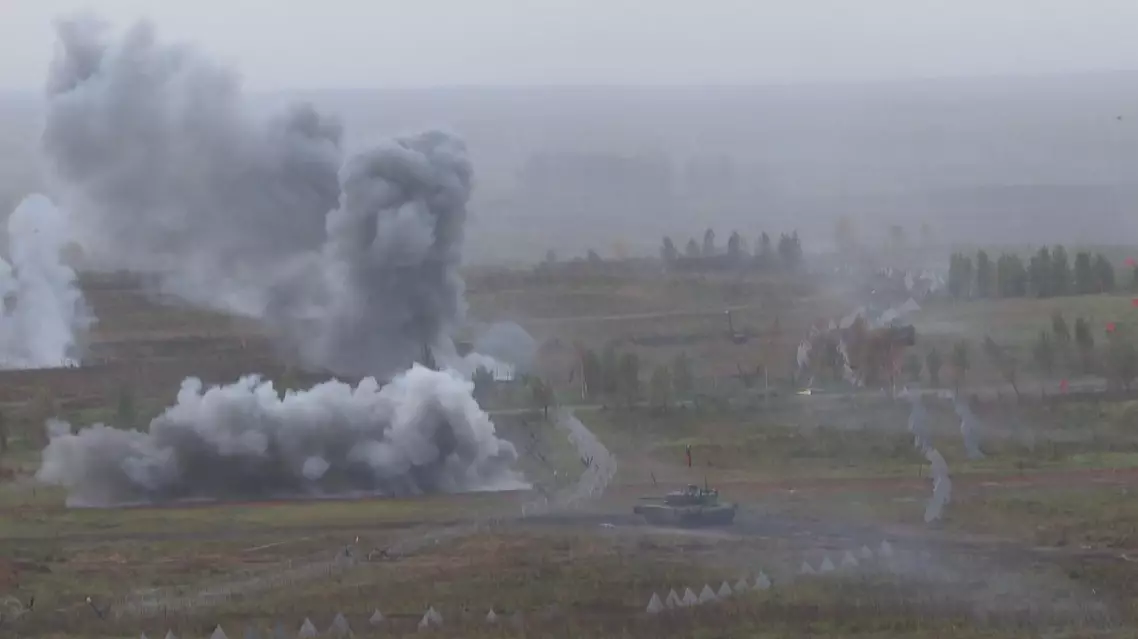
Eight-country troops conduct joint land-air drills in Center-2026 exercise in Russia
Eight-country troops conduct joint land-air drills in Center-2026 exercise in Russia