China's consumer market has seen strong activity during the National Day holiday, as a range of government measures, including trade-in subsidies and interest subsidies on consumer loans, have boosted spending and encouraged buyers to upgrade their purchases.
As the weeklong holiday kicked off Thursday, local governments across the country have also rolled out targeted incentives and created new consumption scenarios to bring the benefits of these policies closer to consumers.
In north China's Tianjin Municipality, for example, home appliance exhibitions have been brought to township markets, allowing residents to shop and try out appliances while enjoying government subsidies close to home.
"I came to the market today and saw the appliances on sale. The government subsidy can be as much as 1,500 yuan (around 224 U.S. dollars), so I thought, why not take one home?" said a customer surnamed Feng.
The holiday shopping boom has also been supported by a new round of government funding.
A fourth batch of 62.5 billion yuan (around 9.32 billion U.S. dollars) in ultra-long special treasury bonds for consumer goods trade-ins was allocated ahead of the National Day holiday, helping spur consumer demand.
In southwest China's Sichuan Province, interest subsidies on consumer loans have been rolled out, while financial institutions have expanded consumer credit and retailers have launched holiday promotions.
The combination has drawn large crowds to home furnishing and renovation stores, with many consumers taking the opportunity to upgrade their homes.
"The interest subsidy on the loan is very appealing. It can save me 3,000 yuan in interest each year, which is really worthwhile," said a Chengdu resident named Xiang Jie.
During the National Day cultural and tourism consumption month, more than 20,000 cultural and tourism activities will be held nationwide, while more than 310 million yuan (about 46.24 million U.S. dollars) in consumer vouchers and other subsidies will be issued, offering residents and tourists more choices and a more enjoyable holiday experience.

China’s consumer market heats up as holiday policies boost spending
U.S. Democratic Senator Chris Murphy said on Tuesday that the Pentagon had barred him from entering a key U.S. military base during his recent visit to Qatar, which he said reflected an effort by the U.S. government to conceal the costs of the conflict with Iran.
Murphy made the remarks while visiting Riyadh, capital city of Saudi Arabia, the second stop on his current trip to the Middle East.
He told reporters that the trip had reinforced his belief that the U.S. administration was making an unprecedented and unconstitutional effort to withhold information about the war's costs and consequences from Congress and the American public.
The United States and Israel launched military strikes against Iran in late February, prompting Iranian retaliation against U.S. military installations across the Middle East. Al Udeid Air Base, southwest of Qatar's capital Doha and one of the largest U.S. military facilities in the region, was among the major targets of the Iranian attacks.
A September 14 report by the U.S. Defense Department's inspector general, Office of Inspector General of the U.S. Department of Defense (DoDIG), said the conflict had caused significant damage to U.S. military bases and diplomatic facilities across the region, with hundreds of buildings and other structures damaged or destroyed and more than 50 U.S. aircraft damaged or destroyed.
Members of Congress have repeatedly called on the administration to provide more information about the financial costs and casualties resulting from the conflict.
Murphy, who serves on the Senate Foreign Relations Committee, said he had never encountered such restrictions during his time in the Senate when discussing the Pentagon's decision to prevent him from accessing the U.S. military facility in the Middle East.
During his visit to Saudi Arabia, Murphy also saw extensive damage to the U.S. Embassy in Riyadh caused by a drone attack. He warned that the incident could have resulted in mass casualties had it occurred during working hours.
According to data from the Defense Casualty Analysis System of the U.S.Department of Defense, U.S. forces had recorded 838 casualties in the conflict as of September 8, including 18 deaths and 820 injuries.
The Pentagon has faced criticism over delays in releasing information about wounded U.S. service members during the conflict, while officials have cited security concerns as the reason for withholding or delaying some details.
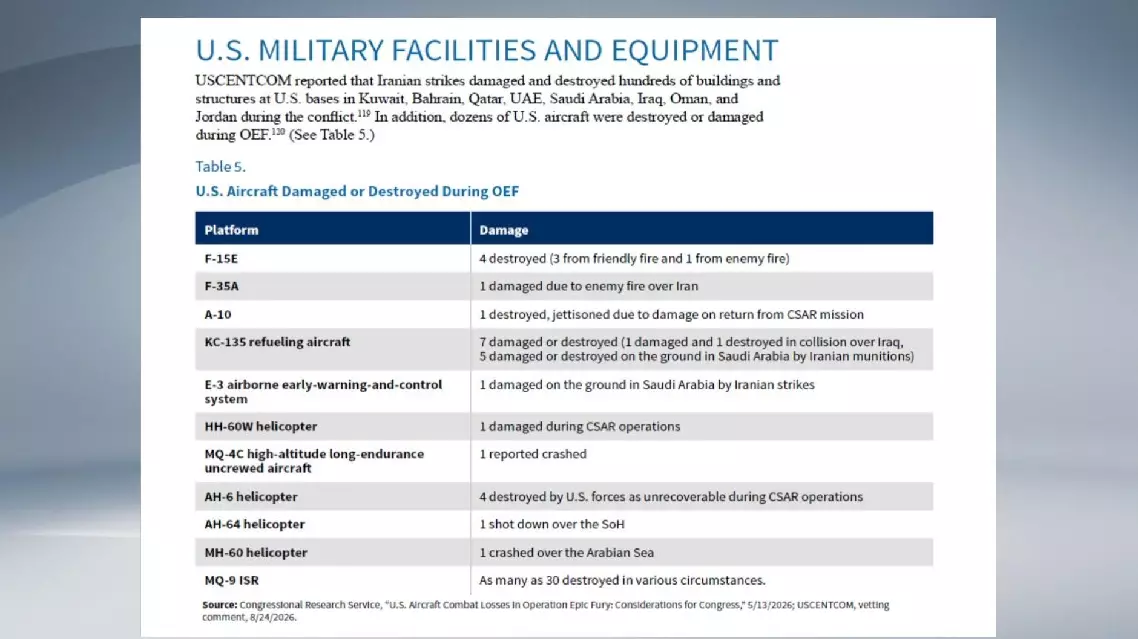
US senator accuses government of concealing Iran war costs