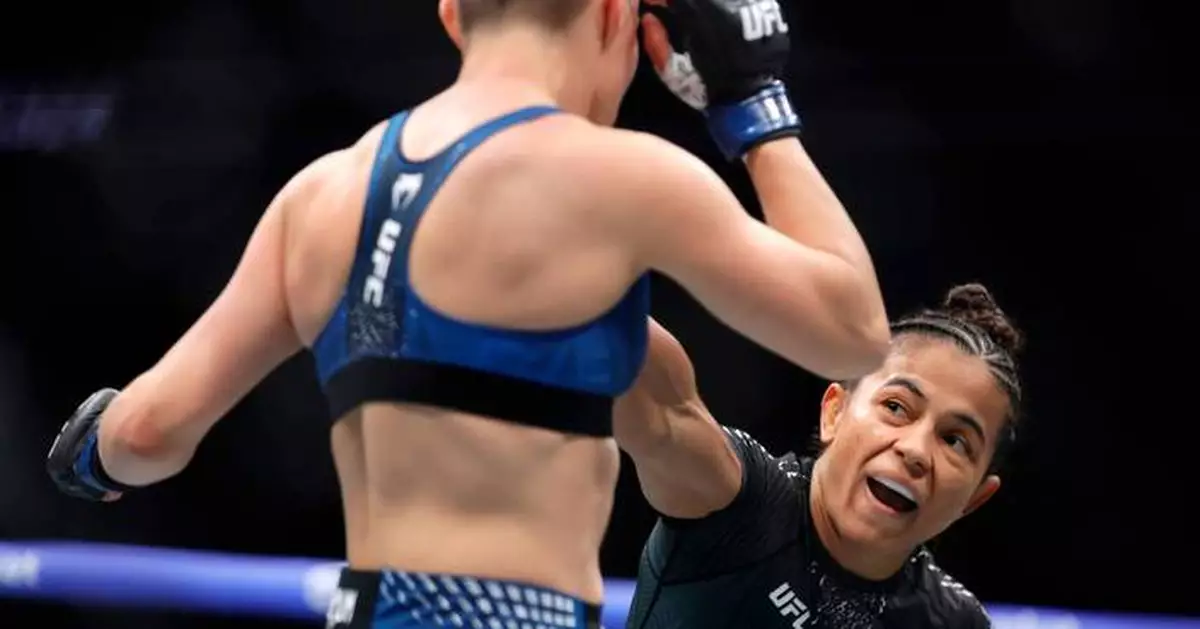
SALT LAKE CITY (AP) — Natalia Silva unanimously outpointed Wang Cong to claim the vacant UFC women’s flyweight championship Saturday night at UFC 332.
Silva (21-5-1) extended her winning streak to 15 bouts after largely dominating Wang (10-2) over five rounds.
“This is incredible for me,” Silva said. “I have worked hard for this moment and now I am the new (champion) and I am so so so happy.”
Silva went from challenger to favorite in the title bout after Valentina Shevchenko vacated the title nearly a month ago because of back and shoulder injuries. She proved far more aggressive than Wang early, using her speed, fluid movement, and strong legs to create an advantage.
Silva knocked Wang to the canvas midway through the second round with a sharp head kick. She kept Wang on her heels with her quick striking ability through the next two rounds and connected on other roundhouse kicks.
Wang fought back in the final round, but Silva landed enough blows to stay in control and had winning scores of 48-47, 48-47, 49-46 from the judges.
“I think if she had stepped on the gas a little earlier, it would have been a completely different fight,” UFC President Dana White said.
Payton Talbott earned a victory via TKO over Delveson Figueiredo with 2:51 left in the first round of the bantamweight bout billed as the co-main event.
Talbott (12-1) dominated Figueiredo (25-8-1) from the start of the fight. He put him on the canvas early with a right-handed strike and then delivered an elbow along the fence that sent Figueiredo reeling.
Talbott pressed his advantage, raining down blows and forcing his opponent to cover up until he forced a TKO.
“Definitely thought he was going to be more durable,” Talbott said.
It marked a successful return to the octagon for the Nevada fighter after going 10 months between bouts.
Talbott said he wished the latest bout had not ended so quickly.
“I wanted to just feel that war,” Talbott said. “I’m really happy to get the finish because it’s been a while since I got that finish. Deep down, that’s who I am. I chase finishes. But, yeah, I definitely wanted it to come a little bit later in the fight.”
Roman Kopylov defeated Ateba Gautier by TKO with 3:12 remaining in the first round of the middleweight bout that served as the first of three main card fights leading into the co-main event. Kopylov swarmed Gautier with several clean strikes before finally dropping him to the canvas with a left-handed blow. He earned his second UFC victory of the year while handing Gautier his second career defeat.
UFC newcomer Roberto Soldic debuted with a unanimous decision victory, scoring 29-28, 29-27, 29-27 over Khaos Williams in the welterweight bout. The fight lasted all three rounds, but Soldic dominated his opponent throughout with timely blows and bottled him up on the canvas at the end of each of the first two rounds.
Esteban Ribovics edged King Green by TKO with 52 seconds to go in the first round of the lightweight bout. Ribovics dropped Green to the canvas three times with well-timed strikes, overwhelming him after the third fall.
White reported a gate of $2.7 million for the event with 16,492 fans in attendance.
See AP’s full sports coverage here
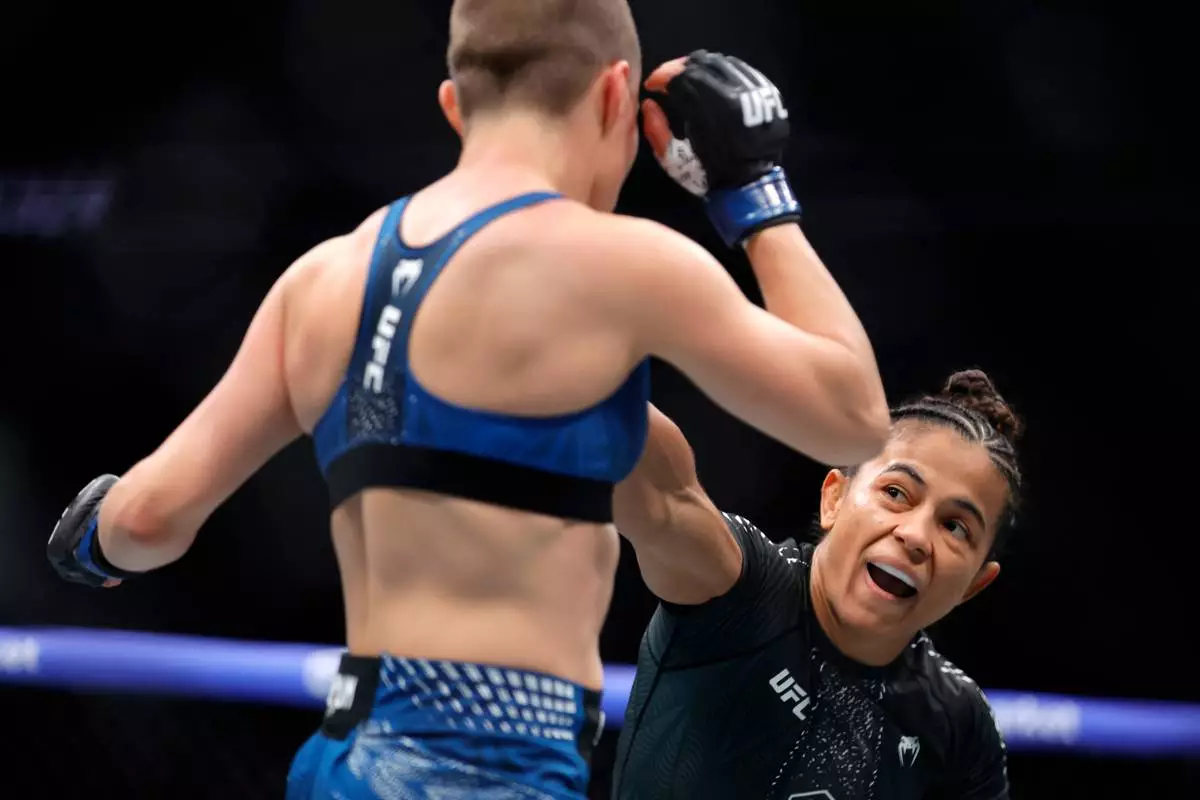
FILE - Natalia Silva, right, punches Rose Namajunas in a women's flyweight bout during the UFC 324 mixed martial arts event Saturday Jan. 24, 2026, in Las Vegas. (AP Photo/Steve Marcus, File)
SARAJEVO, Bosnia-Herzegovina (AP) — Bosnia holds a general election Sunday in which citizens of the multi-ethnic Balkan nation are focused on everyday problems, while some mainstream politicians are whipping up war-era tensions that have kept the country divided since its brutal 1992-95 conflict.
Once polls open at 7 a.m. local time, around 3.4 million voters in Bosnia will choose three multi-ethnic presidency members, lawmakers for the national Parliament and heads of institutions for the country's two entities, the Federation of Bosnia and Herzegovina and Republika Srpska.
The complex network of institutions was created in a U.S.-brokered peace agreement that ended the war.
Taking center stage in the contest is a staunchly pro-Russian politician who, despite not appearing on the ballot, has dominated the campaign and inflamed divisions that have sparked fears of renewed instability.
Milorad Dodik, the separatist and nationalist former president of the Serb-majority Republika Srpska, has been banned from holding public office after being convicted of defying decisions by the international envoy overseeing the 1995 peace agreement.
Just back from a trip to Moscow where he met with Russian President Vladimir Putin, Dodik's party, the Alliance of Independent Social Democrats, is likely to win the election in Republika Srpska.
At his party's final election rally Friday night in Banja Luka, Republika Srpska's administrative capital, Dodik told supporters that Bosnia “is dead."
"It is an impossible country. It doesn’t make any sense,” Dodik said at the rally, which was also attended by the Russian ambassador to Bosnia and Herzegovina, Igor Khalabukov.
Dragan Bursac, an analyst, said despite Dodik not appearing on the ballot for the first time in nearly 30 years, he “is still in command. He is everywhere.”
“He is all over the media, not only in the entity of Republika Srpska, but in all of Bosnia and Herzegovina. It is obvious that these measures to ban him from political life are not working, and he is using them,” Bursac said.
While Bosnia has been peaceful in recent years, its politicians have kept alive the divisions between the country's Bosniaks, who are mainly Muslim, and its Serbs and Croats. Bosnian Serb leaders like Dodik have pushed for the separation of their entity from the rest of Bosnia, which has led to concerns among Western countries that tensions could once again spill over.
One of the poorest countries in Europe, Bosnia is still struggling to recover decades after the war that started in 1992 after Bosnia declared independence from the Serb-led former Yugoslavia and ethnic Serbs took up arms to carve out their own state and join Serbia.
The conflict killed more than 100,000 people and displaced millions.
Bosnia is formally seeking to join the European Union, but progress toward membership has been stalled despite EU efforts to encourage Bosnia's divided leaders to work together for reform.
Ahead of Election Day, Durak Miler, a resident of the Bosnian capital of Sarajevo, said governing politicians “just poison people when they talk.”
“We should change the old faces,” he said. “They have been governing for 35 years ... I think whoever comes next will work better for retired people and the poor.”
The country's wartime wounds were recently revived by a public homage in Serbia and among Bosnian Serbs to the wartime army commander Ratko Mladic, who died in late August while serving a life sentence for genocide and other war crimes.
Bosnian Serbs view Mladic as a hero despite his conviction by a U.N. court over the massacre of more than 8,000 Muslim men and boys in Srebrenica in 1995, and other atrocities.
Key Bosnian Serb officials attended the funeral service for Mladic in Belgrade that sparked harsh EU criticism and angered Bosniak politicians.
In an important change to Bosnia's elections, authorities for the first time will use electronic identification of voters and scanning of ballots to prevent any irregularities or organized voter manipulation that has cast doubt on the fairness of previous elections.
Salko Bijavica, from the southern town of Mostar, said he is glad that “every vote will be counted,” and that the change will give “hope to people that elections will be fair.”
Most of Bosnia's 75 political parties running in the election are organized along ethnic lines in the country's Serb-controlled Republika Srpska and the Bosniak-Croat Federation of Bosnia-Herzegovina. The two entities are bound together by the central presidency and Parliament.
The Bosniak nationalist Party of Democratic Action has focused its campaign on efforts to keep Bosnia united against Serb separatism. Bosnian Croats, too, largely support their ethnic parties, including the Bosnian branch of Croatia's ruling conservative Croatian Democratic Union.
Polls will close at 7 p.m. local time.
Many disillusioned citizens say politicians are using nationalism to avoid solving important problems such as poor living standards and an exodus of youth from the country.
Ivan Silic, from the southern town of Mostar, said: “I don’t see that anything is getting better, from the moment I started to vote.”
“We all know who lives well,” he said. "It is better for (politicians), and for the rest of us everything is the same.”
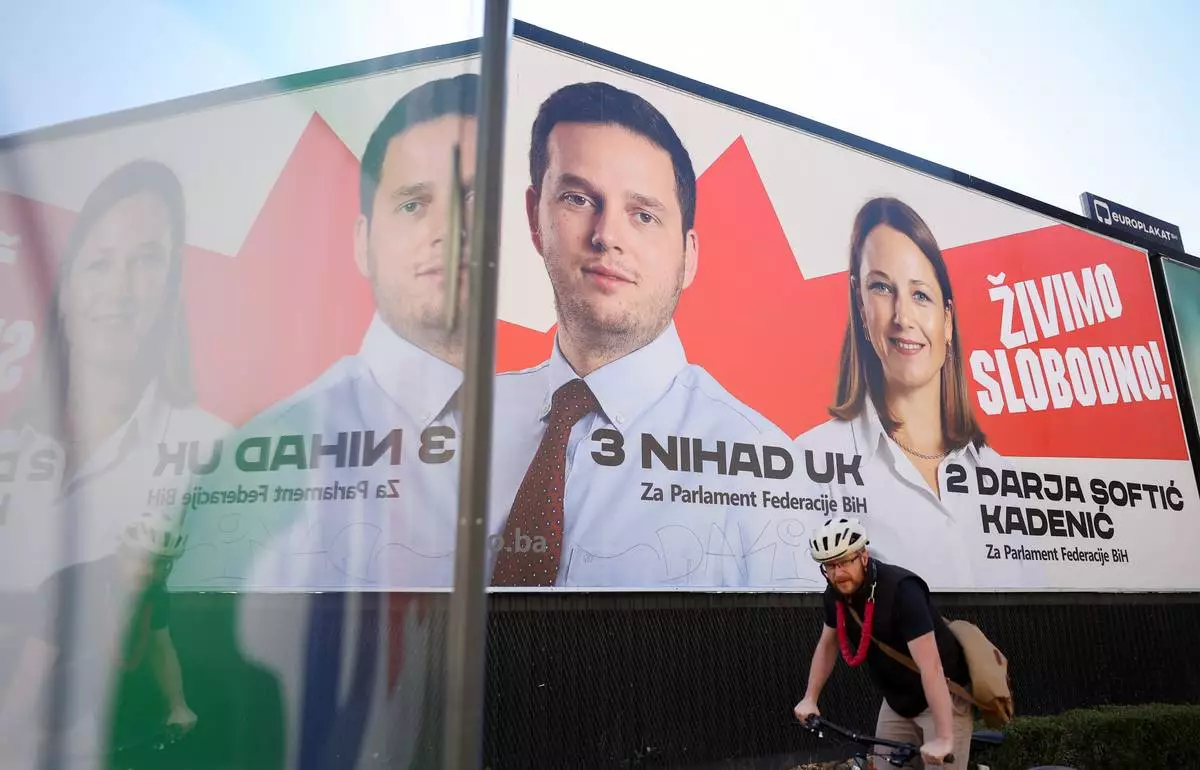
A man rides a bicycle beneath an election poster featuring Our Party (NS) candidates for the upcoming general elections in Sarajevo, Bosnia, on Sept. 29, 2026. (AP Photo/Armin Durgut)
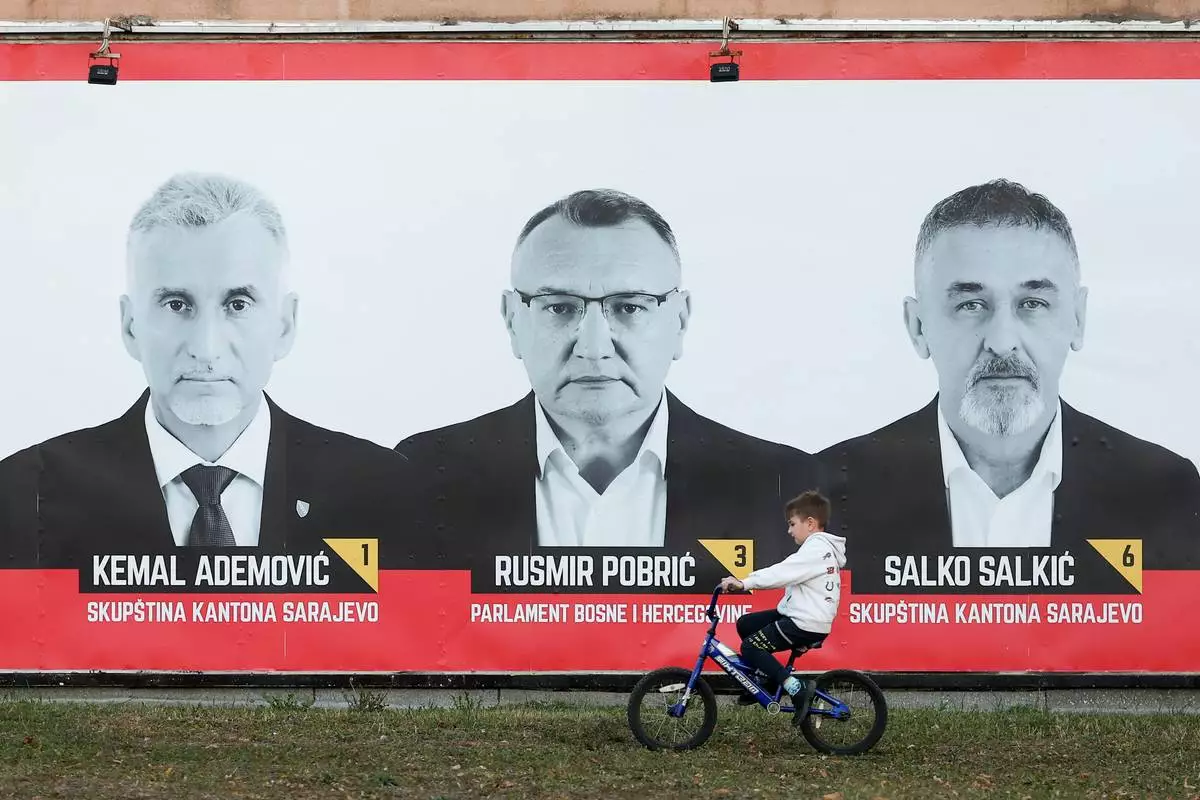
A boy rides a bicycle past an election poster featuring Red Lines (CL) candidates in the upcoming general elections in Sarajevo, Bosnia, on Sept. 30, 2026. (AP Photo/Armin Durgut)
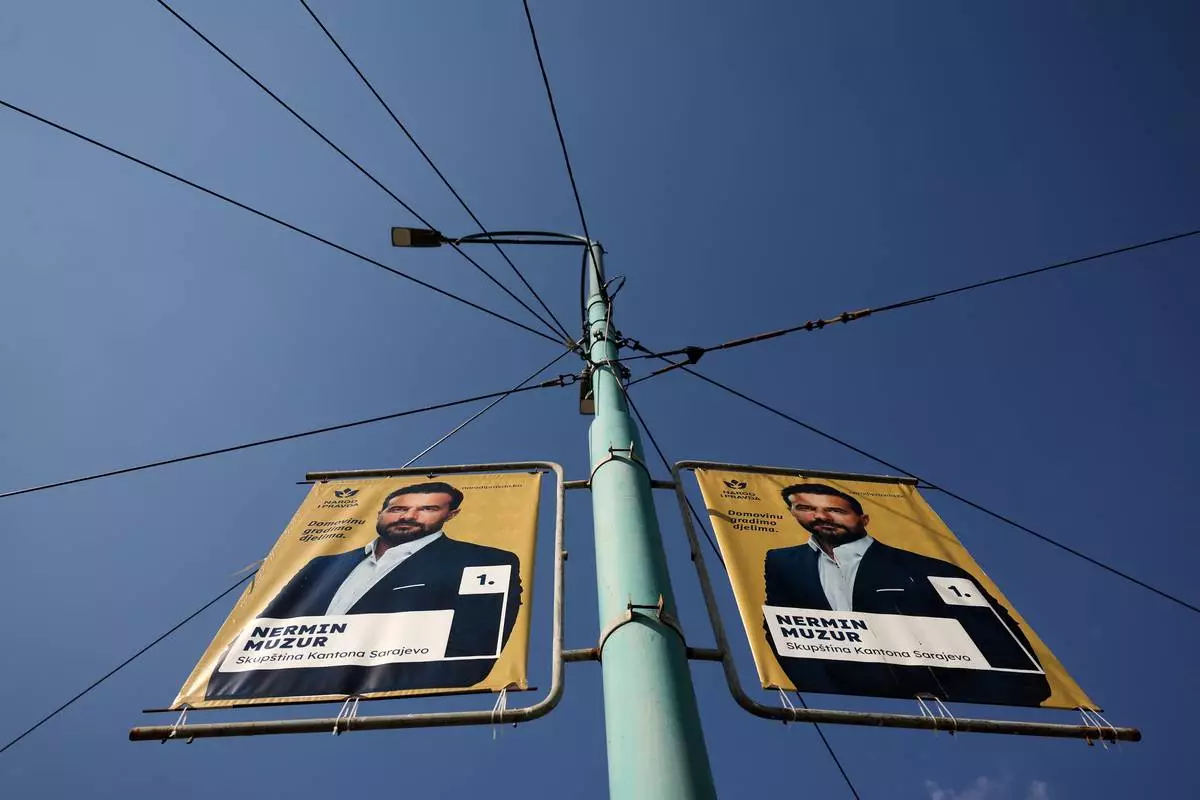
An election poster featuring Nermin Muzur, People and Justice Party (NiP) candidate, hangs from a pole ahead of the upcoming general elections in Sarajevo, Bosnia, on Sept. 29, 2026. (AP Photo/Armin Durgut)
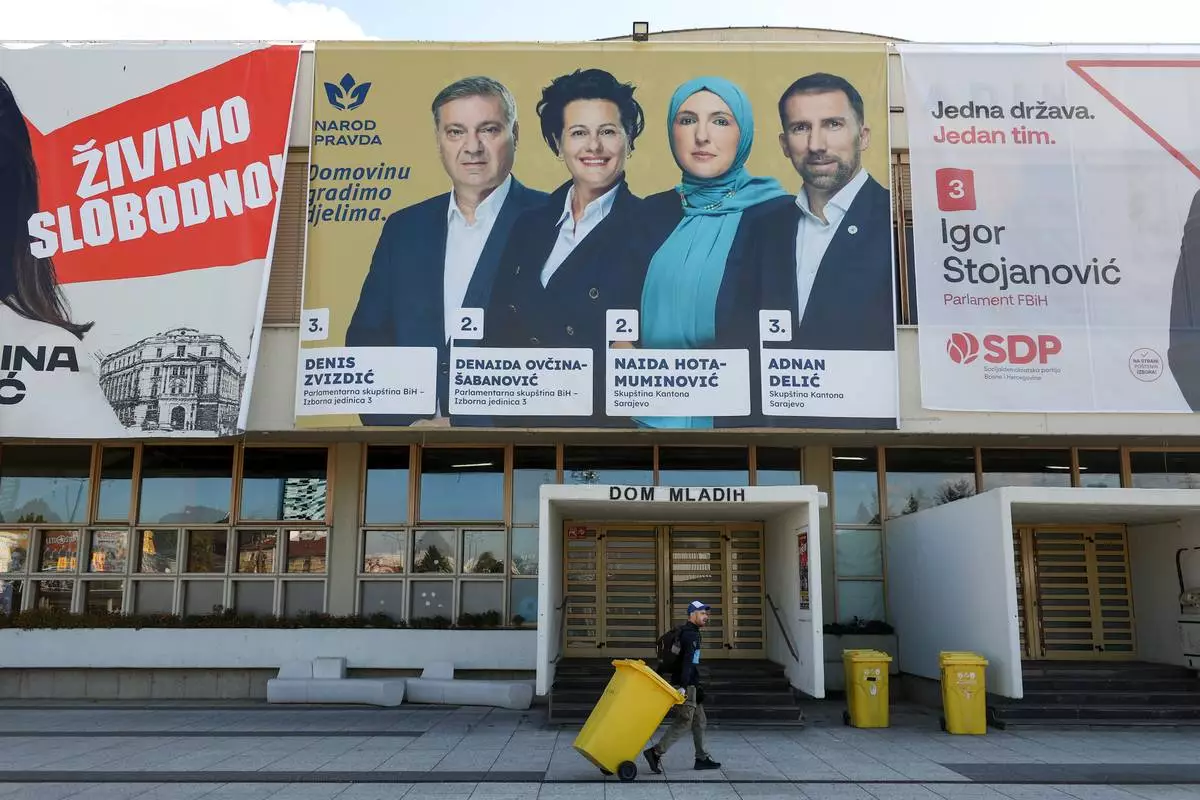
A man walks beneath an election poster featuring People and Justice Party (NiP) candidates for the upcoming general elections in Sarajevo, Bosnia, on Sept. 29, 2026. (AP Photo/Armin Durgut)
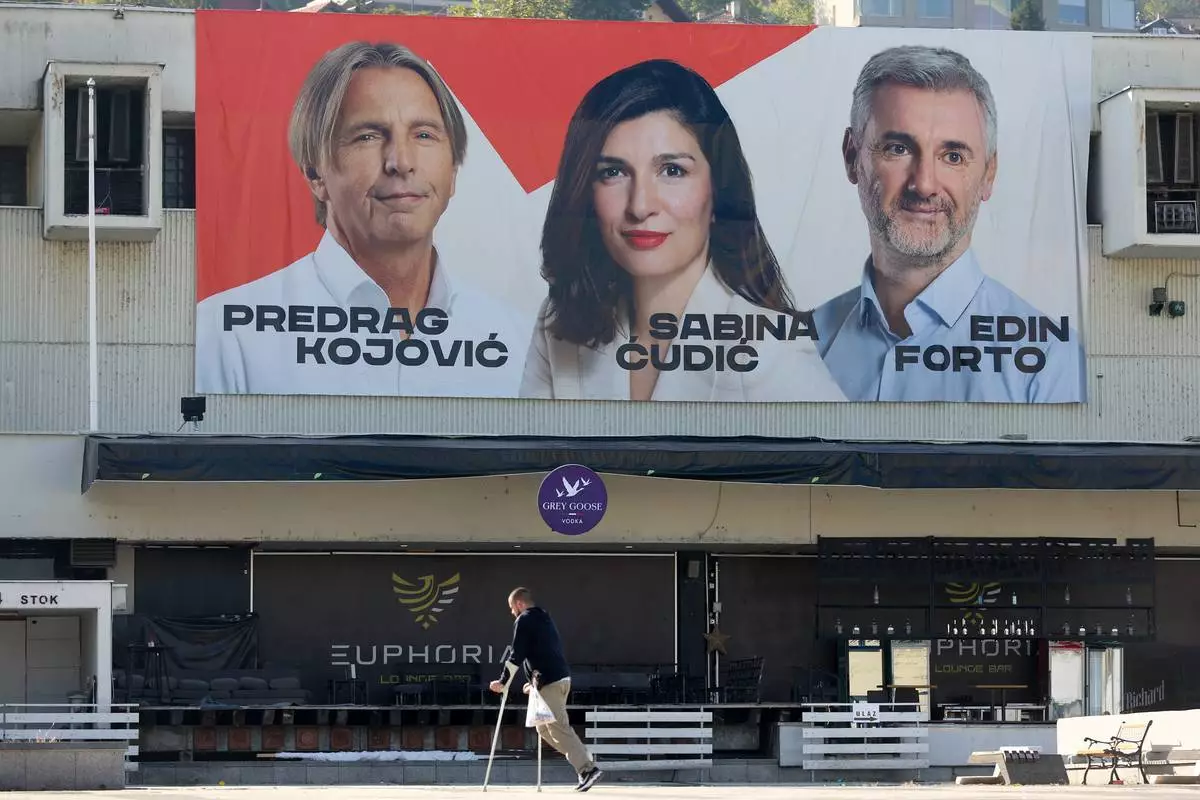
A man walks beneath an election poster featuring Our Party (NS) candidates for the upcoming general elections in Sarajevo, Bosnia, on Sept. 29, 2026. (AP Photo/Armin Durgut)