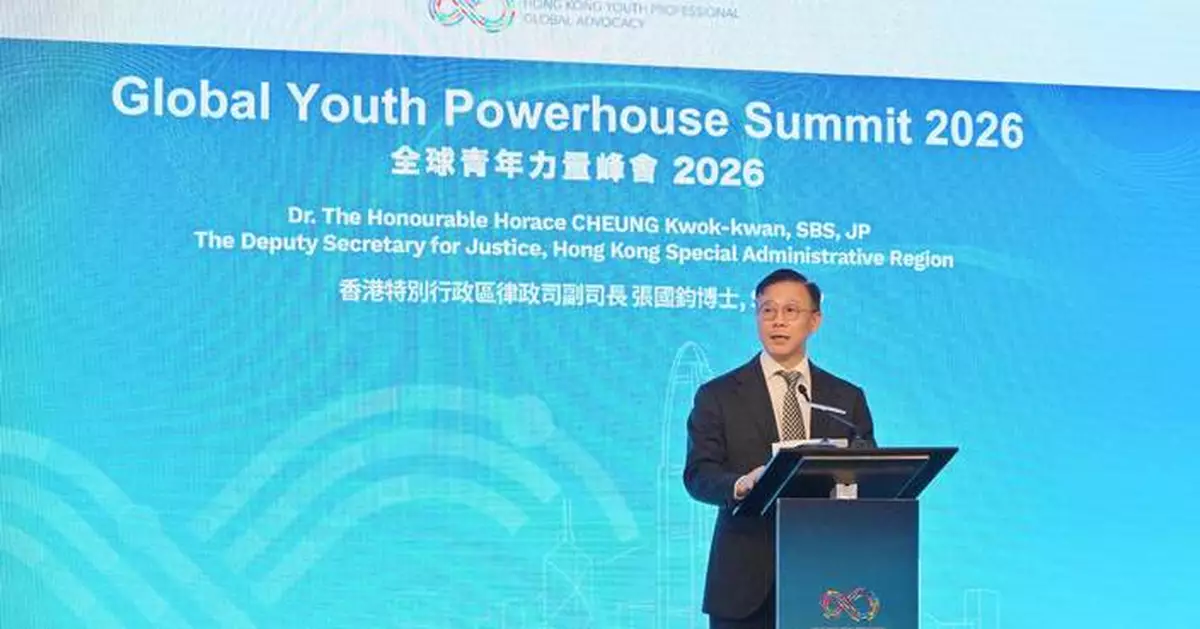
Opening keynote address by DSJ at Global Youth Powerhouse Summit 2026
Following is the opening keynote address by the Deputy Secretary for Justice, Dr Cheung Kwok-kwan, at the Global Youth Powerhouse Summit 2026 today (October 5):
Dr Kevin Lau (Founding Convenor of the Hong Kong Youth Professional Global Advocacy), distinguished guests, ladies and gentlemen,
It is my great pleasure to join you all today at the Global Youth Powerhouse Summit 2026. I would like to extend my warmest congratulations to the Hong Kong Youth Professional Global Advocacy for another year of outstanding dedication in empowering our next generation.
"Change is the only constant". This ancient Greek saying was once popularised in Hong Kong through the verse, "", from a Cantopop classic in the late 1970s. I am sure that this saying still strikes a familiar chord with our young audience today – not so much because you know the song, but because changes are, like it or not, ever-present. The key difference between now and then is that we no longer measure the pace of change in terms of centuries, decades, or years – but months, weeks, days or even hours.
But where there is change, there is opportunity, and it is always reserved for the well-prepared. I am pleased to say that Hong Kong is getting ourselves ready. The National 15th Five-Year Plan supports Hong Kong in consolidating and enhancing its status as an international centre for finance, trade, maritime, innovation and technology, as well as legal services and dispute resolution, among other initiatives. Our inaugural Five-Year Plan released recently has also unveiled the blueprint for Hong Kong to enhance our global competitiveness, with details of visionary projects such as the Northern Metropolis.
These upcoming initiatives create new opportunities for young professionals across various fields. Let me share some examples with you.
First, consider the development of the Greater Bay Area (GBA). The First Five-Year Plan and the Chief Executive's Policy Address this year place strong emphasis on accelerating the GBA's development. With a host of initiatives to promote connectivity within the GBA, from physical infrastructure, professional standards to sports and cultural development, we are striving to create seamless connections with fewer barriers and more opportunities. In particular, I am tasked by the Chief Executive to chair a Task Force (GBA Task Force) to expedite the alignment of rules and mechanisms in the GBA. For you, this means immense potential for professional growth and cross-boundary engagement.
Another opportunity for Hong Kong professionals is to assist Mainland enterprises in going global. As Chinese companies expand internationally, they require world-class legal, financial, and other professional support. Our department, the Department of Justice, has been working closely with our Mainland counterparts to connect our professionals with promising Mainland enterprises. This is your chance to be the "super-connector" and "super value-adder", guiding these enterprises into the global marketplace.
Furthermore, we are embracing the power of technology and AI. Regardless of your specialties, professionals need to acquaint themselves with new technologies to enhance productivity and client experience. As a quick illustration from my own field - the legal profession: AI-powered legal tools have been blossoming in recent years, offering a wide range of services from legal research and drafting to practical management. We will therefore launch a short-term fundraising to promote the wider adoption of lawtech such as AI in the legal sector, in order to enhance our profession's competitiveness.
So the key takeaway today is very straightforward: step outside of your comfort zone, and embrace changes and opportunities. The future of our city and our world will be shaped by your dedication and contributions today. I wish you all a most fruitful Summit. Thank you very much.
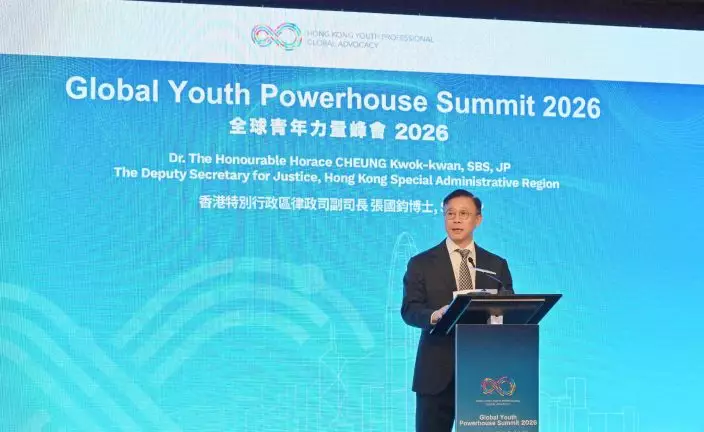
The Deputy Secretary for Justice, Dr Cheung Kwok-kwan, speaks at the Global Youth Powerhouse Summit 2026 today (October 5). Source: HKSAR Government Press Releases
A hot and relatively dry September
Attributed to the stronger-than-normal upper-air anticyclone over southern China, September 2026 was hotter and drier than usual. The monthly mean minimum temperature of 27.1 degrees was 1.0 degree above the normal and the fifth highest on record for September. The monthly mean temperature of 28.8 degrees and mean maximum temperature of 31.8 degrees were 0.9 degree and 1.3 degrees above their respective normals and both were one of the 10th highest on record for September. Moreover, the monthly mean relative humidity of 74 per cent was four percentage points below the normal of 78 per cent and was one of the sixth lowest on record for September. Rainfall in the month was only 94.3 millimetres, about 29 per cent of the normal of 321.4 millimetres. The accumulated rainfall in the first nine months of the year was 2 451.9 millimetres, about nine per cent above the normal of 2 242.8 millimetres for the same period.
After Saudel re-intensified into a tropical depression on the last day of August, it moved northeastwards across the northern part of the South China Sea on September 1 and skirted about 200 kilometres southeast of Hong Kong. It further intensified into a tropical storm on the next day before making landfall over Zhangzhou, Fujian, on the morning of September 3. It then moved across the eastern part of inland Guangdong and weakened gradually. Locally, under the combined effect of Saudel and the northeast monsoon, there were occasional strong winds offshore and on high ground on September 1. There were occasional squally showers and thunderstorms. Around 20 millimetres of rainfall were generally recorded over the territory, and rainfall even exceeded 40 millimetres over the eastern part of the New Territories. With the departure of Saudel, showers decreased and there were sunny intervals during the day on September 2 and 3.
Winds over Hong Kong were weak during the next five days. Apart from isolated showers, local weather became generally fine on September 4 and 5. However, a band of clouds covered Guangdong on September 6 and brought a few showers to the territory. There were more showers in some areas in the morning. Around 10 millimetres of rainfall were recorded over many places, and rainfall even exceeded 40 millimetres over the northeastern part of the New Territories. Under light wind conditions, daytime heating triggered showers over inland Guangdong the next day. The heat-triggered showers moved southwards and affected the territory that afternoon with more than 20 millimetres of rainfall recorded over Yuen Long and Tsuen Wan Districts. With the thinning out of the cloud bands, the weather of Hong Kong turned mainly fine apart from isolated showers on September 8.
The northeast monsoon affected southern China in the next four days. Locally, the weather was dry during the day with a mixture of sunny periods and a few showers. Showers were heavier with more than 20 millimetres over North District on the morning of September 10. Under the showers in the small hours on September 11, the temperature at the Observatory dropped to a minimum of 25.5 degrees, the lowest of the month. With plenty of sunshine, it was very hot on September 12. Under the combined effect of a strong northeast monsoon and a tropical depression over the seas to the east of Vietnam, local winds strengthened gradually on September 12 and persisted until the next day. Local weather was mainly cloudy with sunny intervals and a few showers on September 13.
The northeast monsoon moderated on September 14 and a band of clouds over the coast of Guangdong brought a few showers to the territory. Showers were heavier in some areas with thunderstorms. More than 40 millimetres of rainfall were recorded over parts of the North District, Tuen Mun and Kowloon. Under the influence of a replenishment of the northeast monsoon, local weather was mainly cloudy with a few showers on September 15 and became generally fine on the following two days. It was dry in the afternoon of September 17. Affected by an anticyclone aloft, local weather remained dry during the day and generally fine from September 18 to 20. It was very hot on September 19 and 20.
Winds were weak over the coast of Guangdong on September 21. Locally, it was still very hot with sunny periods. Upper-air disturbances brought a few showers and thunderstorms to the territory on September 22. Around 5 millimetres of rainfall were recorded over Hong Kong Island and parts of the New Territories East. Under the influence of the northeast monsoon, the weather of Hong Kong was generally fine apart from isolated showers in the mornings on September 23 and 24. The northeast monsoon moderated and an anticyclone aloft continued to bring mainly fine weather to the coast of Guangdong from September 25 to 30. Local weather remained dry during the day and generally fine during the last six days of the month, apart from isolated showers from September 28 to 30. It was also very hot on September 29 and 30. With abundant sunshine, the temperature at the Observatory rose to a maximum of 34.2 degrees on the afternoon of September 30, the highest of the month.
Seven tropical cyclones occurred over the South China Sea and the western North Pacific in September 2026.
Details of the issuance and cancellation of various warnings/signals in the month are summarised in Table 1. Monthly meteorological figures and departures from normal for September are tabulated in Table 2.
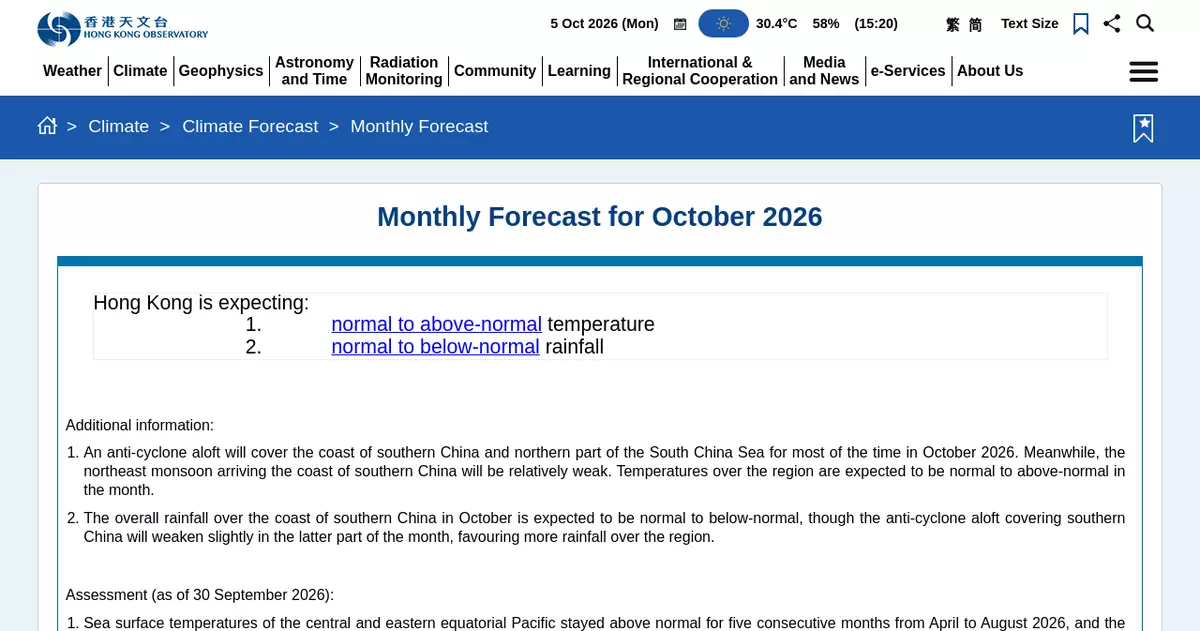
Please refer to the following link for the latest monthly forecast: Monthly Forecast.
Source: AI-found images