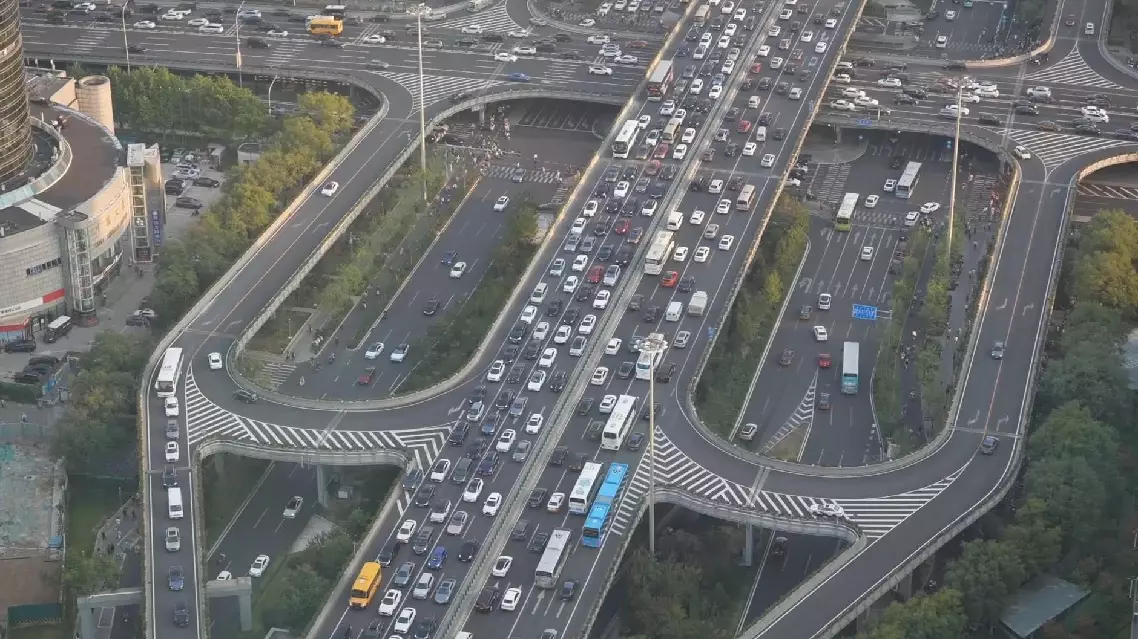
Beijing's Guomao area, the heart of the city's central business district, has undergone a redesign since late 2025 to allow more space for people, showcasing the capital's urban renewal plan.
The area now boasts a nearly one-kilometer-long walkway beneath the bridge, flanked by lush greenery that screens out horns and exhaust fumes.
As one of Beijing's heaviest traffic, business, and finance centers, Beijing's Guomao area is long known as a CBD tangled with overpasses and surrounded by skyscrapers, with the Guomao Bridge cutting through the center. Part of Beijing's urban renewal plan is to improve such a congested area through integrated governance across transportation, spatial design, urban functions, and public wellbeing.
Ma Weiguo, a section chief with the Chaoyang District Urban Management Commission who was deeply involved in the renewal project, explained why the redesign was needed.
"The original space beneath the Guomao Bridge, including the main bridge and ramps, covered more than 50,000 square meters. It was used for bus operations, car parking, and sanitation facilities. The constant movement of vehicles and people added to traffic, environmental, and management challenges in the area. So there was an urgent need for a comprehensive transformation," he said.
Starting in 2025, Ma and his team proposed opening up the space beneath the bridge. Their goal was simple: create space for people amid the capital's most congested traffic.
"West of the Guomao Bridge is the Guomao Subway Station, one of the busiest stations in Beijing. Before the renovation, this area was divided into three sections: space for subway passengers, a right-turn lane, and the space beneath the bridge. We integrated all three into one unified design. And this is what it looks like today," Ma said.
Beyond the bridge itself, Ma's team carved out additional pathways and mini parks for pedestrians, cyclists, and residents to enjoy their lunch breaks, reclaiming space for a more balanced urban life.
"Across the Guomao Bridge area, the space around subway entrances has increased nearly tenfold. We also used underused spaces in the area to create hidden bicycle parking areas, adding about 4,000 square meters with room for 1,400 non-motorized vehicles. But this kind of transformation was far from easy. We had to coordinate people, vehicles, roads, and the environment," Ma said.
"This is one of the spaces we have completed," Ma said, referring to a well-organized intersection with generous room for bike parking and pedestrians.
Beijing's Guomao CBD gets people-first makeover with new walkway, greenbelt