Hailed as the cradle of China's automotive industry, Changchun in northeast China's Jilin Province is turning its industrial heritage into a driver of growth, as city authorities breathe new life into old factories and neighborhoods.
For generations, the industrial landscape has defined Changchun. In 1956, the country's first domestically-built vehicle -- the Jie Fang CA10 truck -- rolled off the assembly line in the city. Seventy years on, many of the early factory buildings are still standing and have taken on a new life.
Sun Weida has worked for more than a decade as a maintenance technician at China's leading automaker FAW Group, which produced the CA10. He has seen firsthand how the industry has changed.
"In the past, we frequently relied on traditional approaches such as dismantling and reassembling equipment, which involved a lot of manual work. Now, however, we primarily use AI models. That has made our work more efficient and helped improve productivity," he said.
The numbers tell the story. At the Hongqi Prosperity Factory, stamping production is more than 70-percent automated, and a vehicle can roll off the line within one minute.
Yet, according to the company, it seeks not just to manufacture more cars but to make better ones. Zhang Qiang, Director of the Technology Innovation Management Department at the FAW Research and Development General Institute, said the company has made breakthroughs in electrification, intelligent driving, smart cockpits and intelligent chassis.
Zhang said that in terms of the intelligent chassis, the company has mastered key technologies like virtual dynamics development and chassis domain control. He stressed that the company will keep investing in new technologies to deliver safer, more comfortable and more convenient driving experiences.
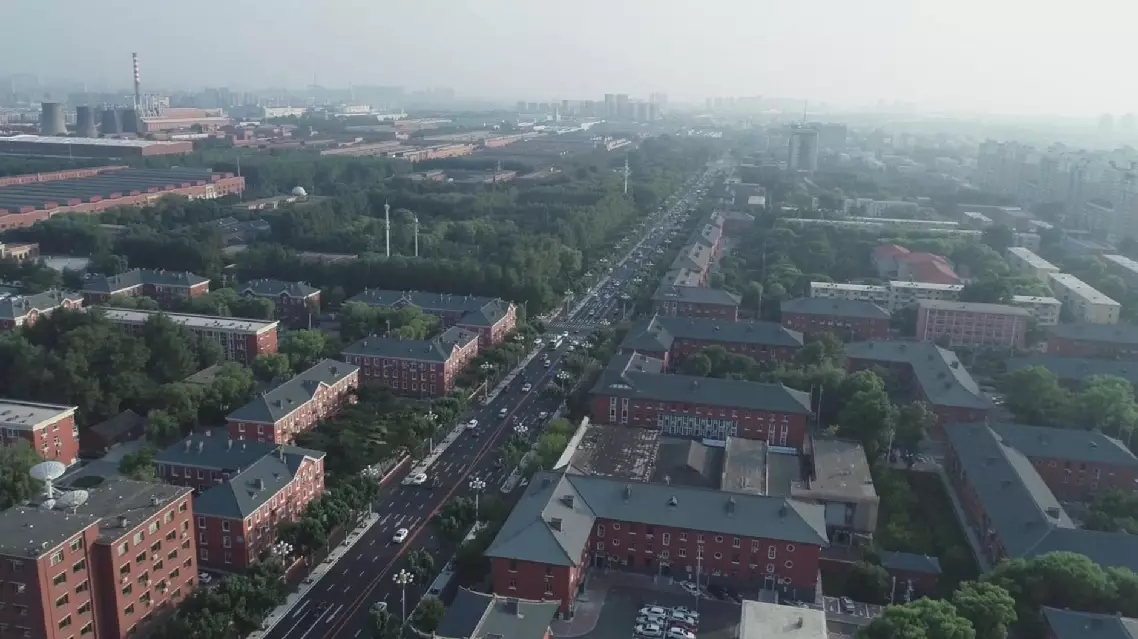
Those kinds of investments have already begun to pay off for communities in Changchun. As the industry in the city continuously upgrades, the old neighborhoods around the factories are being renewed, with better public services, more green spaces, improved community facilities and a subway line now running nearby.
"I've been living here for more than 20 years, from young to adult, and the neighborhood has changed a lot," said Du Li, a resident.
Du said that the old buildings have been carefully preserved while the facilities and services around them continue to improve, making residents' daily lives much more convenient.
The renewal has also opened up new opportunities for Changchun. In 2024, the city launched a tourism route built around its auto heritage. From museum exhibits to smart production lines, visitors can see how China's auto industry has evolved.
"FAW's old factories and residential buildings stand as tangible witnesses to the beginning of the automotive industry of New China and are a unique part of Changchun's industrial heritage. We want to preserve their history while giving these spaces new life," said Yang Jiuliang, Director of Cultural Tourism of FAW Asset Management Co., Ltd.
Yang said the company wants to turn these buildings into places where people can visit, learn and experience something for themselves. He hopes visitors leave with a deeper understanding of the city, or perhaps a real connection to it.
For Changchun, industrial heritage is not a burden from the past, but an asset for the future, helping drive new industries while making the city a better place to live and visit.
Birthplace of China's automotive industry revives its industrial heritage