TORONTO--(BUSINESS WIRE)--Oct 5, 2026--
Meet Al Gorithm. He looks like a person. He sounds like a person. But he isn’t a journalist.
This press release features multimedia. View the full release here: https://www.businesswire.com/news/home/20261005151510/en/
Al is the face of this year’s National Newspaper Week campaign, running October 4–10 across Canada. This fictional character was created to make a simple point: as AI-generated content becomes more human-looking and human-sounding, it can be harder to tell whether a person is actually behind the information we see.
The campaign presents Al as a real person to encourage Canadians to look more closely at who, or what, is behind the news and information they see.
“Al Gorithm looks like a real person for a reason,” said Kelly Levson, Director of Marketing and Research, News Media Canada. “We want people to stop and ask: Who reported this? Who checked it? And who is accountable for it?”
That distinction matters: 78% of Canadians are concerned about fake news and disinformation.
“Technology can generate copy in seconds, but journalism is about more than producing words on a page. The human work is what gives credible journalism its value,” said Paul Deegan, President and CEO, News Media Canada.
Every day, journalists across Canada attend council meetings, cover local events, talk to residents and business owners and follow stories as they develop. Much of that work happens long before a story is published.
The recently released 2026 Canadian Community Newsmedia Awards ( CCNAwards ) put that work on display. The winning reporting, photography and storytelling reflect the kind of locally rooted journalism that keeps readers informed, connected and engaged with their communities.
Newspapers continue to connect with a broad audience. News Media Canada’s Newspapers 24/7: 2026 research found that 83% of Canadians read newspaper content each week, in traditional or online formats.
Canadians can support local journalism by reading their local newspaper in print or online, subscribing where possible, sharing trusted reporting and supporting businesses that advertise in local media.
National Newspaper Week runs October 4–10, 2026, and in Canada recognizes the journalists and newspapers that keep communities informed, connected and engaged. This project has been made possible in part by the Government of Canada.
For more information, visit nationalnewspaperweek.ca.
About News Media Canada
News Media Canada is the voice of the print and digital news media industry in Canada and represents hundreds of trusted titles in every province and territory.

National Newspaper Week Asks Canadians Who Is Really Behind the News
A trip to the park. A day at the beach. A workout session at the gym. All in public spaces where smart glasses can snap photos, record conversations or stream video online — without people in the line of their lenses and microphones knowing about it.
Norway's government wants to get a handle on both the promise and peril of AI glasses and is proposing that parliament enact a temporary ban on them in some places.
It's the latest sign of growing concern in many countries about new technologies that are fundamentally changing the way people live. Some governments have banned the use of social media by children and young teens.
Norway’s government said the proposal for the temporary ban will be made to parliament, the Storting, “as soon as possible.”
A key question is where to draw the line.
Norwegian authorities say a ban on the use of smart glasses could apply to places where “privacy is particularly important,” like healthcare facilities, or fitness centers with changing rooms and showers. A major focus is spaces where children congregate, such as schools, kindergartens, playgrounds and youth clubs.
But it could extend to public concerts and sports events, plus parks, beaches, museums and shopping centers.
A temporary ban would give authorities time to decide what types of devices might be affected, and debate whether permanent regulation is needed. The government was quick to note that it was not proposing a total ban and said such devices should still be allowed in some places and for private use.
The government also said it was considering exceptions to a ban for vulnerable groups, so that “socially beneficial uses” of smart glasses could be permitted in some circumstances.
Adam Smith, a technology advocacy officer at Britain-based Privacy International, said Norway's move was "a welcome protection against big tech’s greedy attempts to extract ever more data, often in absence of any thought for the privacy or rights of others.”
“No reality exists in which people expect to be secretly surveilled going about their daily lives,” he said.
One effort to rein in the use of AI glasses has run aground — in the home of Silicon Valley.
California's governor last week vetoed legislation that would have penalized the use of smart glasses to record people without their permission in places like changing rooms, doctor’s offices and other spaces people generally consider private.
Meta, the company behind Facebook, WhatsApp and Instagram that has rolled out AI glasses with eyewear vendor Ray-Ban, encourages respect for privacy and advises customers on how to use the glasses responsibly.
“Respect people’s preferences. Not everyone loves being photographed. Stop recording if anyone expresses that they would rather you not,” Meta wrote on its site.
The tech giant based in Menlo Park, California, says a light on the glasses indicates when recording in underway, and if the glasses detect that the light has been blocked or physically tampered with, the camera is automatically disabled.
Despite such advice and assurances, some privacy advocacy groups cite a growing backlash against AI glasses.
Hans Anders, a prominent eyewear retailer in the Netherlands, has suspended sales of the Ray-Ban Meta glasses.
“This decision follows the ongoing public and political debate surrounding smart glasses and the questions being raised about the conditions under which this technology can be used,” Hans Anders said in a statement, suggesting that it plans to await the outcome of the debate before making a final decision.
In Britain, the UK Cinema Association said in August it was introducing policies to prohibit or restrict the wearing of camera-enabled smart glasses, citing concerns about privacy and film piracy through the use of such technology.
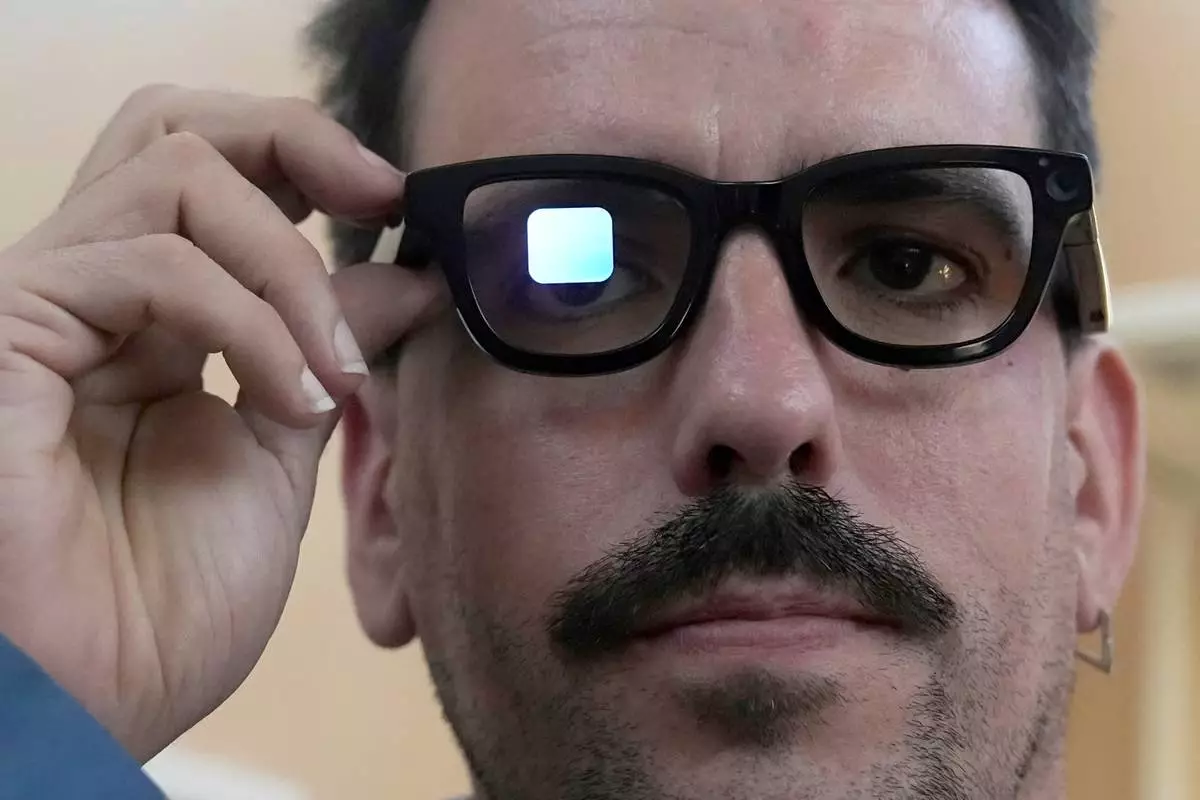
FILE - Michael Mcloughlin, of El Confidencial, gets a demonstration of Gemini on Android XR glasses at a Google I/O event in Mountain View, Calif., Tuesday, May 20, 2025. (AP Photo/Jeff Chiu, File)