WASHINGTON--(BUSINESS WIRE)--Oct 5, 2026--
EQUS, a company building the trust layer between people and the AI that acts for them, today announced EQUS X, a personal AI that enables customers to retain control of their own data.
This press release features multimedia. View the full release here: https://www.businesswire.com/news/home/20261005164880/en/
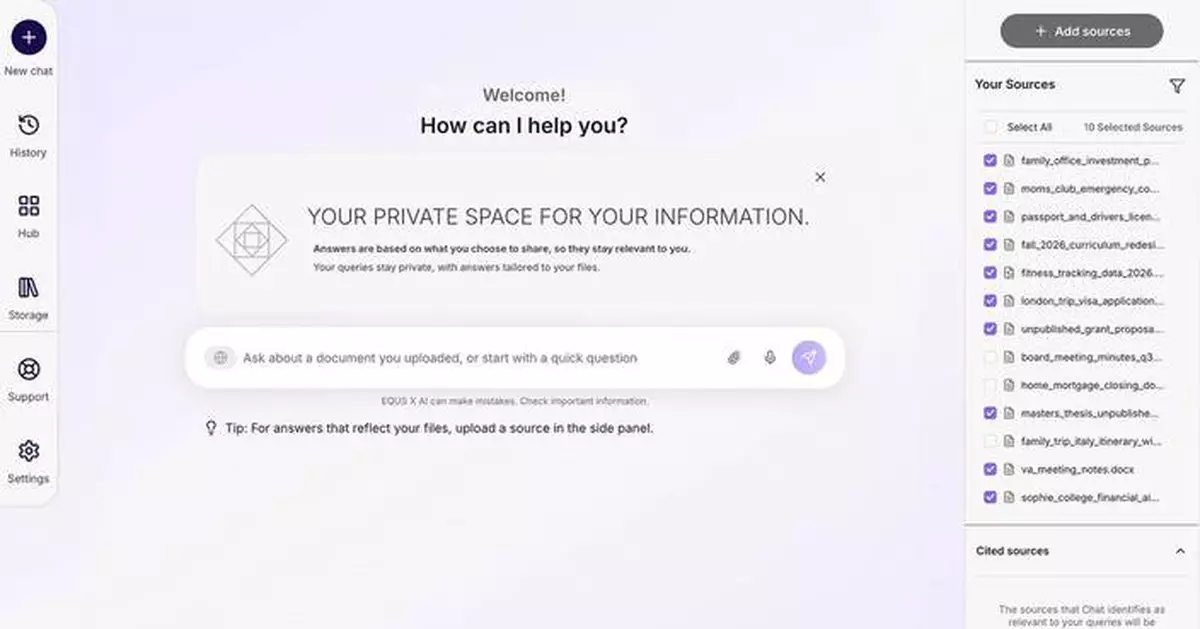
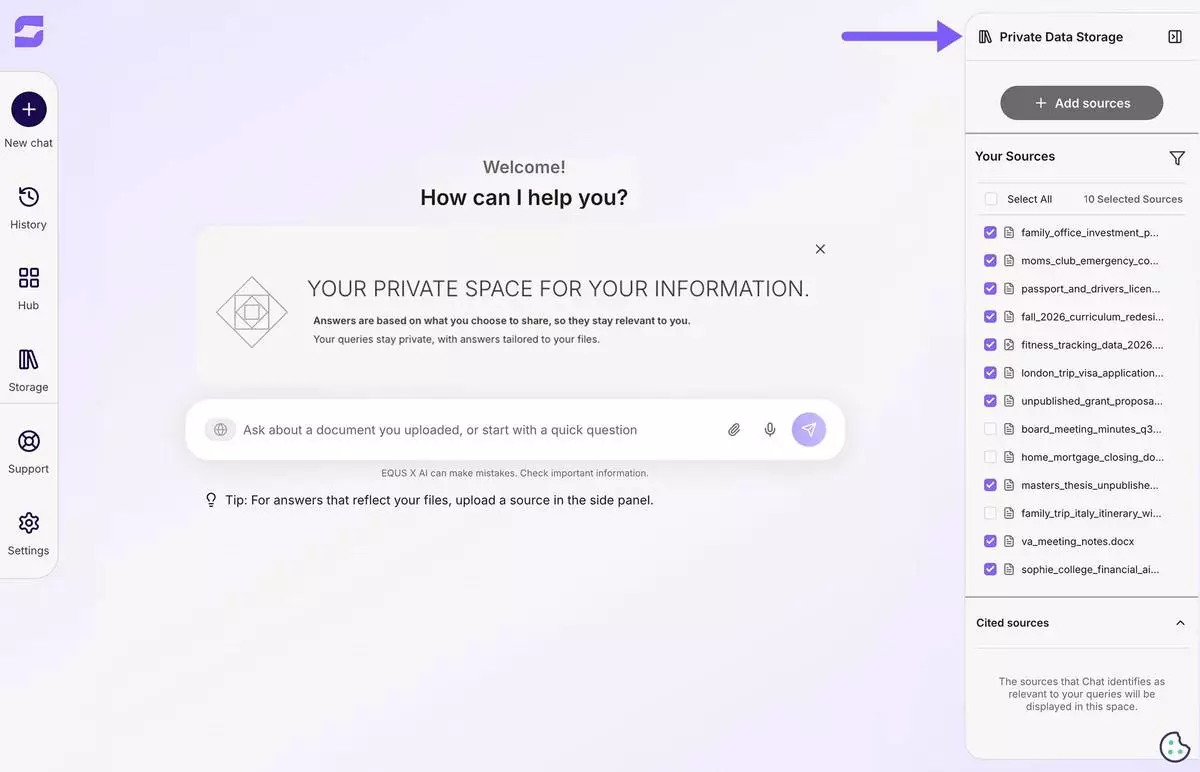
EQUS X pairs a personal AI with private data storage the user controls. Nothing is read by AI unless the user allows it, file by file, and they can turn off that access at any time. What the AI learns is kept in that private data storage rather than on a model provider's servers. The Daily Brief draws on the files in their storage as well as the accounts they connect like mail and calendar, to pull together plans, open items, conflicts, and what needs attention for the day ahead.
EQUS is accepting EQUS X Priority Access requests today, ahead of general availability later this month, and is free through the end of 2026. It is a platform with no ads, no data mining, no use of personal information for training, and the company will not resell any data.
“Most AIs now on the market require you to trade data ownership for speed and usability. To EQUS, that trade is unwarranted and most likely, short-lived,” said Sandy Carter, CEO of EQUS. “Customers want a personal AI that helps without taking something from them in return. We built EQUS X so that users can decide what the AI knows, one input at a time, and revoke information whenever they want. Your data is not our business.”
The architecture created by EQUS for EQUS X is not new work. It comes from years of EQUS’ work building in self-sovereign identity, backed by 14 granted and nine pending patents, three of which cover the Private Data Store itself.
How EQUS X Gives AI Data Control Back to the User
Operating a personal AI today typically means handing over all of a user’s information to the platform being used. It captures that context in its proprietary silos, leaving users with no visibility into what the AI has ingested and no ability to retrieve and revoke access to the data being shared.
EQUS X builds ownership, control, and privacy into a personal AI from the start. That flips how AI has traditionally been offered, with user retention of data only an afterthought bolted onto a system designed to ingest everything from the outset. EQUS X achieves this through its Private Data Storage. Because EQUS X reads from the customer’s own storage, rather than ingesting a copy into a separate profile, revoking access to a file ends that access immediately. It is not a deletion request filed against a provider that already holds the data.
This is of paramount importance as user distrust of how AIs operate is high. Nearly half of U.S. adults, 49%, now use AI chatbots. A quarter of them check in daily. But use isn't the same as belief. In the same Pew Research survey, 71% of U.S. adults said they think wider AI use will make their personal information less secure.
"Whoever owns the data owns the value personal AI creates," said R "Ray" Wang, Founder, Chairman, and Principal Analyst at Constellation Research. "Treat personal data as a property right, require consent to use it, and ownership goes back to the people creating it. That is the model personal AI should be built on."
Core Features and Capabilities
These features, and the underlying premise of allowing users to fully control their data, are derived from EQUS’ expertise in the self-sovereign identity and digital ownership space.
“I tested EQUS X because I wanted to understand whether an AI assistant could protect privacy while also delivering meaningful business value. EQUS X provides a promising foundation, with an architecture centered on user control, credentialed actions, and traceability,” said Dr. Maria Azua Himmel, Independent Director, Pan-American Life Insurance Group; Former Managing Director and Global Head of Enterprise Data Platforms & Services, Bank of America. “The next phase of AI will be defined by trust, accountability, and verifiable insight, and I believe EQUS X is well positioned to address this significant market opportunity.”
The Developer’s Toolkit
The company has also built the EQUS Developer Toolkit, a stack for issuing, holding, and verifying digital credentials, for people, organizations, and the AI agents acting on their behalf. It supports the credential formats and protocols the industry is converging on, including SD-JWT VC, ISO mDoc, and W3C Verifiable Credentials, with both X.509 certificates and Decentralized Identifiers (DIDs) for signing.
Its private beta is aimed at companies that do business in Europe and run identity or anti-money laundering (AML) checks on customers: from July 2027, two EU regulations, AMLR and eIDAS 2, recognize digital credentials as a valid way to verify identity, and obliged entities will very likely need to accept them. The same shift is underway in the U.S., where Mobile Driver's Licenses (mDLs) are already live in more than 20 states.
The toolkit also supports The Agent Payments Protocol (AP2) an open-standard framework that Google originally developed and later donated to the FIDO Alliance for community-led governance. AP2 handles trust at the payment layer; EQUS supplies the credentials and delegated authority underneath it, so an agent's mandate to act is something a merchant or bank can verify rather than take on faith. The toolkit's foundation, the EQUS Credentials SDK, is open source under Apache 2.0.
Availability
About EQUS
EQUS builds the trust layer between people and the AI that acts for them, and builds it to belong to the person rather than the platform. The platform gives each person somewhere to keep their data, proof of who their AI is acting for, and control over what it may do: a private data store the individual controls, credentials that disclose only what a given interaction requires, and permissions granted and revoked file by file, with a record of everything the AI has been given. For more information, visit www.Equs.ai.
EQUS Launches EQUS X, a Personal AI With Private Data Storage That Gives Individuals Full Control Over Their Data