A scenic spot by the Yellow River in Lanzhou City, northwest China's Gansu Province, has drawn large crowds during the seven-day National Day holiday, as its unique natural landscapes and intangible cultural heritage events fueled local tourism spending.
The century-old Zhongshan Bridge, an iron bridge spanning the Yellow River, is one of the most popular spots along the Yellow River Scenic Line.
Together with Baita Mountain on the north bank, the famous landmark forms a picturesque urban landscape. Willows sway along both banks as the Yellow River flows, drawing visitors who stop to admire the scenery and take photos.
Recognized as a national-level intangible cultural heritage, Lanzhou Taiping Drum performances added to the festive atmosphere. Classic shows such as Qinqiang or Shaanxi Opera, Peking Opera, and Yuju Opera also took turns on stage. Residents and tourists packed the area in front of the stage, applauding and cheering.
At the scenic area’s intangible cultural heritage exhibition zone, local traditional crafts -- including Lanzhou gourd carving, which involves etching patterns onto the curved surface of a small gourd with a carving knife -- caught the attention of residents and tourists alike.
According to statistics, the Yellow River Scenic Line received 740,000 visits from Sept 30 to Oct 5, an increase of 19 percent year on year.

Lanzhou’s Yellow River scenic line draws crowds during National Day holiday
After more than three months at sea, members of China's 16th Arctic Ocean expedition have jointly created a painting that captures both the triumphs and trials of polar scientific research.
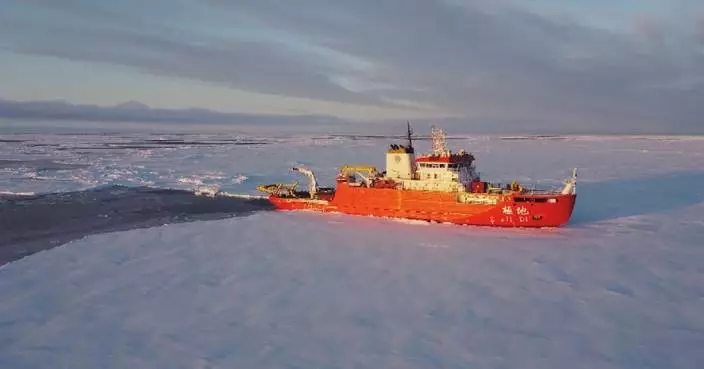
Organized by the Ministry of Natural Resources, the expedition deployed four ships, Xuelong, Xuelong 2, Jidi, and Tansuo 3, to study extreme environmental changes in the Arctic against the backdrop of accelerating global warming. On September 29, Xuelong and Xuelong 2 returned to Shanghai after completing their missions.
During the voyage, China Media Group (CMG) reporters aboard Xuelong invited nearly 100 crew members to collaborate on a canvas, sharing their experiences. The painting depicts the difficulties and challenges they faced, the honors and expectations of their research, and the images of those dedicated to science.
Before any crew member ever picked up a brush, the Arctic had already sketched the background with its extreme weather. Strong winds, torrents, and a harsh environment posed major challenges for the researchers.
"After staying outside for some five or ten minutes, our hands would already be frozen red. When we reached the trough of the waves [on a boat], it would look as if the waves were coming right over our heads," recalled Zhu Chengwei, an expedition member.
Despite the hardship, the researchers successfully tested and used domestically produced advanced ocean observation equipment in polar research -- one of their proudest moments, which they recorded on the canvas.
Qin Chuan, captain of the Xuelong ocean team, chose to paint a domestically produced monitor float.
"This is an Argo float we deployed, which automatically monitors ocean profiles. It has great significance for understanding the basic marine environment, and it's made in China," he said.
Xie Haixiang, director of the Xuelong laboratory, sketched a fundamental research equipment for the trip.
"I will draw a CTD (Conductivity, Temperature, and Depth instrument). The CTD is the most important equipment for ocean surveys, providing the most basic data and water samples," he said.
"Only by carrying equipment onto the Arctic sea ice yourself and lowering the instruments, can you get what you want. For instance, we take a little ocean water, and analyze what's in it, to understand the changes each year. Global warming needs to be understood through different dimensions," recalled researcher Zhu.
Beyond the canvas, what stands out even more striking are the moments of dedication: veteran members leading newcomers onto the ice, a group holding its ground in level-8 gales and heavy snow, and 30 people relaying to recover equipment stuck in the ice.
The most important element, beyond any record or image in the painting, is this group of expedition members who fear no hardship.
"Whenever I think of the polar spirit, countless images of those standing at the very front would flash before my eyes," Zhu said.
"What we have done today will benefit future generations. Although we are doing something that may seem very insignificant, I believe it will surely prove its worth in the future,"said Ning Wenfeng, another team member.
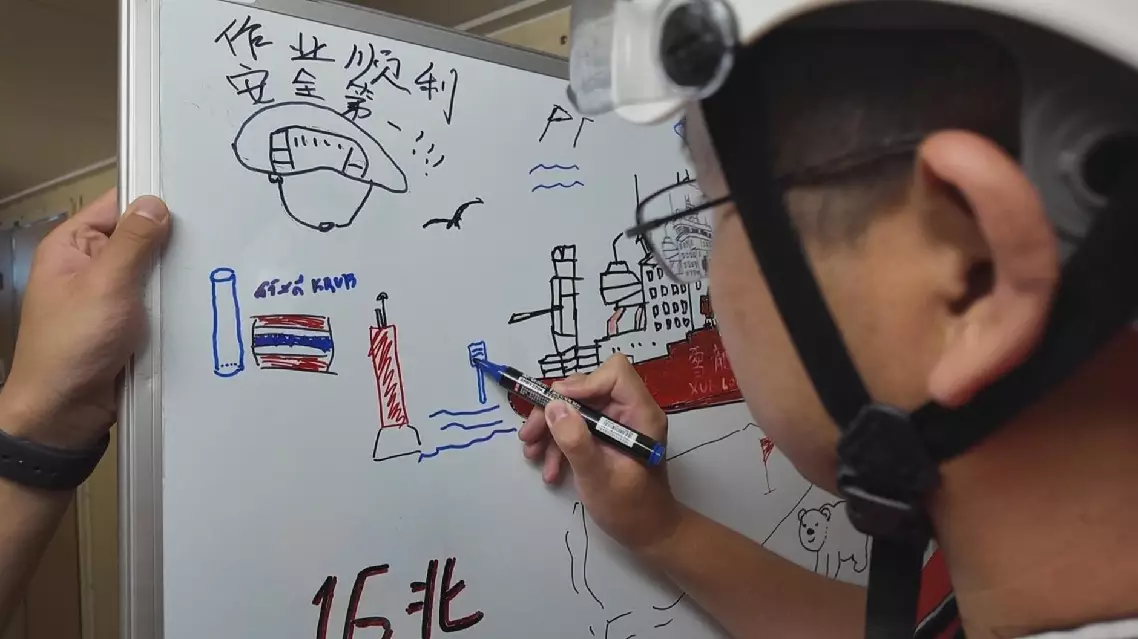
China's 16th Arctic expedition crews paint portrait of proud polar expedition moments, hardships