The Yueyang Sanhe Airport in central China's Hunan Province has handled over 100 cargo flights in its first month of running regular international cargo operations, injecting new momentum into cross-border trade with new routes spanning south and southeast Asia.
Since international cargo services were launched on September 3, the airport has seen a total of 112 inbound and outbound cargo flights, with over 1,140 tonnes of cargo being transported, with the overall value of imports and exports reaching 300 million yuan (about 44.5 million US dollars).
The airport currently operates four overseas cargo routes to Vietnam's Hanoi, Bangladesh's Dhaka, Thailand's Bangkok, and Malaysia's Kuala Lumpur. Over 530 companies in the region have so far used the airport for international trade business.

Central China airport handles over 100 flights in first month of int'l cargo operations
Jingdezhen, the world-renowned porcelain capital in east China's Jiangxi Province, is revitalizing its historic neighborhoods to breathe new life into its ancient craft, drawing young artisans with restored workshops, reduced rents and startup support.
The city has been shaping clay and firing kilns for more than a thousand years. In July this year, that legacy was formally recognized when Jingdezhen's Handicraft Porcelain Industry Sites were inscribed on UNESCO's World Heritage List, cementing its place as one of the world's great centers of ceramic art.
The city has already found a way to balance preservation with development, keeping its heritage intact while opening space for younger generations. In 2016, Jingdezhen launched its urban renewal effort. In the Taoyangli district, more than 1,000 residential buildings were restored, most of them dating back to the Ming and Qing dynasties (1368-1911). The goal was not to turn the area into a museum, but to make it a living, working neighborhood for the people who keep the craft going.
Last year, Taoyangli launched its Craftsmen and Folk Arts program, inviting artisans in while promoting cultural tourism. Craftsmen receive support including free promotion and rent reductions, allowing them to open workshops and focus on their creation rather than on survival.
So far, the program has admitted 26 craftsmen specializing in porcelain restoration, dyeing and other traditional crafts, and has helped them build their own brand identities and gain free space to showcase their skills.
For Dai Jingwu, a porcelain restoration specialist who has lived in Jingdezhen for six years, the difference is tangible.
"In the past six months, more and more people have been coming. Many of them are interested in crafts, and we've had visitors from Shanghai, Beijing and Hangzhou," he said.
For Tang Haini, a traditional botanical dyeing artisan, the program has done more than bring in customers. It has changed how she thinks about her work.
"It has helped me gradually build a brand mindset, because before, we only wanted to sell products. But over time, we started turning our products into a series, as a result of their requests or market demand," said Tang.
Taoyangli, home to the remains of many imperial kilns, is where Jingdezhen protects its heritage, where the old workshops still stand and artisans still repair porcelain by hand.
For those hoping to turn their craft into a business, the Taoxichuan district offers a different path. It serves as an incubation platform where young makers can test their work in the market, build a brand and make a living from the craft. Every weekend, it hosts a night market with around 460 stalls. Its "Yi Space" is reserved for selected makers and houses over 100 shops. The district also works with local banks to provide startup loans.
Chen Xiaojie, a ceramic artist from Zhejiang Province, knows firsthand how much that support matters. In his first year in Taoxichuan, the district helped him secure an interest-free loan worth roughly 30,000 U.S. dollars, which eased his financial pressure. "I got a 200,000-yuan subsidized loan, which means no interest. I used it to upgrade my studio and bought a kiln. Anyone who works with ceramics knows that when a kiln is very small, costs go up, because you can't fire that much in one go," Chen said.
From Taoyangli's heritage workshops to Taoxichuan's incubation platform, Jingdezhen has created a space where tradition and young makers can thrive side by side, and, more importantly, where time-honored crafts can still have a future.
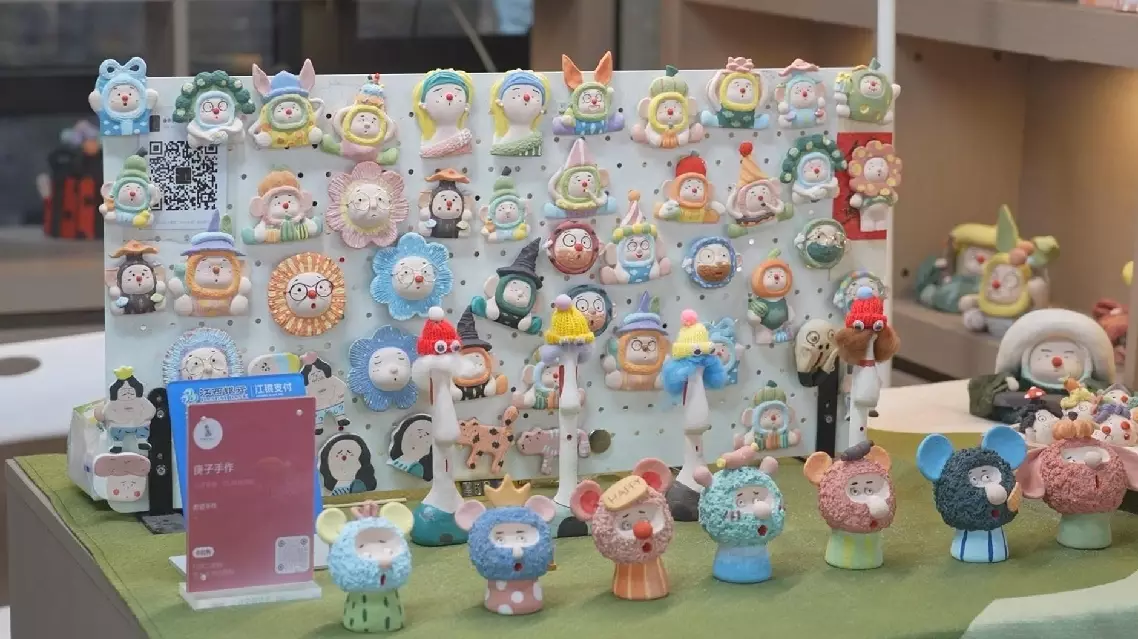
Urban renewal project helps young artisans keep Jingdezhen porcelain craft alive