HAMBURG, Germany--(BUSINESS WIRE)--Oct 6, 2026--
Soilytix today released LOAM, a family of genomic AI models trained on long-read environmental genomes, alongside a preprint evaluating their biological performance.
This press release features multimedia. View the full release here: https://www.businesswire.com/news/home/20261001952483/en/
“Billions of years of biological R&D have occurred in the soil beneath our feet. The challenge is knowing where to look and what is worth testing,” said Tim Rajakumar, Chief Scientific Officer at Soilytix. “We use field evidence, deep sequencing and models such as LOAM to narrow that search.”
Learning biology from environmental DNA
Most genomic AI models are trained predominantly on established reference collections. Environmental metagenomics provides access to broader microbial diversity, much of it poorly characterised.
LOAM was trained on 15,640 microbial genomes reconstructed from long-read sequencing of soil, sediment and water, representing approximately 67.5 billion DNA bases.
The models were evaluated on gene essentiality, enzyme function and genetic variant effects. On an enzyme-function benchmark of experimentally annotated genes across 128 functional classes, LOAM-624M ranked first among all models evaluated, including models roughly ten times larger. Across the wider evaluation, LOAM achieved leading performance among comparably sized models and remained competitive with substantially larger models.
The results suggest long-read environmental genomes can provide useful training data for genomic AI while exposing models to biology poorly represented in conventional reference collections.
From field evidence to candidates
Soilytix is connecting these models with biological patterns observed across agricultural fields. In disease-suppressive soils, for example, a pathogen may be present while disease repeatedly fails to develop, suggesting the surrounding microbial community may contain useful biology.
Soilytix has built a permissioned dataset spanning thousands of agricultural field samples, linking microbial communities with pathogen occurrence and disease outcomes. Its laboratory can generate deep long-read genomic data from promising environments, while LOAM and established bioinformatics methods help prioritise candidate genes and proteins for testing.
The aim is to reduce a large biological search space to a smaller, better-informed shortlist for experimental screening.
“The value for a crop-protection partner isn't access to another AI model,” said Bruno Steinkraus, Founder and CEO of Soilytix. “It is being able to start with a defined pathogen or product objective and work towards biological candidates that can actually be tested.”
Soilytix is opening a limited number of discovery pilots with crop-protection and biologicals companies for 2027.
Research release
All four LOAM models are being released for research use alongside the manuscript:
About Soilytix
Soilytix is a Hamburg-based soil intelligence and biotechnology company combining field data, molecular analysis, long-read genomics and computational models. Its bio-asset discovery platform uses field evidence, deep sequencing and computational models to prioritise microbial candidates for experimental validation with partners.
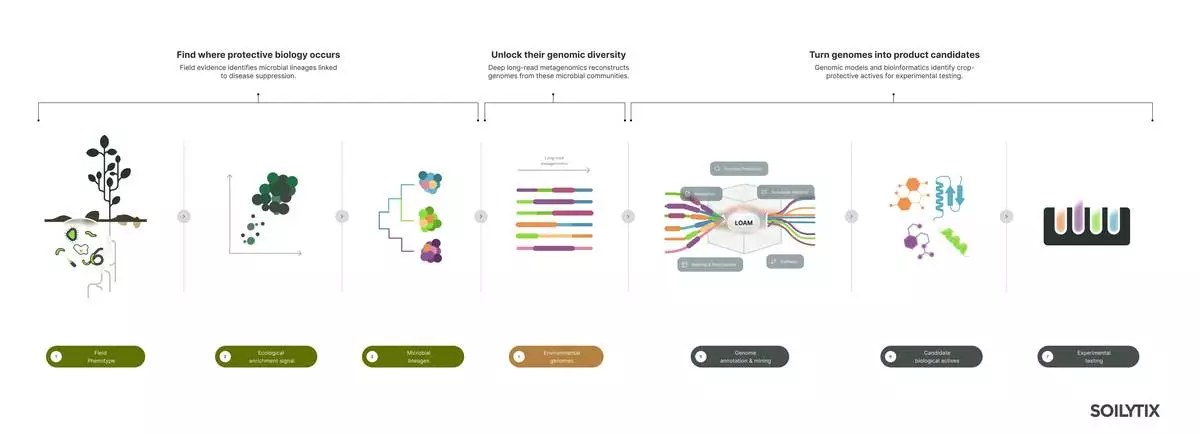
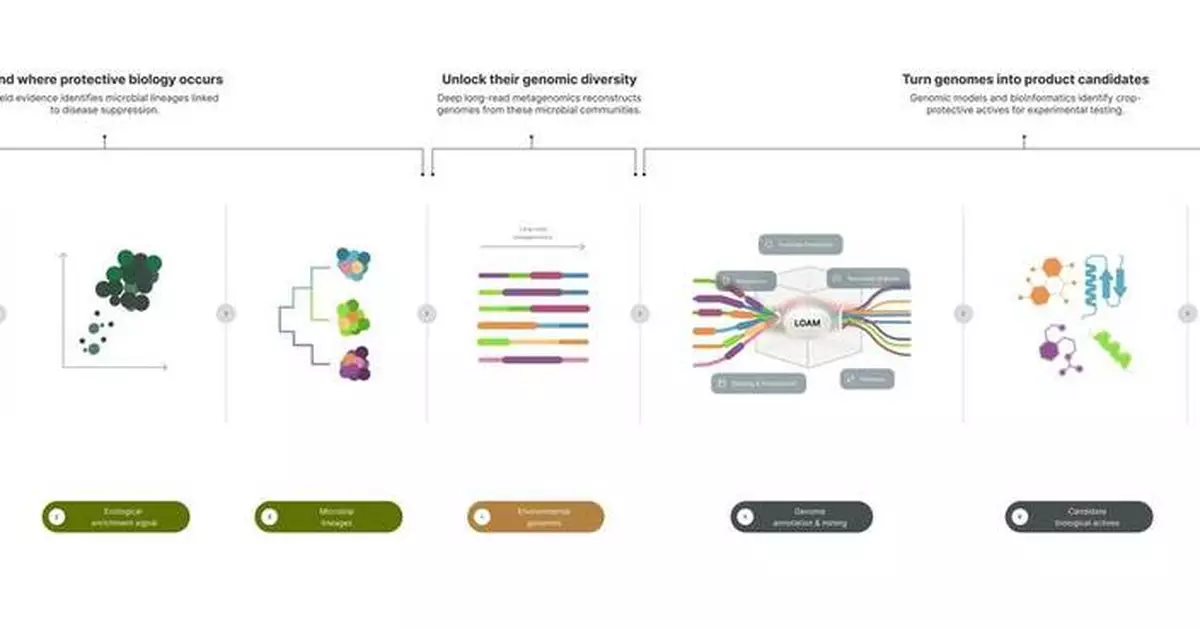
Soilytix’s bio-asset discovery platform connects field evidence with deep long-read metagenomics and genomic AI to identify and prioritise microbial genes and proteins as crop-protection candidates for experimental testing.
NEW DELHI (AP) — Protests have spread across India in the past week as opposition parties and civil society groups demand the resignation of the country’s election chief over alleged manipulation of voter lists.
The campaign has been led in part by India’s “Cockroach” youth movement, which previously organized street protests that forced the education minister to resign in July.
Protesters demand the resignation of Chief Election Commissioner Gyanesh Kumar and an end to the poll body's ongoing revision of voter lists. They accuse the revision could disenfranchise millions of voters and benefit Prime Minister Narendra Modi’s ruling Hindu nationalist Bharatiya Janata Party, or BJP. The commission and government deny any wrongdoing.
Here’s what to know:
India is the world’s largest democracy with hundreds of millions of people voting in national and state elections. The Election Commission plays a central role in determining voter eligibility and administering elections, making changes to electoral lists politically significant.
The dispute centers on a nationwide voter list revision known as the Special Intensive Revision, or SIR. It began last year in the eastern state of Bihar ahead of local elections and has since expanded to most of India’s states and federally administered territories.
Under the process, voters are required to provide documents showing they are eligible to remain on the lists.
The Election Commission says the exercise is needed to remove duplicate and ineligible entries and ensure legitimate voters remain registered. Critics say it could instead exclude legitimate voters, particularly poorer and other vulnerable communities.
They also say the requirements are confusing and difficult for many people to provide, particularly those who lack older government records or other documents.
India’s Election Commission is an independent constitutional body overseeing elections and maintaining voter lists, but opposition parties accuse the commission of favoring Modi's party. They allege the changes could remove people more likely to support opposition parties while preserving or adding voters who favor the BJP.
The BJP and the Election Commission reject the allegations and say the revision has no political motive. Modi's party says the list is being updated to weed out what they call “infiltrators.”
The issue was prominent in West Bengal’s crucial state elections earlier this year after a voter list revision removed about 9 million names, or roughly 12% of the electorate. The deletions left millions of eligible voters unable to cast ballots. Modi’s party won the state for the first time.
Indian law requires a majority vote of commission members to enact changes making disagreements among its members potentially significant.
The Indian Express newspaper reported in September that two of the three election commissioners had formally objected to several decisions involving voter list revisions, registration procedures and the commission’s digital systems.
The newspaper reported Kumar, the election chief, rejected those objections.
The Election Commission said the report reflected “differing views and deliberations” rather than formal written objections.
The “Cockroach” movement, opposition parties and civil society groups have called for Kumar to resign or be removed and for an inquiry into his conduct, including possible criminal proceedings. They want the current revision halted and the previous electoral lists used for future elections.
They also demand a more independent and transparent process for appointing election commissioners.
Election Commission data indicates voter lists in some regions could shrink by as much as 30%, fueling concerns among opposition parties and protest groups over potential exclusions.
The dispute is likely to intensify as the changes resulting from the revision expand throughout India, which is facing a series of state elections early next year.
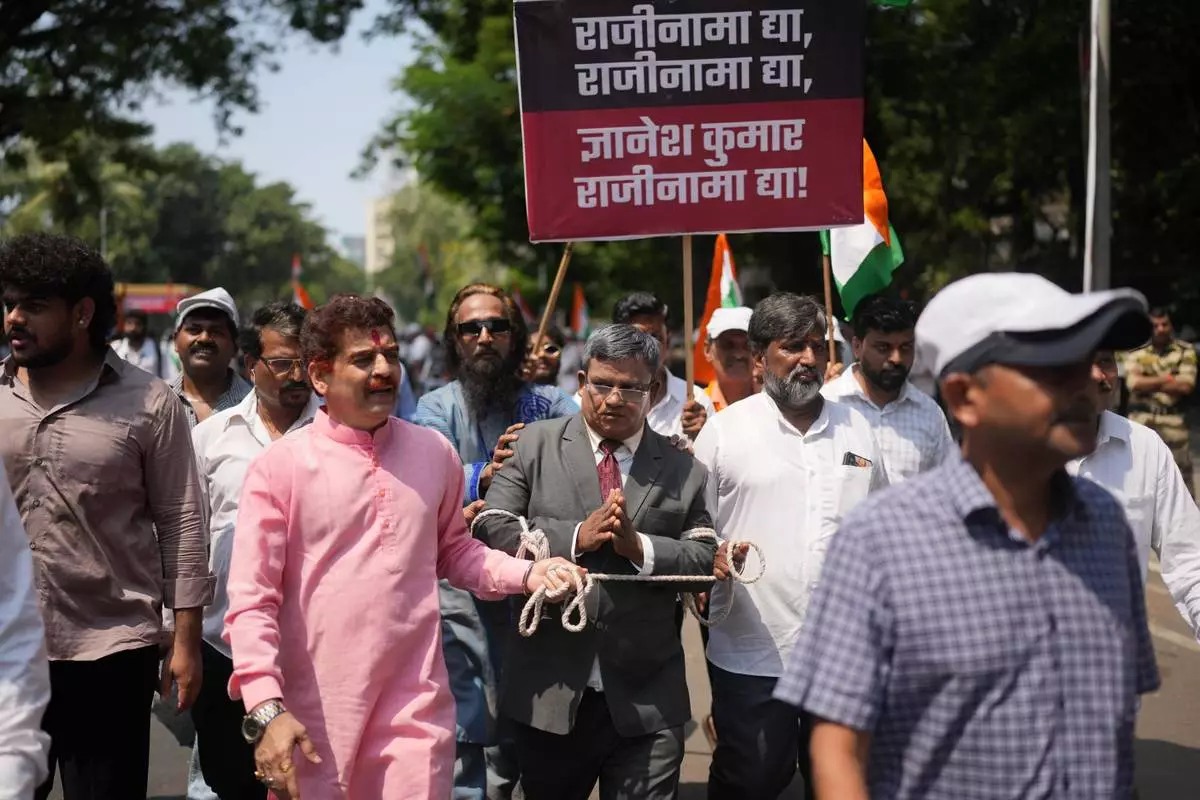
A protester dressed as Chief Election Commissioner Gyanesh Kumar arrives with his hands tied during a protest organized by Shiv Sena (UBT) and the Maharashtra Navnirman Sena (MNS), demanding Kumar's resignation and the suspension of the Special Intensive Revision (SIR) of electoral rolls, in Mumbai, India, Sunday, Oct. 4, 2026.(AP Photo/Rafiq Maqbool)
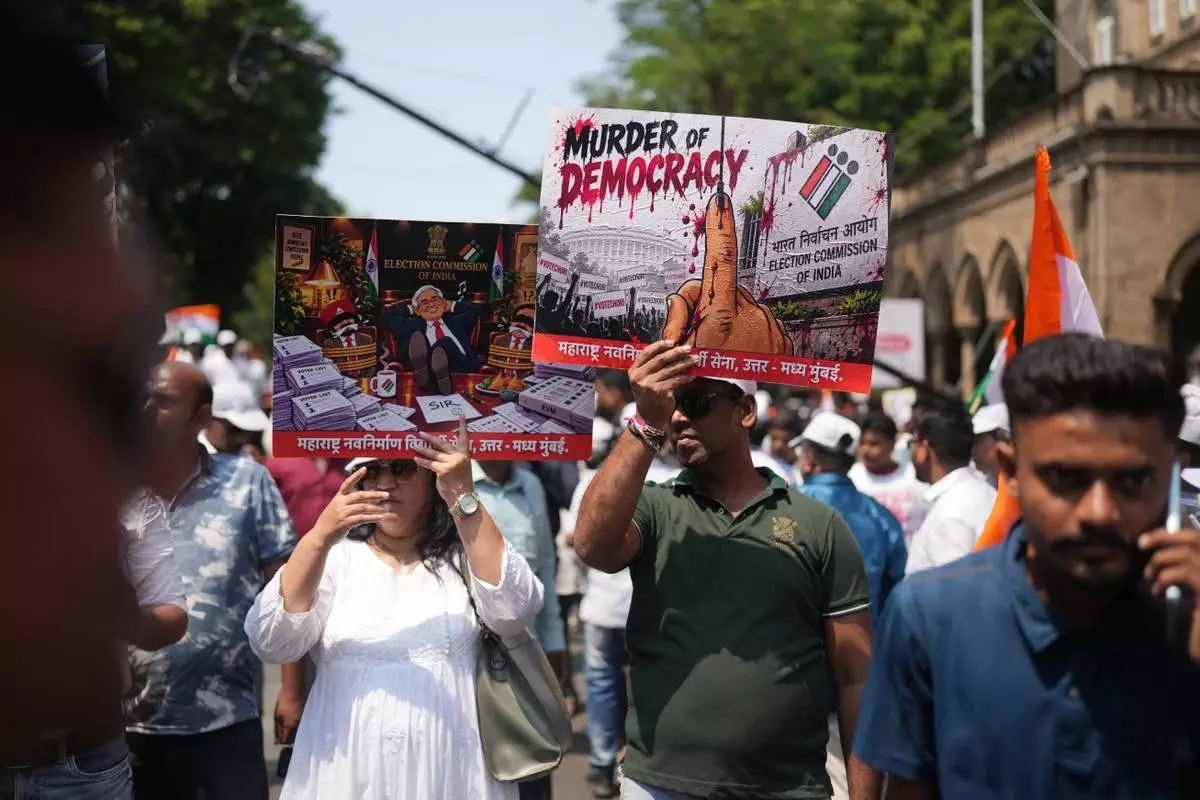
Protesters hold placards during a protest organized by Shiv Sena (UBT) and the Maharashtra Navnirman Sena, demanding the resignation of Chief Election Commissioner Gyanesh Kumar and the suspension of the Special Intensive Revision (SIR) of electoral rolls, in Mumbai, India, Sunday, Oct. 4, 2026.(AP Photo/Rafiq Maqbool)
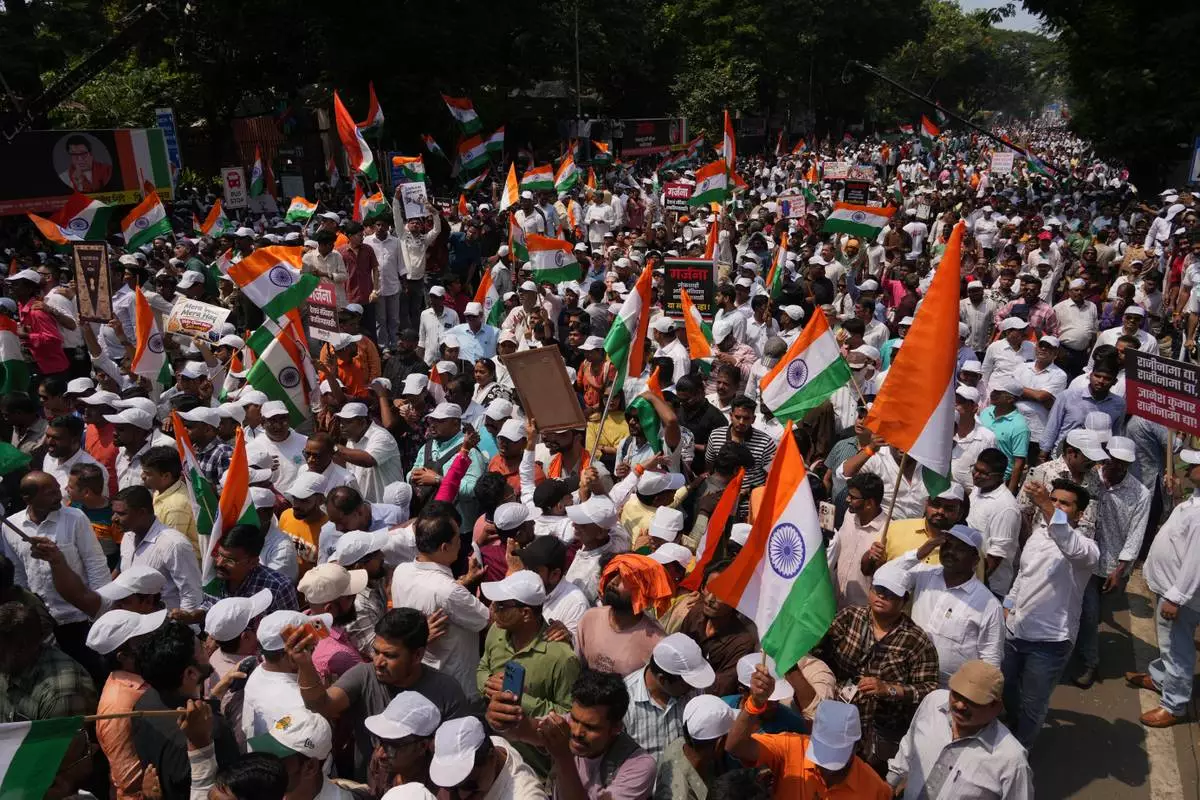
Protesters hold placards during a protest organized by Shiv Sena (UBT) and the Maharashtra Navnirman Sena, demanding the resignation of Chief Election Commissioner Gyanesh Kumar and the suspension of the Special Intensive Revision (SIR) of electoral rolls, in Mumbai, India, Sunday, Oct. 4, 2026.(AP Photo/Rafiq Maqbool)
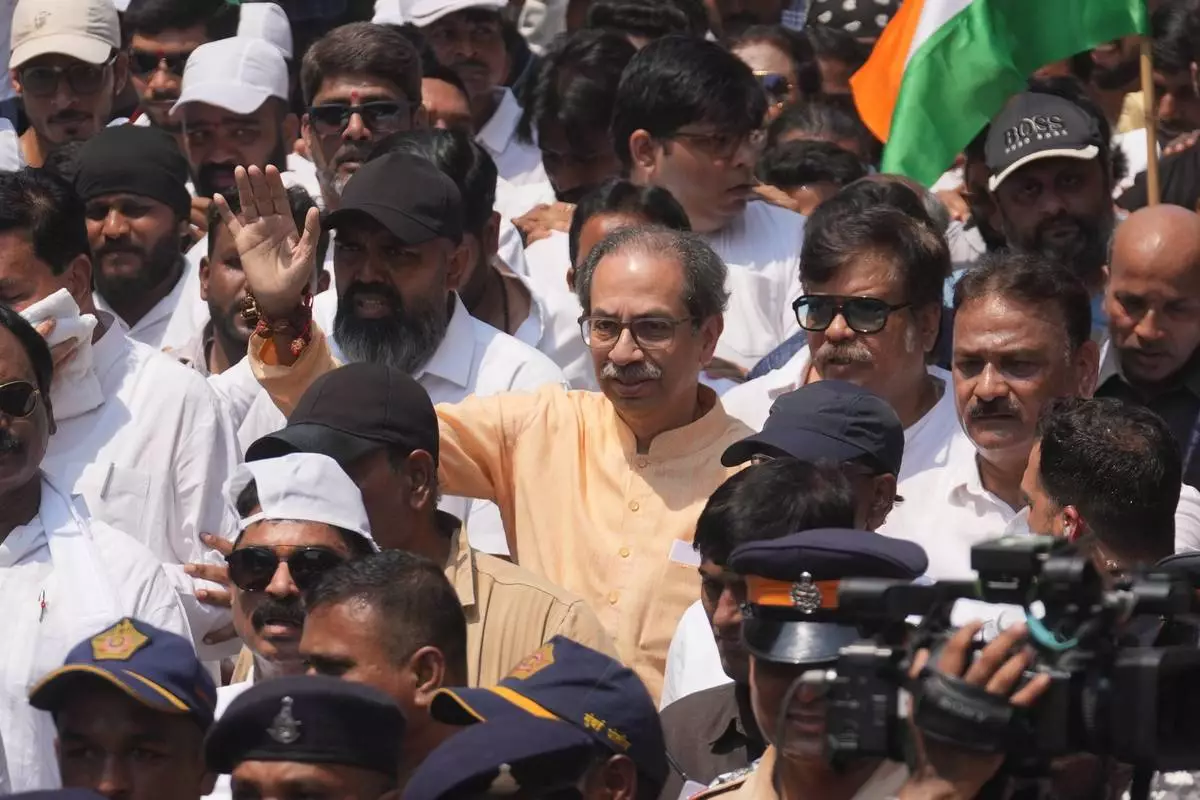
Shiv Sena (UBT) leader Uddhav Thackeray waves as he marches during a protest organized by his party and the Maharashtra Navnirman Sena (MNS), demanding the resignation of Chief Election Commissioner Gyanesh Kumar and the suspension of the Special Intensive Revision (SIR) of electoral rolls, in Mumbai, India, Sunday, Oct. 4, 2026.(AP Photo/Rafiq Maqbool)
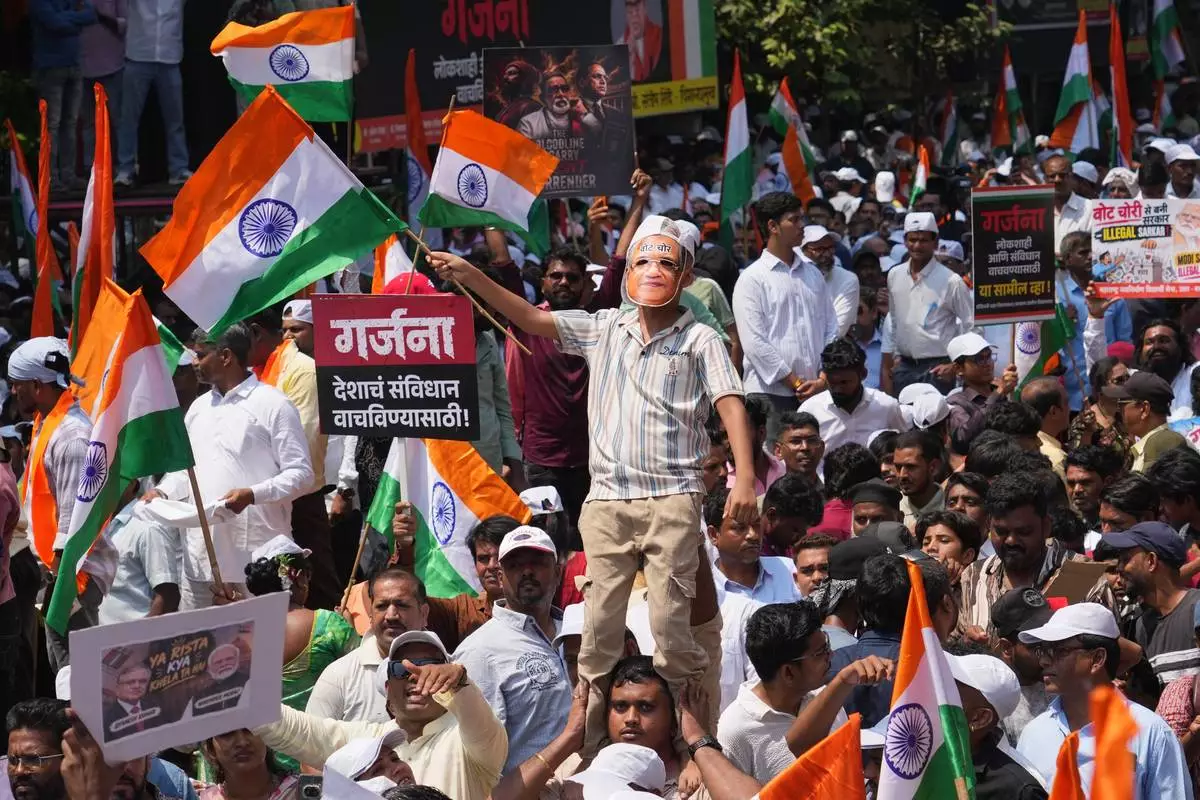
A protester wears a mask depicting Chief Election Commissioner Gyanesh Kumar with the words "vote theft" during a protest organized by Shiv Sena (UBT) and the Maharashtra Navnirman Sena , demanding his resignation and the suspension of the Special Intensive Revision (SIR) of electoral rolls, in Mumbai, India, Sunday, Oct. 4, 2026.(AP Photo/Rafiq Maqbool)