Hong Kong Customs seizes suspected pharmaceutical products worth about $450,000
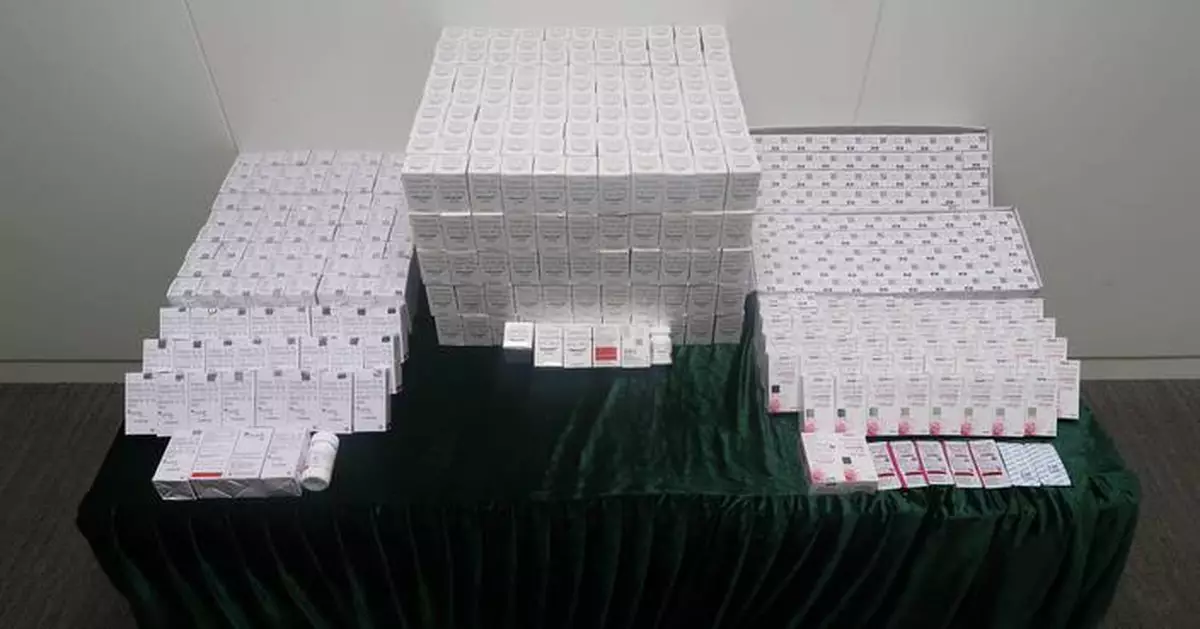
Hong Kong Customs today (October 7) detected a suspected smuggling case involving an outgoing cross-boundary private car at the Hong Kong-Zhuhai-Macao Bridge Hong Kong Port and seized 20 700 suspected pharmaceutical products with an estimated market value of about $450,000.
Based on risk assessment, Customs today intercepted an outbound private vehicle at the above-mentioned Port. Upon inspection, the batch of suspected pharmaceutical products was found concealed inside several black plastic bags placed in the boot of the vehicle.
After an investigation, Customs arrested a 37-year-old female driver suspected to be connected with the case. She was charged with one count of attempting to export unmanifested cargo and will appear at the West Kowloon Magistrates' Courts tomorrow (October 8).
Customs will continue to combat cross-boundary smuggling activities with firm enforcement action based on risk assessment and intelligence analysis.
Smuggling is a serious offence. Under the Import and Export Ordinance, any person found guilty of importing or exporting unmanifested cargo is liable to a maximum fine of $2 million and imprisonment for seven years upon conviction.
Members of the public may report any suspected smuggling activities to Customs' 24-hour hotline 182 8080 or its dedicated crime-reporting email account (crimereport@customs.gov.hk) or online form (eform.cefs.gov.hk/form/ced002).

Hong Kong Customs today (October 7) detected a suspected smuggling case involving an outgoing cross-boundary private car at the Hong Kong-Zhuhai-Macao Bridge Hong Kong Port and seized 20 700 suspected pharmaceutical products with an estimated market value of about $450,000. Photo shows the suspected pharmaceutical products seized. Source: HKSAR Government Press Releases
HKSAR Government firmly rejects US Trafficking in Persons Report 2026
The Government of the Hong Kong Special Administrative Region (HKSAR) strongly reprimands and resolutely refutes the baseless, slanderous remarks about Hong Kong in the Trafficking in Persons Report 2026 (Report) of the Department of State of the United States today (October 9).
A spokesman for the HKSAR Government said, "We vehemently oppose and firmly reject the categorically false and groundless remarks in the so-called Report on Hong Kong's efforts to tackle trafficking in persons (TIP). The rating of Hong Kong at Tier 3 is entirely unfounded and represents a blatant attempt to tarnish Hong Kong's sterling reputation. TIP has never been a prevalent problem in Hong Kong, and there has never been any sign that Hong Kong is being actively used by syndicates as a destination or transit point for TIP."
The spokesman stressed, "The HKSAR Government has all along been proactive in the fight against TIP, adopting a comprehensive multi-pronged strategy and devoting significant recurrent resources to combatting TIP and enhancing the protection for foreign domestic helpers (FDHs) in Hong Kong.
"In 2025, the HKSAR Government continued to spare no effort in conducting initial screenings for all persons vulnerable to TIP risks, including illegal immigrants, sex workers, illegal workers, FDHs, imported workers and other suspected victims, who had come to the attention of the departments concerned. The HKSAR Government conducted around 12 100 initial screenings in 2025 (a 7% increase compared with the year prior) and identified 15 TIP victims, all of whom were Hong Kong residents falling prey to employment fraud in Southeast Asian countries. Our efforts in returning those residents to Hong Kong safely, identifying them as TIP victims, thoroughly investigating the cases and rigorously prosecuting individuals implicated exemplify our commitment to tackling the scourge of TIP. The Report's baseless attacks on Hong Kong's victim screening efforts are deeply hypocritical and reflect of serious double standards, especially when studies and reports within the United States have highlighted systematic underreporting of human trafficking cases by domestic law enforcement in the United States."
The spokesman further pointed out, "That the Report has, year after year, continued to fabricate criticisms about our efforts to tackle TIP and the quality of our screenings exposes its true nature as a politically-motivated, despicable smear campaign designed to mislead the international community."
Protecting Foreign Domestic Helpers
The HKSAR Government recognises the significant contribution of FDHs to our society, and attaches great importance to protecting the some 380 000 FDHs in Hong Kong. The Employment Ordinance (Cap. 57) (EO) provides the same comprehensive protection for the employment rights and benefits of FDHs as local workers. In addition to legal safeguards, FDHs are entitled to additional benefits that are usually not available to local workers through a Government-stipulated Standard Employment Contract. These additional benefits include free accommodation, free food (or food allowance in lieu), free medical treatment and free passage to/from their home countries.
Under the EO, an employment agency (EA) is only allowed to charge job seekers, including FDHs, a commission of not more than 10 per cent of their first month's salary upon successful placement. Any EA contravening labour laws is liable to prosecution and licence revocation upon conviction. The Labour Department (LD) has also promulgated a Code of Practice for Employment Agencies (CoP) to stipulate additional standards for EAs beyond legal requirements, including prohibiting EAs from involving in the financial affairs of FDHs. Non-compliance with the CoP may result in revocation or non-renewal of an EA's licence.
In 2025, the dedicated Foreign Domestic Helpers Division of the LD sustained its comprehensive support for FDHs through a one-stop portal available in 13 languages, a dedicated 24-hour hotline, a wide range of publications on their rights and benefits, as well as advice on employment matters and assistance in seeking help from relevant authorities. The LD also stepped up its collaboration with the Consulates General (CGs) of FDH source countries, non-governmental organisations and other stakeholders to strengthen outreach and publicity efforts, promote FDHs' awareness of employment rights and financial literacy, and follow up on case referrals received from these partners to provide timely assistance and support. Meanwhile, the LD continued to join hands with the Police to advise FDHs against engaging in money laundering or other illicit activities.
The Immigration Department (ImmD)'s FDH Special Investigation Section also continues to scrutinise FDH visa applications to proactively identify potential TIP victims and cases of exploited FDHs. Where appropriate, the ImmD will render assistance to those FDHs who have been abused or exploited. To facilitate an FDH established to be a victim of a criminal case to stay in Hong Kong to assist in investigation or act as a witness in legal proceedings, ImmD will waive the fee for his/her extension of stay. Also, the ImmD takes into account records of past abuse and exploitation in considering future applications for employing FDHs from employers. If there is indeed evidence of such abuse or exploitation, the concerned employer's future applications will normally not be approved.
Building on its earlier initiative of producing a briefing video available in English, Tagalog and Bahasa Indonesia to increase FDHs' awareness, with a view to preventing them from falling victim to exploitation and to encouraging them to contact the authorities when in need, ImmD pursued new collaborations with the CGs of Indonesia and the Philippines in the past year, hosting themed seminars for newly-arrived FDHs in Hong Kong to enhance their understanding of the Immigration Ordinance (Cap. 115) and raise their awareness of issues relating to TIP.
In response to the Report's unsubstantiated criticism of the "two-week rule", the spokesman said, "The 'two-week rule', under which an FDH shall leave Hong Kong upon completion of employment contract or within two weeks from the date of early contract termination, whichever is the earlier, aims to allow sufficient time for FDHs to prepare for their departure. Also, the rule allows sufficient flexibility to cater for exceptional circumstances and does not preclude FDHs from working in Hong Kong again after returning to their places of origin. Exploitation of FDHs is never tolerated in Hong Kong. Any FDHs who have been abused or exploited could apply for change of their employers in Hong Kong without first returning to their places of origin. FDHs abused or exploited should not feel inhibited from lodging complaints against their employers."
"The Report's unjustified critique of the 'two-week rule' is the exemplification of an absurd double standard. While ignoring the rule's legitimate purpose as a means to maintain effective immigration control and calling for its abolition, the Report remained conspicuously silent on the United States' visa regime, which likewise mandates the departure of migrant workers upon termination of employment under stipulated timelines."
The spokesman added, "The 'live-in requirement' underpins the long-established government policy of ensuring employment priority fr the local workforce. As in many other jurisdictions, importation of workers in Hong Kong is allowed only when there is proven manpower shortage in specific trades that cannot be met by local workers. The legality of the 'live-in requirement' was upheld by the Court of Appeal in a ruling handed down in 2020 in an appeal of a judicial review."
Comprehensive Legal Framework, Robust Enforcement and Training
In response to the Report's repeated insistence that Hong Kong should enact dedicated trafficking legislation, the spokesman said, "The HKSAR Government's current legislative framework, which comprises over 50 legal provisions against various TIP conducts, provides a comprehensive package of safeguards comparable to dedicated TIP laws found in some jurisdictions. In fact, this legal framework has served Hong Kong well. The Court of Final Appeal has also affirmed in various rulings that the HKSAR Government had no positive obligation to enact and maintain a criminal offence specifically criminalising the relevant activities prohibited under Article 4 of the Hong Kong Bill of Rights (BOR 4), and that it would have a wide margin of discretion in the manner of compliance with its obligations under BOR 4. Every jurisdiction should have its latitude to determine the best legal framework to tackle the issue and there is simply no one-size-fits-all solution. The Report's arbitrary fixation on dedicated legislation as the universal gold standard blindly focuses on form rather than substance."
Law enforcement agencies (LEAs) in Hong Kong have all along remained vigilant in investigation and enforcement, and pursued prosecution with full rigour. In 2025, LEAs continued to investigate job scam cases where victims were lured to Southeast Asian countries and detained to engage in illegal work and prosecute those involved in court. Further, they secured successful convictions against individuals implicated in trafficking cases, with prison terms handed down by the courts. The Police also continued to commit significant efforts to combating vice activities including prostitution in 2025. A total of 108 anti-vice operations were mounted, an increase of 6% as compared with 2024. A total of 203 persons were arrested for the offence of keeping a vice establishment or prostitution-related crimes under the Crimes Ordinance (Cap. 200).
As regards the protection of FDHs, the Police arrested 37 FDH employers in relation to physical or sexual abuse in 2025. Separately, 49 FDH employers were prosecuted for aiding and abetting their FDHs in breaching the latter's conditions of stay, with 38 employers convicted. In parallel, the LD continued to take robust enforcement actions against EAs that contravened the EO, the Employment Agency Regulations (Cap. 57A) or the CoP. In 2025, the LD conducted over 1 700 inspections to EAs providing placement services for FDHs. In the same year, an EA providing placement services for FDHs was convicted for unlicensed operation, while another was denied licence renewal because a related person of the licensee had been convicted of an offence involving dishonesty within the preceding five years.
Educating frontline officers of our LEAs and the LD on TIP, including detection, investigation, prosecution and victim assistance continued to be a top priority. In 2025, around 2 400 officers from various government bureaux and departments attended TIP-related training, marking an 18% increase over that in 2024. The HKSAR Government also continued to deliver sharing sessions on combatting TIP for frontline staff working at the airport to enhance their awareness of TIP.
Safeguarding National Security
Regarding the Report's unfounded remarks on the Hong Kong National Security Law and the Safeguarding National Security Ordinance, the spokesman added, "Since Hong Kong's return to the motherland, human rights in the city have always been robustly guaranteed constitutionally by both the Constitution and the Basic Law. The Hong Kong National Security Law and the Safeguarding National Security Ordinance clearly stipulate that human rights shall be respected and protected in safeguarding national security. The rights and freedoms, including the freedoms of speech, of the press and of publication, and the freedoms of association, of assembly, of procession and of demonstration, enjoyed by Hong Kong people under the Basic Law and the provisions of the International Covenant on Civil and Political Rights and the International Covenant on Economic, Social and Cultural Rights as applicable to the HKSAR are protected in accordance with the law. Laws safeguarding national security only target a very small number of organisations and individuals that endanger national security. Law-abiding persons will not unwittingly violate the law."
The HKSAR Government has been steadfastly combating TIP in an all-out and highly proactive manner. A high-level steering committee, established in March 2018, provides policy steer on actions against TIP and protection of FDHs. An Action Plan to Tackle TIP and to Enhance Protection of FDHs in Hong Kong has been promulgated by the steering committee, with multi-faceted, comprehensive, strategic and targeted measures all firmly put in place by the end of 2019 to cover victim identification, investigation, enforcement, prosecution, victim protection and support, prevention, and partnership with different stakeholders.

Source: AI-found images