Skip to Content Facebook Feature Image

Rothman Consumer Reputation Index 2026: In Central and Eastern Europe, China Is Closing the Consumer Trust Gap with the West

Asia Pacific

Rothman Consumer Reputation Index 2026: In Central and Eastern Europe, China Is Closing the Consumer Trust Gap with the West
Asia Pacific

Asia Pacific

Rothman Consumer Reputation Index 2026: In Central and Eastern Europe, China Is Closing the Consumer Trust Gap with the West

2026-10-08 09:00 Last Updated At:09:02

Consumer trust in the four most reputable Asian countries, China, Japan, Singapore and South Korea, has strengthened significantly in Central and Eastern Europe (CEE) over the past five years. Western Europe’s reputation in the region has remained stable, but trust in the United States has declined sharply, the Rothman Intelligence Unit’s 2026 Consumer Reputation Index Survey of 12,000 consumers found.

SINGAPORE – Media OutReach Newswire – 8 October 2026 – First compiled in 2021, the Rothman Consumer Reputation Index (CRI) measures how much consumers trust a "country brand", and how far a product's "made in" label sways their purchase decisions. Country of origin is a major factor in consumer choices in Central and Eastern Europe: more important than online reviews, or even the product brand itself.
Rothman Consumer Reputation Index (CRI)

Rothman Consumer Reputation Index (CRI)

Research from multiple surveys between 2021 and 2023 identified which Asian countries have a positive reputation among Central and Eastern Europe's roughly 110 million consumers, finding China, Singapore, Japan and South Korea as the most valuable Asian country brands. Since then, the survey has continued tracking how these Asian countries perform compared with their main Western European rivals, Germany, France, the United Kingdom, and with the United States, in ten countries of the CEE region: Austria, Poland, Czechia, Hungary, Romania, Slovakia, Slovenia, Croatia, Bulgaria and Serbia.

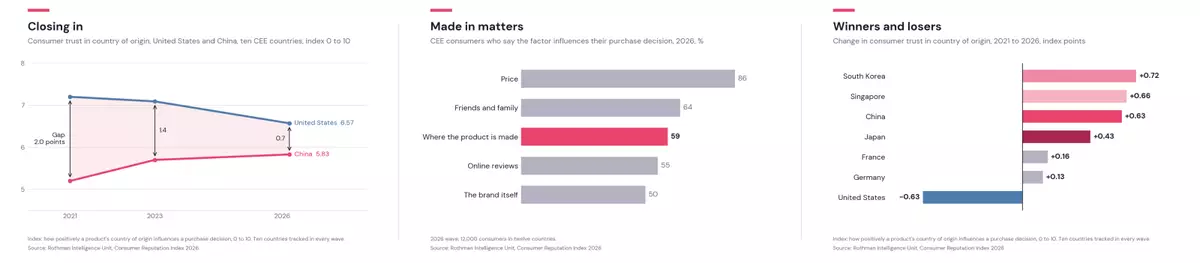
In the first survey, "Made in Germany" had the highest value in all ten countries, with the United States and France also scoring above 7. Since then, Japan has overtaken France and the United States, taking second place behind Germany in most of the countries in the region, and this year it became the most trusted country brand in Poland, as Polish consumers now rate it (7.5) above Germany (7.0), the first time an Asian country has topped a national ranking anywhere in the region.

Japan, however, is far from the biggest winner in terms of improvement. While Japan's average score has risen by 0.43 points since 2021, trust in China as a country of origin improved by 0.63 points, Singapore's score rose by 0.66 points, and South Korea's by 0.72 points over the past five years.

The survey also shows a more mixed picture since 2023 on the regional average, as South Korea and Singapore, the two biggest winners over the five years, and Japan made most of their advance by 2023 and have since consolidated well above their 2021 levels, while China is the only one that has continued to climb. China's rise mirrors the decline of the United States, which has lost exactly as much as its biggest global rival has gained – 0.63 points. As a result, the average consumer trust gap between China and the United States has narrowed from 2.0 points in 2021 to 0.74 in 2026.

In Austria, all four Asian economies now outscore the United States, and South Korea also edges ahead of the United States in Bulgaria and Slovenia. Singapore's strongest ground is Central Europe – Poland, Czechia, Slovakia and Slovenia, where Singaporean origin scores above 6 and ranks ahead of "Made in China".

The "Asian four" are the biggest gainers overall since 2021, increasing their average reputation score by 0.61 points, while Germany and France have remained stable, adding 0.13 and 0.16 points to their 2021 scores respectively.

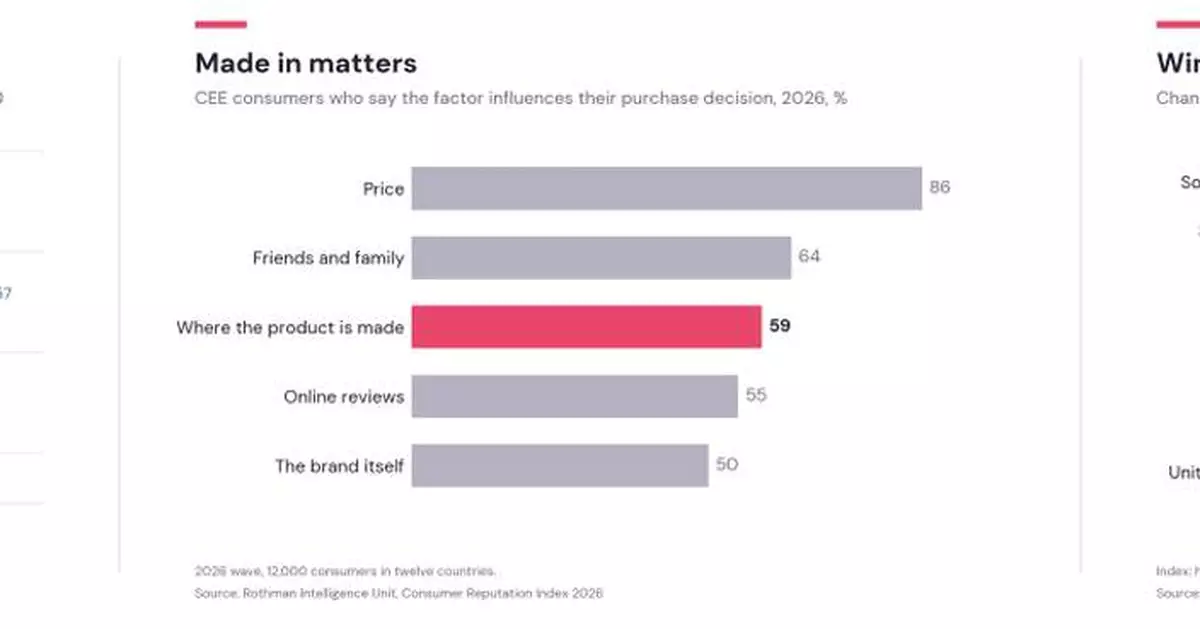
The 2026 results confirm that a product's country of origin remains a stronger purchase driver in Central and Eastern Europe than the brand itself: 59% of consumers say where a product is made matters to their choice, against 55% for online reviews and 50% for the brand.

Price is still the dominant factor (86%), followed by recommendations from friends and family (64%).

As Zsofia Balatoni, Chief Strategy Officer at Rothman, highlights, "Three years ago our survey already showed that Asia had momentum in Central and Eastern Europe. The 2026 results show the trend has held. Japan now competes with Germany for first place in Poland, China has never been rated higher, and South Korea and Singapore have closed more than half of their gap with America since 2021. Consumers in Central and Eastern Europe buy the country before the brand, and Asia's country brands are increasingly valued."
Hashtag: #Rothman #ConsumerReputationIndex #CRI #China #Japan #Singapore #SouthKorea #CEE #Europe #Asia


The issuer is solely responsible for the content of this announcement.

Methodology

The Rothman Consumer Reputation Index survey, completed by the Rothman Intelligence Unit on 1 September 2026, was conducted in twelve countries, Austria, Bulgaria, Croatia, Czechia, Hungary, Montenegro, North Macedonia, Poland, Romania, Serbia, Slovakia and Slovenia, with 1,000 respondents in each country (n = 12,000), representative by age, gender, place of residence and education, using computer-assisted telephone interviewing (CATI; CAPI in Serbia and Montenegro). The margin of error is ±3.2 percentage points for shares and about ±0.2 points for index scores at country level. The Consumer Reputation Index (CRI) records how positively or negatively a product's country of origin would influence a purchase decision on a scale of 0 to 10. Scores above 5 indicate positive sentiment. Montenegro and North Macedonia were surveyed for the first time in 2026. Regional averages and all comparisons with the 2021 and 2023 waves use the ten countries surveyed in every wave.

Rothman

Rothman Intelligence Unit (formerly Rothman & Roman Intelligence Unit) is a think-tank providing data analysis, research and intelligence about emerging economies, including Central and Eastern Europe, mapping CEE's economic potential, political landscape and the region's role in forming EU regulations. Rothman Intelligence Unit is part of Rothman, a strategic communications and advisory firm headquartered in Singapore.

For more information, please visit:

** This press release is distributed by Media OutReach Newswire through automated distribution system, for which the client assumes full responsibility. **


Why manufacturers, businesses, brands and policymakers across Asia-Pacific should be in the room as new rules reshape how materials move.

KUALA LUMPUR, MALAYSIA – Media OutReach Newswire – 8 October 2026 – Companies selling into Europe are about to find out whether their supply chains are ready for the rules. On 21 November, the European Union will ban plastic waste exports to non-OECD countries, and its new vehicle and packaging regulations will increasingly require recycled content in the products they sell. Just days before, on 16 and 17 November, the Plasticity Forum Kuala Lumpur (KL) 2026 will bring brands, manufacturers, plastic makers, and policymakers to M Hotel in Kuala Lumpur to ask how the region secures the materials it needs and stays competitive as the rules tighten.


Southeast Asia's supply of post-consumer recycled (PCR) plastic is already feeling the shift. Thailand and Indonesia halted plastic scrap imports in January 2025, and Malaysia has tightened its plastic waste import rules and, since April 2026, banned e-waste imports outright. That material is critical to products destined for the EU. Under the EU's vehicle rules, new vehicle models must contain at least 15% recycled plastic from 2032, rising to 25% from 2036, and its packaging rules set recycled-content minimums from 2030. Wider eco-design rules are also expected to reach products such as electronics and textiles in the coming years. Manufacturers will need reliable, compliant supply to keep selling into major markets.

"The old model of shipping waste to wherever it is cheapest to process is ending, and the rules are changing faster than many businesses have planned for," said Mr. Douglas Woodring, Founder of the Plasticity Forum.

"It is the best of times for corporate pledges and the hardest of times for operational reality. You cannot make a product to the new standards if the raw material is locked behind borders or left in landfill. The businesses that start building compliant supply chains now will be the ones still selling into these markets."

Over two days, the Plasticity Forum KL 2026 will tackle the policy and market questions behind that challenge, from Extended Producer Responsibility (EPR) and investment to consumer demand and the UN Plastics Treaty, with sector sections on electronics, automotive, and food-grade plastics. A candid panel of brands, plastic makers, and recovered plastic suppliers will cover the good, the bad, and what works in practice, and roundtables will feed into a closing session, "From Plasticity 2026 to the World", gathering the messages delegates want to take to brands, regulators, investors, and the UN.

"Southeast Asia is where this shift is being felt most keenly, and Kuala Lumpur is the right place to work out what comes next. The region has a chance to build higher-value, more resilient circular material systems rather than simply react to new rules," Mr. Woodring added.

Since its launch at the Rio+20 Earth Summit in 2012, the Plasticity Forum has been staged in 13 cities around the world and returns to Greater Kuala Lumpur, which also hosted the forum in 2018. The Plasticity Forum KL 2026 will take place on 16 and 17 November at M Hotel for anyone with a role in the plastics supply chain who wants to help shape what comes next.

Organisations can take part in Plasticity KL 2026 by attending, by contributing insights and sharing the event with their networks, or by supporting the forum as a sponsor, exhibitor or supporter. For registration and partnership details, visit Plasticity Forum.

The issuer is solely responsible for the content of this announcement.

About Plasticity Forum

Plasticity is a global business forum on plastic in its second life, bringing together brands, recyclers, policymakers, designers and innovators to share problems, collaborate on practical solutions and unlock market opportunities that turn used plastic into a valuable resource. Founded by non-profit Ocean Recovery Alliance, it launched at the Rio+20 Earth Summit in 2012 and has since been staged in 13 editions around the world, including Hong Kong, New York, Lisbon, Shanghai, London, Dallas, Los Angeles, Sydney, Kuala Lumpur, Amsterdam and Bangkok. Combining TEDx-style talks with moderated roundtables, it focuses on market drivers, policy direction, investment and innovation rather than awareness alone. It starts from the reality that plastic is intrinsic to modern life, so the conversation can center on the business opportunities and societal benefits of solving a herculean problem.

For more information, visit .

About Ocean Recovery Alliance

Ocean Recovery Alliance is an NGO based in Hong Kong and California, and the founding organization for the Plasticity Forum, focused on creating innovative solutions and collaborations to improve our waters and the environment. It creates networks of organizations, entrepreneurs and innovators, particularly related to plastic sustainability and circularity for a wide variety of stakeholder groups, from companies, multilateral institutions, governments, villages and youth. It is dedicated to broad and new thought leadership, to help create engaged and active dialogue where gaps often occur due to between entities that often do not have a history of working with one another, both on plastic pollution issues, and ocean governance. The group creates purposefully designed activities to educate, build awareness and provide solutions which inspire positive societal change at the community, national and international levels.

Its work has included the Plastic Disclosure Project and the Global Alert platform, both launched at the Clinton Global Initiative in 2010, and it created the Plasticity Forum. For more information, visit.

** This press release is distributed by Media OutReach Newswire through automated distribution system, for which the client assumes full responsibility. **

Mr. Douglas Woodring, Founder of the Plasticity Forum

Mr. Douglas Woodring, Founder of the Plasticity Forum

Recommended Articles