New Appian research finds the most significant AI errors encountered had financial, compliance, or reputational impact consequences
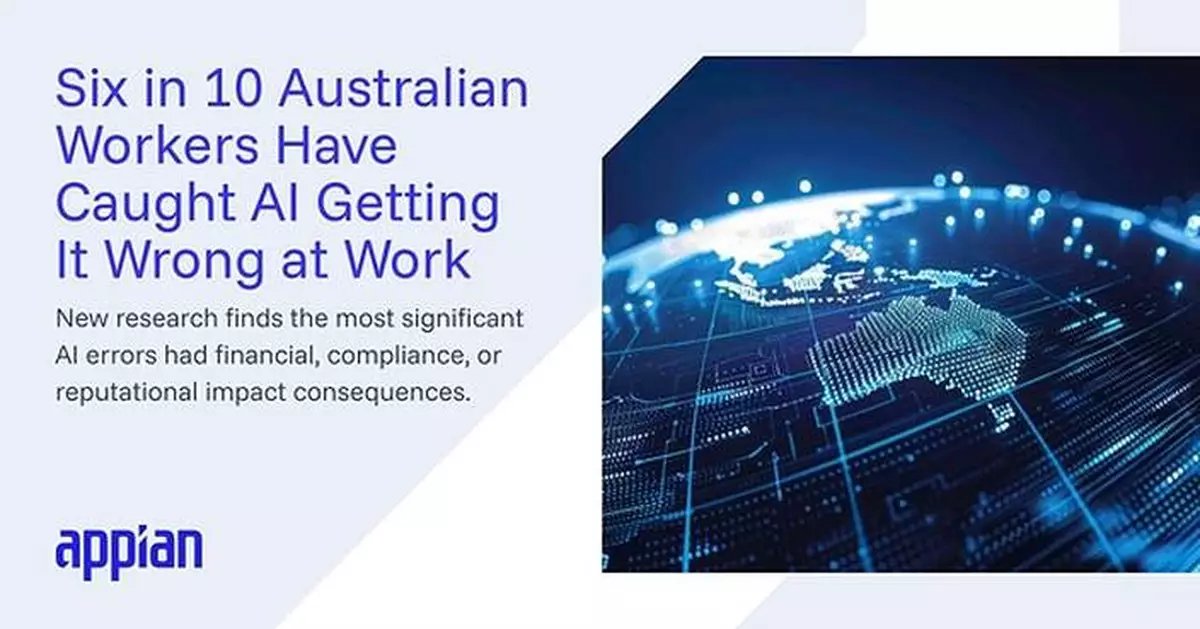
SYDNEY, Oct. 8, 2026 /PRNewswire/ -- Sixty percent of Australian workers have personally identified an error made by an artificial intelligence (AI) tool at work, according to new research from Appian (Nasdaq: APPN).
The Australian workplace study found that while workers widely report AI mistakes, more than one in five said employees in their organisation are discouraged from challenging its recommendations or decisions. Against that backdrop, only 14% fully trust the AI-generated outputs used within their organisation.
Charlie Hutchinson, SVP Asia-Pacific and Japan at Appian, said organisations cannot expect workers to embrace AI if they do not trust its outputs or feel able to question them. "It is hardly surprising that complete trust in AI is so low when workers are catching it making mistakes and are discouraged from questioning its outputs," said Hutchinson.
"For businesses, mistrust creates a lose-lose situation. Employees may avoid AI or spend time checking everything it produces, wiping out the productivity gains it was meant to deliver. Alternatively, they may continue using an output they suspect is wrong because they do not feel able to challenge it. AI needs to operate within the same governance processes and controls as the rest of the business, with people able to step in before a significant error occurs."
AI mistakes are undermining worker trust
AI errors are already affecting customers and business operations. One in five workers said the most significant AI error they encountered caused a customer service issue, while 13% reported operational disruption.
Almost half said the most significant AI error they experienced resulted in consequences beyond minor inconvenience, including financial, compliance, or reputational impact.
The potential for AI to make incorrect decisions was the greatest concern for 25% of respondents, followed by data privacy and security risks at 22%, and a lack of transparency around how AI reaches decisions at 20%.
"Every visible error gives workers another reason to question whether AI should be trusted with more consequential work," said Hutchinson. "Employees are often the last line of defence before an incorrect output reaches a customer or becomes part of a business decision. If they are discouraged from speaking up, organisations remove one of their most important safeguards."
As a result of these challenges, almost all workers (94%) said AI should not be allowed to make decisions affecting employees or customers without limits or human oversight. This is reinforced by findings that senior management remains more trusted than AI, with 52% placing greater trust in senior leaders compared with 29% who trust AI more.
Businesses recognise the risk, but controls are lagging
Global research from Harvard Business Review Analytic Services, sponsored by Appian, found a significant gap between recognising the risks of AI and acting on them. While 92% agreed AI agents need rules-based guardrails to operate safely and effectively, less than half (48%) said their organisation has defined them.
As businesses move AI from standalone productivity tools into core processes that directly affect employees and customers, the consequences of that gap will become more significant.
"Businesses know AI needs rules, but many are deploying it before those rules are in place. Doing so without the right controls can quickly lead to unexpected token costs, operational disruption and accountability gaps," said Hutchinson. "Governance cannot be bolted on after AI is already influencing decisions. AI needs to be embedded within governed business processes that control what it can access, define the rules it must follow, and determine when a decision must be handed to a person. That gives employees the visibility and confidence to use AI while allowing businesses to capture its productivity benefits without giving up accountability."
Workers reject AI without accountability
Two-thirds (66%) of Australian workers believe decisions affecting employees or customers should either require human review and approval or always be made by people. A further 28% would restrict AI to low-risk decisions.
"Australian workers are rejecting unchecked AI. Businesses will only realise the full value of AI if employees build trust, are willing to use it within critical processes, and confident enough to act on its outputs. That requires governed processes where AI recommendations and autonomous agent outputs can be systematically reviewed, validated, or overridden and human judgement remains part of important decisions," concluded Hutchinson.
If you are ready to leverage AI automation for critical processes with structure, reliability and control, start here.
Appian Australian Research Methodology:
Appian commissioned Zoho Research to survey 500 Australian workers in Q3 2026.
About Appian:
Appian provides AI automation for mission-critical work.. We automate complex processes in large enterprises and governments. Our platform is known for its unique reliability and scale. We've been automating processes for more than 25 years and understand enterprise operations like no one else. For more information, visit appian.com. (Nasdaq: APPN)
Follow Appian: LinkedIn, YouTube, Instagram, Facebook, and X.
Forward-Looking Statements
This press release includes forward-looking statements. All statements contained in this press release other than statements of historical facts are forward-looking statements. The words "anticipate," "believe," "continue," "estimate," "expect," "intend," "may," "will," and similar expressions are intended to identify forward-looking statements. These forward-looking statements are subject to a number of risks and uncertainties, including the risks and uncertainties set forth in the "Risk Factors" section of Appian's most recent Annual Report on Form 10-K, quarterly reports on Form 10-Q, and other filings with the Securities and Exchange Commission. Appian is under no duty to update any of these forward-looking statements after the date of this press release to conform these statements to actual results or revised expectations, except as required by law.
** This press release is distributed by PR Newswire through automated distribution system, for which the client assumes full responsibility. **
Six in 10 Australian Workers Have Caught AI Getting It Wrong at Work