SEOUL, South Korea, Oct. 8, 2026 /PRNewswire/ -- Recognition honors EnergyFluo™, an agentic AI energy management system that orchestrates power from multiple sources, inclusive of grid, battery storage and on-site generation, and optimizes facility load so data centers can flexibly run more IT capacity within the power they already have.
Hanwha announced that EnergyFluo™, an agentic AI Energy Management System (EMS) engineered by TransGrid Energy, a Hanwha Group company, has been named to Fast Company's 2026 Next Big Things in Tech, an annual list recognizing breakthrough technologies driving meaningful innovation and shaping the future of technology.
Hanwha was selected in the Applied AI category for its innovative new product designed to help data centers and large-load facilities navigate increasingly complex power environments. Using agentic AI, physics-based equipment models, and digitized operating procedures, EnergyFluo™ analyzes real-time data across power generation, battery storage, cooling, and IT loads to help operators optimize energy use, with targeted operational cost savings of 5% to 25% depending on site configuration. Human operators remain in control of critical decisions, and the technology behind the system was among the first AI-enabled products globally to receive certification under UL 3115, the Outline of Investigation for Safety of AI-Based Products, in March 2026.
Fast Company highlighted EnergyFluo™'s machine learning and large language model (LLM)-driven capability to autonomously monitor data center operations, analyze potential causes of issues, and determine how to respond to optimize power consumption. It also pointed to Prime Group's adoption of the technology for a nationwide deployment of edge data centers as an example of its real-world application.
"Data centers have become some of the most complex energy systems on the grid, and they can no longer be managed one site at a time," said Dr. Youngchoon Park, CEO of TransGrid Energy. "EnergyFluo™ orchestrates grid, storage and on-site generation as one system and optimizes the load behind them, so operators can put more megawatts to work for IT and run their entire fleet from one intelligent view."
Fast Company's Next Big Things in Tech recognizes innovative technologies developed by established companies, startups, and research teams that are making meaningful progress toward transforming the lives of consumers, businesses, and society. This year's honorees span industries, with each innovation demonstrating the potential to create significant impact in the years ahead.
"The most exciting technology innovations are the ones that move beyond promise to demonstrate real potential for impact," said Brendan Vaughan, editor-in-chief of Fast Company. "The companies and teams recognized on this year's list are tackling ambitious problems with new ideas, products, and approaches that have the potential to fundamentally shape the years ahead."
For more information or to view the complete list, visit: Fast Company's 2026 Next Big Things in Tech
About Hanwha
Hanwha is South Korea's fifth-largest business group, with innovative businesses in aerospace & defense, energy & maritime solutions, finance, and tech & life solutions. As a multinational company with a robust global network of affiliates, Hanwha designs, builds, and operates foundational systems that secure societies, strengthen industries, and drive future resilience. Through continuous investment in technology, talent, and trusted partnerships, Hanwha delivers integrated solutions that enable sustainable growth and create long-term value for industries and communities.
For more information, visit: www.hanwha.com
About TransGrid Energy
TransGrid Energy is an energy infrastructure platform advancing the transition from traditional independent power producer models to AI-enabled, data-driven energy systems. A wholly owned subsidiary of Hanwha FutureProof, TransGrid develops, owns, and operates grid-connected generation, battery storage, and distributed energy resources while integrating Grid & Energy Services technology to optimize performance, reliability, and value across the asset lifecycle.
TransGrid is building a scalable platform that connects physical energy infrastructure with software intelligence to support utility-scale, distributed, and behind-the-meter energy applications. As a member company of Hanwha Group, a global leader in renewable energy solutions, TransGrid combines deep energy expertise, proven project execution capabilities, and significant capital to support the evolving energy needs of its customers.
For more information, visit: transgridenergy.com
About Fast Company
Fast Company is the only media brand fully dedicated to the vital intersection of business, innovation, and design, engaging the most influential leaders, companies, and thinkers on the future of business. Headquartered in New York City, Fast Company is published by Mansueto Ventures LLC, along with fellow business publication Inc.
For more information, visit: fastcompany.com
** This press release is distributed by PR Newswire through automated distribution system, for which the client assumes full responsibility. **
Hanwha recognized on Fast Company's 2026 Next Big Things in Tech list
The open-source project includes 10,807 physics-interactive simulation tasks and a 500-task benchmark; fine-tuning improves task success from 0.8% to 21.2%.
SINGAPORE, Nov. 25, 2026 /PRNewswire/ -- Einsia AI today announced the release of RoboUniverse-10K, an open-source suite of 10,807 interactive physics simulation environments designed for embodied AI agent training. Developed in collaboration with researchers from Tsinghua University, Peking University, the University of Illinois Urbana-Champaign (UIUC), the University of Hong Kong (HKU), University College London (UCL), and the University of North Carolina at Chapel Hill (UNC-Chapel Hill), the project aims to address a fundamental bottleneck in embodied AI: the lack of scalable, physically realistic, and verifiable training environments.
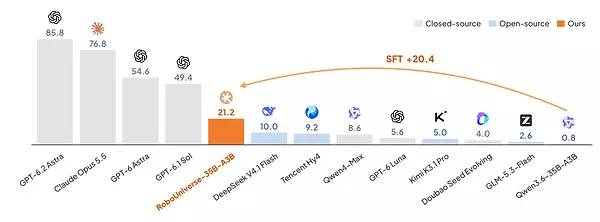
The release also includes RoboUniverse-Verified, an independent benchmark comprising 500 held-out tasks. Using approximately 17,000 multi-turn interaction trajectories collected from the environments, the team fine-tuned a Qwen3.6-35B-A3B-based model, improving its task success rate from 0.8% to 21.2%. Experiments across additional simulation benchmarks and on a real Franka robot further demonstrate the potential of the approach.
Large language models have benefited from scaling training data across the internet, while coding agents have advanced through executable environments built from real-world software repositories, such as SWE-Gym and SWE-smith. Embodied AI faces a more complex challenge: agents must interact with physical environments governed by realistic dynamics, while relying on accurate feedback to determine whether their actions have succeeded.
Yet simulation environments have traditionally been expensive and labor-intensive to build, limiting the number and diversity of available tasks. Without reliable physics and task verification, agents may also exploit simulation flaws, such as passing through objects or using unrealistic movements to obtain rewards without actually completing a task.
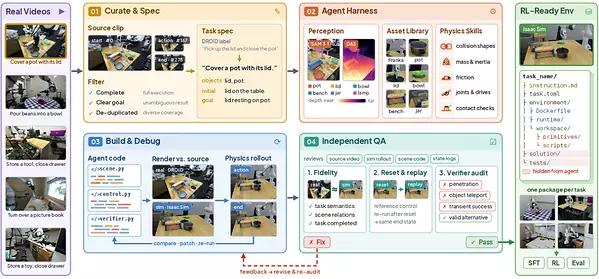
RoboUniverse-10K addresses these challenges by turning real-world robot manipulation videos into executable and verifiable simulation environments.
Turning Real-World Robot Data into 10,807 Interactive Environments
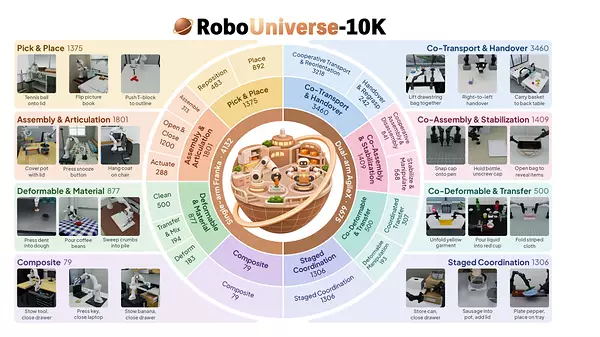
The project covers both single-arm and dual-arm manipulation tasks. Its single-arm environments draw primarily from DROID, alongside more than ten datasets including BridgeData V2, BC-Z, RT-1, and RoboCook. Dual-arm tasks incorporate data from RoboDesk, RoboCOIN, GM100, and RoboMIND2, among others.
To ensure that the dataset reflects genuine task diversity rather than superficial variations in object appearance or placement, the team established a five-level deduplication framework covering robot configuration, task family, individual task, scene layout, and manipulation trajectory.
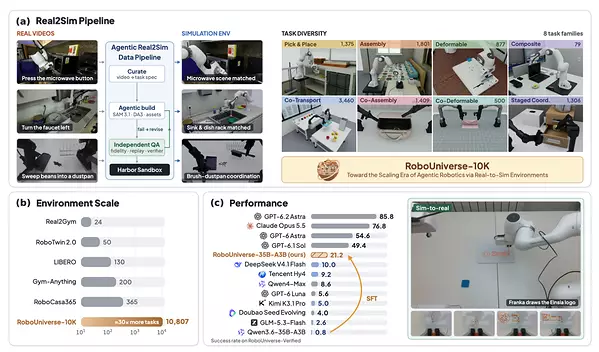
The resulting dataset contains 10,807 distinct tasks, including 10,307 training tasks and 500 held-out evaluation tasks. Its scale is approximately 30 times that of RoboCasa365, with dual-arm tasks accounting for more than 60% of the collection.
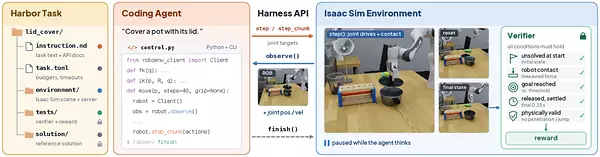
At the core of the pipeline is an automated Real-to-Sim workflow powered by Coding Agents. Using tools such as SAM 3.1 for segmentation and DA3 for depth estimation, the system extracts task-relevant information from real-world videos. Coding Agents then construct simulation scenes, reference solutions, and task verifiers in Isaac Sim, iteratively refining the environments through comparisons between real footage and simulated execution.
An independent QA Agent reviews the source videos, simulation replays, and state logs to assess physical fidelity, reset reproducibility, and verifier robustness. Environments containing issues such as object penetration, teleportation, or false-positive success detection are rejected before entering the dataset.
Evaluating Agents Without Privileged Information
RoboUniverse-10K also introduces a strict execution-and-verification architecture compatible with Harbor, isolating the agent's execution environment from the simulation backend and task verifiers.
Agents can interact with the environment only through five public interfaces. They cannot access hidden object coordinates, reference solutions, or verification logic. Simulation time advances only when actions are executed, not while the agent is reasoning or analyzing visual observations. The environment provides no intermediate progress rewards and does not allow agents to reset tasks themselves. Each task permits only one attempt, with success determined independently by the verifier based on the final physical state.
These constraints are designed to ensure that agents complete tasks through visual perception and action control, rather than relying on privileged information or shortcuts unavailable in the real world.
Benchmark Results Reveal Key Gaps in Embodied Agent Capabilities
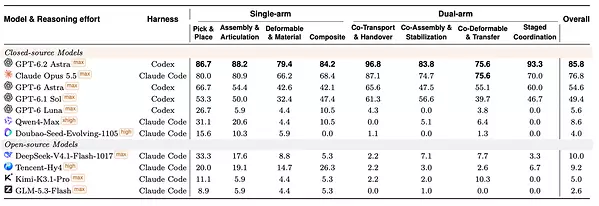
The team evaluated 11 leading closed-source and open-source models on RoboUniverse-Verified. GPT-6.2 Astra achieved the highest success rate at 85.8%, followed by Claude Opus 5.5 at 76.8%. GPT-6 Astra, GPT-6.1 Sol scored approximately 50%, while the remaining seven models each achieved no more than 10%. The strongest native open-source baseline reached 10.0%.
Further analysis identified three major capability gaps.
First, grasping remains a fundamental challenge. Models with overall success rates below 10% achieved an average success rate of 32.1% on non-grasping tasks, such as pushing and pressing, but only 2.7% on grasping tasks. By comparison, the four leading models achieved an average of 63.2% on grasping tasks.
Second, flexible-object manipulation remains difficult even for frontier models. While leading models improved by 35–38 percentage points on rigid-object tasks, their performance on cloth manipulation improved by only around three percentage points, with success rates remaining between 28% and 41%.
Third, precise control after contact is a major bottleneck. Approximately 80% of failures among leading models occurred after initial contact with an object. In one cup-lid assembly task, failed attempts showed an average offset of 6 mm and a tilt of 5.6°, exceeding the tolerances of 2 mm and 4°. In another task, some models applied excessive force to remote-control buttons, reaching 70–138 N.
These findings suggest that the next stage of embodied agent development will require more than improved visual recognition and task planning. Reliable grasping, contact-aware control, and the ability to respond to continuous physical feedback remain critical challenges.
Fine-Tuning Improves Task Success from 0.8% to 21.2%
To test whether RoboUniverse-10K can translate into measurable capability improvements, the team conducted a post-training experiment using Qwen3.6-35B-A3B as the base model.
The researchers freezing the visual encoder and alignment modules while fully fine-tuning the language backbone. The resulting model, RoboUniverse-35B-A3B, achieved a task success rate of 21.2% on RoboUniverse-Verified, up from 0.8% for the base model.
Performance on single-arm tasks increased from 2.0% to 40.5%, while success on pick-and-place tasks rose from 0% to 62.2%. The model also achieved an 8.3% success rate on dual-arm tasks, where the base model had previously recorded no successful completions.
The fine-tuned model also completed tasks in three additional simulation benchmarks: LIBERO-MAX, RoboCasa, and RoboTwin 2.0 where the base model had failed to complete the corresponding tasks.
In a real-world experiment, the model was deployed on a Franka robotic arm and successfully completed a whiteboard drawing task not included in its training data. Given a reference image, the robot drew the Einsia logo while adapting to an unknown whiteboard height through visual observation, trial movements, and continuous correction.
Building Scalable Infrastructure for Embodied AI
RoboUniverse-10K, including its environments, benchmark, and related fine-tuned model, is now open source. The release is intended to provide researchers with a reusable foundation for embodied agent training, evaluation, and further research.
While the current post-training results are based on supervised fine-tuning rather than reinforcement learning, the project demonstrates the potential value of scalable, physically grounded environments for improving embodied agent capabilities.
Just as large-scale internet text helped advance language models and real-world code repositories provided training grounds for coding agents, RoboUniverse-10K aims to establish scalable physical-world training infrastructure for embodied AI, helping the field move toward an era of environment scaling.
Project Resources
About Einsia AI
Founded in 2026, Einsia AI is a research-driven AI lab focused on advancing the frontiers of artificial intelligence. Through the development of authoritative model benchmarks and research into advanced AI training methods, Einsia AI aims to expand the boundaries of intelligence aligned with the real world.
** This press release is distributed by PR Newswire through automated distribution system, for which the client assumes full responsibility. **
Einsia AI Open-Source RoboUniverse-10K, the First 10K-Scale RL Environment Suite for Agential Robotics
Einsia AI Open-Source RoboUniverse-10K, the First 10K-Scale RL Environment Suite for Agential Robotics

Einsia AI Open-Source RoboUniverse-10K, the First 10K-Scale RL Environment Suite for Agential Robotics
Einsia AI Open-Source RoboUniverse-10K, the First 10K-Scale RL Environment Suite for Agential Robotics
Einsia AI Open-Source RoboUniverse-10K, the First 10K-Scale RL Environment Suite for Agential Robotics
Einsia AI Open-Source RoboUniverse-10K, the First 10K-Scale RL Environment Suite for Agential Robotics
Einsia AI Open-Source RoboUniverse-10K, the First 10K-Scale RL Environment Suite for Agential Robotics