Over 90 years ago, villagers along the Wujiang River risked their lives to help Red Army soldiers cross on bamboo rafts and floating bridges, while today, their descendants in southwest China's Guizhou Province are crossing a new frontier, using livestreams to bring mountain produce to the nationwide families.
This year marks the 90th anniversary of the victory of the Long March, which concluded in October 1936 when the main forces of the Red Army broke through the siege of the Kuomintang forces and reunited in northwest China.
The military odyssey of roughly 12,500 kilometers, which started in 1934, not only preserved the revolutionary forces, but also gave the Communist Party of China (CPC) a new foothold to grow the strength of the revolution, and a new starting point to carry the revolution forward to victory.
Guizhou's Zunyi City witnessed one of the gravest crises for China's revolution. A young, battle-weary army faced relentless pursuit. To reach Zunyi and survive, they had to cross the deadly Wujiang River.
Surrounded by steep cliffs and raging waters, the historic riverfront of the Wujiang battlefield was a true no-retreat battleground. As the largest river in Guizhou Province, the Wujiang River is famous for its rapid currents, numerous shoals and narrow valleys. Crossing the river required three essential conditions: clear weather, large wooden boats and skilled boatmen. However, the Red Army had none of these resources at that time. They could only cross the river using bamboo rafts and bamboo pontoons.
In desperate times, humanity became the greatest strength. Local villagers risked their lives, building bamboo rafts and floating bridges through the night.
"My maternal grandfather rallied local villagers to aid the Red Army back then. Villagers hiked up the hills to cut bamboo and carry the bamboo poles to the river. Working nonstop for two days, they made many bamboo rafts. These rafts were bound with keel ropes to form a bamboo pontoon bridge across the Wujiang River," said Wu Wenhua, a local villager.
Local villagers linked dozens of bamboo rafts to build a floating bridge, enabling the main force of the Red Army to successfully cross the Wujiang River at Huilong Ferry.
On January 2, 1935, the Red Army forced the crossing. This bold breakout shattered the blockade and saved the revolution from collapse. After breaking through the Wujiang River defense line at Huilong Ferry, the Red Army advanced toward its next strategic stronghold -- Zunyi.
Attended by 20 delegates from January 15 to 17, 1935, the landmark Zunyi Conference is a turning point that changed the course of history. In just three days, the conference corrected past errors and reset the revolutionary course.
The Long March spirit is defined by perseverance against overwhelming hardship. This resolve has lived on in Zunyi's land and people. Decades have passed. Battlefields have turned into peaceful, vibrant countryside. History has given way to ordinary, beautiful life.
Surrounded by rolling mountains, Hongdu Village was once isolated. Today, rural livestream e-commerce brings hidden mountain produce to nationwide families.
Villagers carefully sort fresh farm goods, preparing for daily online sales. By half past ten, the village's livestream base becomes bustling. Authentic mountain produce travels from remote hills to every corner of the country.
Behind every lively livestream lies quiet dedication. Young streamer Xiuxiu handles packing and delivery, sustaining the village's online business.
"I can see how hard these uncles, aunts and grandparents work to grow vegetables. That's why I hope to do my part to help them earn more, and get our special local farm products from Hongdu Village out of Guizhou," said Xiuxiu.
This work requires great effort. Xiuxiu works late every day on selection, live hosting and delivery, but she said that seeing villagers earn more makes it all worthwhile.
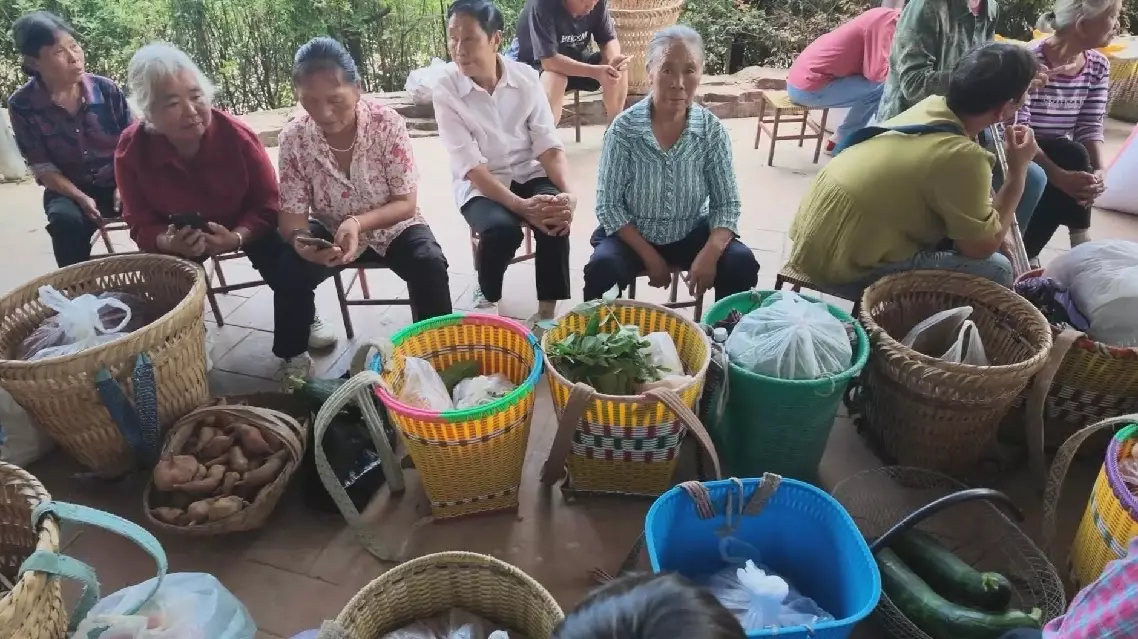
Guizhou village turns once Long March battlefield into peaceful, vibrant countryside