KAWASAKI, Japan--(BUSINESS WIRE)--Oct 7, 2026--
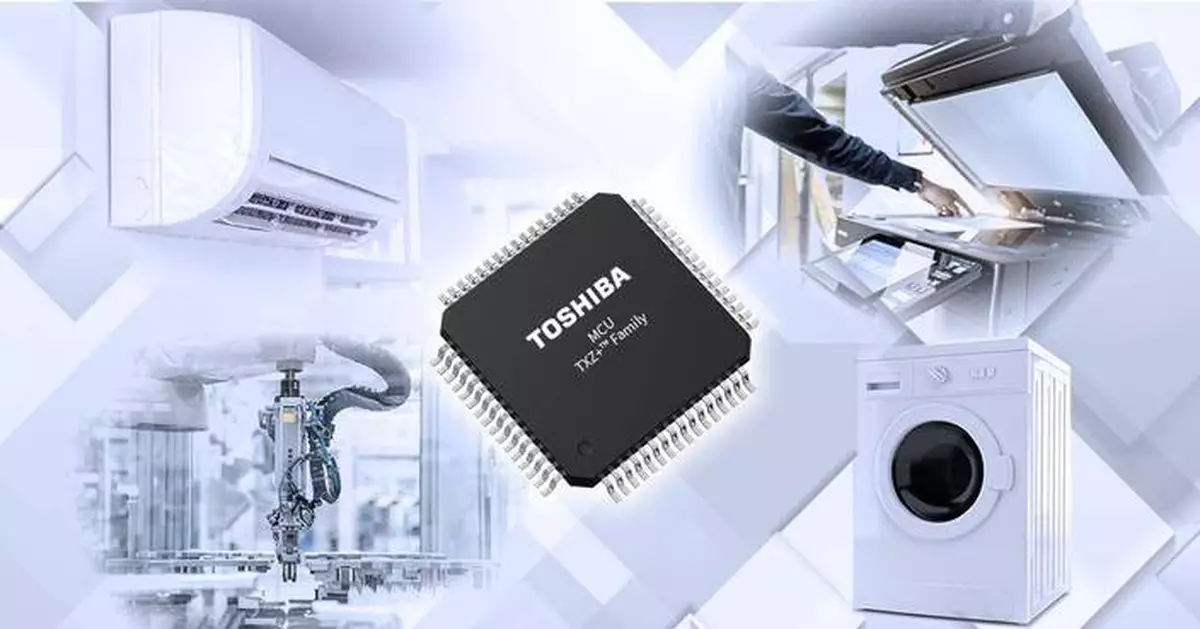
Toshiba Electronic Devices & Storage Corporation ("Toshiba") has started mass production of the TXZ+™ Family Entry-Class M4H Group, standard microcontrollers [1] featuring an Arm® Cortex®-M4 core with a floating-point unit (FPU). The microcontrollers are expressly designed for use in small-scale system control applications in consumer products, such as air conditioners and washing machines, and in industrial equipment, including multifunction printers and factory automation systems.
This press release features multimedia. View the full release here: https://www.businesswire.com/news/home/20261007242546/en/
As consumer products and industrial equipment continue to become more sophisticated and diversified, microcontrollers for system control are required to deliver real‑time performance and stable operation while also offering easy system design, versatility for long-term deployment, and extensibility to derivative products. There are also small-scale system control applications which require microcontrollers that provide essential control functions and can be readily applied to both existing systems and new designs, not highly advanced functions optimized for specific applications.
Toshiba has addressed these requirements with the launch of the TXZ+™ Family Entry-Class M4H Group as standard microcontrollers that emphasize essential functionality and ease of use. Despite being entry-class products, they employ an Arm® Cortex®-M4 core with FPU and operate at speeds up to 120MHz. This ensures computing performance and real-time responsiveness required for system control in consumer products and industrial equipment, and supports core system control applications such as control logic, interface processing, and timing control.
M4H products support a supply voltage range of 2.7V to 5.5V, making them suitable for both 3V and 5V systems. They also integrate a high-speed oscillator with ±1% accuracy, which helps to reduce external components and improve design flexibility. The products can be used in a wide range of system configurations, from derivative development of existing equipment to new system designs.
The microcontrollers integrate basic functions required for system control, including a 12-bit analog-to-digital converter (ADC), timers, universal asynchronous receiver/transmitter (UART), serial peripheral interface (SPI), inter-integrated circuit (I²C), and direct memory access (DMA). They also incorporate an advanced programmable motor control circuit (A-PMD) for brushless DC motor control, enabling flexible use across a variety of applications and system configurations.
Toshiba supports product evaluation and development with product documentation, sample software, and driver software for peripheral functions. The company will progressively roll out evaluation boards and development environments in collaboration with Arm® ecosystem partners, helping customers from initial evaluation through mass-production ramp-up.
Toshiba will continue to expand its design support resources and enhance its lineup of microcontroller products suitable for system control in consumer products and industrial equipment.
Note:
[1] A standard microcontroller that is not specialized for a specific application, designed to emphasize versatility in supporting power supply conditions and peripheral functions, and suitable for a wide range of system control applications.
Applications
Features
Follow the links below for more on the new products.
TMPM4H4FYUG
TMPM4H2FYDUG
TMPM4H1FYUG
Follow the link below for more on Toshiba’s microcontrollers.
Microcontrollers
* Arm and Cortex are registered trademarks of Arm Limited (or its subsidiaries) in the US and/or elsewhere.
* TXZ+™ is a trademark of Toshiba Electronic Devices & Storage Corporation.
* Other company names, product names, and service names may be trademarks of their respective companies.
* Information in this document, including product prices and specifications, content of services and contact information, is current on the date of the announcement but is subject to change without prior notice.
About Toshiba Electronic Devices & Storage Corporation
Toshiba Electronic Devices & Storage Corporation, a leading supplier of advanced semiconductor and storage solutions, draws on over half a century of experience and innovation to offer customers and business partners outstanding discrete semiconductors, system LSIs and HDD products.
Its 17,400 employees around the world share a determination to maximize product value, and to promote close collaboration with customers in the co-creation of value and new markets. The company looks forward to building and to contributing to a better future for people everywhere.
Find out more at https://toshiba.semicon-storage.com/ap-en/top.html
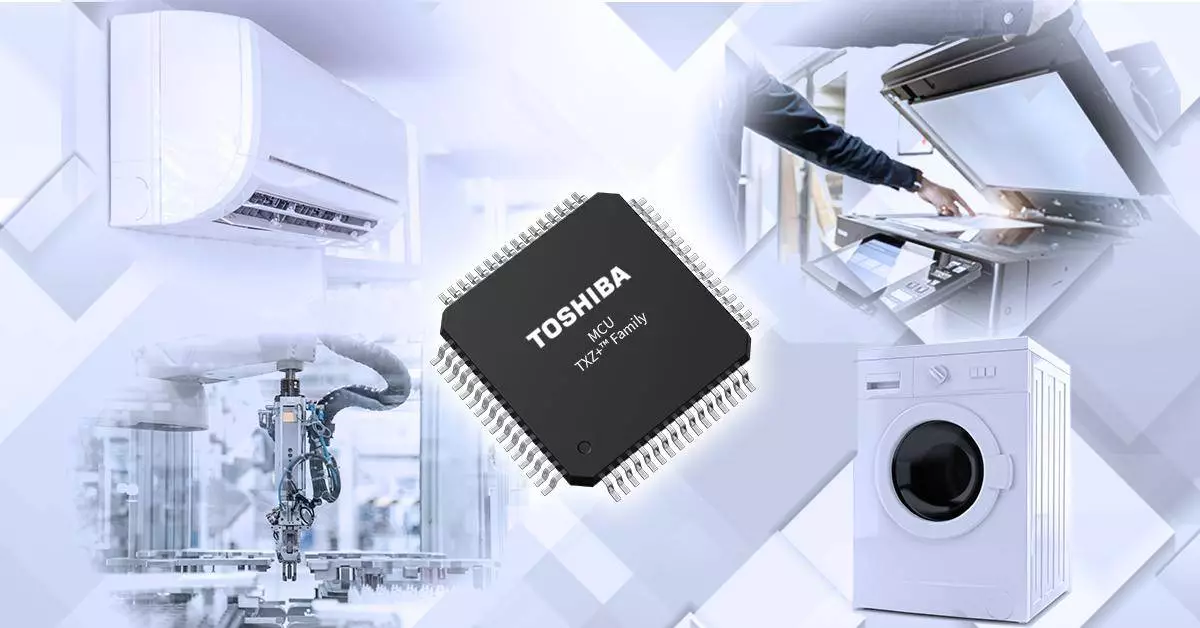
Toshiba: TXZ+™ Family Entry‑Class M4H Group, standard microcontrollers featuring an Arm® Cortex®‑M4 core with a floating-point unit (FPU).
President Donald Trump has turned emergency relief into a campaign talking point in the final sprint to the midterm elections, approving disaster declarations in consequential states and coupling endorsements with funding announcements. As the country braces for a major hurricane barreling toward the U.S. Gulf Coast, the moves have revived questions about whether the administration is politicizing disaster recovery.
The latest example came Wednesday, when Trump voiced support for Republican Rep. Tom Tiffany in Wisconsin’s governor race while pledging millions to help with recent storms.
In addition, the president recently joked that he would cut off money to North Carolina, which is still healing from Hurricane Helene two years ago, if Republican Senate candidate Michael Whatley lost. And the day before an Ohio campaign rally with Sen. Jon Husted last Saturday, Trump approved a disaster declaration for the state while leaving 15 other requests pending.
Disaster survivor advocates say they want elected officials to prioritize their recovery — not wield it as a political tool.
“Recovery isn’t partisan,” said Sierra Lindsey-Kos, co-founder and co-executive director of Extreme Weather Survivors, an advocacy nonprofit.
“Neighbors help each other without asking who anyone voted for, and that’s exactly the way it should be," she said.
The White House rejected the idea that it's injecting politics into disaster recovery. “There is no politicization to the president’s decisions on disaster relief,” spokesperson Lauren Bis said Tuesday.
Trump has frequently mentioned disaster support in social media posts about the midterms, sometimes announcing new funding in conjunction with reminders of endorsements for Republican candidates like Ashley Hinson in Iowa and Andy Barr in Kentucky.
On Wednesday, Trump posted that he’d spoken to Tiffany, “who has my Complete and Total Endorsement to be the next Governor of the Great State of Wisconsin,” and told him about $17.9 million in disaster funds were coming to the state. “18 Million Dollars should help, A LOT,” Trump wrote. Tiffany is up against Democratic nominee David Crowley in Wisconsin’s governor’s race.
A spokesperson for Democratic Gov. Tony Evers said their office had not been informed about the money, and Evers responded to the announcement on social media.
"Clearly, President Trump and Congressman Tiffany are continuing to play politics with emergency aid that’s meant to help communities recover in the wake of disasters like tornadoes and floods."
FEMA later confirmed that Trump approved disaster declarations for Wisconsin and West Virginia, though he didn’t announce the one for West Virginia on social media.
Even creating the perception that disaster relief and votes are connected has traditionally been “out of bounds,” said Rafael LeMaitre, FEMA spokesperson under former President Barack Obama.
“It diminishes the integrity of the disaster management system and it erodes trust in the way the government addresses disasters generally,” he said.
When Trump held a rally in North Carolina for Republican Senate candidate Michael Whatley, the president acknowledged the state was still waiting for billions of dollars in federal recovery funds for Hurricane Helene.
“Now if Michael loses, I’m not sending it,” he said. “No, I’m only kidding, you’re getting it,” he added.
Republican Jennifer Balkcom, a congressional candidate in a western North Carolina district, later defended Trump's comments.
"I don’t know if he was being funny,” Balkcom told WLOS ABC News 13. “I think he was trying to persuade voters to vote for Michael Whatley.”
While the joke might not faze Trump’s most dedicated supporters, others found it off putting, said Jon Council, who works for the organizing group Down Home North Carolina.
“That just doesn’t strike me as a person or administration that’s taking the conditions on the ground here seriously, and taking the responsibility to the American taxpayer seriously,” Council said.
Trump also brought up disaster relief funds at a campaign rally in Ohio last Saturday, telling supporters in a high school gymnasium in Vandalia that he had signed a “special” disaster declaration for the state after August severe weather.
“You had some bad storms, and Jon and everybody wanted me to help, and I took care of it,” Trump said, referring to Republican Senator Jon Husted, who is running a tight reelection race against Democrat Sherrod Brown.
The major disaster declaration for Ohio authorizes direct assistance to residents of seven of the 23 counties requested by Republican Governor Mike DeWine. It came while 15 other requests from states, tribes and territories remain pending, including two from Hawaii, which experienced back-to-back hurricanes in August and September.
Trump did not answer pending disaster requests before rallying in two other Republican states last week with less consequential races, Oklahoma and Nebraska.
Andrew Rumbach, a senior fellow at the Urban Institute who tracks presidential disaster declarations, said politicians “have always tried to use disasters to their advantage." However, he said this White House's behavior has been “unusual and frankly concerning."
An Associated Press analysis in July found that Trump had approved more than three-quarters of the requests from states that voted for him in the 2024 election but less than half the requests from states that did not.
A FEMA spokesperson said Tuesday that “any suggestion that disaster decisions are politically motivated does not reflect how this process works or how FEMA carries out its mission.”
Politics has permeated recent communications from FEMA itself.
A September news release about preparations for a nor'easter storm listed 18 Republican members of Congress with whom it said agency leadership was “working closely” during the weather event, omitting mention of any Democrats despite the states mentioned being Democrat-led.
A FEMA spokesperson did not address questions about why only Republican representatives were named.
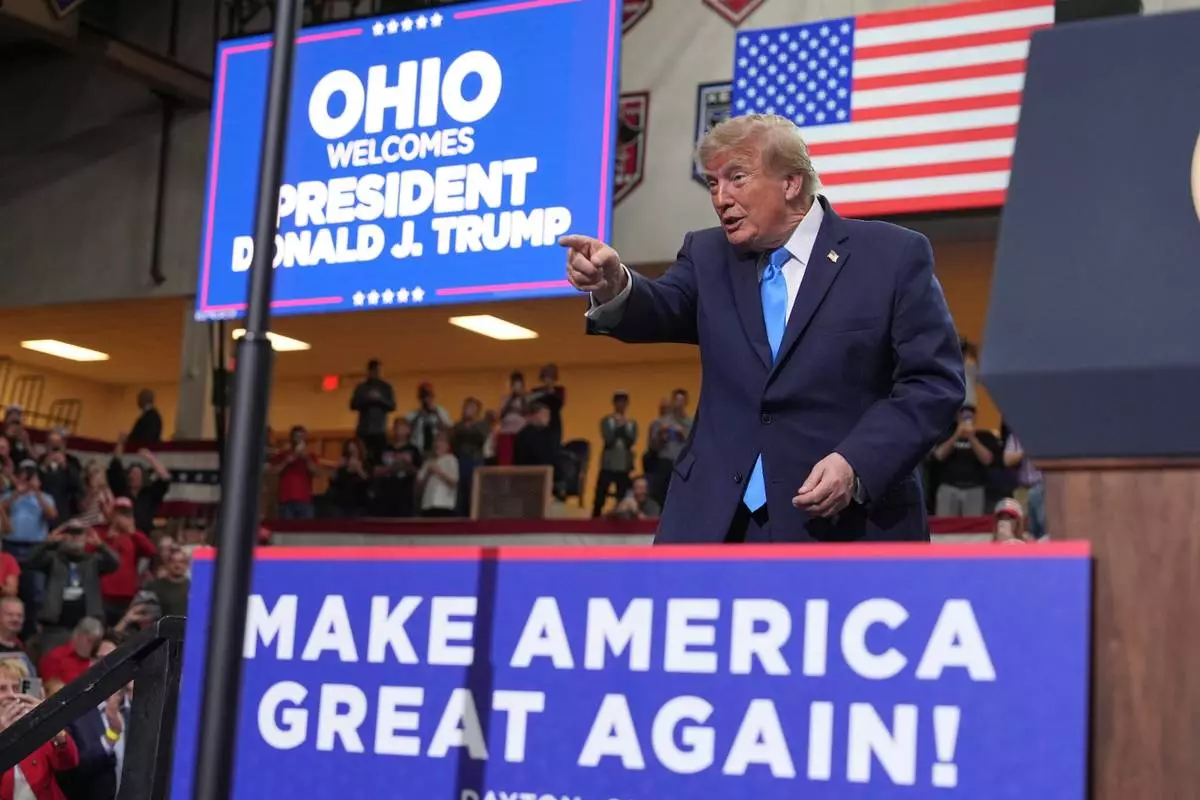
President Donald Trump departs after speaking during an event at Butler High School in Vandalia, Ohio, Saturday, Oct. 3, 2026. (AP Photo/Mark Schiefelbein)