Cequence launches Agent Trust so businesses can see AI agents and stop out of bounds actions
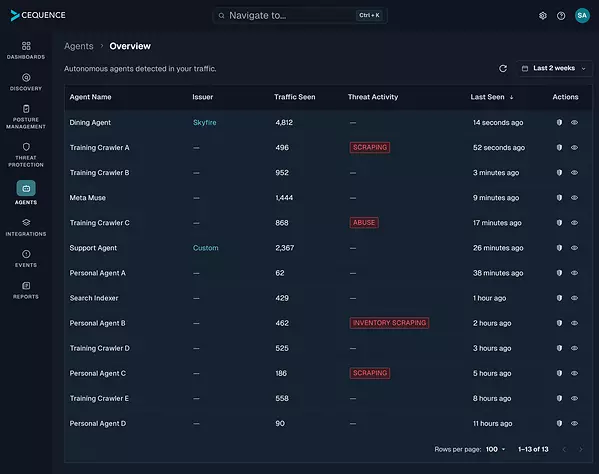
SINGAPORE and SANTA CLARA, Calif., Oct. 8, 2026 /PRNewswire/ -- Within two weeks of Meta's Sep. 8 launch of its Muse personal AI agent, Cequence Security found traffic matching Muse at more than half of the customers it studied. Most of those businesses would not have known. Muse presents itself as an ordinary Chrome browser rather than identifying as an AI agent, so to standard security checks it looks like a person.
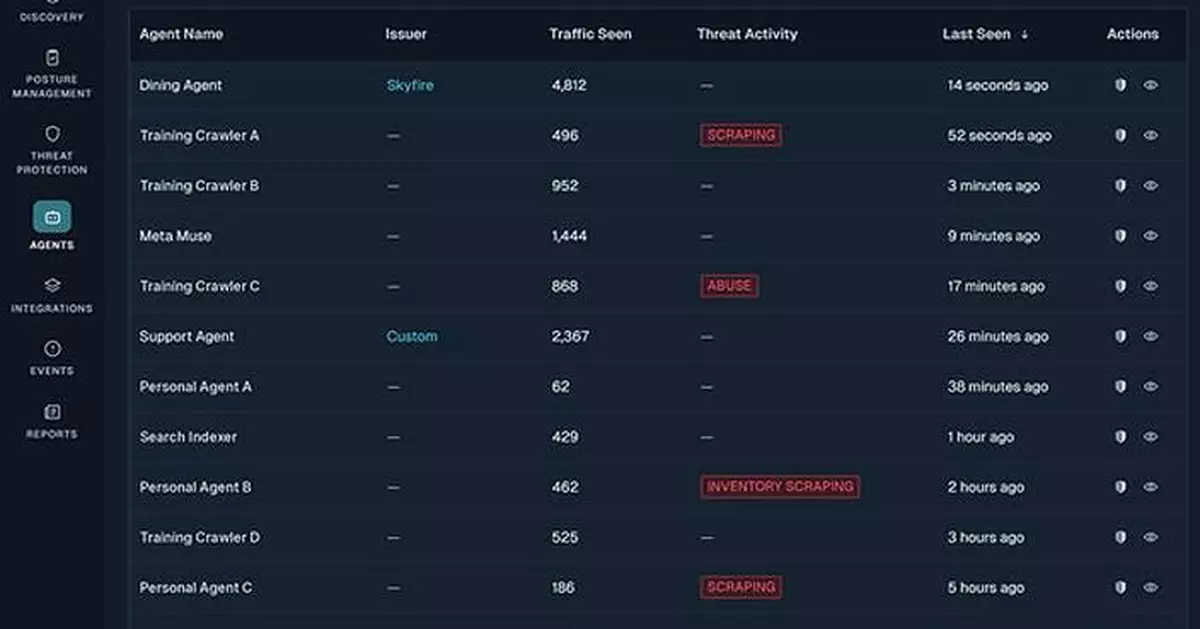
Cequence spotted the traffic with the same behavioral detection that powers Agent Trust, a new capability in Cequence Application and API Protection available today. Agent Trust verifies agents that present an identity and catches the ones that don't. Muse shows why businesses need both. With Agent Trust, they can stop harmful requests while still letting customers use their services through agents like Muse.
What Cequence found
Cequence analyzed traffic across customers in financial services, retail, travel, software and other sectors from Sep. 1 to Sep. 24, 2026. Muse traffic grew nearly sixfold from its first week to its most recent week, depending on the industry.
- Passes as a regular browser: Each Muse user gets their own agent. It runs a real Chrome browser in the cloud, directed by an AI model that reads each page and decides what to click, and it routes its traffic through a consumer VPN. It does not sign its requests or identify itself as an agent, so to most security tools it looks like a person browsing. Cequence identified it through behavioral analysis, which picked up signals such as a browser update that went from 0% to more than 90% of Muse traffic within days, a sign that Meta hosts and updates these browsers centrally.
- Getting through multi-factor authentication: At financial institutions, Muse logged in to customer accounts and completed multi-factor authentication on users' behalf, with confirmed successful sign-ins. For those businesses, a successful multi-factor login no longer shows whether a person or an agent is on the other end.
- Browsing like a bot, buying like a customer: Muse searched, compared options, filled carts and moved through checkout, and a small share of sessions ended in a completed purchase. Most sessions browsed and left; the pattern businesses have long used to spot bots. Whether a visitor completes a purchase is no longer a reliable way to tell a bot from a customer.
- Blocking the request, not the agent: In late September, a travel and hospitality customer's security team began blocking nearly one in five Muse requests, targeting only the ones that looked abnormal. Muse itself remains allowed, and the rest of its traffic goes through. More businesses face this choice now, and it only works with controls precise enough to act on individual requests.
"Muse launched in the U.S., but agents like it won't stay there. In Asia-Pacific, where many consumers already shop, bank and pay mostly on their phones, agents will find a ready audience, and businesses should prepare before that traffic arrives. Blocking agents outright will turn customers away, and letting them all through is a risk most security teams can't defend. The businesses that prepare now will be able to act on a single suspicious request without shutting out the agent behind it. That's the control Cequence Agent Trust gives enterprise organizations," said Ameya Talwalkar, co-founder and CEO of Cequence.
Together, the findings show why agents are hard to govern. Traffic that is almost always legitimate, invisible to standard checks and trusted with customer logins looks the same whether it comes from Muse or from an attacker using a stolen agent credential.
"AI agents like Meta's Muse are bots that act on behalf of real customers. Many businesses can't see them, and those that can are tempted to block them," said Hari Nair, VP of product management at Cequence. "Agent Trust lets businesses block the action, not the agent. The agent keeps working for its customer, and the one request that crosses a line gets stopped, slowed or challenged."
How Agent Trust works
Agent Trust pairs identity verification with the behavioral detection Cequence has run across bot and API traffic for years. It includes:
- Detected agents inventory: A live view of every agent in an organization's traffic, including agents like Muse that do not identify themselves. Built-in agent detection rules, kept up to date by CQ Prime Threat Intelligence, are already running for every Cequence customer with no setup required.
- Issuer registry: Verification of agent identity against the providers an organization trusts, alongside Cequence Biometric Check. The registry is protocol-agnostic, so supporting a new agent identity framework means registering a new issuer rather than waiting on a product update.
- Agent activity log and behavioral analysis: A request-by-request record of what each agent did. Cequence Intent Graph builds a behavioral profile of each agent that separates the real agent from an impostor replaying a stolen token.
- Transaction-level enforcement: Policies that block, rate-limit, or challenge a specific action rather than the agent behind it. For sensitive actions such as changing an account email, Biometric Check lets the account holder confirm on their own device whether they meant for their agent to act.
Because Cequence discovers and inventories an organization's APIs, Agent Trust knows which endpoints handle login, checkout, pricing, and stock. If an agent that normally checks order status starts pulling price and stock for every product, the platform can stop the scraping while the agent keeps working for its customer.
"Every CISO is about to hear the same question from the business, which is whether the company can let AI agents in. Saying no is no longer the safe answer, because customers are choosing agents and will take their spending wherever those agents are welcome. Our job is to make yes the safe answer," added Ameya Talwalkar, co-founder and CEO of Cequence.
Availability
Agent Trust is immediately available to Cequence customers as part of Application and API Protection. To learn more or discuss how Agent Trust applies to your environment, request a demo at https://www.cequence.ai/demo/bot-management.
Resources
About Cequence Security
Cequence protects the applications and data that power the agentic enterprise. More than a decade of bot defense and API security experience has established Cequence as the leader of safe and secure agentic AI adoption. The Cequence platform delivers deep insight into user, entity, and agent behavior, enabling organizations to secure, govern, and control agentic AI workflows while protecting against bad actors and rogue agents. Cequence delivers value in minutes rather than days or weeks with a highly scalable, no-code approach. Trusted by the largest and most demanding private and public sector organizations, Cequence protects more than 10 billion daily API interactions and 4 billion user accounts. To learn more, visit: https://www.cequence.ai/.
** This press release is distributed by PR Newswire through automated distribution system, for which the client assumes full responsibility. **
Meta's Muse Reached More Than Half of Customers Cequence Studied in Two Weeks Without Identifying Itself as an AI Agent
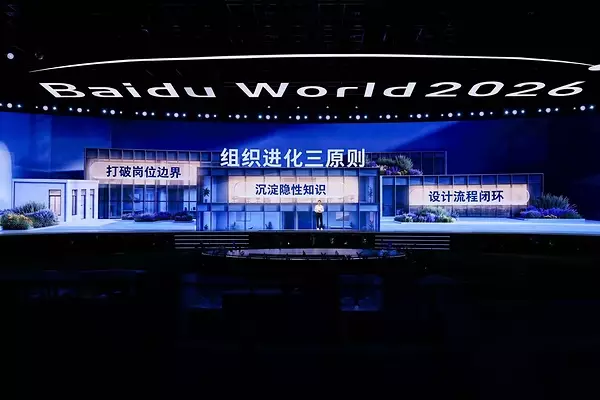
- Robin Li, Co-founder and CEO of Baidu, outlined his vision for the next chapter of AI, centered on the intelligent organization, and introduced three principles of organizational evolution.
- Baidu also introduced ERNIE 5.5 Flash Preview, the latest open-weight foundation model designed for efficient inference, and two application models ERNIE Wizshot Micro-Expression and ERNIE Light Deep Thinking.
- Baidu launched Token Exchange, a neutral, transparent, and trusted marketplace connecting model service providers to customers.
- Baidu also upgraded its agent lineup, including digital human agent Baidu Yijing, the general-purpose agent DuMate, document and creative workspace KOOKO, and self-evolving agent Famou 3.0.
BEIJING, Nov. 12, 2026 /PRNewswire/ -- Baidu, Inc. (NASDAQ: BIDU and HKEX: 9888), a leading AI company with strong internet foundation, today unveiled new offerings and upgrades across its full-stack AI portfolio spanning chips, cloud, models, and agents, designed to help enterprises transform into intelligent organizations. The new lineup includes Token Exchange, a trusted marketplace for model services; upgrades to its agents DuMate, KOOKO, Baidu Yijing, and Famou; ERNIE 5.5 Flash Preview, its latest foundation model, which balances intelligence with inference efficiency; as well as the new Tianchi 1024-card Supernode and Kunlunxin roadmap.
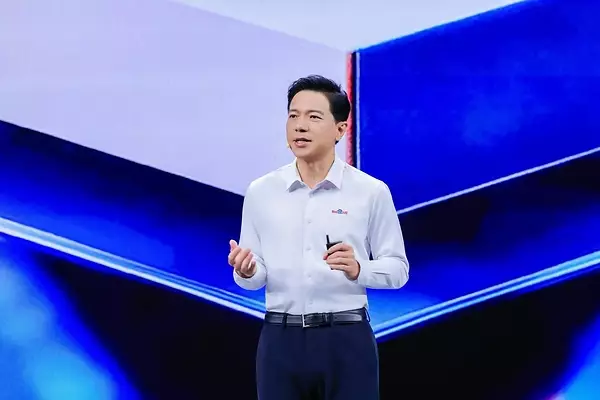
In his opening keynote, Robin Li, Co-founder and CEO of Baidu, described the intelligent organization as the next chapter of AI. Li explained why turning that technological progress into productivity gains means moving beyond traditional hierarchies. Just as AI needs energy to run, making full use of its capabilities requires an AI-native approach to how organizations operate. "If AI is the new electricity, then the intelligent organization is the new factory of the AI era, where productivity truly happens," Li said.
Li also laid out three principles for how organizations should evolve. The first is to break down job boundaries. With AI now enabling one person to act in multiple roles, Li said organizations will be built around tasks rather than jobs and become a network of tasks. "Jobs won't disappear, but they will converge into roughly two types: Builders, who create new things, and Sellers, who connect with people to forge emotional bonds and earn their trust," Li said. The second is to capture tacit knowledge and turn it into a shared company asset. "This is a capability that competitors can't copy, hire away, or buy. That's what a real moat looks like." The third is to design closed-loop processes. Li put forward a formula: measurability plus looping equals continuous evolution, so that "the organization becomes a system that never stops learning and evolving."
Early results at Baidu have already validated the three principles. Over the past year, the average number of daily active agents (DAA) inside Baidu rose from 5,000 to 37,000, an increase of more than 600%. Agents now complete more than 1 million tasks a week, up from 84,000. Baidu has also built 4,300 workspaces and captured more than 20,000 organizational skills. According to Li, by turning practical experience into reusable skills, organizations can build shared capabilities that benefit the entire workforce.
Foundation and Application Models Advance in Parallel: ERNIE 5.5 Flash Preview, ERNIE Wizshot Micro-Expression and ERNIE Light Deep Thinking
Baidu also released its latest-gen foundation model ERNIE 5.5 Flash Preview. With 280 billion total parameters and 14 billion parameters activated per token, the model supports a 1M context window and performs strongly in coding, 3D modeling, knowledge work, and content creation.
ERNIE 5.5 Flash Preview balances intelligence with inference efficiency. Across multiple benchmarks, including Terminal-Bench and AutomationBench, it achieved competitive scores while maintaining extremely fast decoding speed. The model API is now available on Baidu AI Cloud's Qianfan platform, and the model weights will be open-sourced by November 25. API pricing is RMB 1 per million input tokens and RMB 4 per million output tokens, with cached input at just RMB 0.04 per million tokens. The model is also available for free on OpenRouter. ERNIE 5.5 Flash Preview is optimized with ERNIE Evolve, Baidu's proprietary recursive self-improvement (RSI) technology, to boost inference efficiency and reduce cost.
Baidu also introduced two application models, the ERNIE Wizshot Micro-Expression model and the ERNIE Light Deep Thinking model, available via API on Baidu AI Cloud's Qianfan platform. The ERNIE Wizshot Micro-Expression specializes in highly expressive video creation. It processes text, images, and speech together and can support long-form text input of up to 4,000 Chinese characters. It leads the industry for podcasts and short animated dramas at half the typical cost. Originally developed for multimedia search, the ERNIE Light Deep Thinking is designed to handle complex requests and tool calls at search-scale speed. It pairs a fast-thinking model that serves users with a slow-thinking model that continuously refines it in a closed loop. It also incorporates Baidu Sparse Attention (BSA), a proprietary technology that compresses historical memory during decoding to reduce inference costs without compromising model performance.
Token Exchange: A Trusted Marketplace for Model Services
Looking at the broader market, demand for model services is growing fast. To make high-quality model services easier to find and use, Baidu launched Token Exchange, a neutral, transparent, and trusted marketplace that connects AI model providers with customers. Customers can compare model services side by side, with clear pricing and performance data, and access them in one place. Quality providers, in turn, gain a channel to access more customers. Li described it as an exchange for foundation models, where businesses and individuals can easily find, buy, and use trusted model tokens.
Token Exchange rests on two pillars of trust: verification and credit rating. To verify each resource, it compares model fingerprints and tests capability, performance, and availability. To rate each provider, it runs regular spot checks and monitors calls end to end in real time. One month in, Token Exchange has onboarded more than 100 model resources and now handles a daily average of more than 50 million calls and over 700 billion tokens.
Over time, Token Exchange is expected to help put underused compute to work and make the AI and foundation model ecosystem healthier and more efficient.
Baidu Yijing, DuMate, KOOKO, and Famou: Agent Upgrades Put the Intelligent Organization to Work
At the event, Baidu Yijing, the hyper-realistic digital human agent, introduced short animated drama creation covering concept, script, storyboard, and final cut, turning a single idea into a finished production in one stop. With one-click localization, creators can then take their dramas to global audiences. Built on Baidu's proprietary video generation model, production costs are just RMB 0.2 per second of video.
Baidu's general-purpose agent DuMate has been upgraded to serve as the unified gateway to Baidu's full range of specialized agents, and Baidu has fully opened its Harness engine and Agent API. Over the past quarter, DuMate became the fastest-growing general-purpose agent. The DuMate team also put the three principles of organizational evolution into practice: it has iterated more than 160 times in six months, with 90% of its code and 50% of its external communication materials generated by DuMate.
KOOKO, the global AI-powered platform for documents and creative workflows, brings together publicly available information, professional databases, and users' own content to help research, write, and create high-quality artifacts such as research reports, slide decks, and websites. Upgraded from GenFlow 3.0, KOOKO draws on 1.8 billion professional resources from Baidu Wenku and Baidu Drive, 750 million Chinese and English academic papers, and a network of millions of experts.
Baidu Famou, a self-evolving agent designed to address complex operational challenges across industries, has been upgraded to version 3.0. Combining an agent platform with forward-deployed engineer (FDE) services, it takes direct responsibility for continuously optimizing final business results in real production systems. Its customers now span 25 of China's 41 industrial categories.
Cloud and Chips Strengthen the Foundation as Apollo Go Expands Globally
At the event, Baidu AI Cloud launched the Tianchi 1024-card Supernode, an all-optical interconnect supernode built for high-speed data transmission. Kunlunxin, Baidu's AI chip business, also announced a major roadmap update: the Kunlunxin M100 inference chip has shipped as planned and delivers exceptional cost-effectiveness, while the flagship M300 is expected to ship in 2027 with a major leap in computing power, memory, and interconnection. "We believe inference will be the primary driver of sustained long-term growth in the AI chip market," Li said.
"Embodied AI is now at a stage comparable to where autonomous driving stood in 2016," Li said. Apollo Go, Baidu's autonomous ride-hailing service, now covers 28 cities worldwide and has logged more than 350 million autonomous kilometers, including over 240 million in fully driverless mode. It has launched fully driverless commercial operations in Abu Dhabi and Dubai, and partnered with CAR Inc. in Hainan to pioneer the world's only driverless car rental model.
Li said intelligent organizations will open three major opportunities: asset-light operations, new competitive moats, and the creation and discovery of new markets. "So now is the moment to drive the intelligent evolution of organizations," he said.
"Baidu is ready to work with everyone to rethink, redesign, and recreate the organization," Li said. "Let us take the initiative in organizational transformation and win the future through intelligent evolution."
About Baidu
Founded in 2000, Baidu's mission is to make the complicated world simpler through technology. Baidu is a leading AI company with strong internet foundation, trading on the NASDAQ under "BIDU" and HKEX under "9888." One Baidu ADS represents eight Class A ordinary shares.
Media Contact:
intlcomm@baidu.com
** This press release is distributed by PR Newswire through automated distribution system, for which the client assumes full responsibility. **
Baidu Unveils Latest ERNIE Models Amid Broader Full-Stack AI Lineup, and Debuts Token Exchange to Power Intelligent Organizations
Baidu Unveils Latest ERNIE Models Amid Broader Full-Stack AI Lineup, and Debuts Token Exchange to Power Intelligent Organizations