NEW YORK (AP) — Major League Baseball proposed to shorten the regular season to 154 games from 162 starting in 2029 and to expand the Division Series to best-of-seven in a plan given to players during collective bargaining Thursday.
Owners also proposed adding nine additional days off to the current postseason format, extending it to a maximum 42 days in a move that would give top starting pitchers potential to appear more often.
MLB would allow higher-seeded teams in the first two rounds of the postseason to pick their opponents beginning next year and would make most regular-season Mondays a day off for the vast majority of teams starting in 2029 except for those in up to two nationally broadcast games.
Cutting regular-season games would reduce the opportunity for players to set season and career records.
“Returning to a 154-game schedule would allow us to introduce a weekly off day, which is good for player health, while also creating a new national broadcast window to showcase our most exciting teams and players," MLB spokesman Glen Caplin said in a statement.
The players' association said it will review the plan and will respond at the bargaining table.
Baseball's five-year labor contract expires Dec. 1, and management is expected to lock out players in a confrontation that could delay or wipe out the 2027 season. MLB proposed a salary cap, which the union has vowed to never accept, along with limits on contract values and length.
“Unfortunately, the league once again made clear that all of its proposals are contingent on players’ agreement to a salary cap, a system that guts player rights and compensation, as well as its other anti-player proposals,” the union said in a statement.
MLB's regular season currently schedules 162 games over 187 days, and the new format would play the 154 games over 180 in most years.
MLB would keep the Wild Card Series at best-of-three at the ballpark of the higher-seeded team, add an extra day off between Games 1 and 2 and stagger series starts. There would be only two games scheduled on each of the first three days rather than the current format of up to four games per day.
No. 3 seeds could select after the regular season whether to host No. 5 or No. 6 in the Wild Card Series, and the No. 1 seeds could pick which wild-card winner to play in the Division Series.
Each best-of-seven series would be played over 11 days instead of nine, adding off days before Games 5 and 7 in addition to the travel days before Games 3 and 6. MLB would stop scheduling early round postseason games in afternoons after some teams have struggled to fill stadiums in those slots.
Management made a “pick your opponent” proposal in 2022 bargaining as part of a 14-team playoff plan players didn't agree to.
“A shorter regular season unlocks making October even better for our fans — with fewer weekday afternoon games, a longer Division Series and more opportunities to see the game’s best pitchers on the biggest stage," Caplin said. "And allowing the top seeds to select their opponents in the first two rounds would create compelling storylines, intensify existing rivalries and create new ones.”
As part of the proposal, each team would be scheduled for four day-night doubleheaders, one against each division rival.
Minor league schedules have included days off on Mondays since 2021.
Big league clubs would be scheduled for Monday games on national holidays, when many typically draw large crowds. Teams that play Mondays would be scheduled to have Thursday off.
MLB said player salaries would not be adjusted to reflect fewer games and bonus provision thresholds — like those that pay players for games played — would be adjusted to reflect the shortened schedule.
The National and American Leagues adopted 154-game schedules in 1904 that had every team in each eight-team circuit playing all opponents 22 times.
The AL switched to a 162-game schedule when it expanded to 10 teams for 1961 and the National League followed suit the next year.
The LCS started in 1969 and were best-of-five through 1984, then expanded to best-of-seven.
Division Series have been best-of-five since their inception for annual use in 1995. Wild card games started with the expansion of the playoffs from eight to 10 teams in 2012 and became best-of-three Wild Card Series when the postseason increased to 12 clubs in 2022.
See AP’s full MLB coverage here

Los Angeles Dodgers two-way player Shohei Ohtani advances to first base on a walk during the second inning in Game 4 of baseball's National League Division Series against the Atlanta Braves, Wednesday, Oct. 7, 2026, in Atlanta. (AP Photo/Mike Stewart)
The U.S. Army found many systemic breakdowns that led to last year’s midair collision between an American Airlines jet and a Black Hawk helicopter near Washington, D.C., and recommended numerous steps the military should take to prevent future tragedies.
The military has not publicly released its report on the deadliest plane crash on U.S. soil in over two decades, but eventually shared it late last week with families of the 67 people who died.
For months, many of the families have been pressuring the Army in daily social media posts to release the report, which was completed in May. The Associated Press obtained a copy on Thursday. The Army did not immediately comment.
Former Army Black Hawk pilot Tim Lilley, whose son Sam Lilley was the first officer on the American Airlines jet, said he still wants more details from the military. Some information in the report was redacted and the military assigned responsibility for its shortcomings broadly across the Army.
“The Army owes the families and the American public a full accounting of how these risks were allowed to persist, who was responsible for the decisions that allowed them to persist and what will be done to make sure this never happens again,” said Lilley, who is a commercial jet captain today.
While the report largely reinforces the National Transportation Safety Board's conclusions, the civilian investigation was broader and NTSB members focused on years of warning signs missed by the Federal Aviation Administration. The Army report highlighted how the air traffic controller in the tower at Reagan National Airport could have prevented the crash, but also acknowledged the military's own failings.
The report recommended that the Army look beyond Washington, D.C., to study the practices in every major city where its helicopters operate to ensure similar risks aren't present. An Army official said the review of helicopter flights in other cities, including Los Angeles and the Seattle-Tacoma region, is ongoing. The official spoke on condition of anonymity because they were not authorized to speak publicly on the situation.
The lieutenant general who authored the report said “breakdowns across all layers of conflict management caused this accident” but “the most salient contributing factor was the two broken radio transmissions” that contributed to the helicopter crew not identifying Flight 5342 as it was circling to land on Reagan National Airport's alternate runway. The military pilots were wearing night-vision goggles that limited their field of vision and made it difficult to spot the plane amid the lights of the city.
The poorly designed helicopter route in use at the time of the crash provided only a scant 75 feet (23 meters) of vertical separation between a helicopter and a plane landing on Reagan’s secondary runway, and that was only true if the helicopter stuck to the riverbank. This did not allow enough separation to account for the accepted level of error in a Black Hawk’s altimeter, and the NTSB found the helicopter was flying nearly 100 feet (30 meters) higher than its instruments read.
The NTSB said in a letter to the Army last week that the agency is pleased with the progress being made on seven of the eight recommendations to the Army. That contrasts with the FAA, which the NTSB has faulted for failing to implement roughly one-third of the recommendations to that safety regulator.
The Army report said the controller should have provided the helicopter crew with more details about exactly where the plane was to help the pilots spot it, and the controller should have warned the plane about the helicopter headed toward it. The FAA has prohibited controllers from relying on pilots to maintain visual separation in busy airspace since this crash.
The main group of families of passengers on the plane, who were flying from Wichita, Kansas, said the report reinforces their call for Congress to pass aviation safety reforms and require aircraft to be equipped with systems that will help pilots know where traffic in the air is.
“It’s a simple concept anyone can understand: aircraft should be able to see each other in the sky. The technology is proven. All that’s required is the political will to do the right thing,” the Families of Flight 5342 group said in a statement Thursday.
“We have waited long enough. We waited for the NTSB. We waited for the Army. Both investigations are complete, and both make clear that collision avoidance technology must be part of the solution. There is nothing left for Congress to wait for,” they said.
Both the House and Senate passed different aviation safety bills, but lawmakers are still working on a compromise piece of legislation to bring up for a vote in both houses of Congress.
Associated Press Writer Konstantin Toropin in Washington contributed.
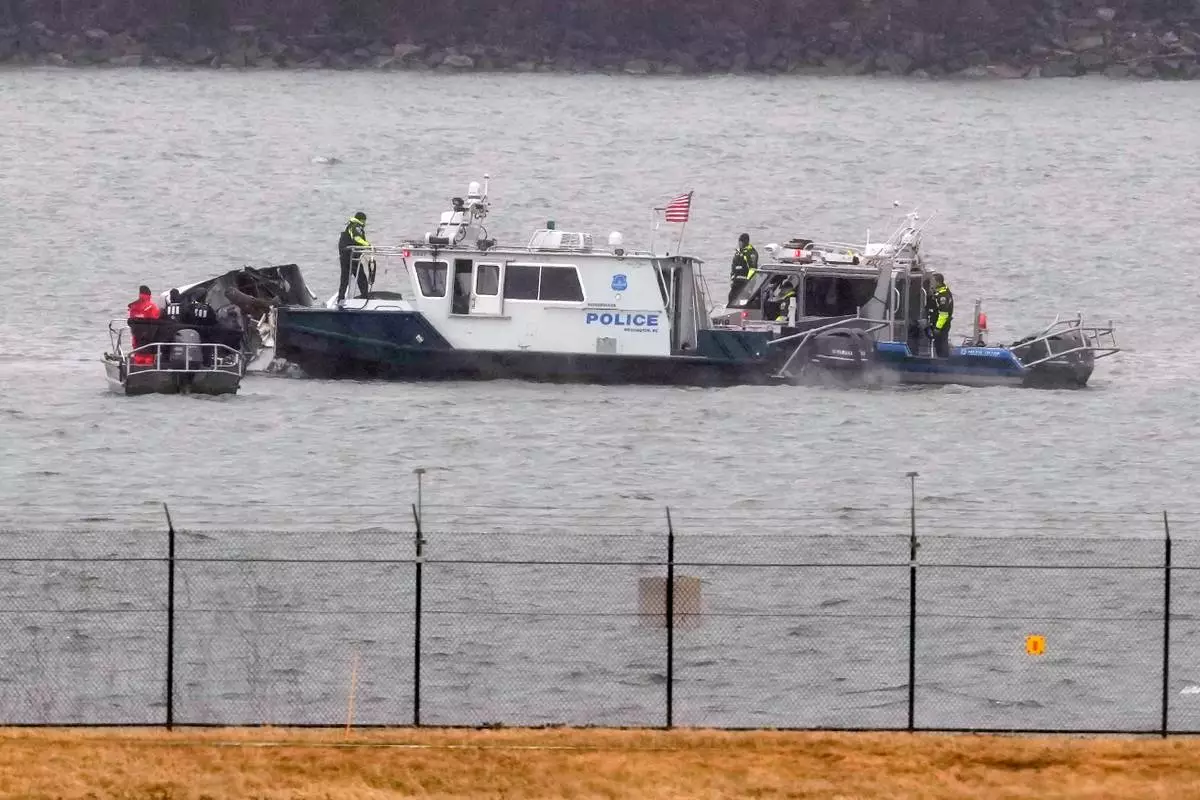
FILE - Search efforts are seen around a wreckage site of a deadly midair collision between an American Airlines jet and an Army helicopter in the Potomac River near Ronald Reagan Washington National Airport, Jan. 31, 2025, in Arlington, Va. (AP Photo/Alex Brandon, File)