China is expanding training infrastructure, developing industry standards and increasing real-world trials to move embodied AI from laboratories into commercial use, as growing volumes of human and simulated data help robots learn complex workplace tasks.
Embodied AI refers to artificial intelligence integrated into physical systems such as robots, enabling them to perceive and interact with the real world.
More than 70 embodied AI training centers are operating across China, while over 40 others are under construction or being planned.
Three major clusters have emerged in the Yangtze River Delta in the east, the Beijing-Tianjin-Hebei region in the north and the Pearl River Delta in the south.
At Lightwheel AI in Beijing's Zhongguancun technology hub, a data platform pools videos of people performing tasks with synthetic data generated through simulations at training centers nationwide.
The company said it has delivered more than 1.5 million hours of human video data, a volume it describes as among the largest in the industry worldwide.
"We are building infrastructure that allows robots to keep learning. In practice, that means feeding the experience they gain after deployment back into the system so it can support further training," said Du Xiqi, an executive at Lightwheel AI.
The growing pool of training data is already being used to improve robots performing real-world tasks. In Shenzhen, south China's Guangdong Province, wheeled humanoid robots trained on such data can operate electrical control cabinets and open or close industrial valves.
"After training the robot on tens of thousands of data samples, it can now carry out a given action with a success rate of 80 to 90 percent," said Dong Dianbiao, an executive at Shenzhen Cyborg Robotics.
The development comes as China's broader artificial intelligence industry continues to expand. The value of the country's core AI industry exceeded 1.2 trillion yuan (about 180 billion U.S. dollars) in 2025, with more than 6,200 companies operating in the sector.
In June, China's Ministry of Industry and Information Technology and state assets regulator launched an embodied AI program that covers industrial production, services and specialized operations, including workplace safety and emergency response.
The program seeks to create a cycle in which real-world training generates data, the data drives product improvements and upgraded systems are deployed at scale. It aims to validate the regular deployment of key products in representative settings and identify more than 100 high-value applications by the end of 2026.

China opens over 70 robot training centers in embodied AI push
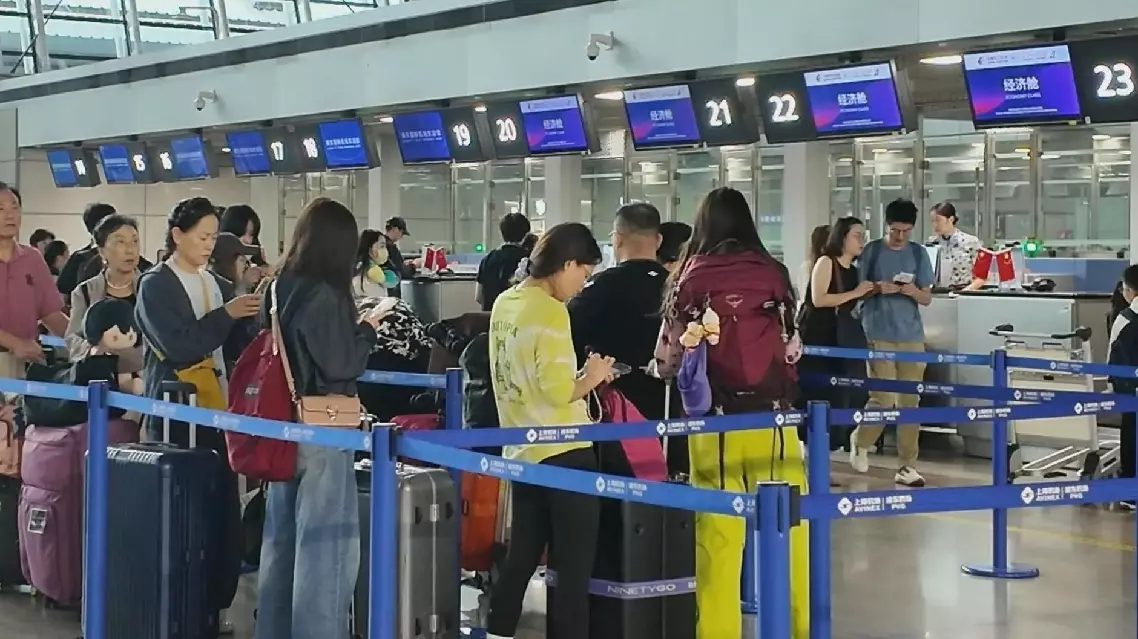
China recorded more than 15.46 million cross-border trips during the week-long National Day holiday, as international travel has continued to rebound and visa-free policies have helped drive inbound tourism, official data released on Thursday showed.
According to the National Immigration Administration, border inspection authorities across the country handled a total of 15.462 million inbound and outbound passenger crossings by Chinese and foreign travelers during the holiday, averaging 2.209 million trips per day. The figure was 6.7 percent higher than that in the same period of last year.
Foreign nationals made 682,000 inbound trips during the holiday, up 5.4 percent year on year. Of these, 505,000 entered under visa-free policies, an increase of 9.2 percent from a year earlier.
Major cities, including Shanghai, Guangzhou and Chengdu, witnessed busy cross-border passenger flows.
At the Mohan Railway Port in southwest China's Yunnan Province, nearly 7,000 travelers from 31 countries and regions crossed the border during the holiday. Visa-free foreign travelers accounted for more than 58 percent of inbound passengers there.
In Chengdu City, southwest China's Sichuan Province, international visitors explored attractions such as the Chengdu Research Base of Giant Panda Breeding and Du Fu Thatched Cottage, sampled local cuisine and experienced traditional cultural activities.
As of October 7, Sichuan border inspection authorities had processed more than 141,000 inbound and outbound passenger trips and 840 flights during the holiday, with passenger traffic up 7.8 percent year on year.
Other parts of the country also saw strong travel and consumption activities. In south China's Hainan Province, the offshore duty-free market recorded sales of 855 million yuan (about 127 million U.S. dollars) from October 1 to 7. Nearly 700,000 items were sold, while the number of shopping trips reached 123,000, up 10.41 percent year on year.
In Guangzhou City, south China's Guangdong Province, where the 140th Canton Fair is approaching, ports also recorded heavy passenger flows.
The Guangzhou General Station of Immigration Inspection said its ports handled about 405,000 inbound and outbound traveler trips during the holiday, the highest National Day holiday figure in nearly five years.
"Many businesspeople arrived in Guangzhou ahead of schedule to visit factories and hold business negotiations, bringing a peak in inbound passenger flows at Pazhou Port. We have fully implemented the 16 measures introduced by the Guangzhou General Station of Immigration Inspection to provide services and support for the 140th Canton Fair. We've opened special lanes for Canton Fair businesspeople to ensure that travelers and overseas businesspeople can pass through border controls safely, conveniently and efficiently," said Xiao Yan, an inspection officer at Zhoutouzui Border Inspection Station.
China records 15.46 million cross-border trips during National Day holiday