Fields Medalist Maxim Kontsevich said AI's advancements in mathematics have exceeded his expectations, acknowledging that a total takeover of the field by this technology is possible but stopping short of calling it inevitable.
Kontsevich won the Fields Medal in 1998 for his groundbreaking work in mathematical physics and other areas. In an exclusive interview with China Media Group (CMG) that aired Friday, he reflected on how quickly AI is transforming mathematics.
"It's really faster than I expected. But in fact, the same, my older brother who introduced the mathematics he used for maybe 10 years, working a very long time ago in lab of artificial intelligence in Moscow. It was very different period, essentially before computers, in a sense. But we discuss a lot. So I kind of got exposed to these ideas," said the famed mathematician.
"But still it's not really surprising because in mathematics, there is some kind of mechanical and maybe to say democratic aspect of mathematics. Actually, a long time, I used to think that in fact, anybody can be mathematician, just to have interest and concentration, but in principle, there's kind of some rules, some logical rules and which restrict you, harness you, so you see you can check yourself if they do mistakes and so on," he added.
Regarding which aspects of mathematical research AI could enhance or eventually replace, Kontsevich was candid about the uncertainty of the future.
"I actually have no idea. Maybe everything will be replaced. But definitely it's good to do complicated arguments, which are hard to follow. It's really similar to chess in this level. It's like winning complicated chess in complicated position in this complicated proof. It's more or less the same stuff, but to make simple proof, but it's a new viewpoint. It's something that I like, it's a different part of activity, but who knows, maybe AI will learn this as well. And then our task will be to understand what is going on here," he said.
Kontsevich remained open-minded but cautious about forecasts that AI could overtake human mathematicians in just two years.
"Who knows? Maybe it's on the border of its capabilities, but the progress was really amazing just the last few months. If it's AI that discovered something, I will also be glad to learn it," he said.
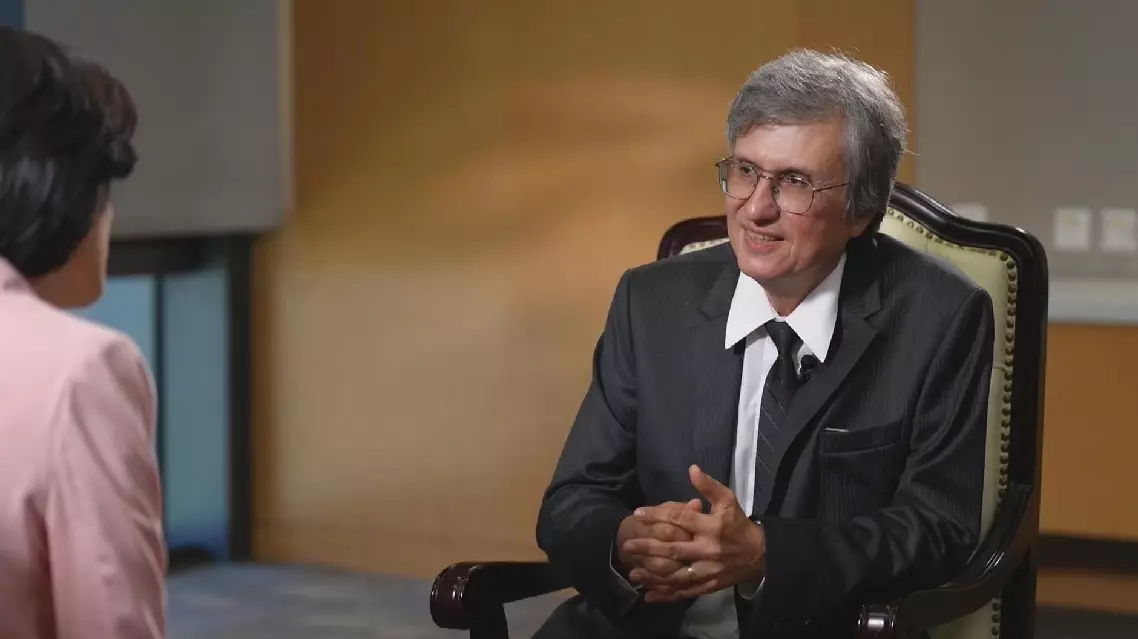
Fields Medalist Kontsevich says speed of AI advances in math took him by surprise