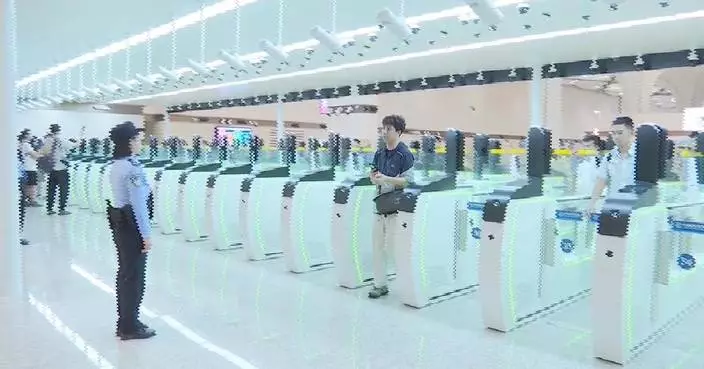
The newly redeveloped Huanggang Port, which officially opened on Monday, has introduced a streamlined "five-in-one" joint inspection model designed to shorten clearance times for vehicles traveling between China's Shenzhen and Hong Kong Special Administrative Region.
As China's largest single port building and the world's largest land port complex, the redeveloped port offers round-the-clock clearance services for cross-border passengers and vehicles.
The upgraded crossing features a joint vehicle-inspection system that brings together five regulatory authorities from the mainland and Hong Kong at a single stop, allowing vehicles to queue only once, undergo a single round of data collection, receive simultaneous verification and complete coordinated clearance procedures.
The vehicle clearance procedure requires drivers to go through three sequential gates.
The first gate remains constantly open, allowing vehicles to enter without stopping. At the second gate, drivers pause briefly for a one-time data collection, covering vehicle registration, credentials, fingerprints, and body temperature, which is simultaneously verified by authorities from both regions. Once cleared, the third gate opens immediately, enabling drivers to exit the lane without leaving their vehicle or repeating any inspection steps.
"Compared with old clearance modes, cross-border vehicles no longer need to line up twice and undergo repeated verification. Drivers can have their documents, vehicle info, and biometric data collected all at once, while the five authorities conduct simultaneous reviews. With 24-hour non-stop clearance and the 'five-in-one' vehicle inspection, we have significantly cut down time costs for cross-border sci-tech innovation, commuting, and business travel between Shenzhen and Hong Kong, turning the 'Shenzhen-Hong Kong half-hour quality living circle' from a vision into everyday reality," said Wu Yue, an officer at Huanggang Border Control Station.
"The customs clearance at the upgraded Huanggang Port is extremely smooth and wonderful. In the past, we had to pass several gates before passing through the Huanggang Port. Now, we just need to go through a single barrier, which is super comfortable. This upgrade is fantastic in serving travelers in the Guangdong-Hong Kong-Macao Greater Bay Area. I feel very satisfied," said a resident.
With significantly enhanced customs clearance efficiency, the redeveloped port is expected to boost regional connectivity and facilitate cross-border travel for the Guangdong-Hong Kong-Macao Greater Bay Area.
The original Huanggang Port, which opened in 1989, was China's first large-scale land port with 24-hour clearance. It has served hundreds of millions of travelers, with daily passenger traffic peaking at over 60,000 and daily vehicle traffic reaching around 10,000.
Reconstruction on the original site began in 2019 to meet the surging demand for cross-border passage.
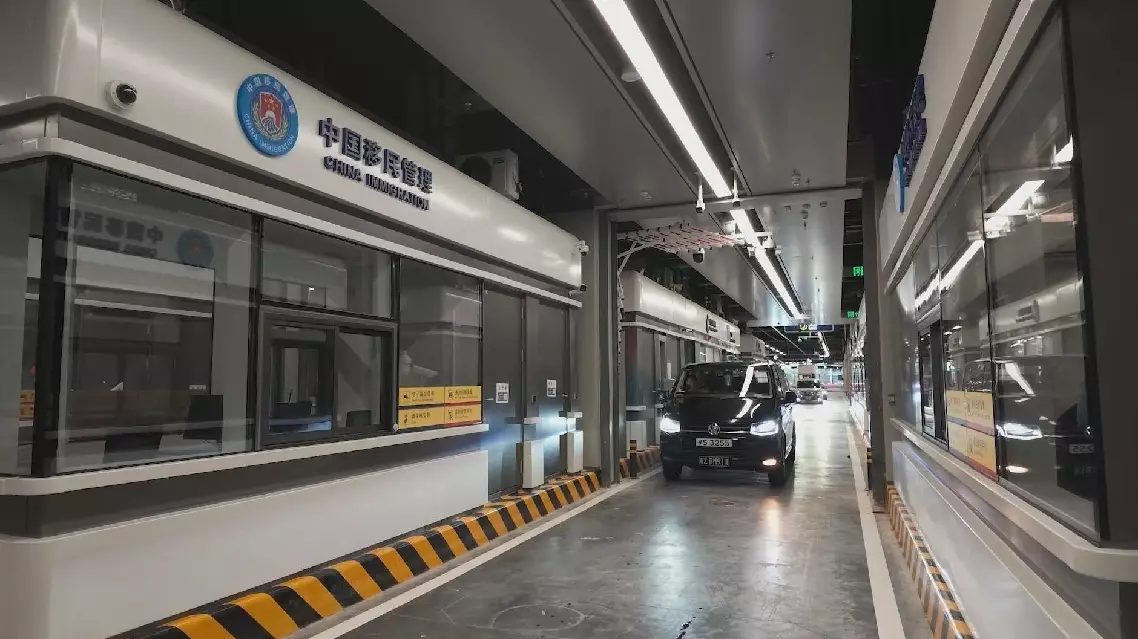
Redeveloped Huanggang Port boosts vehicle transit efficiency