COLUMBUS, Ohio--(BUSINESS WIRE)--Oct 12, 2026--
NetJets ®, the global leader in private aviation, today announced the addition of new private terminals at Dallas Love Field (DAL) in Texas, Washington Dulles International Airport (IAD) outside of Washington, D.C., and Colorado’s Rifle Garfield County Airport (RIL). The company is also moving from its existing exclusive-use terminal to a new, larger space at Donald J. Trump International Airport (DJT) in West Palm Beach, Florida. These investments further enhance the dependable access and anticipatory service that define seamless travel for NetJets customers, referred to as Owners, throughout the United States.
This press release features multimedia. View the full release here: https://www.businesswire.com/news/home/20261008369404/en/
“As Owner demand continues to grow across key business, leisure, and seasonal destinations, NetJets is investing in the infrastructure to deliver an unmatched experience while supporting the service and reliability our Owners expect where they fly most,” said Patrick Gallagher, President, NetJets Aviation.
Exclusive-use terminals give Owners access to NetJets-only facilities that offer greater privacy, premium amenities, and thoughtful assistance from dedicated, on-site NetJets Service Representatives who work to ensure every arrival and departure detail is personalized and perfectly orchestrated. Each facility features inviting lounges, VIP conference rooms, and curated design elements that reflect the character of its region. With every new exclusive-use space, NetJets underscores its foundational service philosophy—to deliver a tailored experience that makes every Owner feel as if their flight is the only one—while upholding its safety-first operations.
The company currently operates more than 50 NetJets locations across the globe, including corporate and regional offices. This growing network of facilities includes dedicated private terminals and NetJets Service Hubs ® where NetJets’ aircraft are detailed, restocked, and, at select locations, proactively maintained.
Dallas Love Field (DAL)
Dallas is one of NetJets’ busiest operational hubs and has seen growing demand with flight activity up more than 25% since 2022. The new NetJets-only complex, totaling nearly 114,000 square feet, is set to open in late 2028. It includes an expansive private terminal, developed in partnership with Signature Aviation ®, as well as a second NetJets Service Hub hangar, building on the existing maintenance hangar established in 2021, to strengthen mission-ready aircraft availability across the southern United States.
NetJets Owners will be welcomed into a private space with a southwest-inspired design, featuring stone and other natural materials. Additional parking and a dedicated airside gate will ensure smooth transitions to and from aircraft.
Washington Dulles International Airport (IAD)
Serving the Washington, D.C., metropolitan area, Dulles Airport is consistently among NetJets’ top five Owner destinations. Construction is scheduled to begin in early 2027 to convert the first and second floors of an existing three-story Signature Aviation facility into a dedicated space of more than 14,000 square feet for NetJets Owners.
Intended to create an open and unified experience, a new grand staircase will visually and physically connect both levels, encouraging exploration. The spacious, contemporary facility will be designed with Owners’ professional and personal travel needs in mind, offering a lounge with ample seating, a family room, and private VIP suites.
Rifle Garfield County Airport (RIL)
With the upcoming Aspen/Pitkin County Airport runway renovation, Rifle Garfield County Airport in Colorado is set to become a gateway to one of the country’s premier mountain destinations. To maintain access to this sought-after area, NetJets anticipates its new complex will be operational by early 2027, ahead of the Aspen airport closure. It will feature a state-of-the-art, 6,000-square-foot private terminal—built from the ground up in partnership with Vantage Aviation—and a new aircraft hangar to safeguard NetJets’ aircraft from winter temperatures and snow while maintaining operational readiness.
For Owners, the facility will make it easier to reach this in-demand seasonal location, which is expected to become increasingly popular in the coming years. The private terminal will include an Owner lounge with expansive mountain views and incorporate natural materials reflective of the surrounding landscape.
Donald J. Trump International Airport (DJT)
NetJets is also enhancing its established presence at Donald J. Trump International Airport in West Palm Beach. In partnership with Signature Aviation, the company is transitioning to a larger exclusive-use terminal with expanded accommodations for Owners, additional vehicle parking, and increased dedicated ramp space for NetJets’ aircraft. The total footprint of the new facility will increase from 10,000 to 15,000 square feet. DJT is the fourth-busiest airport for NetJets and remains a major gateway to South Florida for both seasonal and resident Owners.
Through ongoing investments in exclusive-use terminals, hangars, and support services, NetJets continues to expand and strengthen the infrastructure built around its Owners and operations—advancing the unmatched access, safety, and personalized service that set the company apart.
About NetJets
Originally incorporated in 1964 as Executive Jet Airways, NetJets has been setting—and exceeding—industry standards for more than 60 years. Today, NetJets is proud to be a Berkshire Hathaway company known for its unwavering commitment to safety and service. The NetJets portfolio of distinctive companies, encompassing NetJets, Executive Jet Management, QS Partners, and QS Security, offers a variety of customizable travel solutions, including shared ownership, lease and jet card options, aircraft management, private jet charter, brokerage and acquisition services and specialized security services. This comprehensive suite of solutions is why so many of the world’s most discerning travelers choose NetJets generation after generation. It is also because NetJets has the largest, most diverse private jet fleet in the world, which grants anytime access to even the most remote destinations across the globe. To learn more about the leader in private aviation, visit netjets.com today.
All marks are property of their respective owners.

Interior rendering, NetJets private terminal at Rifle Garfield County Airport

Interior rendering, NetJets private terminal at Dallas Love Field

Exterior rendering, NetJets private terminal at Dallas Love Field
STOCKHOLM (AP) — American economists Robert E. Hall and Michael Woodford won the Nobel Memorial Prize in economics Monday for their work on models that have helped governments and central banks manage economic shocks, such as energy crises and inflation.
The Royal Swedish Academy of Sciences announced the winners in Stockholm, noting that their work created the theoretical foundation to better understand how consumers decide whether to save or spend, insights that make it easier for policymakers worldwide to stabilize economies after fluctuations.
“The laureates’ research has made it possible to manage major macroeconomic crises far more effectively than before,” the Nobel committee wrote in a paper explaining the economists' work. “It has been hugely beneficial during the pandemic and the energy crises of recent years.”
Hall, 83, is affiliated with Stanford University in California. Woodford, who was born in 1955, is affiliated with Columbia University in New York.
Woodford spoke to the committee by phone from New York: “It’s a tremendous honor. It’s a surprise.”
For decades, governments responded to economic shocks by following the Depression-era prescriptions of the British economist John Maynard Keynes: Intervene in the economy by lowering interest rates and taxes and hiking government spending, thereby encouraging consumers and businesses to spend and invest and help restart growth.
“This is the Keynesian recipe and it worked well — until it didn’t,” said Timo Boppart of the Nobel economics committee.
Policymakers had thought economic management involved simple trade-offs — unemployment, for instance, would stay low at a time of high inflation and rise when inflation fell. But the “ stagflation ’’ of the 1970s — when the world economy experienced simultaneous high inflation and high unemployment — proved the formula was simplistic.
Some economists argued that government attempts to intervene in the economy were doomed to fail. But Hall and Woodford, in separate contributions, set about improving the Keynesian model to take into account how consumers and businesses actually make decisions about whether to invest and spend.
“Economic outcomes are the result of millions of decisions made at the microlevel by households and businesses,’’ the Nobel committee wrote. “Using models based upon this approach, rather than simply studying the economy from a macro perspective, like a bird’s eye view," Hall and Woodford’s research “generated a paradigm shift in the theory of stabilization policy.”
Hall studied the way that consumers' decisions about whether and how much to spend depend on what they expect their future income to be.
“If they are optimistic, they will consume more than if they are pessimistic,’’ the committee wrote. But consumer expectations can change unexpectedly as new information about the economy comes in. Hall found that forecasting future consumer spending is virtually impossible.
The idea that consumption is mostly unpredictable “is not good news for forecasters, or policymakers,” Olivier Blanchard, who was chief economist at the International Monetary Fund during the 2008 financial crisis, said by email. “But it is news they must take into account in thinking about the effects of policy.”
Hall also explored the idea that some households are so strapped financially that they can’t borrow or tap savings in response to economic changes. In a 1982 paper with the economist Fredric Mishkin, Hall found that around 80% of households made spending decisions based on their expectations for the future “while the rest lived hand to mouth," the committee wrote.
“The prize is for research that pushes our understanding of macroeconomics from the bottom up, from families and firms making decisions over time, while looking ahead,” Ivan Werning, an economist at the Massachusetts Institute of Technology, said in an email.
Woodford’s research established that businesses make decisions about prices based on where they think interest rates will go in the future.
“If the business believes that its competitors’ prices and its own costs will increase, it is best to set a higher price than it would with the opposite expectation,” the Nobel committee wrote. “Businesses’ decisions are thus also governed by their expectations."
Therefore, central banks such as the U.S. Federal Reserve, which set short-term interest rates, should provide “clear and credible communication about how they reason and what they plan to do." Central banks have responded to this insight by working harder to explain what they are doing.
The new Fed chair, Kevin Warsh, has said the trend toward such “forward guidance” went too far. He's trying to scale back how much the U.S. central bank talks about its thinking and its intentions.
Woodford's research also offered guidance on how central banks should respond to energy price shocks — like the one that followed the U.S. and Israeli attack on Iran in February — that can both feed inflation and send unemployment higher.
“Unlike the traditional Keynesian models, Woodford’s model recommends a cooling measure, such as increased interest rates, to avoid uncontrolled inflation,” the Nobel committee wrote. “His insight has made it possible to respond to recent supply shocks more effectively than during the oil crises of the 1970s.”
During the phone call broadcast at a news conference, Woodford said his work has stressed “the understanding of the people who are in the markets and making decisions about spending.”
The winners did not immediately respond to requests for comment from The Associated Press.
The economics prize is formally known as the Bank of Sweden Prize in Economic Sciences in Memory of Alfred Nobel. The central bank established it in 1968 as a memorial to Nobel, the 19th-century Swedish businessman and chemist who invented dynamite and established the five Nobel Prizes.
Nobel purists stress that the economics prize is technically not a Nobel Prize, but it is always presented together with the others on Dec. 10, the anniversary of Nobel’s death in 1896.
Nobel honors were announced last week in medicine, physics, chemistry, literature and peace.
Monday’s award was the second Nobel win for a Stanford University professor this year. Dr. Karl Deisseroth shared the medicine prize with Peter Hegemann and Georg Nagel for their work that led to a tool that uses light to help unravel how the brain works.
The prize money this year is 12 million Swedish kronor (about $1.2 million), whether for an individual, small group of laureates or organization.
Dazio reported from Berlin, and Wiseman reported from Washington. Associated Press Writer Wyatte Grantham-Philips in Chicago contributed to this report.
AP Nobel Prizes: https://apnews.com/hub/nobel-prizes
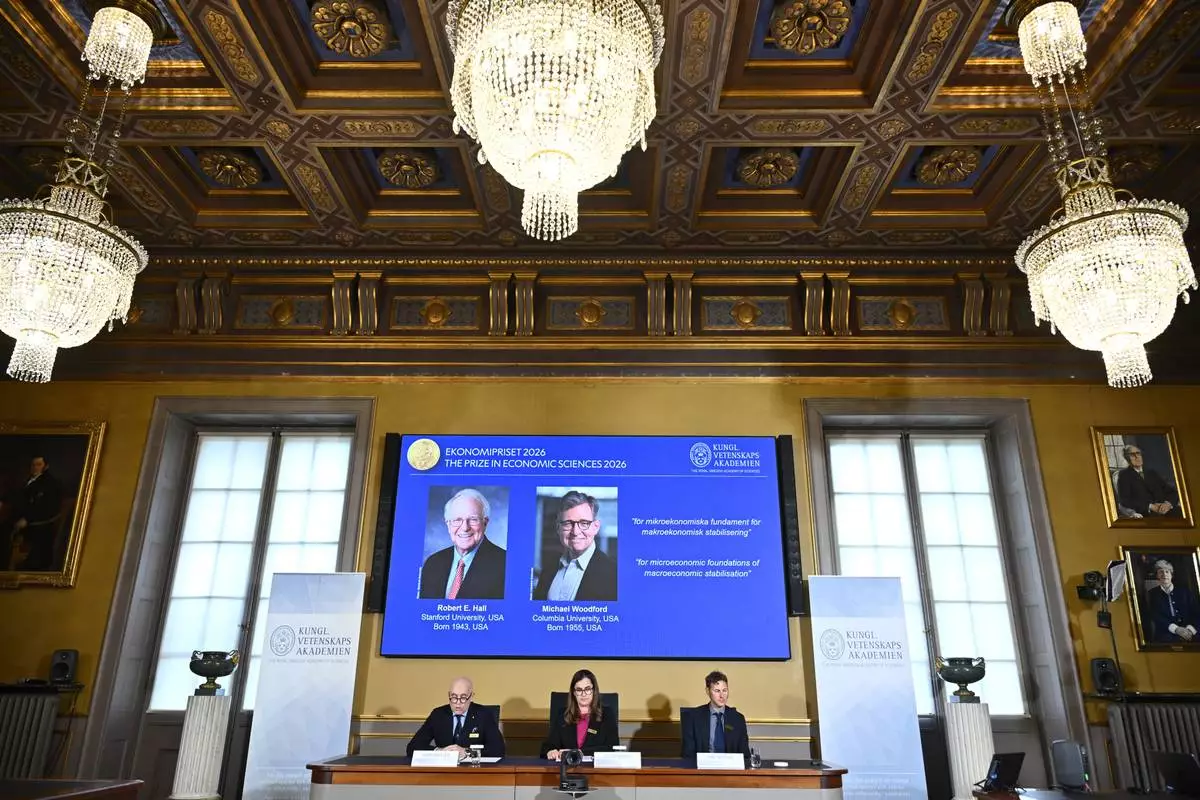
Portraits of Robert E. Hall and Michael Woodford are shown on the screen as they are announced as the laureates of the Sveriges Riksbank Prize in Economic Sciences in Memory of Alfred Nobel at the Royal Swedish Academy of Sciences in Stockholm, Sweden, Monday, Oct. 12, 2026. (Anders Wiklund/TT News Agency via AP)
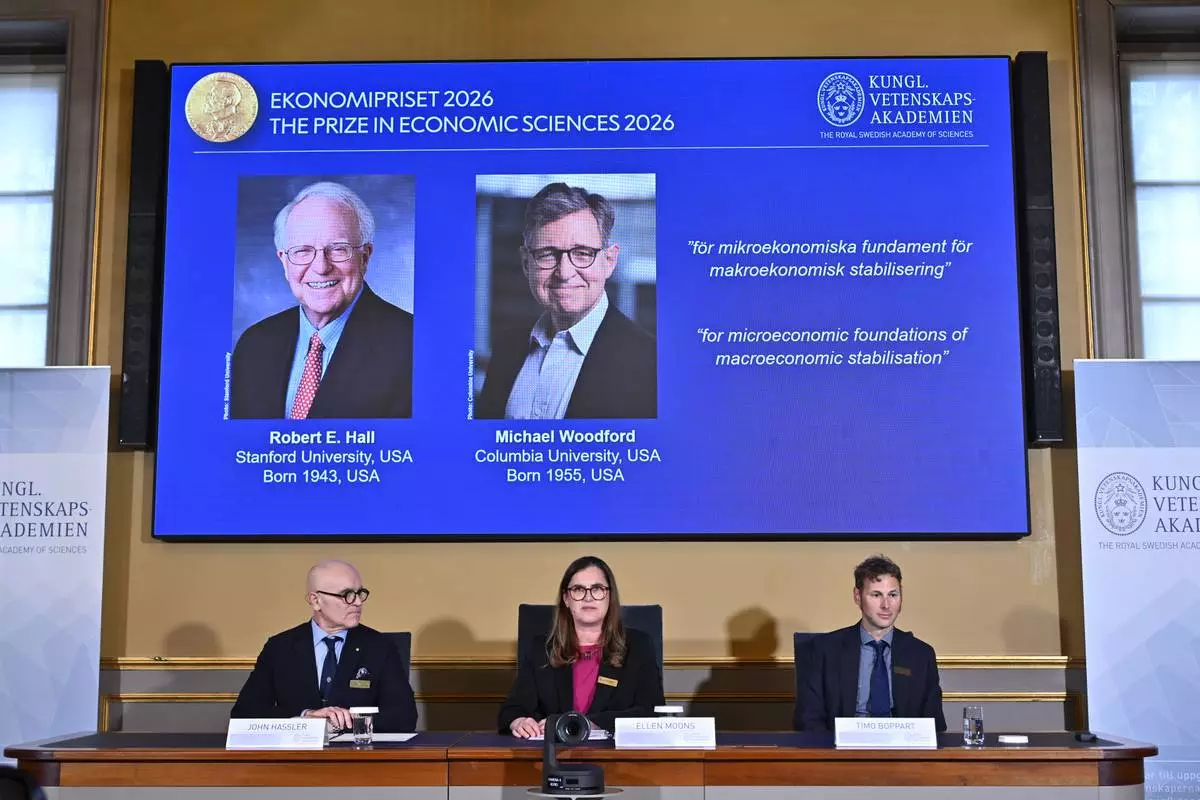
Portraits of Robert E. Hall and Michael Woodford are shown on the screen as they are announced as the laureates of the Sveriges Riksbank Prize in Economic Sciences in Memory of Alfred Nobel at the Royal Swedish Academy of Sciences in Stockholm, Sweden, Monday, Oct. 12, 2026. (Anders Wiklund/TT News Agency via AP)

Portraits of Robert E. Hall and Michael Woodford are shown on the screen as they are announced as the laureates of the Sveriges Riksbank Prize in Economic Sciences in Memory of Alfred Nobel at the Royal Swedish Academy of Sciences in Stockholm, Sweden, Monday, Oct. 12, 2026. (Anders Wiklund/TT News Agency via AP)
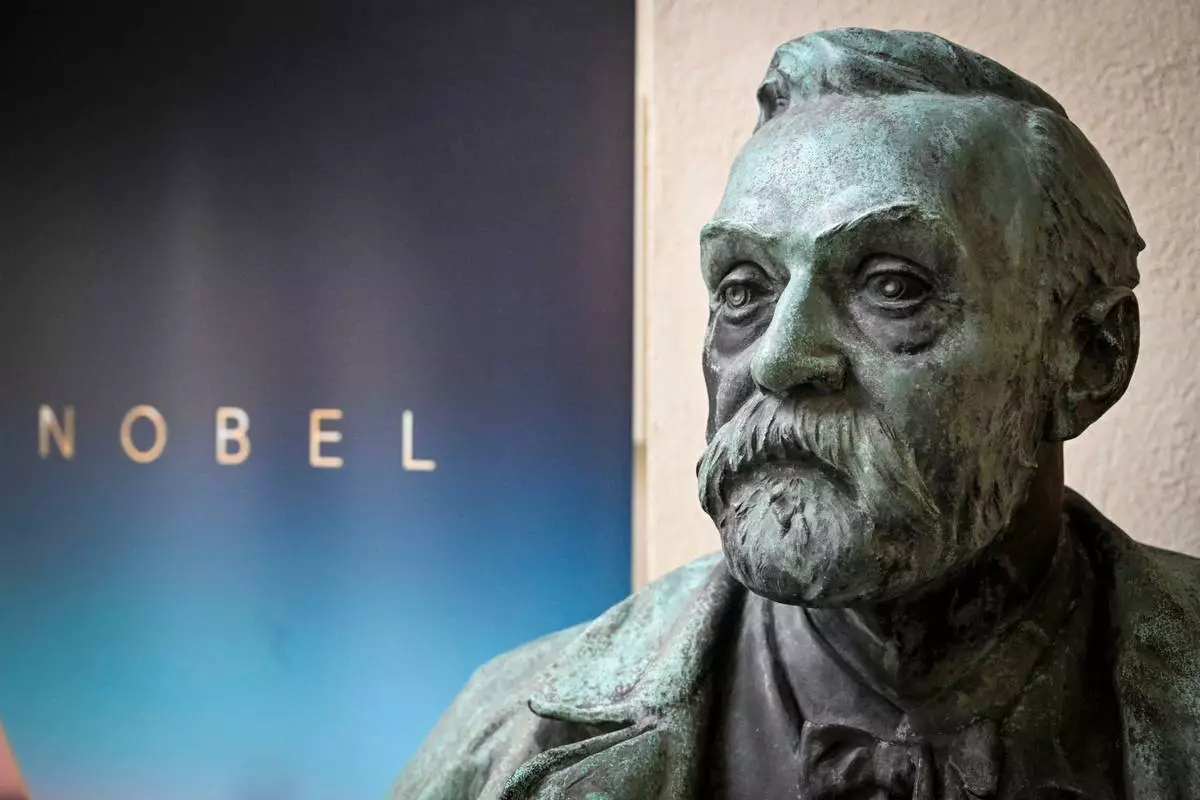
FILE - A bust of Alfred Nobel on display following a press conference to announce the Nobel Committee for Physiology or Medicine at the Karolinska Institute in Stockholm, Sweden, on Oct. 3, 2022. (Henrik Montgomery/TT News Agency via AP, File)

FILE - A Nobel medal is held up during a ceremony in New York, Dec. 8, 2020. (Angela Weiss/Pool Photo via AP, File)