The 2026 Beijing Forum on Swift Response to Public Complaints opened on Monday, with the release of a number of research findings, reports on city hotline services, and global case studies on urban governance.
Beijing's 12345 hotline is the city's unified government service platform, allowing residents to report problems, lodge complaints, and seek information on public services ranging from utilities and transportation to healthcare and housing.
Since 2019, the hotline has evolved from a traditional call center into a smart governance hub powered by big data and AI. Data generated by the hotline helps identify recurring issues and informs policy decisions, turning everyday public concerns into input for improving urban services. The hotline has so far handled around 200 million requests from individuals and businesses.
"This is a vivid example of how Beijing is responding to the people's concerns and addressing the challenges of our times, making AI work for the public good and making cities smarter and warmer," said Shen Haixiong, president of China Media Group (CMG), at the opening ceremony.
Digital technology, particularly artificial intelligence, is a key focus for the two-day event.
"Digital governance has developed rapidly over the past few years, closely linked to the revolution in artificial intelligence. The key is to integrate technology into governance and align it with organizational mechanisms, enabling greater collaboration among different stakeholders," said Meng Tianguang, a tenured professor with the School of Social Sciences, Tsinghua University.
For many participants, the forum is an opportunity to learn from Beijing's experience in urban governance and explore ideas that could be applied in their own cities.
"You are dealing more with what will be useful to the people, what will be useful to everyone. It doesn't have to be tremendously exciting and make newspaper headlines and attract individual investors. It just has to produce good results by improving communication, which is what this hotline and AI are ultimately about," said Tony Prosser, professor of public law at the University of Bristol, on the sidelines of a Sunday special screening of the new documentary sequel "Hotline Beijing II" or "Your Voice 2", an important activity for forum.
"I think that [for] the Chinese system of incorporating all of the different aspects and perspectives, it's a more holistic, inclusive approach. And I think that we can learn a lot from that," said Charlotte Villiers, a professor of law at the University of Bristol.
Every city has its own challenges, and every community has different needs. But the goal is the same: to build more inclusive cities that work for everyone.
"There is not just one model that can be applied to all cities. Take whatever you have and put it into the system. Build one unit first then extend it. Overall, ultimately, we want to involve as many countries as possible so that we have a holistic overview about how urban governance should be done properly and how to serve citizens," said Helen Bao, professor of urban economics and public policy in the Department of Land Economy, the University of Cambridge.
The discussions will continue on Tuesday, with more parallel sessions and field trips to local communities. Participants will have the opportunity to see how public services and urban governance work on the ground.
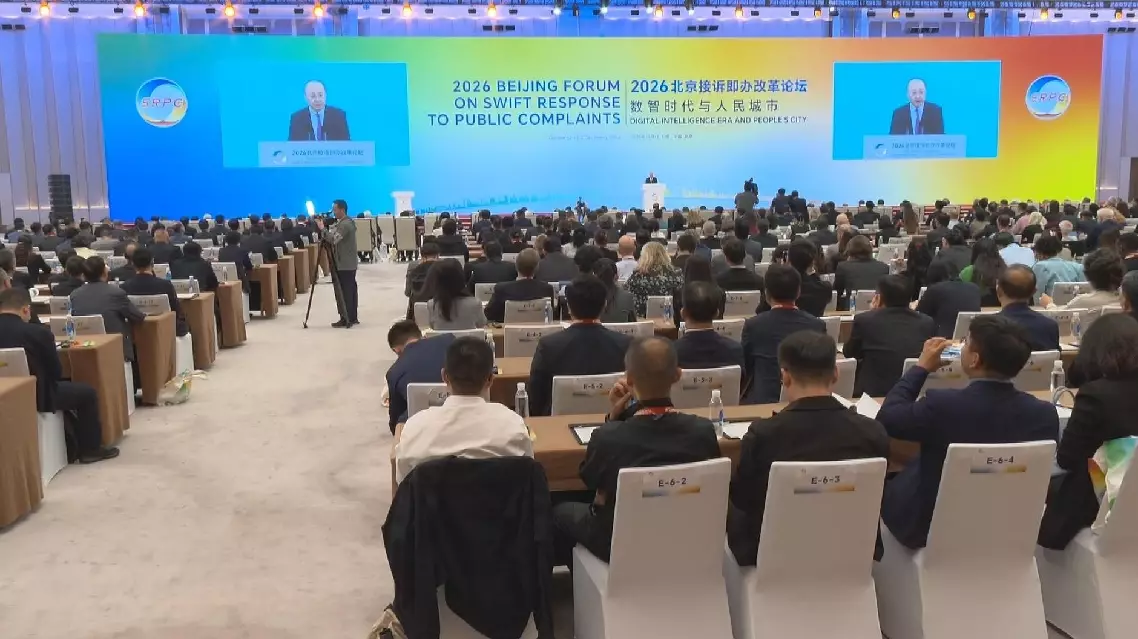
Forum on Swift Response to Public Complaints opens in Chinese capital