The European tour has delivered an ultimatum to players contemplating the new version of LIV Golf, saying anyone who joins will not be allowed to be European tour members.
“Players need to make a choice,” Guy Kinnings, CEO of the European tour, said in a statement Monday first reported by the BBC.
The DP World Tour, as it is commercially known, previously let LIV players to keep their European membership as long as they paid fines for playing LIV events that conflicted with the tour.
It extended an olive branch earlier this year to nine players, allowing them to play LIV events without sanctions provided they settled all previous fines and agreed to add European tour events to their 2026 schedules.
Kinnings delivered a far stronger message — us or them — as LIV is trying to emerge from bankruptcy stemming from Saudi Arabia's sovereign wealth fund cutting off the financial support. LIV has spent more than $5 billion since its launch in 2022.
LIV has the backing of up to $300 million from BC Partners as it leans into a 10-tournament season with a focus on team competition and players owning equity in LIV 2.0. Players have until Oct. 25 to decide whether to stick with LIV, which could determine whether the beleaguered circuit can move forward out of bankruptcy.
The European tour, however, is requiring anyone seeking to join to disclose where they intend to play in 2027. The tour said it would terminate membership if the disclosures prove false.
“As we have said for many years, we have rules and regulations which are there to protect our tour and which our members must all abide by,” Kinnings said. "Players who are not willing to comply with our rules and regulations should not be seeking to join our tour.”
Players must be European tour members to compete in the Ryder Cup next September, adding pressure to the likes of Tyrrell Hatton of England, Tom McKibbin of Northern Ireland, Adrian Meronk of Poland and Thomas Detry of Belgium.
An attorney for Jon Rahm said last week in a bankruptcy hearing for LIV that the former No. 1 wanted to terminate his LIV contract. The question for Rahm, a two-time major champion, is how he works his way back to the PGA Tour.
Sergio Garcia also asked to end his LIV contract, and David Puig of Spain has indicated he is ready to take on a European tour schedule.
The European tour is negotiating a renewed alliance with the PGA Tour, which involves commercial opportunities and a path for the leading 10 players on the Race to Dubai to get PGA Tour cards.
Patrick Reed and Eugenio Chacarra, who both previously played for LIV Golf, are a lock to earn PGA Tour cards this year off the European tour points list. Bernd Wiesberger of Austria, another player who signed early with LIV, also has a chance at a tour card.
The plan of LIV 2.0 is to have such a streamlined schedule to allow players to compete elsewhere. But the PGA Tour bans LIV players for at least one year dating to their last LIV appearance, and now the European tour is demanding them to pick a tour.
Scott O'Neil, who took over as LIV CEO when Greg Norman left, has been preaching the phrase, “Complete, not compete,” as he sees the new version of his league — without Saudi funding to offer as much as nine-figure signing bonuses — to be complementary to other golf tours.
“We shouldn’t live in a world where one group of golfers is uniquely restricted from playing elsewhere,” O'Neil said in August when laying the groundwork for LIV Golf 2.0. “Our goal isn’t to replace or restrict any tour. Our mission is to bring something distinctive to the ecosystem that elevates it and makes the whole game better.”
See AP’s full golf coverage here
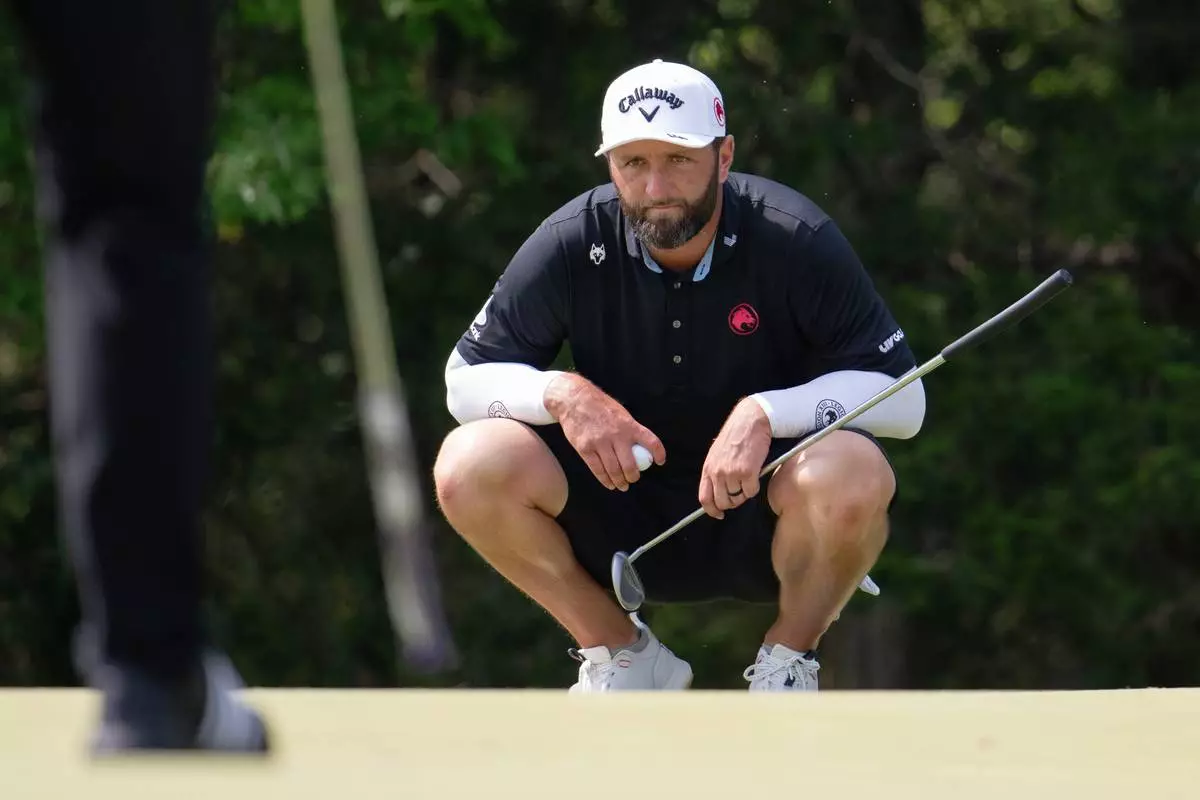
FILE - Captain Jon Rahm of Legion XIII reads his putt during the final round of LIV Golf Bedminster at Trump National Golf Club on Sunday, Aug. 9, 2026 in Bedminster, N.J. (Montana Pritchard/LIV Golf, File)
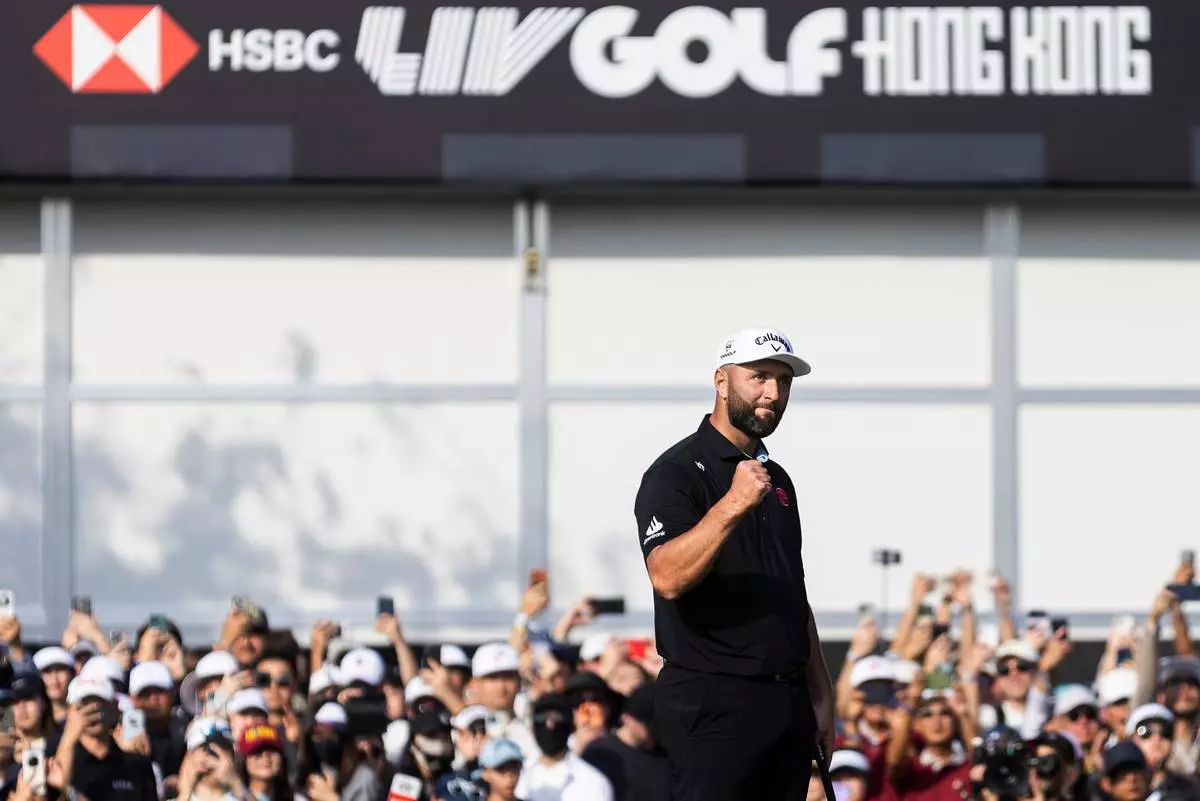
FILE - Captain Jon Rahm of Legion XIII celebrates after putting on the 18th hole green during the final round of HSBC LIV Golf Hong Kong at Hong Kong Golf Club Fanling, Sunday, March 8, 2026 in Hong Kong. (Mike Stobe/LIV Golf via AP, File)
STOCKHOLM (AP) — American economists Robert E. Hall and Michael Woodford won the Nobel Memorial Prize in economics Monday for their work on models that have helped governments and central banks manage economic shocks, such as energy crises and inflation.
The Royal Swedish Academy of Sciences announced the winners in Stockholm, noting that their work created the theoretical foundation to better understand how consumers decide whether to save or spend, insights that make it easier for policymakers worldwide to stabilize economies after fluctuations.
“The laureates’ research has made it possible to manage major macroeconomic crises far more effectively than before,” the Nobel committee wrote in a paper explaining the economists' work. “It has been hugely beneficial during the pandemic and the energy crises of recent years.”
Hall, 83, is affiliated with Stanford University in California. Woodford, who was born in 1955, is affiliated with Columbia University in New York.
Woodford spoke to the committee by phone from New York: “It’s a tremendous honor. It’s a surprise.”
For decades, governments responded to economic shocks by following the Depression-era prescriptions of the British economist John Maynard Keynes: Intervene in the economy by lowering interest rates and taxes and hiking government spending, thereby encouraging consumers and businesses to spend and invest and help restart growth.
“This is the Keynesian recipe and it worked well — until it didn’t,” said Timo Boppart of the Nobel economics committee.
Policymakers had thought economic management involved simple trade-offs — unemployment, for instance, would stay low at a time of high inflation and rise when inflation fell. But the “ stagflation ’’ of the 1970s — when the world economy experienced simultaneous high inflation and high unemployment — proved the formula was simplistic.
Some economists argued that government attempts to intervene in the economy were doomed to fail. But Hall and Woodford, in separate contributions, set about improving the Keynesian model to take into account how consumers and businesses actually make decisions about whether to invest and spend.
“Economic outcomes are the result of millions of decisions made at the microlevel by households and businesses,’’ the Nobel committee wrote. “Using models based upon this approach, rather than simply studying the economy from a macro perspective, like a bird’s eye view,” Hall and Woodford’s research “generated a paradigm shift in the theory of stabilization policy.”
Hall studied the way that consumers' decisions about whether and how much to spend depend on what they expect their future income to be.
“If they are optimistic, they will consume more than if they are pessimistic,’’ the committee wrote. But consumer expectations can change unexpectedly as new information about the economy comes in. Hall found that forecasting future consumer spending is virtually impossible.
The idea that consumption is mostly unpredictable “is not good news for forecasters, or policymakers,” Olivier Blanchard, who was chief economist at the International Monetary Fund during the 2008 financial crisis, said by email. “But it is news they must take into account in thinking about the effects of policy.”
Hall also explored the idea that some households are so strapped financially that they can’t borrow or tap savings in response to economic changes. In a 1982 paper with the economist Fredric Mishkin, Hall found that around 80% of households made spending decisions based on their expectations for the future “while the rest lived hand to mouth," the committee wrote.
“The prize is for research that pushes our understanding of macroeconomics from the bottom up, from families and firms making decisions over time, while looking ahead,” Ivan Werning, an economist at the Massachusetts Institute of Technology, said in an email.
Woodford’s research established that businesses make decisions about prices based on where they think interest rates will go in the future.
“If the business believes that its competitors’ prices and its own costs will increase, it is best to set a higher price than it would with the opposite expectation,” the Nobel committee wrote. “Businesses’ decisions are thus also governed by their expectations."
Therefore, central banks such as the U.S. Federal Reserve, which set short-term interest rates, should provide “clear and credible communication about how they reason and what they plan to do." Central banks have responded to this insight by working harder to explain what they are doing.
The new Fed chair, Kevin Warsh, has said the trend toward such “forward guidance” went too far. He's trying to scale back how much the U.S. central bank talks about its thinking and its intentions.
Woodford's research also offered guidance on how central banks should respond to energy price shocks — like the one that followed the U.S. and Israeli attack on Iran in February — that can both feed inflation and send unemployment higher.
“Unlike the traditional Keynesian models, Woodford’s model recommends a cooling measure, such as increased interest rates, to avoid uncontrolled inflation,” the Nobel committee wrote. “His insight has made it possible to respond to recent supply shocks more effectively than during the oil crises of the 1970s.”
During the phone call broadcast at a news conference, Woodford said his work has stressed “the understanding of the people who are in the markets and making decisions about spending.”
The winners did not immediately respond to requests for comment from The Associated Press.
The economics prize is formally known as the Bank of Sweden Prize in Economic Sciences in Memory of Alfred Nobel. The central bank established it in 1968 as a memorial to Nobel, the 19th-century Swedish businessman and chemist who invented dynamite and established the five Nobel Prizes.
Nobel purists stress that the economics prize is technically not a Nobel Prize, but it is always presented together with the others on Dec. 10, the anniversary of Nobel’s death in 1896.
Nobel honors were announced last week in medicine, physics, chemistry, literature and peace.
Monday’s award was the second Nobel win for a Stanford University professor this year. Dr. Karl Deisseroth shared the medicine prize with Peter Hegemann and Georg Nagel for their work that led to a tool that uses light to help unravel how the brain works.
The prize money this year is 12 million Swedish kronor (about $1.2 million), whether for an individual, small group of laureates or organization.
Wiseman reported from Washington. Dazio reported from Berlin. Associated Press Writer Wyatte Grantham-Philips in Chicago contributed to this report.
AP Nobel Prizes: https://apnews.com/hub/nobel-prizes
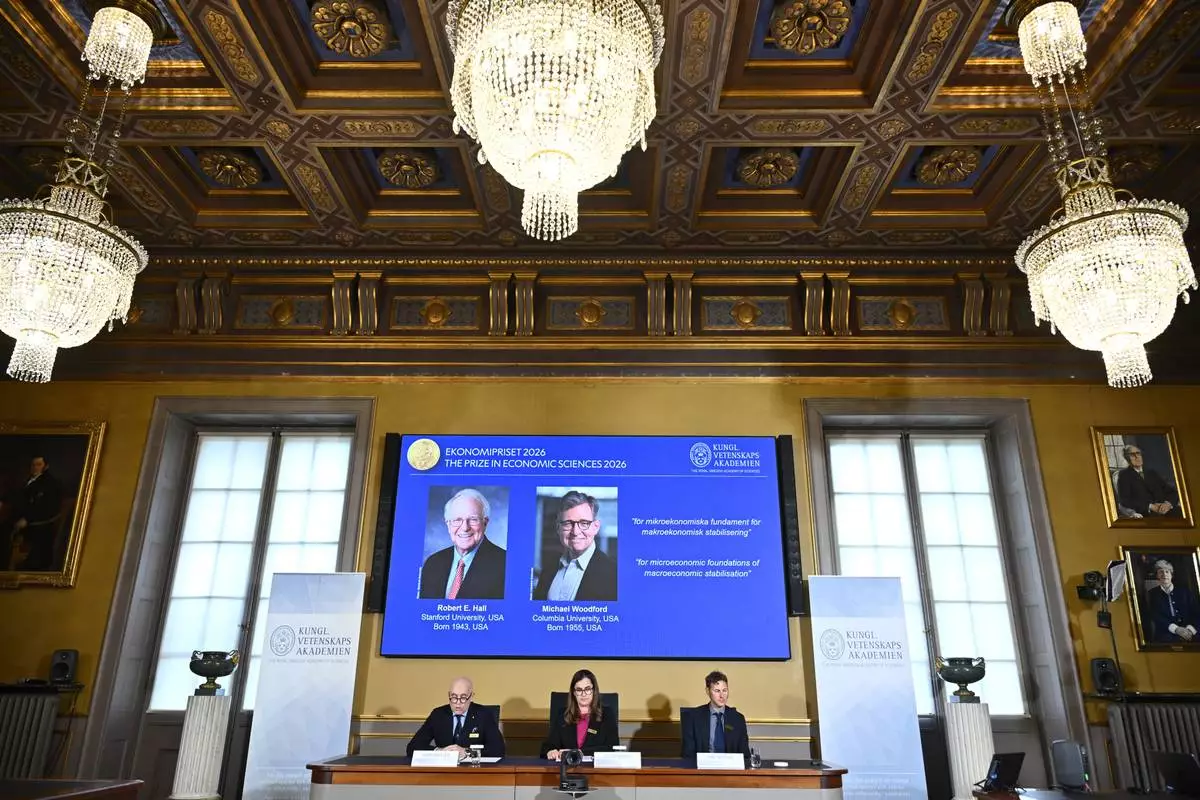
Portraits of Robert E. Hall and Michael Woodford are shown on the screen as they are announced as the laureates of the Sveriges Riksbank Prize in Economic Sciences in Memory of Alfred Nobel at the Royal Swedish Academy of Sciences in Stockholm, Sweden, Monday, Oct. 12, 2026. (Anders Wiklund/TT News Agency via AP)
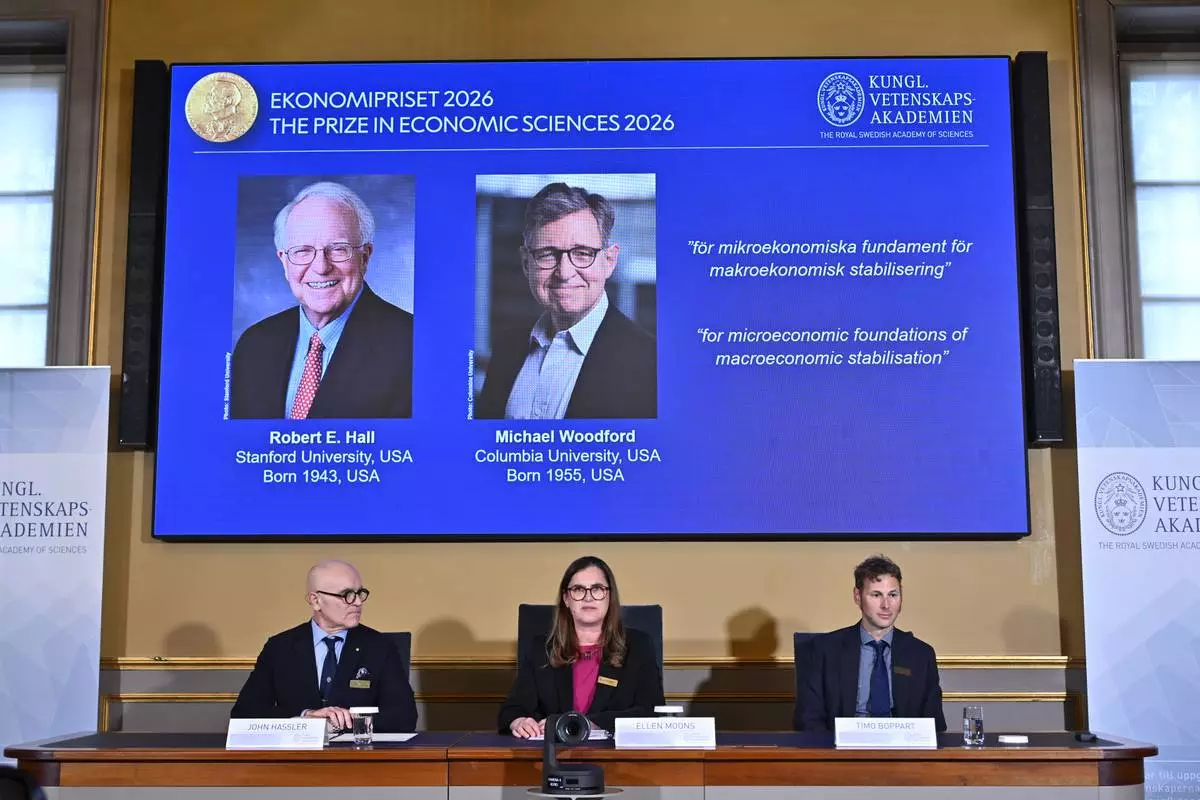
Portraits of Robert E. Hall and Michael Woodford are shown on the screen as they are announced as the laureates of the Sveriges Riksbank Prize in Economic Sciences in Memory of Alfred Nobel at the Royal Swedish Academy of Sciences in Stockholm, Sweden, Monday, Oct. 12, 2026. (Anders Wiklund/TT News Agency via AP)
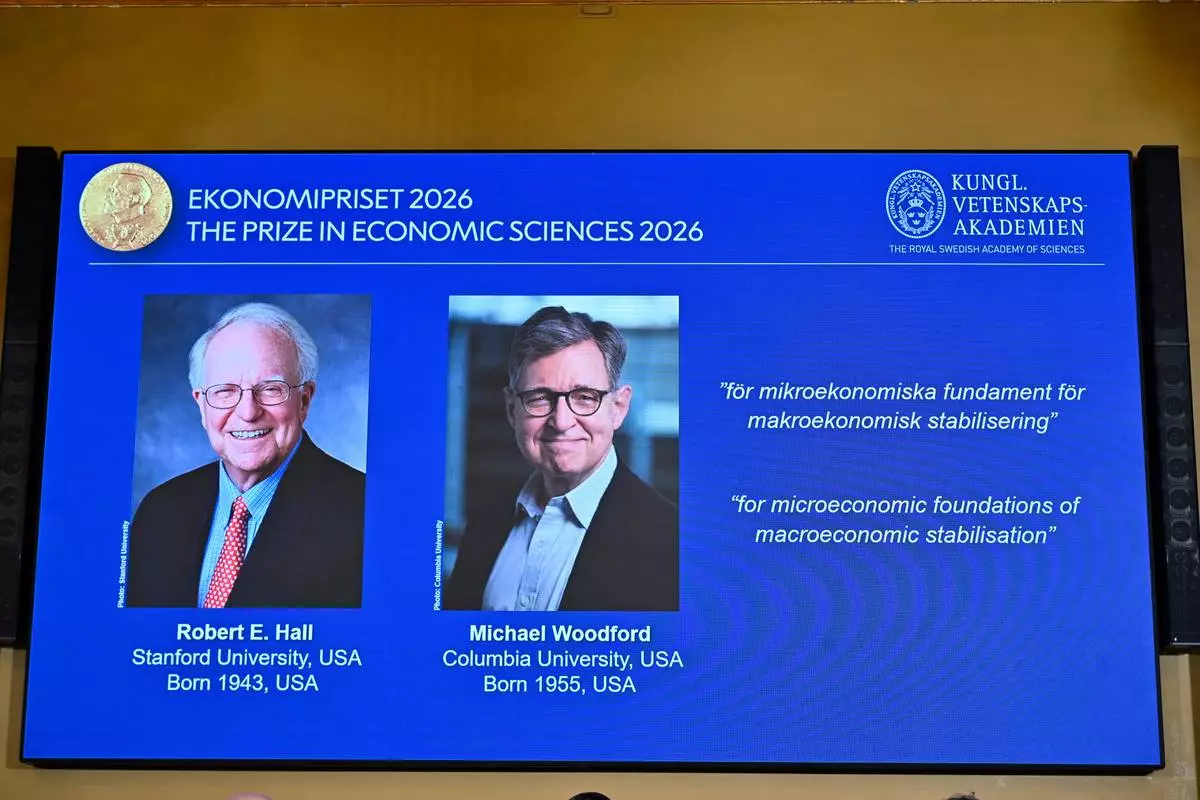
Portraits of Robert E. Hall and Michael Woodford are shown on the screen as they are announced as the laureates of the Sveriges Riksbank Prize in Economic Sciences in Memory of Alfred Nobel at the Royal Swedish Academy of Sciences in Stockholm, Sweden, Monday, Oct. 12, 2026. (Anders Wiklund/TT News Agency via AP)
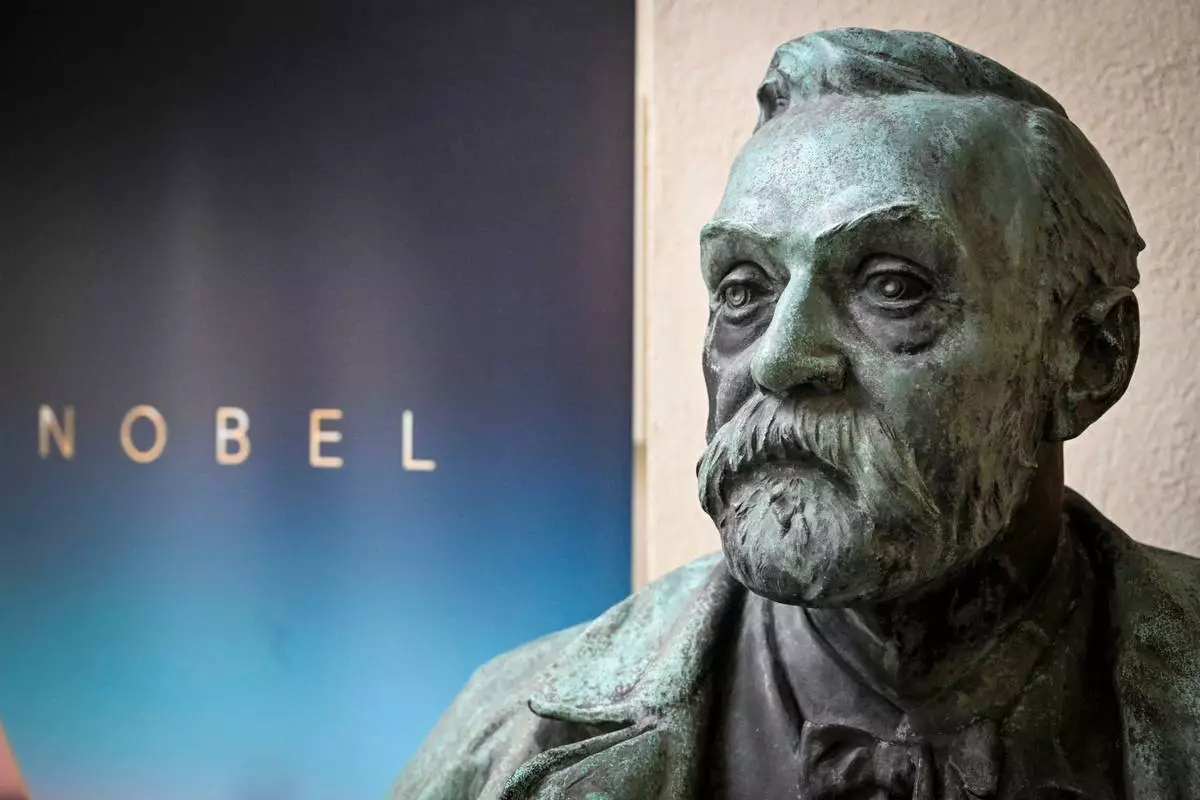
FILE - A bust of Alfred Nobel on display following a press conference to announce the Nobel Committee for Physiology or Medicine at the Karolinska Institute in Stockholm, Sweden, on Oct. 3, 2022. (Henrik Montgomery/TT News Agency via AP, File)
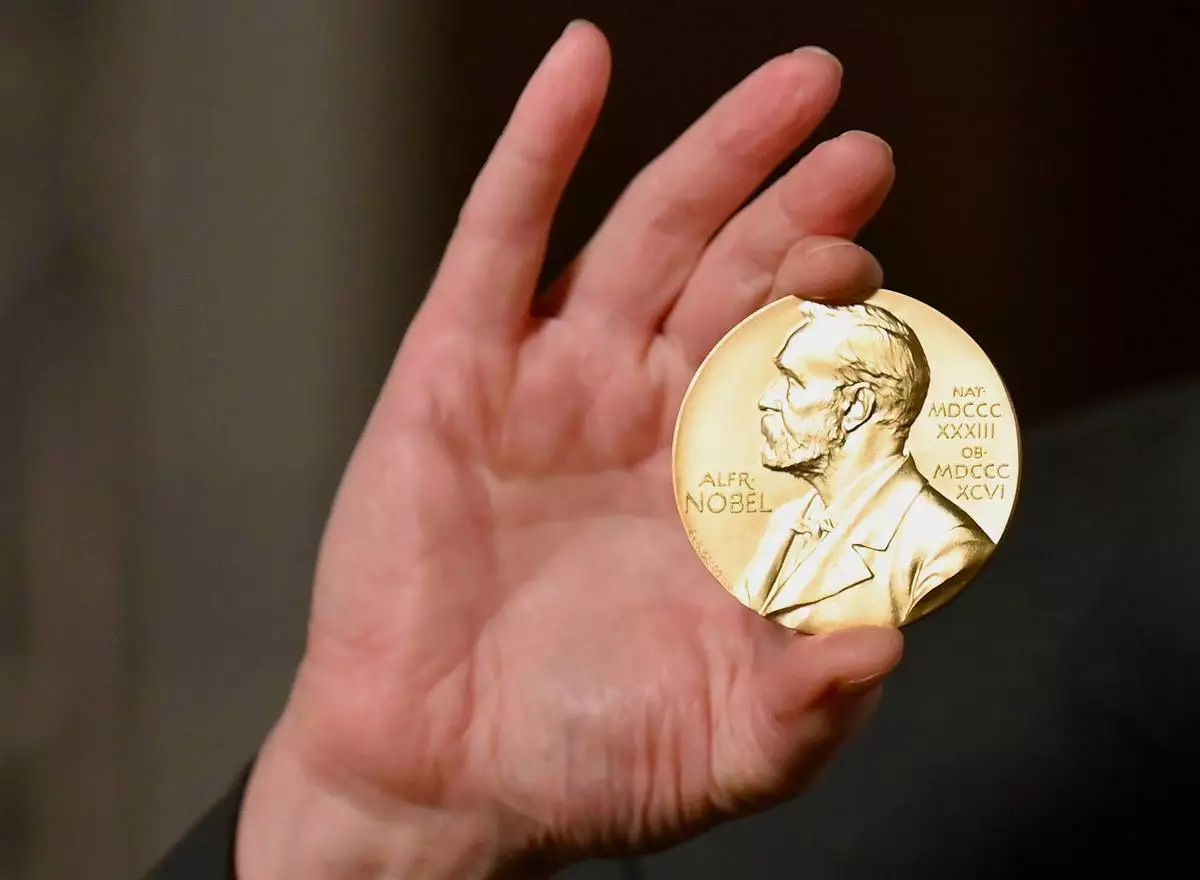
FILE - A Nobel medal is held up during a ceremony in New York, Dec. 8, 2020. (Angela Weiss/Pool Photo via AP, File)