
Skip to Content Facebook Feature Image

Adani Enterprises, Jabil Sign MoU for 50:50 Data Center Hardware Joint Venture

Business

Adani Enterprises, Jabil Sign MoU for 50:50 Data Center Hardware Joint Venture
Business

Business

Adani Enterprises, Jabil Sign MoU for 50:50 Data Center Hardware Joint Venture

2026-10-13 20:20 Last Updated At:20:31

NEW DELHI, India & ST. PETERSBURG, Fla.--(BUSINESS WIRE)--Oct 13, 2026--

Adani Enterprises Limited (AEL), the flagship company of the Adani Group, and Jabil Inc. (NYSE: JBL), a global engineering, supply chain and manufacturing company, have signed a non-binding Memorandum of Understanding (MoU) setting out the framework for a proposed 50:50 joint venture to manufacture and assemble artificial intelligence (AI) and data center equipment in India.

This press release features multimedia. View the full release here: https://www.businesswire.com/news/home/20261013719250/en/

The proposed joint venture remains subject to execution of definitive agreements and satisfaction of applicable approvals and customary conditions.

The MoU follows the June 2026 announcement of Adani Group and Jabil’s intent to establish a strategic alliance to develop an AI and data center infrastructure manufacturing ecosystem in India.

Mr. Gautam Adani, Chairman, Adani Group, said: “The AI revolution will demand far more than just breakthroughs in algorithms. It will require an entire new industrial architecture where energy, hyperscale infrastructure, advanced computing and precision manufacturing converge to power the intelligence economy.”

“At Adani, our vision is to expand up the AI value chain evolving from powering and hosting AI infrastructure to engineering and manufacturing the critical systems that will define the next generation of computing.”

“Our proposed joint venture with Jabil marks a strategic step towards this future, combining Jabil’s world-class engineering and manufacturing capabilities with Adani’s integrated strengths in energy, infrastructure and data centers to help build the physical backbone of the global AI economy.”

Mr. Mike Dastoor, Chief Executive Officer (CEO), Jabil Inc., said: “The signing of this MoU is the next step forward in our shared efforts to establish a scaled AI infrastructure manufacturing platform in India, a market we believe will become increasingly important for both domestic and global AI infrastructure demand. Integrating Jabil’s 60 years of engineering and manufacturing expertise with Adani’s significant infrastructure and energy capabilities, we can bring our rack-level data center solutions to more hyperscalers in India and around the world. We look forward to building on the work we started together in June.”

Manufacturing AI Hardware in India

The joint venture would manufacture and assemble AI racks, servers, storage and networking equipment used in data centers. The racks would house high-performance computing systems for AI applications and other digital services.

The portfolio would also include equipment required to power and cool these systems, including power distribution units, liquid-cooling systems and transformers.

The venture is expected to have multi-gigawatt AI rack manufacturing capacity, supporting computing systems with a combined power capacity of several gigawatts. It would also provide installation and commissioning services.

India’s Data Center Opportunity

India’s data center capacity is projected to reach 5–8 gigawatts (GW) by 2030, driven by AI adoption, cloud expansion and data localization.

The venture would provide a manufacturing base in India to serve domestic demand and support exports. The companies estimate the global market opportunity at more than $3 trillion over the next seven years, driven by investment in AI computing.

The Digital Personal Data Protection Act, 2023, provides a framework for personal data protection. This legal safeguard, complemented by the Union Budget 2026 tax holiday for data centers until 2047, is expected to support investment in domestic data infrastructure.

The venture is aligned with Adani Group’s $100 billion commitment to develop 5 GW of green-energy-powered, hyperscale AI-ready data centers by 2035. The proposed venture would add hardware manufacturing to the Group’s presence across infrastructure, energy, logistics and data centers.

For Jabil, which reported $36 billion in revenue in fiscal year 2026, the venture would expand its engineering and manufacturing footprint in India’s data center market. The company has also expanded its data center capabilities through the acquisition of Hanley Energy Group, which provides critical power and energy management solutions, and Mikros Technologies, which specializes in liquid-cooling solutions for high-performance computing systems.

FORWARD-LOOKING STATEMENTS

This release contains forward-looking statements, including those regarding the potential strategic collaboration with Adani Group. The statements in this release are based on current expectations, forecasts and assumptions involving risks and uncertainties that could cause actual outcomes and results to differ materially from our current expectations. Forward-looking statements could be affected by the following factors, among others, related to the potential alliance: the occurrence of any event, change or other circumstances that could give rise to the termination of work on the alliance, including the possibility of not being able to satisfactorily negotiate and execute a binding agreement regarding the collaboration; unexpected costs or unexpected liabilities that may arise from the potential alliance; the impact of changes in economic, market, political or social conditions; and future regulatory or legislative actions that could adversely affect the parties. Additional factors that could cause such differences can be found in Jabil’s Annual Report on Form 10-K for the fiscal year ended August 31, 2025 and Jabil’s other filings with the Securities and Exchange Commission. Jabil assumes no obligation to update these forward-looking statements.

About Adani Group:

Headquartered in Ahmedabad, India, Adani Group is one of India's largest integrated infrastructure conglomerates with interests in Resources, Logistics, Energy, Agro, Real Estate, Public Transport Infrastructure, Consumer Finance, and Defence. Driven by its core philosophy of ‘Nation Building’ and ‘Growth with Goodness’, the Group is committed to sustainable development and regional transformation. Further information at www.adani.com.

About Jabil:

At Jabil (NYSE: JBL), we are proud to be a trusted partner for the world's top brands, offering comprehensive engineering, supply chain, and manufacturing solutions. With 60 years of experience across industries and a vast network of over 120 sites worldwide, Jabil combines global reach with local expertise to deliver both scalable and customized solutions. Our commitment extends beyond business success as we strive to build sustainable processes that minimize environmental impact and foster vibrant and diverse communities around the globe. Discover more at www.jabil.com.

Mr. Gautam Adani, Chairman, Adani Group (left), and Mr. Mike Dastoor, CEO, Jabil (right). The companies have signed a non-binding MoU setting out the framework for a proposed 50:50 joint venture to manufacture and assemble artificial intelligence and data center equipment in India.


Mr. Gautam Adani, Chairman, Adani Group (left), and Mr. Mike Dastoor, CEO, Jabil (right). The companies have signed a non-binding MoU setting out the framework for a proposed 50:50 joint venture to manufacture and assemble artificial intelligence and data center equipment in India.
CAIRO (AP) — As word came of Houthi rebels advancing on Taiz, Weam Abdullah and her family decided it was time to leave Yemen’s third largest city. They had survived a yearslong siege by the rebels earlier in their country’s civil war, and they didn’t want to endure that again.

They made it out just in time. Shortly after Abdullah, her husband and two young children left, the rebels captured a key town on Oct. 4, largely encircling Taiz and cutting off most supply routes from government-held areas.

“We already feel dead, there was already despair” in the city, Abdullah told The Associated Press by phone from a province farther south. “We feel as if we are cursed. Everyone is conspiring against us even though we’re not affiliated with any party or politics.”

The Iran-backed Houthis are pushing to capture Taiz, a long-sought prize in Yemen’s 12-year civil war, as they also escalate attacks on Saudi Arabia, including a string of deadly strikes on the airport in the capital, Riyadh.

The assault follows a lightning offensive last month in which the rebels seized Yemen’s Red Sea coast, strengthening their ability to attack Saudi oil shipping and plunging global energy prices further into turmoil.

The advance has triggered fear among Taiz's more than 1 million residents, who live in the rugged mountains of southwestern Yemen. On a recent day, crowds mobbed groceries in the city center to buy up food and other essentials, fearing they will soon run out. Diesel fuel and cooking gas supplies are running low, residents said.

Some residents are collecting cardboard and wood to burn for cooking, while merchants are raising food and water prices, said Shaif al-Gabiri, a child protection consultant at the Civic Center for Advocacy and Support, a local nonprofit group.

“If the siege continues, then these stocks will run out,” he said.

Explosions from fighting between Houthis and pro-government forces echo from the surrounding mountains. Some strikes have hit the city itself, reminding residents of an ordeal they hoped might be over.

Taiz has been on the front line of Yemen’s civil war since 2014 when Houthi rebels seized the north and much of the country’s west, including the capital, Sanaa. Saudi Arabia later entered the war at the head of a coalition backing the internationally recognized government, which had been forced to flee south.

A strategic gateway to the south, Taiz is also one of Yemen’s most important historical and cultural centers. It once served as the capital of several Islamic dynasties and a major center of religious learning. Al-Qahira Castle, a monumental fortress more than 800 years old, overlooks the city from a hill. To the south rises Mount Sabir, more than 3,000 meters (9,800 feet) high, its slopes carved into agricultural terraces.

For much of the war, Houthi forces surrounded most of Taiz and blocked its main roads. Bombardments regularly struck the city center, power cuts were frequent, and residents struggled to find food. The only routes to government-held areas were steep, winding mountain back roads. Bringing in supplies or getting people to hospitals in the southern port city of Aden took hours.

Taiz was “a jungle” at the time, Abdullah said. If people didn’t die “from artillery, then they would die from the siege, malnourished because of lack of food,” she said. After nightfall, “many streets were deserted and looked scary.”

A truce reached in 2022 eased fighting across Yemen and brought some life back to Taiz. Many who had fled returned, and homes were rebuilt. But prices remained high, and residents struggled to get by, Abdullah said. Houthi forces still controlled areas north, east and west of the city and charged “customs” duties on supplies passing through.

The truce ended in August when the Houthis launched a new assault. Last month, they seized the Red Sea coast, capturing the port city of Mocha and several strategic islands. They then began advancing around Taiz.

Abdullah said her family feared a new siege would be worse than the last. Her children were afraid to go outside to play.

“This is why we left,” she said. “The situation was terrible, you couldn’t get essentials, and there’s a shortage in everything … There is no diesel to work water pumps.”

As they fled Taiz, they saw government reinforcements heading toward the city and heard explosions and gunfire, she said. They passed through Turbah, about 40 kilometers (25 miles) south of Taiz, before reaching the government-controlled province of Lahj.

Days later, the Houthis captured Turbah, encircling Taiz and a pocket of government-held territory.

As well as the main roads out of Taiz, some of the alternative mountain routes used in the past are now closed, causing “some confusion and panic,” according to Abdelrahman al-Qaliaa, director of the Taiz branch of the Industry and Trade Ministry. He urged residents crowding stores to only buy what they immediately needed to prevent shortages.

Pro-government forces are fighting Houthis in the mountains southwest of Taiz, trying to break the rebels’ hold.

Ahmed Abdel-Jaber said shelling near his house in a mountain village wounded his 7-year-old grandson in his stomach. The boy was taken to a hospital in Taiz.

Abdel-Jaber moved his family of nine to another village farther from the fighting. “If we decide it’s unsafe there, we’ll flee to another area,” he told the AP by phone.

Growing numbers of government soldiers, women and children wounded in the fighting have been brought to hospitals in Taiz.

“Hospitals could run out of diesel at any point,” said Dr. Fahd Nazary of the Taiz provincial health office. Delivering medical supplies has also become more difficult, he said. “This is a huge catastrophe.”

Al-Gabiri, the child protection consultant in Taiz, described fears that the fighting could worsen.

“Here I am sitting in a coffee shop,” al-Gabiri said, “knowing that at any moment a shell could fall on me or an explosive could come from any direction, hitting any house and any street.”

———

Associated Press freelancer Marzouk Al-Jaberi in Taiz contributed to this report.

FILE - This image taken from undated video released Monday, Oct. 5, 2026, by the Yemeni government-allied Southern Giants Brigades media office shows, what the group says, are its fighters firing a weapon mounted on a pickup truck during clashes with the Iran-backed Houthi group in Dhobab district, Taiz, Yemen. (Southern Giants Brigades Media Office via AP, File)

FILE - This image taken from undated video released Monday, Oct. 5, 2026, by the Yemeni government-allied Southern Giants Brigades media office shows, what the group says, are its fighters firing a weapon mounted on a pickup truck during clashes with the Iran-backed Houthi group in Dhobab district, Taiz, Yemen. (Southern Giants Brigades Media Office via AP, File)

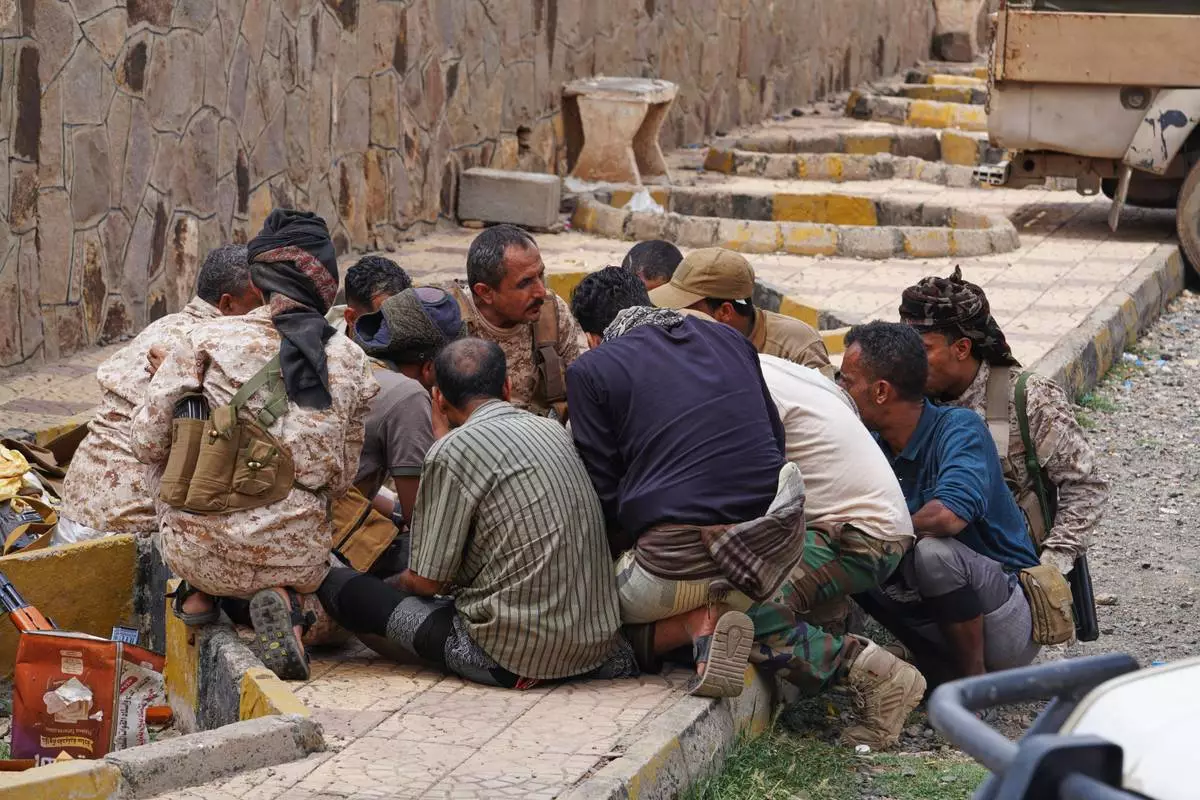
FILE - Yemeni soldiers eat at a military position in the Al-Kadha, in Taiz, Yemen, Saturday, Sept. 26, 2026. (AP Photo/Abdulnasser Alseddik, File)

FILE - Yemeni soldiers eat at a military position in the Al-Kadha, in Taiz, Yemen, Saturday, Sept. 26, 2026. (AP Photo/Abdulnasser Alseddik, File)

FILE - People use minibuses to save gasoline in Taiz, Yemen, Wednesday, Oct. 7, 2026. (AP Photo/Marzouq Al Jabri, File)

FILE - People use minibuses to save gasoline in Taiz, Yemen, Wednesday, Oct. 7, 2026. (AP Photo/Marzouq Al Jabri, File)

Recommended Articles